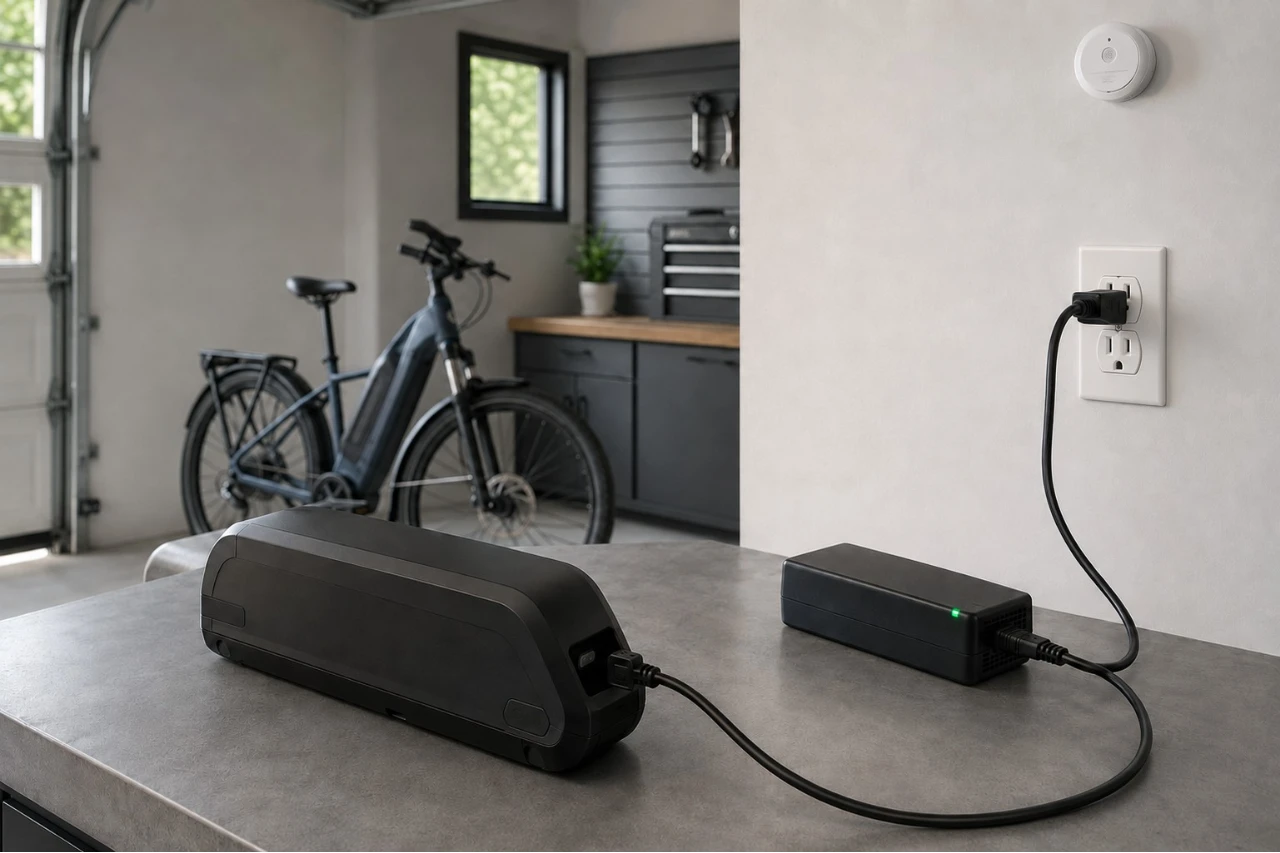
The safest way to charge an e-bike battery is to use the charger supplied with or specifically approved for that battery, charge in a dry indoor area while you are awake and present, and unplug the charger when the cycle is complete.
Do not charge a battery that is damaged, wet, unusually hot, swollen, leaking, or giving off an unusual odor.
Your owner’s manual takes priority for connection order, temperature limits, charge times, and indicator lights.
Quick answers to common e-bike charging questions
| Question | Short answer |
|---|---|
| Should I charge after every ride? | Not always. Partial charging is generally acceptable for lithium-ion batteries. |
| Must I charge to 100%? | No. Charge fully when you need maximum range or when the manufacturer instructs you to do so. |
| Can I charge overnight? | No. Charge only while someone is awake, present, and able to respond to a problem. |
| Can I use a charger with the same plug? | Only if the bike or battery manufacturer specifically approves it. A matching plug is not enough. |
| Can I charge a cold or hot battery? | Wait until it is within the charging-temperature range stated in the manual. |
| Can I charge after riding in rain? | Only after the battery, charge port, and connectors are dry. Never charge a submerged or flood-damaged battery. |
| Can I charge the battery on the bike? | Often, but not always. Follow the instructions for your specific system. |
How to charge an e-bike battery safely
Before connecting anything, turn the bike off and inspect the battery and charger. The battery case should be intact, and the charge port and connectors should be clean and dry. Follow these six steps unless your owner’s manual specifies a different procedure.
1. Let the battery reach a safe charging temperature
After a cold or hot ride, allow the battery to return naturally to the temperature range permitted by its manufacturer. Never use a heater to warm it. If it feels unusually hot rather than normally warm from use, do not connect the charger until the cause has been addressed.
2. Choose a clear, dry charging location
Place the bike or removed battery on a stable, hard, dry surface such as concrete or tile. Keep the charger uncovered so heat can dissipate. Move paper, cardboard, clothing, gasoline, paint, solvents, and other combustible materials away from the charging area.
Do not charge on a bed, sofa, carpet, or other soft surface. Never block an exit, and keep children and pets from disturbing the cable.
3. Use only the approved charger
Use the original charger or a replacement specifically approved for the exact bike and battery model. If it is missing or damaged, contact the manufacturer or an authorized service provider.
A charger is not compatible merely because its plug fits. Compatibility can depend on:
- Battery chemistry
- Nominal battery voltage
- Required charger output voltage
- Permitted charging current
- Connector and pin arrangement
- Polarity
- Battery-management and communication requirements
- Manufacturer approval
Do not rely on a marketplace photo or “universal e-bike charger” claim. A higher-amperage charger is not automatically safe. Never modify a connector, use a homemade adapter, or open the battery or charger. See our e-bike charger compatibility guide for details.
4. Connect the charger in the specified order
Follow the connection sequence in the owner’s manual. Manufacturers may specify different orders, so there is no universal sequence.
Never force the connector. Stop using an outlet that sparks, looks discolored, feels unusually warm, or cannot hold the plug securely, and have it inspected by a qualified electrician.
5. Confirm normal charging and remain present
Confirm the normal charging indication described in the manual. Light colors and flashing patterns are not standardized.
Remain awake and present while charging. The U.S. Consumer Product Safety Commission advises users never to charge micromobility products while sleeping. A working smoke alarm adds warning, but it does not make unattended charging safe.
6. Disconnect the charger when charging is complete
When the completion indicator appears, disconnect the charger as directed. Replace the charge-port cover, if fitted, and store the charger in a dry place. Reinstall and lock a removed battery correctly before riding.
Should I charge the battery on or off the bike?
Either method may be appropriate if the manufacturer permits it.
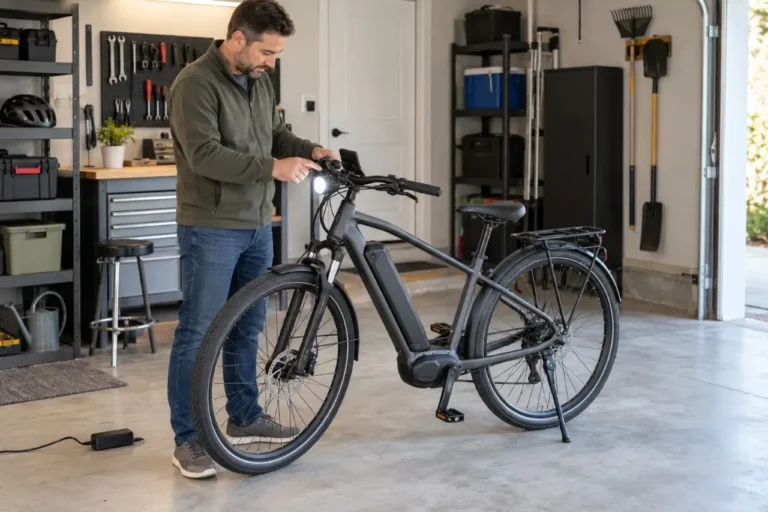
Charging on the bike reduces handling, but the bicycle must be stable and clear of doorways. Protect the cable from being pinched or pulled, and never cover a charging e-bike.
Charging off the bike can help when the storage area is too hot or cold. Keep the battery dry, avoid impacts, and follow the removal and reinstallation instructions.
Temperature, rain, and water exposure
Exact charging-temperature limits vary. Some systems permit approximately 32°F to 104°F (0°C to 40°C), but do not apply that range to every battery. Let a cold or hot battery return naturally to the range in its manual.
Do not charge outdoors in rain or while the battery, charge port, charger, or connector is wet. Water resistance during ordinary riding does not make a wet charging connection safe. After a normal wet ride, turn the bike off and let the equipment dry as the manufacturer directs. Our guide to charging an e-bike outside explains the additional location risks.
If a battery was submerged or exposed to floodwater, do not charge, test, open, or reuse it. Contact the manufacturer or a qualified battery service provider.
Should I charge my e-bike after every ride?
You can, but it is not always necessary. Most modern e-bikes use lithium-ion batteries, which do not need to be drained to zero before recharging. Partial charging is generally acceptable when the battery manufacturer allows it.
Base the decision on the remaining charge, your next route, and the manual. Avoid deliberately running the battery until the bike shuts down. If the manufacturer specifies a recharge threshold, follow it instead of a generic percentage rule.
Do I need to charge to 100% every time?
No. A full charge is useful before a long commute, hilly route, cold-weather ride, or any trip where maximum available range matters.
For shorter rides, follow any manufacturer-provided charge-limit feature. Some systems offer an 80% mode, while others instruct owners to charge fully. No universal “20–80 rule” overrides the manual. If you charge to 100%, unplug when the cycle is complete.
Can I leave an e-bike charging overnight?
No. Charge only when someone is awake, home, and able to notice heat, odor, noise, or smoke. Do not start charging before leaving, and disconnect the charger when the cycle is complete.
How long does an e-bike battery take to charge?
Charging time depends on battery capacity, approved charger output, starting charge, temperature, and system controls. Charging may slow near full capacity, so a simple calculation may not predict the actual time.
Use the manual’s estimate. If charging suddenly takes much longer, repeatedly stops, never completes, or produces an unexpected indicator, stop and contact the manufacturer or a qualified service provider.
What do the charger lights mean?
The manual is the only reliable guide to charger lights. Green may mean complete, standby, or no battery detected, depending on the model. A charger may become warm, but unusual heat, a burning odor, crackling, or repeated faults require attention.
If the battery will not accept a charge but shows no emergency warning signs, review these common e-bike problems and troubleshooting limits before contacting the manufacturer.
How should I store the battery between rides?
For weeks or months of storage, do not assume that fully charged or nearly empty is ideal. Follow the manual for:
- Storage charge level
- Temperature and humidity limits
- Whether to remove the battery from the bike
- How often to check or recharge it
- Returning it to service
Keep it away from heat, direct sunlight, moisture, and temperature extremes. See our guide to storing an e-bike battery safely for more detail.
What should I do if something looks wrong?
Stop charging if you notice any of the following:
- Swelling or a change in the battery’s shape
- Leaking fluid
- A sharp, sweet, burning, or unusual chemical odor
- Hissing or crackling
- Smoke, sparks, or melted plastic
- Unusual or rapidly increasing heat
- Damage to the case, cable, connector, plug, or outlet
- Repeated charging faults or behavior outside the manual’s description
Disconnect power only if you can do so without approaching hot, smoking, hissing, or fuming equipment. Do not move an overheating battery. Leave, warn others, and call 911 or your local emergency number if there is smoke, fire, rapidly increasing heat, or fumes.
Do not open the battery, repair its cells or battery-management system, tape over damage, or reconnect it as a test. If the equipment is stable and not an active emergency, contact the manufacturer or a qualified battery service provider. Review the e-bike battery damage warning signs before returning it to service.
Never place an e-bike battery in household trash or ordinary curbside recycling. Follow the manufacturer’s instructions and local hazardous-waste or battery-recycling requirements.
The safest routine is the one you repeat
Inspect the equipment, wait for an acceptable battery temperature, use only the approved charger in a dry area, remain present, and disconnect when complete. The manual, battery label, charger label, and manufacturer support information take priority. If they do not confirm compatibility or charging conditions, ask the manufacturer before plugging in.