E-bike listings are full of safety language. You will see phrases like “UL certified,” “UL tested battery,” or “certified to UL 2849” scattered across product pages, Amazon listings, and brand websites. Some of those claims are accurate. Others are stretched, misapplied, or outright false.
The only way to know for certain is to verify the certification yourself using official sources, not the seller’s own marketing copy.
This guide walks you through exactly how to do that. You will learn which standards apply to which parts of the bike, how to search the UL Product iQ database, what a legitimate certification mark looks like, and how to spot the half-true claims that get buyers into trouble.
Key Takeaways
- Search UL Product iQ using the brand name or file number and match the result to the exact model you are buying, not just the brand.
- UL 2849 covers the full electrical system; a battery-only certification under UL 2271 is not the same thing and should not be presented as full-bike certification.
- A UL mark on the label is a starting point, not proof; the database record is the confirmation.
The Quickest Way To Confirm A Real Certification Claim
The fastest path to a real answer is a direct database lookup, not a logo on a product page. You need a few specific details from the product, a few minutes on the UL Product iQ website, and a clear understanding of what a confirmed match actually looks like versus a partial or missing result.
Gather The Exact Product Details Before You Check
Before you open any database, write down the brand name, the exact model name or model number, and the manufacturer’s company name if it differs from the brand. These are not always the same. A listing might say “Brand X Pro 750” but the manufacturer filing the certification could be a parent company with a different name entirely.
Also note the battery size and charger if those details are listed. You may need them to confirm the full scope of what is actually certified.
Find The Certification Mark On The Bike, Battery, Charger, Manual, Or Packaging
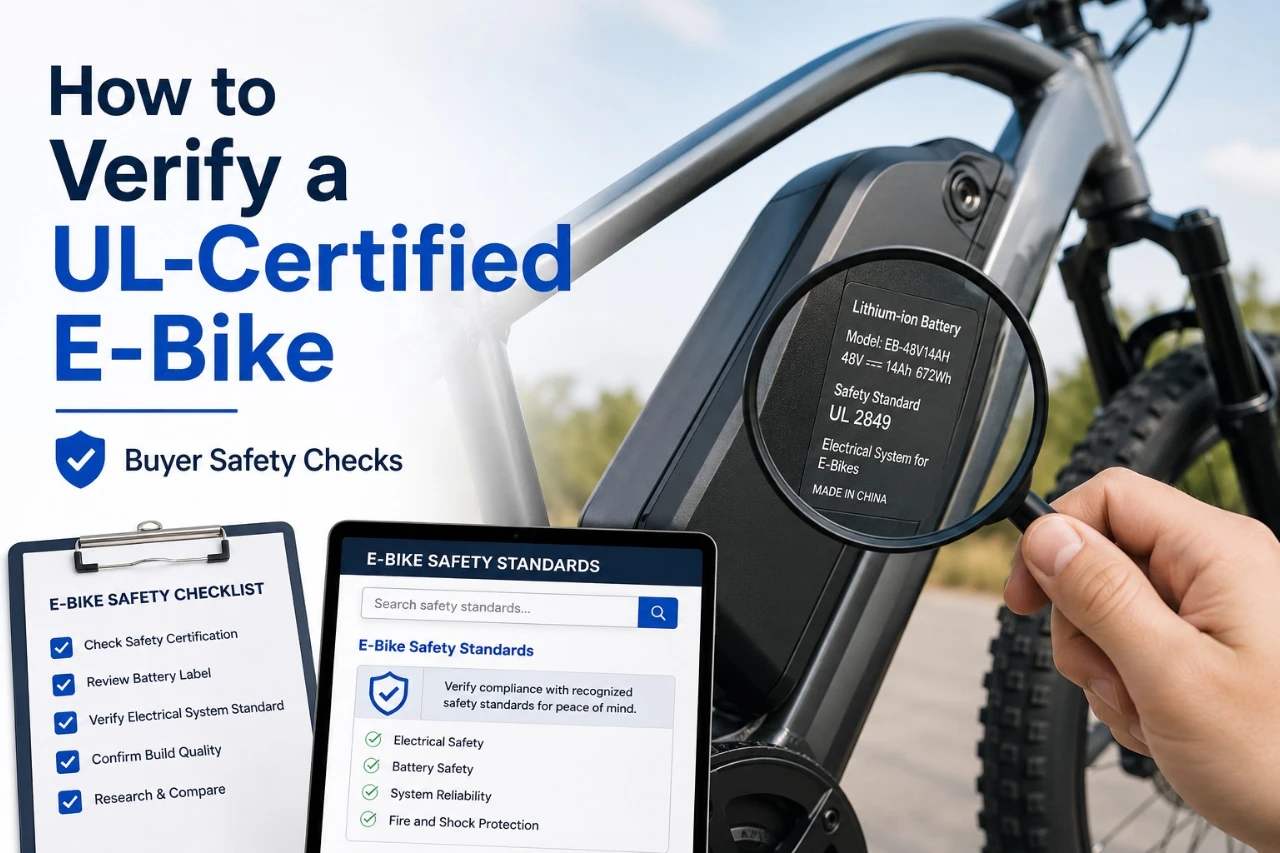
A legitimate UL mark will appear as a physical label, not just a printed logo. Look for it on the battery housing, the frame near the motor or battery mount, the charger body, or inside the manual. The mark should include the UL logo and ideally a file number or certification number.
According to UL certification guidance for buyers, looking for the physical UL mark on the bike and battery is the first physical confirmation step before moving to a database search. A hologram-style label on the frame is also a common indicator for certified products.
Use UL Product iQ Or The UL Database To Search The Listing
Go to UL Product iQ, which is UL Solutions’ public certification database. You can search by company name, brand name, or UL file number. The database is free to use and does not require an account.
Type in the brand or manufacturer name and look for matching records. A confirmed listing will show the standard the product was certified to, the scope of coverage, and the specific models included.
Match The Listing To The Exact Model Being Sold
This is the step most buyers skip, and it is the most important one. Finding a UL record for a brand does not confirm that the specific model you are buying is covered. Some brands certify one model and then imply the certification applies to their entire lineup.
Cross-check the model number in the database record against the model number on the listing or on the bike itself. If they do not match exactly, the certification claim does not apply to what you are buying.
Confirm The Standard Named In The Record
The record will name the standard the product was tested and certified to. You want to see UL 2849 for full e-bike electrical system certification. A record showing only UL 2271 means the battery pack was certified, but the complete electrical system was not evaluated as a unit. That is a meaningful difference, and you should treat those two outcomes differently.
What The Main Standards Actually Mean
Three standards come up most often in U.S. e-bike safety discussions: UL 2849, UL 2271, and UL 2272. They cover different things, and confusing them is one of the most common ways buyers end up with a less meaningful certification than they expected.
Why UL 2849 Matters Most For Complete Bike Safety
UL 2849 is the standard for the electrical system of e-bikes as a complete unit. According to UL Solutions, it evaluates the electrical drivetrain system, the battery system, and the charger system in combination. It also covers risks like electric shock during charging and electrical fire hazards across the product’s life.
This is the standard the U.S. Consumer Product Safety Commission has called on manufacturers to meet for micromobility devices. It is also required under New York City’s local law for any e-bike sold, leased, or distributed there. If you want confirmation that the complete electrical system of a bike has been independently evaluated, UL 2849 is what you are looking for.
What UL 2271 Covers At The Battery-Pack Level
UL 2271 applies specifically to batteries used in light electric vehicle applications. A battery pack certified to UL 2271 has been tested as a standalone component. That testing matters, but it does not confirm that the battery, charger, motor, and controller work together safely as a system.
A seller who advertises “UL certified battery” is referring to UL 2271. That is not the same as saying the full e-bike electrical system is certified to UL 2849. Both can coexist on the same bike, but one does not substitute for the other.
When UL 2272 Comes Up In E-Mobility Comparisons
UL 2272 applies to the electrical systems of personal e-mobility devices, most commonly hoverboards and e-scooters. You may see it mentioned in broader micromobility discussions or in listing language for products that blur the line between categories.
For e-bikes specifically, UL 2849 is the relevant standard. If you see UL 2272 cited in an e-bike listing, that is worth questioning. It may indicate the seller has applied a certification from a different product category to make the listing appear more credible than it is.
How To Verify A Listing In UL Product iQ
UL Product iQ is the official public database where you can confirm whether a specific product holds a valid certification. The process takes a few minutes if you have the right information ready. Knowing what to look for, and what to do when nothing comes up, is what separates a confirmed claim from one you should treat with skepticism.
Search By Brand Name, Company Name, Or File Number
Start your search at the UL Product iQ site using the brand name displayed in the listing. If that returns no results, try the parent company or manufacturer name if you can find it. Some brands certify products under a corporate entity name that differs from the consumer-facing brand.
If the seller has provided a UL file number or UL certification number, that is the most direct search path. A file number search returns a specific record rather than a broad brand result, which makes model matching easier.
Check Whether The Listing Covers The Full Bike Or Only A Component
Once you find a matching record, read the scope carefully. The listing will specify what the certification covers. A record scoped to a battery pack means UL 2271 testing was completed on that component. A record scoped to the e-bike electrical system means UL 2849 was applied to the complete system.
As one comment from an e-mobility testing lab professional noted on Reddit, you should ask for the certificate number and the issuing NRTL by name and then verify it in the NRTL’s public database on the exact model you are buying.
Compare The Certified Standard With The Seller Claim
Look at what the seller claims in the listing, then compare it against what the UL Product iQ record actually shows. If the listing says “UL 2849 certified” but the record only shows UL 2271 for the battery, the claim is misleading. If the listing says the entire bike is certified but the record only covers one model variant and you are buying a different configuration, the claim may not apply to your purchase.
What To Do If You Cannot Find A Match
If you search UL Product iQ and cannot find a matching record for the brand, model, or file number, that is a meaningful data point. It does not automatically mean the product is unsafe, but it does mean you cannot confirm the certification claim independently. At that point, your next step is to contact the seller directly and ask for the file number and issuing lab name. If they cannot provide that information, you should treat the certification claim as unconfirmed.
Safety Marks, Labs, And Why The Logo Alone Is Not Enough
A UL logo on a product page or a printed mark on the box can look official and still be meaningless. Knowing what a legitimate certification mark actually requires, and who is authorized to issue one, gives you a more reliable filter than logos alone.
What A Legitimate NRTL Mark Means
A Nationally Recognized Testing Laboratory, or NRTL, is a testing organization that OSHA has recognized as qualified to certify products to established safety standards. UL Solutions is an NRTL, as are several other labs. When a product earns an NRTL certification mark, it means an accredited third party, not the manufacturer, conducted the evaluation.
The mark should be traceable. A legitimate NRTL mark connects back to a database record you can verify. A logo without a traceable file number or database entry is not evidence of certification.
Why Different Labs Can Certify To UL Standards
UL Solutions develops the standards, but other NRTLs are also authorized to test and certify products against those same standards. A product certified to UL 2849 by a different accredited lab is still legitimately certified to that standard. What matters is that the certifying lab is a recognized NRTL and that the record is publicly verifiable.
This is worth knowing because sellers sometimes imply that only UL Solutions can certify to UL standards. That is not accurate, but all certifying labs should have a searchable public database similar to UL Product iQ.
How Sellers Misuse Terms Like “UL Tested” Or “UL Compliant”
The phrases “UL tested,” “UL compliant,” “meets UL standards,” and “UL components” are not certifications. They are marketing language. A product can be described as UL tested if the manufacturer ran internal tests following UL guidelines, without any third-party verification. “UL compliant” means nothing enforceable.
Only “UL Listed,” “UL Recognized,” or “Certified to UL 2849” (or UL 2271) by a named NRTL carries real meaning, and even then, you need to confirm the claim in the database before relying on it.
Common Red Flags Buyers Should Treat Seriously
Certain patterns in listings and product materials signal that a certification claim may be incomplete, misdirected, or fabricated. None of these red flags on their own prove a product is dangerous, but each one warrants a harder look before you complete a purchase.
Battery Certified But No Full-System Proof
A seller who highlights battery certification under UL 2271 but cannot point to a UL 2849 record for the complete e-bike system is presenting a partial picture. Lithium-ion battery fires and thermal runaway events often involve the interaction between the battery, charger, and controller, not just the battery in isolation. A battery management system, or BMS, with overcharge protection and short circuit protection is important, but it is only one part of a system-level evaluation.
If the seller emphasizes battery certification while staying vague about the rest of the electrical system, that gap is worth pressing on.
Charger Claims That Do Not Match The Bike
UL 2849 evaluates the battery system and charger system in combination with the bike. If a seller provides a different charger than the one tested, or uses a generic replacement charger not covered by the certification, the system-level evaluation no longer applies to what you are actually using. Watch for listings that sell bikes with third-party chargers or that offer multiple charger options without clarifying which one is part of the certified configuration.
Vague Listings Missing Model And Manufacturer Details
A listing that names a brand but lacks a specific model number, a manufacturer name, or any reference to a certification file number gives you nothing to verify. Legitimate certified products can point you to a specific record. If the seller cannot name the model covered by the certification and the lab that issued it, the claim is not independently confirmable.
Conflicting Information Across The Product Page, Manual, And Box
If the product page says “UL 2849 certified” but the manual only mentions UL 2271, or the box shows a different certification mark than the listing image, those inconsistencies suggest the claim has not been carefully applied. Reddit discussions on deceptive e-bike marketing have highlighted cases where brands use certification language loosely across marketing materials without the underlying documentation to support it.
Questions To Ask The Seller Or Brand Before You Buy
Asking direct questions before purchasing is one of the most practical tools you have. A seller who can answer clearly and specifically is a better sign than a product page loaded with certification badges.
Which Standard Is The Product Certified To?
Ask for the exact standard by name, UL 2849 for the full electrical system or UL 2271 for the battery pack. A seller who responds with “it’s UL certified” without naming the standard is either uninformed or being deliberately vague. Both outcomes should raise your level of scrutiny.
Which Exact Models Are Covered By The Certification?
Certification applies to specific models, not entire brand catalogs. Ask the seller to confirm which model name and configuration is covered by the certificate. If you are buying a color variant, a motor size variant, or a newer production year than the certified version, you need confirmation that the change is within the scope of the original certification.
Can They Share The File Number, Lab Name, And Supporting Documents?
A UL certification number and the name of the certifying NRTL give you everything you need to run your own independent check. According to guidance shared by e-mobility testing professionals, you should ask for the certificate number and the issuing NRTL by name, then verify it yourself in that NRTL’s public database.
Some sellers will also share a certificate of conformity or a test report. Those documents are worth reviewing, but a verifiable database entry is still the most reliable form of confirmation.
How To Judge Evasive Or Incomplete Answers
If a seller responds with marketing language instead of specific numbers and lab names, that is an evasive answer. If they say the bike “passed UL testing” without naming a certifying body, that is incomplete. If they promise to send documentation but never follow through, treat the certification claim as unconfirmed. A seller with a legitimate certification has no reason to be vague about it.
A Buyer Checklist For Pre-Purchase Verification
Running through a short checklist before and after purchase gives you a structured way to catch problems before they become expensive or dangerous. The goal is to confirm the specific claim, not just accept the label.
Before You Order
- Search UL Product iQ using the brand name, company name, or file number to find a matching record.
- Confirm the standard named in the record is UL 2849 for full electrical system coverage, not only UL 2271 for the battery pack.
- Match the model number in the database record to the exact model number in the listing.
- Ask the seller for the UL certification number and the name of the certifying lab if the database search is unclear.
- Check whether the charger included with the bike is part of the certified configuration.
- Note any state-level requirements; California and New York City have specific rules for certified e-bike electrical systems and battery packs.
When The Bike Arrives
- Look for the physical UL mark on the battery housing, frame, charger, or a label affixed near the battery compartment.
- Check that the model number on the physical label matches what you verified in the database before purchase.
- Compare the charger included in the box against any charger details noted in the certification record.
- Review the manual for any certification references and confirm they are consistent with what the listing claimed.
Before First Charge And First Ride
- Use only the charger that came with the bike or one confirmed to be within the certified configuration.
- Do not charge the battery unattended for the first few cycles.
- Read the battery care and storage guidance in the manual before the first charge.
- If anything about the packaging, labels, or components looks inconsistent with what you verified, contact the seller before using the bike.
Certification Lowers Risk But Does Not Replace Safe Ownership
UL 2849 certification means a product’s electrical system passed independent testing under defined conditions. That is meaningful, and it is a better starting point than an uncertified product. It does not mean the bike is immune to problems caused by misuse, poor storage, or damaged components.
Why Certified Products Can Still Be Misused
A certified e-bike electrical system is evaluated under specific test conditions. Real-world use introduces variables that no certification covers completely. Riding in extreme heat, dropping the battery, using a non-original charger, or ignoring early signs of battery damage can increase fire risk even in a certified product. The Consumer Product Safety Commission and the National Fire Protection Association both recommend buying certified products, but neither organization suggests certification eliminates all risk.
Charging, Storage, And Replacement Battery Basics
Charge the battery at room temperature and avoid leaving it on the charger overnight or unattended for extended periods. Store the battery away from flammable materials, and avoid storing it fully discharged for long periods. If you ever need a replacement battery, confirm it is compatible with and, if possible, covered by the same certification as the original.
Using a third-party battery that is not part of the certified configuration means the system-level safety evaluation no longer applies to your setup. This is one of the most common ways a previously certified setup is compromised over time.
Why Reputable Support And Parts Availability Still Matter
Certification is assessed at the point of manufacture and testing. After purchase, ongoing safety also depends on whether the brand provides real customer support, replacement parts, and warranty service. Brands like Aveton that have established U.S. support infrastructure or use components from recognized suppliers like Shimano are generally better positioned to back up their products over the long term.
An editorial approach like the one GoEBikeLife takes, emphasizing support availability, spare parts access, and realistic ownership expectations alongside safety certifications, reflects how certification fits into a broader buying decision rather than being the only factor that matters.
If you want a practical way to compare e-bike options and cross-reference product claims before you buy, the E-Bike Gear Finder tool can help you organize what you know and flag details worth confirming independently.
Frequently Asked Questions
How can I check whether an e-bike is UL 2849 certified in the U.S.?
Search UL Product iQ using the brand name, manufacturer name, or file number to find a matching certification record.
Confirm that the record specifically names UL 2849 as the certified standard and that the model number in the record matches the model you are buying.
Where can I look up an e-bike’s UL certification online?
The primary resource is UL Product iQ, which is UL Solutions’ free public certification database.
Other NRTLs that certify to UL standards may also have their own searchable databases, so asking the seller for the specific lab name can help you find the right place to search.
What information on the e-bike or charger label confirms UL 2849 certification?
Look for a physical UL mark, which will appear as “UL Listed” or “Certified to UL 2849,” along with a file number printed on the battery housing, charger body, or a label on the frame.
The file number is what allows you to pull the corresponding database record and confirm the certification is real.
Is there an official directory or list of UL-certified e-bikes I can search?
UL Product iQ serves as the closest thing to an official searchable directory for UL-certified products, including e-bikes.
There is no single static list of all certified models, which is why searching by brand, company name, or file number and matching to a specific model is the recommended verification process.
What does UL 2849 certification mean for an e-bike and its battery system?
As UL Solutions explains, UL 2849 evaluates the electrical drivetrain system, battery system, and charger system together as a combined unit.
It tests for fire hazards and electrical shock risks across the expected life of the product, making it the most comprehensive electrical safety standard currently applied to complete e-bike systems in the U.S.
Are UL-certified e-bikes safer, and what risks does certification help reduce?
A UL 2849 certified e-bike has been independently evaluated for electrical fire and shock hazards, which are among the most serious risks associated with lithium-ion battery systems.
Certification reduces those risks compared to an uncertified product, but it does not eliminate risk entirely, particularly if the bike is misused, stored improperly, or paired with non-original components.