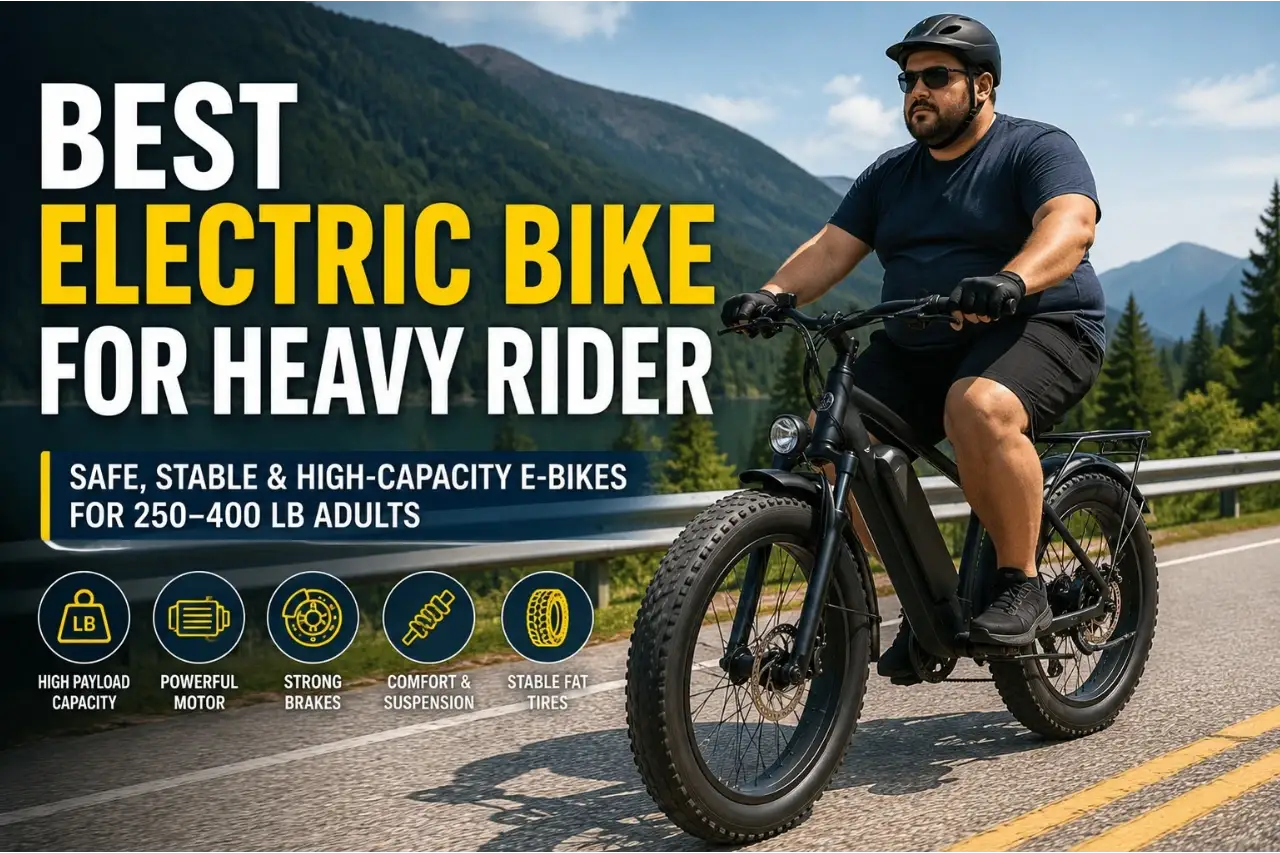
Finding a reliable electric bike as a heavier rider involves more than picking the highest wattage you can find. Payload capacity, frame material, braking power, tire width, and suspension quality all matter far more than motor numbers alone when you weigh between 250 and 400 pounds. A bike rated for 265 lbs will wear out faster, brake less predictably, and feel less stable under a 300-lb rider, even if the motor is strong. The safest approach is to choose a bike whose rated payload exceeds your body weight plus any cargo by at least 20 to 30 pounds, then evaluate braking, tires, and frame construction as your next priorities.
Hydraulic disc brakes, double-walled rims, 4-inch fat tires, and dual suspension systems are not luxury upgrades for heavier riders. They are practical necessities. Range estimates also drop significantly under higher loads, so treat advertised mileage figures as upper-bound estimates and plan accordingly.
We evaluated six models across a range of payload ratings, motor configurations, and price points to help you find the right fit.
Best for high payload capacity: TST Electric Bike for Adults, 1500W Peak Motor
Best for long-range commuting: Jasion Thunder Electric Bike
Best fat tire mountain e-bike: Jasion EB5 MAX Electric Bike
Best for tech-forward security features: DTTZH F6S Electric Bike
Best budget dual-suspension option: HQYEX Electric Bike for Adults
Best for riders prioritizing braking safety: YVY Adult Electric Bike
1. TST Electric Bike for Adults, 1500W Peak Motor

The TST stands out in this category for one reason that matters most to heavy riders: a listed maximum payload of 450 pounds. That figure is unusually high for this price tier and gives riders in the 300 to 400-lb range a meaningful safety margin when you factor in clothing, a backpack, or any cargo.
The aluminum frame pairs with a 750W continuous motor (1500W peak) and a 48V 15Ah battery. Listed range is up to 60 miles in pedal-assist mode and around 40 miles in throttle-only mode, though both figures will be lower under heavier rider weight. Mechanical disc brakes, 20-inch by 4-inch puncture-resistant tires, and a dual suspension system round out the spec sheet. The full suspension setup is particularly useful for riders carrying more weight, as it helps distribute road impact across the frame rather than concentrating it at contact points.
Assembly is listed as 90% complete from the box. Customer feedback mentions one instance of a loose handlebar stem, so tightening all fasteners before every ride is worth building into your routine.
| Spec | Detail |
|---|---|
| Motor | 750W continuous / 1500W peak |
| Battery | 48V 15Ah |
| Max Payload | 450 lbs |
| Tires | 20″ x 4″ |
| Brakes | Mechanical disc |
| Suspension | Dual (front and rear) |
| Range (PAS) | Up to 60 miles |
| Speeds | 7-speed |
| Preview | Product | Price | |
|---|---|---|---|

| TST Electric Bike for Adults, 48V 15Ah Battery, 2000W Peak Motor Yellow R9 | 20*4 Fat… | $579.99 | View on Amazon |
Pros:
- Highest payload rating in this roundup at 450 lbs
- Dual suspension adds comfort and frame stress reduction
- UL 2849 battery certification adds a safety baseline
- Well-rated customer service based on listed reviews
Cons:
- Mechanical disc brakes are less powerful than hydraulic at high loads
- 15Ah battery is on the smaller side for heavy-rider range needs
- Fewer reviews than competing models, so long-term durability data is limited
Best for: Riders in the 300 to 400-lb range who need the widest payload margin available at this price point and plan to use the bike primarily on paved or light off-road surfaces.
Who should skip it: Riders who need confident braking on steep descents or who plan to carry significant cargo regularly. The mechanical disc brakes are a meaningful limitation at higher system loads.
2. Jasion Thunder Electric Bike, 1800W Peak

The Jasion Thunder is listed with a 400-lb maximum payload in its base configuration, making it appropriate for riders in the 250 to 350-lb range when accounting for clothing and any carried items. The 26-inch by 4-inch fat tires offer more ground contact than 20-inch setups, which contributes to stability at higher speeds on varied terrain.
Power comes from an 1800W peak motor rated for 85 Newton-meters of torque. That torque figure is relevant for heavier riders because it determines how well the bike accelerates from a stop and climbs grades under load. The 48V 18Ah battery supports a listed range of up to 80 miles in pedal-assist mode, which is more realistic for heavy riders than the shorter-range options in this roundup.
Hydraulic disc brakes are a meaningful upgrade over mechanical systems at this payload level, offering shorter and more consistent stopping distances. Front suspension only, with no rear shock, is a limitation worth noting for riders who plan to use this on rough terrain regularly.
| Spec | Detail |
|---|---|
| Motor | 1800W peak |
| Battery | 48V 18Ah |
| Max Payload | 400 lbs |
| Tires | 26″ x 4″ |
| Brakes | Hydraulic disc |
| Suspension | Front only |
| Range (PAS) | Up to 80 miles |
| Speeds | 7-speed Shimano |
| Preview | Product | Price | |
|---|---|---|---|

| Jasion Thunder Electric Bike for Adults,1800W Peak Fat Tire E Bikes,26”x 4”,80 Miles… | $679.99 | View on Amazon |
Pros:
- Hydraulic disc brakes improve stopping safety at higher loads
- 85 Nm of torque supports heavier riders on inclines
- 26-inch wheels improve stability at speed
- Remote security lock adds theft deterrence
- 24-month warranty on motor, battery, and controller
Cons:
- Front suspension only; no rear shock absorption
- 400-lb payload leaves less margin for riders near that weight
- Flagged as potentially classified as a motorcycle in some states (verify local laws)
Best for: Heavier riders in the 250 to 350-lb range who prioritize long range, hydraulic braking, and a larger wheel platform for stability on mixed terrain.
Who should skip it: Riders over 350 lbs who need a larger payload buffer, or anyone who rides frequently on unpaved, bumpy routes without rear suspension.
3. Jasion EB5 MAX Electric Mountain Bike

The Jasion EB5 MAX is listed with a 400-lb payload capacity and a 2000W peak motor, making it one of the more powerful options in this roundup on paper. The carbon steel frame is heavier than aluminum alternatives but can offer added rigidity under sustained load, which matters for riders who plan to use this bike daily.
The 26-inch by 4-inch fat tires, lockable front suspension fork, and 180mm dual disc brakes are well-matched to heavier riders. The 180mm rotor size provides more stopping leverage than smaller rotors, which is a relevant safety detail for riders adding weight to the system. Battery capacity is 48V 15Ah (720Wh), with a listed range of up to 65 miles in pedal-assist and around 35 miles on throttle alone. Under heavier loads, expect range to trend toward the lower end of those estimates.
The bike comes with fenders and a rear rack pre-installed, which adds practical utility for commuters. One customer noted a flat tire on arrival, so inspecting tire inflation before first use is advisable.
| Spec | Detail |
|---|---|
| Motor | 2000W peak |
| Battery | 48V 15Ah (720Wh) |
| Max Payload | 400 lbs |
| Tires | 26″ x 4″ |
| Brakes | 180mm dual disc |
| Suspension | Front lockable fork |
| Range (PAS) | Up to 65 miles |
| Speeds | 7-speed |
| Preview | Product | Price | |
|---|---|---|---|

| Jasion EB5 MAX Electric Bike for Adults 2000W Peak Motor, 48V 15Ah Battery | 720Wh Battery… | $859.99 | View on Amazon |
Pros:
- 180mm disc rotors offer stronger braking leverage for heavier loads
- Pre-installed fenders and rear rack add commuter practicality
- Cruise control reduces wrist fatigue on longer rides
- Password-protected display adds basic security
Cons:
- Front suspension only; heavier riders on rough roads will feel more fatigue
- Carbon steel frame adds weight (heavier to transport or store)
- 15Ah battery capacity is modest relative to the motor’s power draw
Best for: Heavier commuters in the 250 to 380-lb range who want a capable daily rider with strong braking, practical cargo features, and a larger wheel for stability.
Who should skip it: Riders who prioritize lightweight handling or need rear suspension for off-road comfort. The steel frame and front-only suspension limit versatility on rough terrain.
4. DTTZH F6S Electric Bike, 2000W Peak

The DTTZH F6S is listed with a 330-lb maximum payload, which is more restrictive than other models in this roundup. Riders at or near 300 lbs should factor in clothing and cargo before selecting this model. That said, the F6S offers a notable combination of features that stand out in its price tier.
The NFC card and 4-digit password unlock system is a practical anti-theft feature. Hydraulic disc brakes provide 30% shorter stopping distances compared to mechanical systems, according to the listed specifications. This is a meaningful difference at higher speeds or on descents. The 48V 25Ah battery is the largest capacity in this roundup, providing a listed 80-mile PAS range. For heavier riders, that translates to a more realistic daily range without mid-route charging anxiety.
Dual suspension (front hydraulic and rear shock) is well-suited for off-road or pothole-heavy urban routes. The high carbon steel frame supports rigidity under sustained load. Several customers noted the speedometer reads approximately 3 mph high, so use the GPS reading on your phone as a more accurate reference.
| Spec | Detail |
|---|---|
| Motor | 2000W peak |
| Battery | 48V 25Ah |
| Max Payload | 330 lbs |
| Tires | 20″ x 4″ |
| Brakes | Hydraulic disc |
| Suspension | Dual (front and rear) |
| Range (PAS) | Up to 80 miles |
| Speeds | 7-speed |
| Preview | Product | Price | |
|---|---|---|---|

| Electric Bike for Adults, Moped Style Ebikes for Adults, E Dirt Bike | 20″ x 4″ 750W Motor… | $729.98 | View on Amazon |
Pros:
- Largest battery capacity in this roundup (25Ah)
- Hydraulic disc brakes with shorter stopping distance
- NFC unlock adds practical security
- Dual suspension handles rough terrain well
- UL 2849 and GCC certifications for safety compliance
Cons:
- 330-lb payload is the lowest in this roundup; limited buffer for heavier riders
- Speedometer accuracy issues noted by multiple customers
- Seat quality noted as below average in customer feedback
Best for: Riders in the 250 to 300-lb range who want maximum battery range, strong braking, and tech-forward features like NFC unlock on a dual-suspension platform.
Who should skip it: Riders over 300 lbs, who have minimal payload margin. Also not ideal for anyone who needs a precise speedometer for training or commuting compliance.
5. HQYEX Electric Bike for Adults, 1500W
The HQYEX is listed with a 330-lb maximum payload and an 88-lb bike weight, making it one of the heavier units in this comparison. Riders near 300 lbs should factor total system load (body weight plus bike weight for handling and transport) before purchasing.
The 1500W brushless motor and 48V 20Ah battery offer a solid power-to-range combination. The 20Ah battery is larger than the TST and EB5 MAX options, which helps partially offset the range reduction that heavier riders experience. Dual suspension and dual disc brakes are listed as standard, which are appropriate safety features for this payload class. The aluminum frame keeps things practical for urban and light trail use.
One customer noted a dented frame bar on arrival, so inspecting the frame carefully on unboxing is important. The minimum rider height is listed at 5 feet 5 inches, so shorter riders should check fit before purchasing.
| Spec | Detail |
|---|---|
| Motor | 1500W brushless |
| Battery | 48V 20Ah (864Wh) |
| Max Payload | 330 lbs |
| Tires | 20″ x 4″ |
| Brakes | Dual disc |
| Suspension | Dual |
| Speeds | 7-speed |
| Bike Weight | 88 lbs |
| Preview | Product | Price | |
|---|---|---|---|

| HQYEX Electric Bike for Adults, 1500W Brushless Motor Ebike, 20″ Fat Tire Electric… | $598.98 | View on Amazon |
Pros:
- 20Ah battery supports longer range under heavier loads
- Dual suspension and dual disc brakes are appropriate for the payload class
- Ergonomic frame design with adjustable components
- 1-year warranty on whole bike and core parts
Cons:
- 330-lb payload cap with less margin than TST or Jasion Thunder
- 88-lb bike weight makes transport and storage more demanding
- Only 20 customer reviews; limited long-term reliability data
- Frame damage reported on arrival in at least one case
Best for: Riders in the 250 to 300-lb range who want a balanced dual-suspension, dual-disc setup with a larger-capacity battery at a competitive price, primarily for urban or mixed-surface commuting.
Who should skip it: Riders over 300 lbs, those who need to transport or store the bike frequently, or anyone who is shorter than 5 feet 5 inches.
6. YVY Adult Electric Bike, 1500W Peak
The YVY K20 is listed with a 330-lb maximum payload and UL 2849 certification, which confirms the electrical system has met a recognized safety standard. For heavier riders, electrical safety certification matters because higher motor loads generate more heat and stress on battery management systems.
The hydraulic brakes are the standout feature here. For riders near the payload limit, hydraulic stopping power on wet or steep surfaces is a practical safety advantage over mechanical disc systems. The listed 5-stage full suspension system is more elaborate than most competitors in this roundup, and the 20-inch by 4-inch puncture-resistant tires pair well with that setup for varied terrain.
The 48V 15.6Ah battery is modest in capacity. Listed range is 30 to 70 miles depending on assist level, and heavier riders should plan around the lower end of that range. One customer reported a battery that failed to recharge after first use, which is worth monitoring. The bike arrives 90% pre-assembled and includes a phone holder, USB charging port, and storage box.
| Spec | Detail |
|---|---|
| Motor | 1500W peak |
| Battery | 48V 15.6Ah |
| Max Payload | 330 lbs |
| Tires | 20″ x 4″ |
| Brakes | Hydraulic disc |
| Suspension | 5-stage dual |
| Range (PAS) | 30 to 70 miles |
| Speeds | 7-speed |
| Preview | Product | Price | |
|---|---|---|---|

| YVY Adult Electric Bike, 1500W Peak Motor Moped Style E-Bike, 48V15.6Ah Removable Battery… | $579.00 $549.00 | View on Amazon |
Pros:
- Hydraulic brakes for reliable stopping at payload limits
- UL 2849 and UL 2271 battery certifications
- 5-stage suspension system handles varied terrain well
- Includes phone holder, USB port, and storage box
- 365-day warranty with 24-hour support response
Cons:
- 15.6Ah battery is small relative to motor demands at higher loads
- 330-lb payload limit with minimal buffer for riders near that weight
- Early battery failure reported by at least one customer
Best for: Safety-conscious riders in the 250 to 300-lb range who prioritize hydraulic braking, certified electrical safety, and a multi-stage suspension setup for smooth commuting or light trail use.
Who should skip it: Riders over 300 lbs or those who need extended range on a single charge. The smaller battery is the primary limiting factor for heavy-load, long-distance use.
Buying Guide
Payload Capacity Comes First
The single most important specification for a heavier rider is the listed maximum payload, not motor wattage. A bike rated for 330 lbs will experience accelerated wear on spokes, bearings, and the frame itself if ridden regularly by a 310-lb rider with a bag. We recommend choosing a bike whose payload rating exceeds your body weight plus cargo by at least 20 to 30 lbs.
Motor Power and Torque
Motor wattage affects speed and hill-climbing ability, but torque (measured in Newton-meters) is the more useful figure for heavy riders. Higher torque means the motor can accelerate and climb more effectively under load. For riders over 250 lbs, look for at least 60 Nm of torque. Riders over 330 lbs should prioritize models with 80 Nm or more.
Battery Capacity and Real-World Range
Manufacturers calculate range estimates at average rider weight, usually around 165 to 180 lbs. A heavier rider will see meaningfully shorter range from the same battery. As a rough rule, plan for 20 to 30 percent less range than the advertised figure. A larger battery (20Ah or higher at 48V) helps offset this reduction.
Braking Systems
For heavier riders, hydraulic disc brakes are strongly preferred over mechanical disc brakes. Hydraulic systems deliver more consistent stopping force and perform better in wet conditions. Look for rotor sizes of 160mm or larger; 180mm rotors provide additional leverage and heat dissipation at higher loads.
Tire Width and Rim Strength
Fat tires (4 inches wide) distribute rider weight more evenly across the contact patch, reducing pressure on any single point of the tire and rim. Double-walled aluminum rims are more resistant to deformation under sustained heavy loads than single-wall designs. Running tires at the recommended PSI for your weight (check the tire sidewall) prevents pinch flats and improves handling.
Suspension and Comfort
Dual suspension (front fork and rear shock) reduces the impact force transmitted through the frame and into the rider’s body. For heavier riders, this also reduces cumulative stress on frame welds and joints over time. Front-only suspension is acceptable for smooth urban commuting but becomes a liability on unpaved or pothole-heavy routes.
Frame Material
Aluminum frames are lighter and resist corrosion, making them practical for most riders. High carbon steel frames are heavier but can offer added rigidity for sustained heavy-load use. Either material can be appropriate; what matters more is frame geometry, weld quality, and whether the manufacturer lists a payload rating that matches your needs.
Quick Comparison Table
| Model | Max Payload | Motor Peak | Battery | Brakes | Suspension |
|---|---|---|---|---|---|
| TST 1500W | 450 lbs | 1500W | 48V 15Ah | Mechanical disc | Dual |
| Jasion Thunder | 400 lbs | 1800W | 48V 18Ah | Hydraulic disc | Front only |
| Jasion EB5 MAX | 400 lbs | 2000W | 48V 15Ah | 180mm disc | Front only |
| DTTZH F6S | 330 lbs | 2000W | 48V 25Ah | Hydraulic disc | Dual |
| HQYEX 1500W | 330 lbs | 1500W | 48V 20Ah | Dual disc | Dual |
| YVY K20 | 330 lbs | 1500W | 48V 15.6Ah | Hydraulic disc | Dual (5-stage) |
Frequently Asked Questions
Which e-bike frame styles and materials are most reliable for heavier riders?
Step-over (diamond) frames generally offer more structural rigidity than step-through designs, which makes them better suited for riders near or above a bike’s payload limit.
Aluminum frames are the most common and practical choice, offering a good balance of weight and corrosion resistance; high carbon steel frames add rigidity but also add bike weight.
Regardless of material, look for bikes with clearly listed payload ratings and avoid models that omit that specification entirely.
How much motor power and torque do heavier riders typically need for hills and headwinds?
For riders between 250 and 330 lbs, a motor producing at least 60 to 80 Newton-meters of torque is a practical minimum for handling moderate inclines and headwinds without overloading the motor.
Continuous wattage matters more than peak wattage; a 750W continuous motor is generally more useful than a motor that only reaches high output for brief bursts.
Riders above 330 lbs should look for 80 Nm or more, especially if their routes include hills or regular cargo loads.
What wheel size, rim strength, and tire width are best for stability and durability under higher loads?
Fat tires in the 4-inch width range distribute load more effectively than standard tires and reduce the risk of rim damage from impacts.
Double-walled aluminum rims resist deformation better than single-wall rims under sustained heavy-rider use.
Wheel size (20-inch vs. 26-inch) affects stability at speed; 26-inch wheels tend to track more smoothly at higher speeds, while 20-inch wheels offer a more compact, maneuverable platform.
Which suspension and seat upgrades improve comfort and control for heavier riders on rough roads?
Dual suspension (front fork plus rear shock) is the most impactful upgrade for heavier riders on rough surfaces, as it reduces frame stress and body fatigue simultaneously.
A wider, gel-padded or memory foam saddle distributes sitting pressure more evenly, which becomes noticeably important on rides over 30 minutes.
Adjustable suspension preload settings, when available, allow heavier riders to tune the shock stiffness to their weight rather than accepting a factory default calibrated for lighter riders.
What braking system and rotor size are recommended for safe stopping with a heavier rider and cargo?
Hydraulic disc brakes are recommended over mechanical disc brakes for any rider near or above 280 lbs, as they provide more consistent force and better heat management during sustained braking on descents.
Rotor sizes of 160mm or larger are appropriate for this rider category; 180mm rotors offer additional leverage and are preferable when total system load (rider plus cargo) regularly approaches the bike’s payload limit.
Brake pad and rotor inspection every few months is advisable for heavier riders, as pad wear accelerates proportionally with system load.
GoEBikeLife publishes independent e-bike reviews, comparisons, and practical buying guides. Some links on this page are affiliate links. If you make a purchase through an eligible link, we may earn a commission at no additional cost to you.