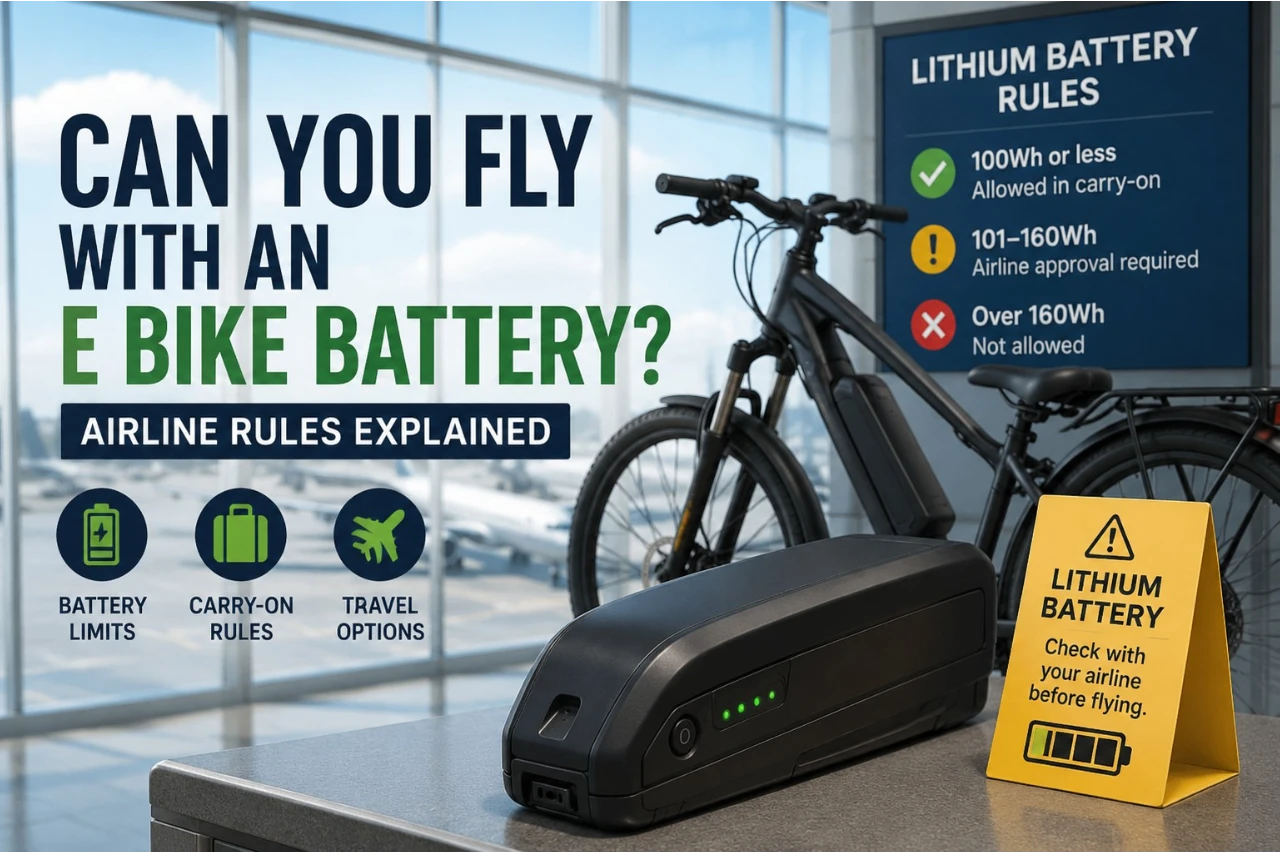
Flying with an electric bike sounds convenient, especially if you want to ride at your destination. But the battery is where most travel plans become complicated.
In most cases, you cannot fly with a standard e-bike battery because it is usually much larger than the lithium-ion battery limits allowed for airline passengers.
Most e-bike batteries are far above 100 watt-hours. Many are also far above 160 watt-hours. That matters because airlines and aviation authorities use watt-hours to decide whether a lithium-ion battery can travel in carry-on baggage, checked baggage, or not at all.
This guide explains the rules in plain language, how to calculate your battery’s watt-hours, and what you can do instead if you want to travel with an electric bike.
Key Takeaways
- Most standard e-bike batteries are not allowed on passenger planes.
- The common passenger limit for lithium-ion batteries is 100Wh.
- Some 101–160Wh lithium-ion batteries may be allowed with airline approval.
- Spare lithium batteries must be carried in carry-on baggage, not checked baggage.
- Many e-bike batteries are 360Wh, 500Wh, 672Wh, 720Wh, or higher.
- Batteries over 160Wh are usually not accepted for recreational electric vehicles.
- Mobility scooters and electric wheelchairs follow different rules.
- Always check the airline’s battery policy before you travel.
- Never hide or mislabel an e-bike battery in your luggage.
Can You Fly with an E Bike Battery?
Usually, no.
A normal e-bike battery is too large to bring on a passenger aircraft. This applies whether the battery is removed from the bike or installed on the bike.
Airline rules are based on the battery’s watt-hour rating, also written as Wh. Small electronics such as phones, cameras, tablets, and many laptops usually fall under airline passenger battery limits. E-bike batteries usually do not.
For most travelers, the practical answer is simple:
You can usually fly with the bike frame, but not with the standard e-bike battery.
The battery is the restricted item. If the e-bike battery is larger than the permitted watt-hour limit, it cannot go in your carry-on bag or checked luggage.
Some very small e-bike or scooter-style batteries may fall under 160Wh, but that is uncommon for regular adult electric bikes. You would still need to check with the airline first.
Why Most E-Bike Batteries Are Not Allowed on Planes
Most e-bike batteries are built for range, power, and hill climbing. That means they store much more energy than small consumer electronics batteries.
A typical e-bike battery might be:
- 36V 10Ah = 360Wh
- 48V 14Ah = 672Wh
- 52V 20Ah = 1040Wh
These numbers are much higher than the common 100Wh airline passenger limit. They are also higher than the 160Wh upper range that some airlines may approve for larger lithium-ion batteries.
That is why most e-bike batteries are not treated like laptop batteries or camera batteries.
The restriction is not just about size or weight. It is about stored energy and fire risk. Lithium-ion batteries can overheat if they are damaged, defective, crushed, short-circuited, or exposed to unsafe conditions.
In rare cases, lithium-ion batteries can enter thermal runaway. This is a chain reaction where the battery overheats and may smoke, ignite, or burn intensely.
Airlines are strict because a battery fire inside an aircraft is a serious safety issue.
What Are the FAA and TSA Battery Limits?
For U.S. air travel, the most important battery limits are based on watt-hours.
Here is the simple version:
| Battery Rating | Typical Rule for Passengers |
|---|---|
| 100Wh or less | Usually allowed for personal use, if properly packed |
| 101–160Wh | Usually requires airline approval and is limited in quantity |
| Over 160Wh | Usually not allowed for passenger baggage |
For spare lithium-ion batteries, the rules are stricter.
Spare lithium batteries are generally not allowed in checked baggage. They must travel in carry-on baggage and must be protected from damage and short circuit.
That means the terminals should be covered or protected. The battery should not be loose in a bag with keys, tools, coins, or metal objects.
For 101–160Wh lithium-ion batteries, airline approval is usually required. Passengers are generally limited to two spare batteries in this range.
However, airline rules can be stricter than the general aviation rules. One airline may accept a battery that another airline refuses.
That is why you should always check your airline’s current policy before booking or packing.
How to Calculate Your E-Bike Battery’s Watt-Hours
To know whether your e-bike battery is allowed, you need to know its watt-hour rating.
Most e-bike batteries show the rating on the battery label. Look for “Wh” first.
If the Wh rating is not shown, you can calculate it with this formula:
Watt-hours = Voltage × Amp-hours
For example:
| Battery Label | Calculation | Watt-Hours |
|---|---|---|
| 36V 10Ah | 36 × 10 | 360Wh |
| 48V 10Ah | 48 × 10 | 480Wh |
| 48V 14Ah | 48 × 14 | 672Wh |
| 52V 15Ah | 52 × 15 | 780Wh |
| 52V 20Ah | 52 × 20 | 1040Wh |
If your battery label uses mAh instead of Ah, divide mAh by 1000 first.
For example:
10,000mAh = 10Ah
Then multiply by voltage.
A small 36V 4Ah battery would be:
36 × 4 = 144Wh
That might fall within the 101–160Wh range, but it would still need airline approval. It is also much smaller than most adult e-bike batteries.
Most full-size e-bike batteries are not close to the airline limit. They are usually several times higher.
Carry-On vs Checked Baggage: Where Can Lithium Batteries Go?
The difference between carry-on and checked baggage is very important.
Spare lithium-ion batteries must usually go in carry-on baggage. They should not be packed in checked luggage.
This is because cabin crew can respond more quickly if a battery overheats, smokes, or catches fire in the cabin. A battery fire in the cargo hold is harder to detect and control.
Here is the general rule:
| Battery Situation | Carry-On | Checked Baggage |
|---|---|---|
| Small lithium battery installed in a device | Usually yes | Usually yes, if powered off and protected |
| Spare lithium battery under 100Wh | Yes | No |
| Spare lithium battery 101–160Wh | Yes, with airline approval | No |
| Standard e-bike battery over 160Wh | Usually no | Usually no |
Do not assume that removing the battery from the bike makes it acceptable.
If the battery is over the limit, it is still over the limit. A removable battery is easier to inspect and safer to handle, but it does not remove the watt-hour restriction.
Also, do not try to check an oversized e-bike battery in your luggage. It can be confiscated, delay your trip, or create a serious safety problem.
Common E-Bike Battery Sizes and Airline Limits
Most adult e-bike batteries are designed for real-world riding range. That makes them much larger than airline passenger battery limits.
Here are common examples:
| E-Bike Battery Size | Watt-Hours | Likely Allowed on a Plane? |
|---|---|---|
| 24V 4Ah | 96Wh | Possibly, if properly packed |
| 36V 4Ah | 144Wh | Possibly with airline approval |
| 36V 10Ah | 360Wh | Usually no |
| 48V 10Ah | 480Wh | Usually no |
| 48V 14Ah | 672Wh | Usually no |
| 48V 15Ah | 720Wh | Usually no |
| 52V 15Ah | 780Wh | Usually no |
| 52V 20Ah | 1040Wh | Usually no |
| 48V 20Ah dual battery setup | 960Wh total | Usually no |
This is why many folding e-bike owners are surprised when they prepare for a flight.
The bike may fold small enough to fit in a travel case, but the battery usually remains too large for air travel.
The size of the bike does not decide the battery rule. The watt-hour rating does.
What About Folding E-Bikes and Removable Batteries?
Folding e-bikes are easier to transport by car, train, RV, or local transit. But flying with one is still difficult because of the battery.
A folding frame does not change the battery limit.
If your folding e-bike uses a 48V 10Ah battery, that battery is 480Wh. It is still far above the typical passenger limit.
A removable battery also does not automatically make the bike flight-ready. It only means you can separate the restricted battery from the frame.
For air travel, you may be able to check or ship the bike frame without the battery, depending on the airline and packaging. But the battery itself still needs to meet lithium battery rules.
Before traveling with a folding e-bike, ask the airline these questions:
- Can I check the e-bike frame without the battery?
- Do you accept electric bikes as sports equipment?
- What packaging do you require?
- Do you require proof that the battery has been removed?
- Do you allow this specific battery watt-hour rating?
- Do you have stricter rules than FAA or TSA guidance?
Do not wait until the airport check-in counter to ask. By then, it may be too late to fix the problem.
Are Mobility Scooter and Wheelchair Batteries Treated Differently?
Yes.
Electric wheelchairs and mobility scooters used as mobility aids have separate airline rules. These rules are not the same as rules for recreational e-bikes.
This difference matters because some people confuse mobility devices with electric bikes.
A regular e-bike is usually considered a recreational or personal transportation device. It does not automatically qualify under mobility device battery exceptions.
For lithium-ion batteries used in wheelchairs and mobility aids, airlines may allow larger battery limits under specific conditions. In many cases, advance airline notification, battery protection, and special handling are required.
Some mobility device batteries may be allowed up to 300Wh, and spare battery limits may also differ. But these rules are designed for passengers who need mobility assistance.
They should not be used as a workaround for bringing a standard e-bike battery onto a plane.
If you use a battery-powered mobility device for a disability or medical mobility need, contact your airline directly before travel. Give them the device model, battery type, and watt-hour rating.
If you are traveling with a recreational e-bike, assume the regular passenger lithium battery limits apply unless the airline confirms otherwise in writing.
What to Do Instead of Flying with an E-Bike Battery
If your e-bike battery is too large for air travel, you still have several options.
1. Rent an E-Bike at Your Destination
This is usually the easiest solution.
Many cities, parks, beach towns, and tourist destinations now have e-bike rentals. Renting avoids airline battery restrictions and reduces the risk of damage during travel.
It may also be cheaper than paying oversized baggage fees or special shipping costs.
2. Travel with the Bike Frame Only
Some travelers bring the bike frame without the battery.
This can work if the airline accepts the bike as checked sports equipment and the frame is packed correctly.
However, you still need a compatible battery at your destination. Make sure the battery mount, voltage, connector, controller, and charger are compatible.
Do not assume any 48V battery will work with any 48V e-bike.
3. Buy or Rent a Compatible Battery Locally
If you plan to stay at your destination for a long time, sourcing a battery locally may be practical.
This works best if your bike uses a common battery system.
Before choosing this option, confirm:
- Voltage
- Amp-hour rating
- Connector type
- Mount style
- Charger compatibility
- Brand or controller requirements
- Return policy
A wrong battery can damage the bike or create a safety issue.
4. Use Ground Shipping When Appropriate
Some large lithium batteries can be shipped by ground through proper hazardous materials channels.
This is not the same as putting the battery in a suitcase.
Large lithium batteries may require special packaging, labels, documentation, and carrier acceptance. Some carriers may refuse certain e-bike batteries or require a business account.
Do not ship an e-bike battery casually without checking the carrier’s lithium battery policy.
5. Choose a Destination with Good E-Bike Access
For short trips, the simplest option is to choose a destination where e-bike rentals are easy to find.
This avoids battery transport problems completely.
It also lets you ride a bike that is already suited to the local terrain, whether that is beach paths, mountain trails, city commuting, or paved touring routes.
Pre-Flight E-Bike Battery Checklist
Use this checklist before you travel.
- Find the Wh rating on your e-bike battery label.
- If Wh is not listed, calculate voltage × amp-hours.
- Check whether the battery is 100Wh or less, 101–160Wh, or over 160Wh.
- Read your airline’s lithium battery policy.
- Contact the airline if the battery is over 100Wh.
- Ask for written confirmation if the airline says the battery is allowed.
- Do not pack spare lithium batteries in checked baggage.
- Protect battery terminals from short circuit.
- Do not travel with a damaged, swollen, wet, or recalled battery.
- Remove the battery from the e-bike if checking the frame.
- Do not hide or mislabel the battery.
- Plan a backup option before arriving at the airport.
The most important step is checking the watt-hour rating. Once you know the Wh number, the airline rules become much easier to understand.
FAQ
Can you take an e-bike battery on a plane?
Usually, no. Most standard e-bike batteries are over 160Wh, which is above the normal passenger limit for lithium-ion batteries.
Can I put an e-bike battery in checked luggage?
No, you should not put a spare e-bike battery in checked luggage. Spare lithium batteries are generally required to travel in carry-on baggage, and oversized e-bike batteries are usually not allowed at all.
Can I bring an e-bike battery in my carry-on bag?
Only if the battery is within the permitted watt-hour limit and packed correctly. Most e-bike batteries are much larger than the allowed limit, so they are usually not accepted.
What is the largest lithium battery I can bring on a plane?
For most passenger travel, lithium-ion batteries up to 100Wh are commonly allowed. Batteries from 101–160Wh usually require airline approval and are limited in quantity. Batteries over 160Wh are usually not allowed for passenger baggage.
Are e-bike batteries TSA approved?
Be careful with the phrase “TSA approved.” TSA screens passengers and baggage, but the airline also controls whether a lithium battery can travel. A standard e-bike battery is usually too large even if it is removable and clearly labeled.
Can I fly with a folding e-bike?
You may be able to fly with the folding bike frame if the airline accepts it as checked baggage or sports equipment. The battery is the main problem. Most folding e-bike batteries are still too large for passenger aircraft.
Can I ship my e-bike battery instead of flying with it?
Possibly, but large lithium batteries require proper hazardous materials handling. You need to check the shipping carrier’s rules and use approved packaging and documentation where required.
What happens if I bring an oversized e-bike battery to the airport?
The airline or security staff may refuse the battery. You may have to leave it behind, miss your flight, or make last-minute shipping arrangements. It is better to check the policy before you travel.
Are electric wheelchair batteries treated the same as e-bike batteries?
No. Electric wheelchairs and mobility scooters used as mobility aids have separate rules. These rules should not be used for recreational e-bikes.
How do I know if my e-bike battery is over 160Wh?
Check the battery label for Wh. If you only see voltage and amp-hours, multiply them. For example, a 48V 14Ah battery is 672Wh, which is over 160Wh.
Final Thoughts
You usually cannot fly with a standard e-bike battery because most e-bike batteries are far above airline passenger lithium battery limits.
The key number is watt-hours. If your battery is over 160Wh, it will usually not be allowed as carry-on or checked baggage. Since many e-bike batteries are 300Wh to 1000Wh or more, most riders need another plan.
The safest options are to rent an e-bike at your destination, travel with the frame only, source a compatible battery locally, or use proper ground shipping when allowed.
Before any trip, check the battery label, calculate the watt-hours, and confirm the airline’s current policy. That one step can save you from losing your battery, delaying your trip, or creating a serious safety risk.