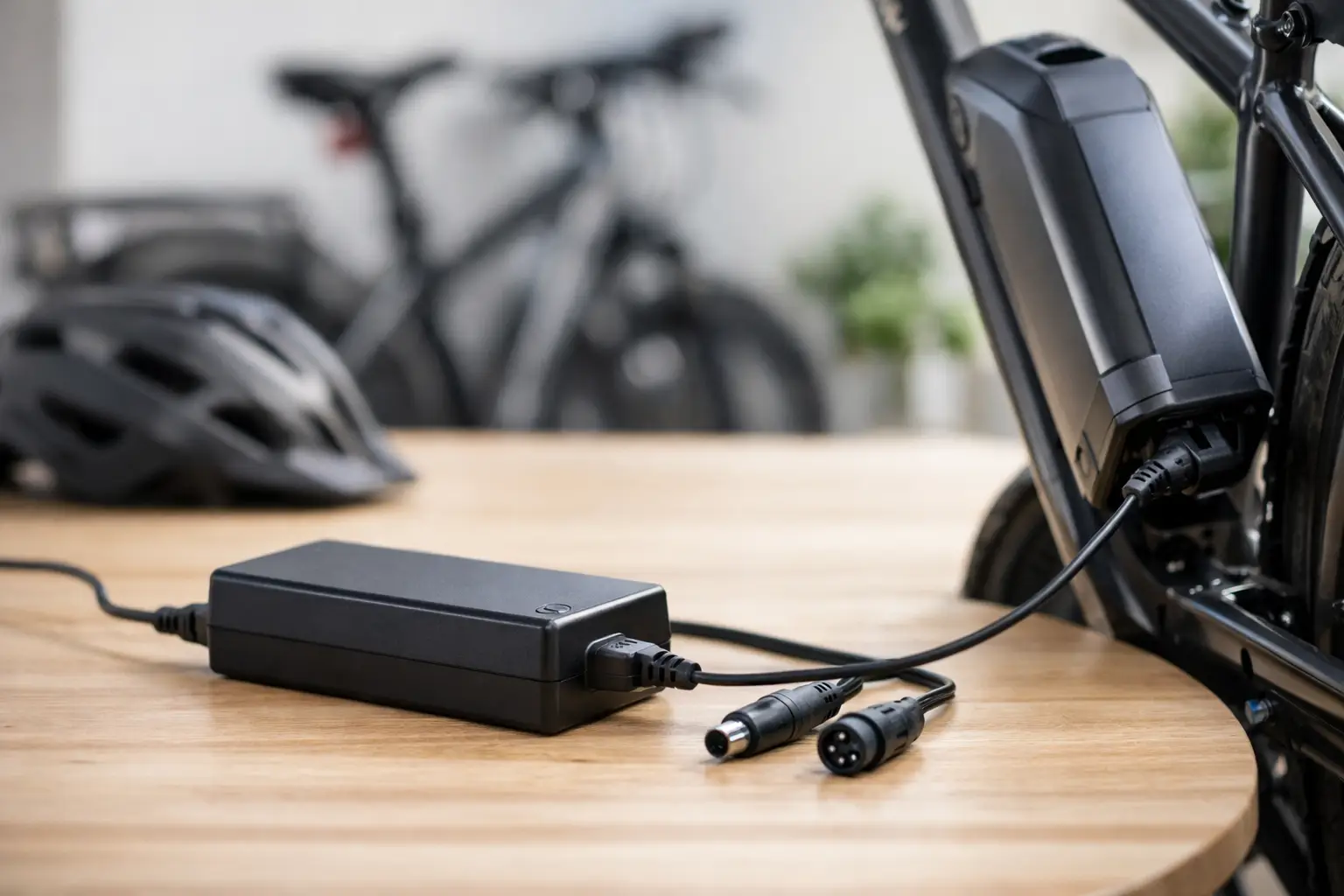
A charger that plugs into your e-bike is not necessarily safe to use with it. This ebike charger compatibility guide starts with the rule that matters most: use the charger specified for your exact battery whenever possible. A similar-looking connector, a matching battery voltage label, or a charger from another e-bike does not prove compatibility.
Charging equipment manages high-energy lithium-ion batteries. The wrong match can lead to a battery that will not charge, a damaged charging port or battery management system, overheating, or other electrical problems. You do not need to understand every electrical detail to make a safe decision, but you do need to verify a few items before connecting a charger.
Ebike charger compatibility guide: check the labels first
Read the label on both the battery and charger in good light. Take a clear photo of each label before comparing information. The owner’s manual and the e-bike or battery manufacturer’s instructions always take priority over general guidance.
The most useful charger label details are output voltage, output current, connector type, polarity if shown, and model or part number. The battery label may list nominal voltage, capacity in amp-hours (Ah), energy in watt-hours (Wh), a model number, and charging specifications.
| What to check | What it means | Safe takeaway |
|---|---|---|
| Output voltage | The charger’s final charging voltage | It must match the battery manufacturer’s required charger voltage. |
| Output current | How quickly the charger can supply energy | Use only the current rating approved for that battery. More current is not automatically better. |
| Connector and polarity | The plug shape, pin layout, and positive/negative arrangement | A plug that fits can still be electrically wrong. |
| Model or part number | Identifies the intended charger and battery system | A manufacturer-approved match is the clearest confirmation. |
| Battery chemistry or system type | May affect how charging is controlled | Do not assume all lithium-ion e-bike systems charge alike. |
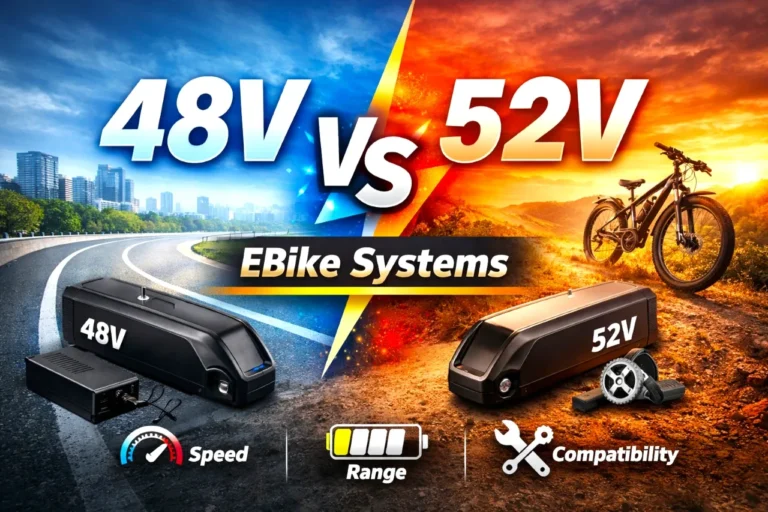
A frequent source of confusion is nominal battery voltage. A battery sold as “48V” does not necessarily use a charger labeled 48V output. Its charger may have a higher output voltage because the battery reaches a higher voltage at full charge. For that reason, match the charger’s output specification to the manufacturer’s required charger specification, not simply to the large voltage number printed on the battery.
Why a matching plug is not enough
Many e-bikes use round barrel connectors, but barrel plugs come in different diameters, pin arrangements, and polarity configurations. Two plugs can look nearly identical and still connect power differently. Some batteries also use proprietary connectors or communication signals between the charger and battery.
The battery’s built-in battery management system, often called the BMS, monitors charging and helps protect the cells under normal conditions. It is not a universal adapter that makes any charger safe. A mismatched charger can prevent charging, trigger a fault, or place the system outside its intended operating limits.
Do not force a plug into a port, use an improvised adapter, alter a connector, or rely on a cable because it physically joins two pieces of equipment. Avoid chargers with loose pins, cracked housings, damaged cords, a bent plug, a hot power brick, or an intermittent connection. Unplug them and arrange service or replacement through the e-bike or battery manufacturer, or a qualified technician.
Verify charger voltage, current, and charging limits
Voltage is the first non-negotiable check. The charger must provide the exact output voltage required by the battery system. A lower-voltage charger may fail to charge the battery fully or at all. A higher-voltage charger can be unsafe and may damage the battery or its control electronics.
Current is measured in amps (A). A 2A charger generally charges more slowly than a 4A charger, but charging speed is not the only consideration. The battery, BMS, wiring, charge port, and charger all need to be designed for that rate. A higher-current charger can be appropriate only when the manufacturer specifically permits it for your battery model.
For example, a 48V e-bike battery with a 14Ah capacity may be supplied with a 2A charger. That does not mean every 4A charger with a similar plug is acceptable. The higher-current unit may charge faster on a different approved battery, but that tells you nothing about yours.
Also check whether your manufacturer sets a daily charging limit, such as stopping at a lower state of charge for routine use. A charger may be compatible electrically while your battery system or app has instructions intended to support long-term battery care. Follow those instructions rather than trying to override them.
A practical compatibility check before charging
Use this process any time you are considering a replacement, spare, or borrowed charger.
- Identify the battery, not just the bike. Record the battery brand, model number, nominal voltage, and any manufacturer charging instructions. Some e-bike models use different batteries across production years.
- Find the original charger specification. Check the original charger label, manual, and manufacturer documentation. Record its output voltage and output current exactly as printed.
- Confirm the charger model is approved. The best evidence is a manufacturer statement that the charger model is intended for your exact battery or e-bike system. If you cannot confirm that, do not treat a similar specification as a safe substitute.
- Inspect the connector without connecting it. Compare its shape, pin count, fit, and any alignment marks. If polarity markings appear, they must match the required arrangement. Never test an uncertain plug by plugging it in briefly.
- Check the equipment condition. Use a charger only if its cord, plug, strain relief, housing, and wall plug are intact. A charger that has been dropped, gotten wet, or started making unusual sounds should not be used until it has been evaluated by an appropriate service provider.
- Make the first charge supervised. When using a confirmed compatible charger for the first time, remain nearby and follow the manufacturer’s connection order. Check periodically for unusual heat, smell, error lights, or repeated cycling on and off.
Charging setup still matters
A correct charger needs a safe place to work. Charge on a hard, stable, nonflammable surface in a dry area with normal room temperatures. Keep the battery and charger away from direct sun, space heaters, flammable liquids, paper, and clutter. Do not charge a battery under bedding, on a couch, or in an exit path.
Let a battery cool after a hard ride before charging it. Likewise, do not charge a battery that is extremely cold unless the manufacturer says it is allowed. For many riders, a dry indoor space around normal room temperature is the practical choice.
Plug the charger directly into a suitable wall outlet unless the manufacturer allows another setup. Avoid overloaded power strips and extension cords, especially thin or damaged ones. Keep charging cords where people, pets, and bicycle tires will not pull or crush them.
Do not leave charging unattended for long periods or overnight unless the manufacturer explicitly states that your battery and charging setup support that practice and you can do so safely. Once charging is complete, disconnect according to the manufacturer’s instructions rather than leaving the system connected indefinitely.
When to stop and get help
Stop charging immediately if the battery, charger, plug, or charging port becomes unusually hot; emits an odor; swells; leaks; makes popping or hissing sounds; shows smoke; or has visible damage. If there is smoke, fire, or an immediate threat, move people away if it is safe to do so and contact emergency services. Do not handle a smoking, leaking, or badly damaged battery.
A battery that will not charge, repeatedly shows an error, or only charges when the cord is held in a certain position needs professional attention. Owners can safely inspect labels, check for visible damage, keep equipment dry, and clean loose surface dirt from around a port with a dry cloth. They should not open a battery, charger, or battery management system, probe terminals, repair cords, or attempt to modify connectors.
A qualified e-bike technician or the battery manufacturer can help identify whether the problem is the charger, charge port, battery, or wiring. That diagnosis matters because replacing the wrong part can leave the original fault unresolved.
The safest charger decision is usually the least complicated one: confirm the exact battery system, use the specified charger, and stop when the labels or behavior do not line up. A few minutes of checking before you charge protects the equipment you rely on for every ride.
Frequently Asked Questions
Can I use any charger that fits my e-bike battery?
No. A connector that fits does not confirm electrical compatibility. The charger’s output voltage, current, connector configuration, polarity, and approved battery model must all match the manufacturer’s requirements.
Can I use a 48V charger with any 48V e-bike battery?
No. A battery’s advertised 48V rating is usually its nominal voltage, while the required charger output voltage is different. Always use the exact charger specification approved for your battery model.
Is a higher-amp e-bike charger safe to use?
Only if the battery manufacturer specifically approves the higher charging current. A higher-amp charger may charge faster, but it can exceed the limits of the battery, BMS, wiring, or charging port.
How do I know whether a replacement e-bike charger is compatible?
Check the battery model, charger output voltage, output current, connector, polarity, and part number. The safest confirmation is a manufacturer statement that the charger is approved for your exact battery or e-bike system.
Can I use a charger from another e-bike?
Do not use it unless the manufacturer confirms compatibility with your battery. Even chargers with similar labels or identical-looking plugs can have different voltage, current, polarity, or communication requirements.
What should I do if my e-bike charger becomes unusually hot?
Stop charging and unplug the equipment if it is safe to do so. Unusual heat, odors, swelling, leaking, smoke, or hissing sounds can indicate a serious problem that requires professional inspection.
Is it safe to charge an e-bike battery overnight?
Avoid unattended or overnight charging unless the manufacturer explicitly allows it and your charging environment is suitable. Charge on a dry, hard, nonflammable surface away from heat, clutter, and exit paths.
Why is my e-bike battery not charging?
Possible causes include an incompatible or damaged charger, a faulty charging port, wiring problems, or a battery or BMS fault. Do not open or modify the equipment; contact the manufacturer or a qualified e-bike technician for diagnosis.