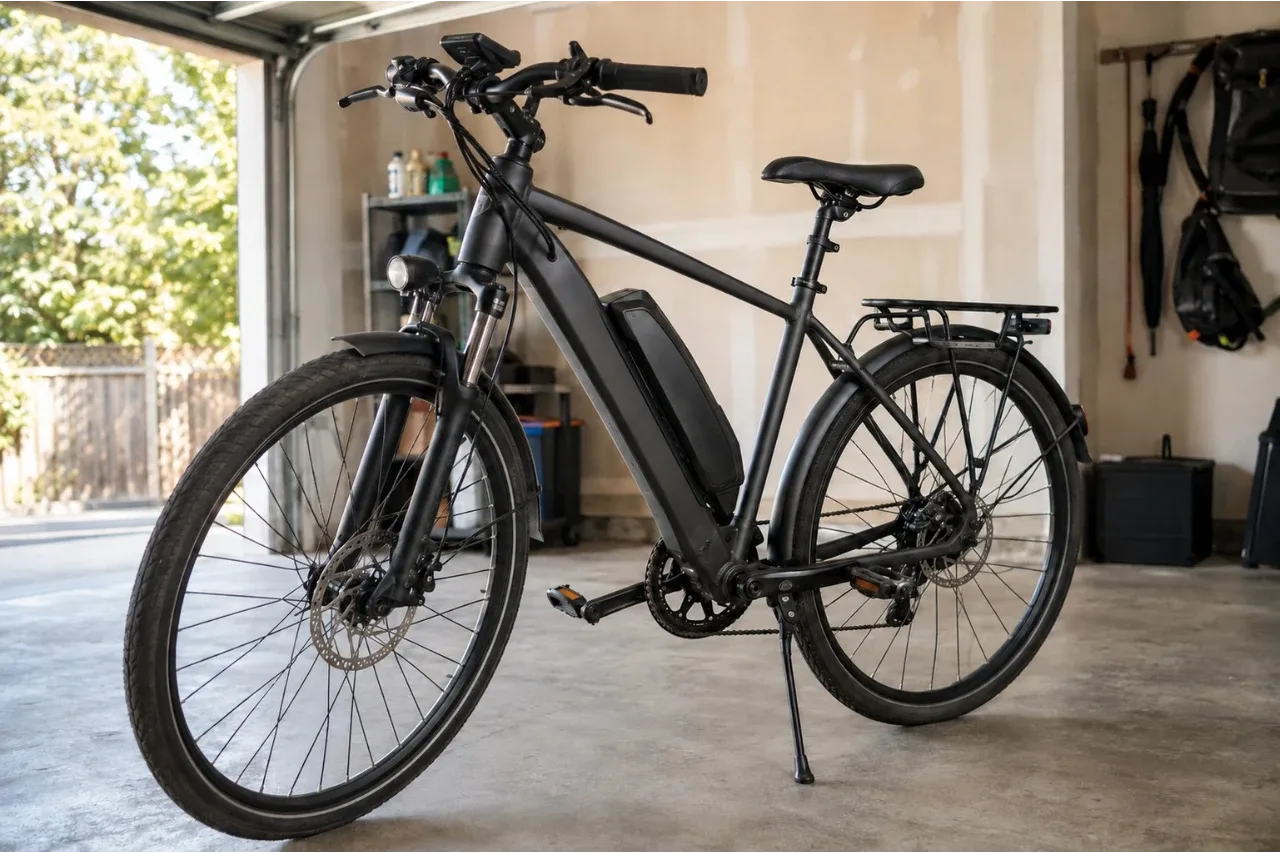
If your e-bike battery is swollen, stop riding and charging immediately. Do not press on the case, reinstall the pack, test it, or try to repair it. Keep people and pets away, clear nearby combustible materials only if you can do so without touching the battery, and contact the manufacturer for model-specific handling and disposal instructions. If the battery is hot, smoking, leaking, hissing, or rapidly changing shape, move away and call 911.
A battery should retain its original shape and fit its mount normally. A new bulge, bowed panel, separated seam, lifted label, distorted charge port, or battery that suddenly binds in its mounting rail is a stop-use condition. Swelling is not a cosmetic issue and should not be monitored through another ride or charging cycle.
Why an e-bike battery can swell
Most e-bike batteries contain lithium-ion cells inside a protective case. When a cell is damaged or deteriorates abnormally, internal chemical reactions can generate gas. Pressure may then distort the cell and eventually the battery housing.
Possible contributing factors include overheating, physical impact, water intrusion, an internal defect, age-related deterioration, or charging with equipment that the manufacturer did not approve. The cause is not always visible from outside, and trying to diagnose it by opening the case creates additional electrical, chemical, and fire risks.
The practical answer does not depend on finding the cause at home: a swollen battery is damaged until the manufacturer or an authorized battery service provider determines otherwise. Do not open the case, puncture it, flatten it, replace cells, repair the battery management system, or attempt to discharge the pack by riding the bike.
For other physical and electrical symptoms, see our guide to e-bike battery damage warning signs.
What to do when an e-bike battery is swollen
The safest response depends on whether the battery is cool and quiet or showing signs of an active thermal event. Do not move it simply to create a more convenient work area.
- Stop using the bike and battery. Turn off the e-bike only if the normal control is accessible without touching or leaning over the damaged battery. Do not ride, run the motor, check the remaining charge, or reconnect the pack.
- Stop charging without handling the battery. If the battery is connected to a charger and the wall plug is safely accessible without approaching the battery, unplug the charger from the wall first. Do not disconnect a hot, smoking, leaking, hissing, or visibly damaged connector at the battery.
- Do not force the battery out of its mount. Swelling can make a removable pack bind in its rail or frame cavity. Pulling harder can damage the case, terminals, or cells. If the battery does not release normally—or if it is integrated into the frame—leave it in place and ask the manufacturer how the entire bike should be handled.
- Protect people without relocating the pack. Keep children, pets, and bystanders away. If it can be done without approaching or touching the battery, remove nearby paper, fuel, paint, propane, textiles, dry leaves, and other combustible materials. Do not carry a swollen battery through a home, apartment hallway, stairwell, or elevator.
- Contact the manufacturer. Provide the e-bike model, battery model and serial number if already visible, purchase date, and a description of what changed. Ask for written instructions covering removal, warranty evaluation, local service, transport, and disposal. The owner’s manual and battery-specific manufacturer instructions take priority over general guidance.
If the manufacturer is unavailable, contact an authorized e-bike dealer, a qualified service provider trained to handle lithium-ion e-bike batteries, or your local household hazardous-waste authority. Call before visiting; many bike shops and collection sites cannot accept damaged batteries.
When swelling becomes an emergency
The U.S. Fire Administration identifies bulging, rising temperature, hissing or popping, mechanical damage, and visible gases as signs of battery damage or possible thermal runaway. Treat the situation as an immediate emergency if you notice:
- Smoke, flames, sparks, or visible vapor
- Rapid heating or a case that is changing shape quickly
- Hissing, popping, crackling, or pressure-release sounds
- Leaking material or a strong unusual chemical odor
- Fire spreading to the bike or nearby property
Do not touch, carry, cover, immerse, or place the battery in a freezer or sealed container. Move everyone away from the immediate area, leave the building if needed, call 911 from a safe location, and tell the dispatcher that an e-bike lithium-ion battery is involved. Follow the dispatcher’s instructions rather than attempting to manage the battery yourself.
Do not delay an emergency call while searching for a recycling location or trying to reach the manufacturer. Our electric bike fire safety guide explains the broader warning signs and safer charging-area practices.
How to confirm that the case has actually changed
Some e-bike batteries have curved or sculpted housings by design. Compare the battery with older photos, the same side on the opposite end of the case, the manufacturer’s product images, or an identical undamaged pack. Focus on a new change rather than assuming every curve is swelling.
Signs that support a stop-use decision include:
- A panel, seam, or label that has lifted or bowed outward
- A case that rocks when it previously sat normally
- New gaps between case sections
- A distorted charge port, latch, key cylinder, or mounting area
- A battery that no longer slides, seats, or releases normally
- Swelling accompanied by unusual heat, odor, leakage, or erratic operation
Do not use a ruler, clamp, straightedge, or hand pressure against the battery to measure the bulge. Photos taken from a safe distance are enough for an initial manufacturer support request. Do not move the pack or rotate it to expose a label that is not already visible.
A charging error, reduced range, or sudden shutdown alone does not prove that a battery is swollen. Cold weather, connector problems, charger faults, and other electrical issues can cause similar symptoms. Visible deformation changes the decision: stop using the pack instead of troubleshooting it through repeated rides or charges.
Do not rely on temporary fixes
Tape, clamps, straps, shrink wrap, a replacement battery cover, or a tighter mounting latch cannot make a swollen battery safe. Neither can charging it outdoors, watching it more closely, using a lower-current charger, or trying to drain it before disposal. These steps do not reverse internal damage.
Do not substitute another charger because its plug fits. A safe charger match depends on the battery chemistry and model, required charger output voltage and current, connector, polarity, communication requirements, and manufacturer approval. Our e-bike charger compatibility guide explains why connector shape alone is not proof of compatibility.
Do not give away or sell a swollen battery, and do not install it on another e-bike for testing. A detached battery remains hazardous even when it is no longer connected to the bike.
How to arrange disposal or transport
Do not put a swollen e-bike battery in household trash, curbside recycling, or an ordinary retail battery collection box. The U.S. Environmental Protection Agency advises consumers to contact the battery or device manufacturer for specific handling information when a lithium-ion battery is damaged. Your local household hazardous-waste program may have a separate process, designated appointment, or approved contractor for damaged batteries.
Before taking the battery anywhere, describe it clearly as a swollen or damaged lithium-ion e-bike battery and ask whether the location accepts that condition and size. Do not arrive unannounced, leave it outside a facility, or place it in a vehicle until the receiving organization has given you instructions.
Do not mail or ship the battery using ordinary parcel service. The U.S. Department of Transportation regulates lithium batteries as hazardous materials, and damaged, defective, or recalled batteries present greater transportation risk and may require specialized packaging, documentation, carrier approval, and trained handling. Damaged, defective, or recalled lithium batteries are forbidden from air transport.
Also check the CPSC recall database using the bike and battery brand or model. A recall or safety warning may provide a specific remedy, but do not move the battery merely to find a hidden model label.
Information to give the manufacturer
Clear, factual details can help support staff decide whether the case involves a warranty, recall, inspection, or specialized disposal route. Share only information you can collect without moving or touching the battery:
- E-bike brand, model, and approximate purchase date
- Battery model and serial number, if already visible
- When and where you first noticed the swelling
- Whether the battery was charging, stored, or installed on the bike
- Recent drops, crashes, high heat, flooding, or other water exposure
- The charger model that was used
- Photos taken from a safe distance
Do not guess at the cause. If the bike was purchased used, the battery was replaced, or the charger did not come with the bike, say so. That information may affect compatibility, warranty, and recall checks.
Reducing the risk of future battery damage
Not every battery failure is preventable, but correct use reduces avoidable stress. Follow the battery and e-bike manuals, use only the charger supplied or specifically approved for that exact battery system, and stop using equipment with damaged cords, plugs, ports, or housings.
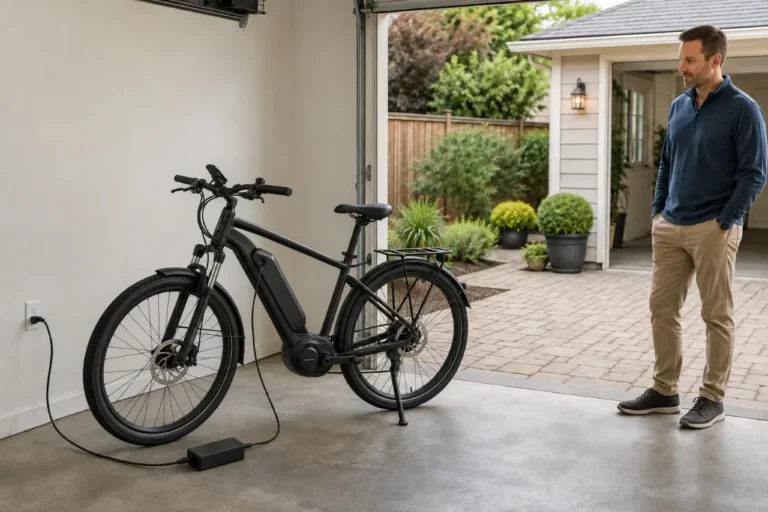
Charge in a dry area on a stable, hard, noncombustible surface, away from exits and combustible clutter. Remain present while charging, unplug the system when charging is complete according to the manufacturer’s instructions, and let a battery that feels hot after a ride return to its permitted charging temperature naturally.
Avoid storing an e-bike battery in direct sun, a hot vehicle, or freezing conditions outside the manufacturer’s limits. Protect it from drops, impacts, pressure washing, flooding, and loose storage where it can fall. Follow the manufacturer’s recommended storage charge and inspection schedule; our guide to storing an e-bike battery safely covers those routine practices in more detail.
If another battery ever develops a new bulge, split seam, unusual heat, odor, leakage, smoke, or abnormal sounds, stop using it at once. A swollen e-bike battery is not a do-it-yourself repair: leave it alone, protect people, and use a manufacturer-directed service and disposal route.