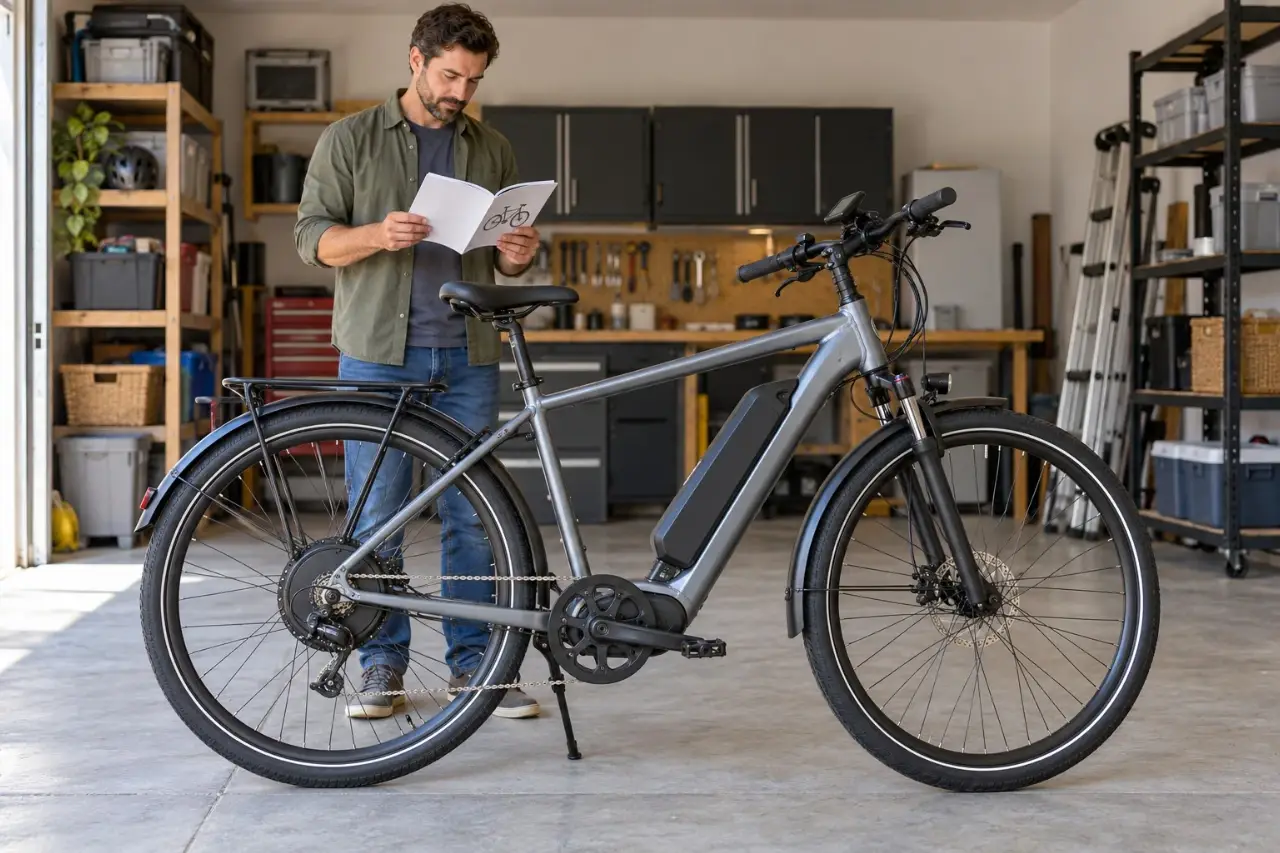
E-bike motor watts describe power: the rate of energy use or mechanical work. To understand a watt rating, first check whether it means electrical input or mechanical output, then whether it is rated, continuous, or peak power.
The number alone cannot predict acceleration, hill climbing, range, or legal classification. Those also depend on the controller, gearing, battery, load, riding conditions, and assistance limits.
A useful specification explains what was measured and under which conditions. Here is how to read the numbers without expecting more from them than they can tell you.
Electrical input and mechanical output are different
Electrical input power is the power supplied to a component or system. Mechanical output power is the useful rotating power the motor delivers. Both use watts, but electrical and mechanical losses mean the output is lower than the input during powered operation.
The measurement point matters. Battery-side input, input at the motor, output at the motor shaft, and power delivered at the tire are not interchangeable figures.
At the battery’s DC output, the basic relationship is:
Electrical power (W) = actual voltage (V) × battery current (A)
For an illustrative calculation, 48 volts multiplied by 15 amps equals 720 watts of electrical input. That does not establish 720 watts of mechanical output. Battery voltage changes with charge level and load; a pack labeled “48V” does not stay at exactly 48 volts.
Use battery current for this calculation, not the motor’s phase current. Grin Technologies’ simulator documentation explains the distinction between battery power, motor current, and mechanical output. You do not need to probe connectors or install a meter to interpret a specification.
Rated, continuous, and peak describe another part of the claim
Input versus output tells you where power is measured. Rated, continuous, and peak tell you how the manufacturer characterizes it.
| Term on the specification | How to interpret it | What to check |
|---|---|---|
| Rated or nominal power | The manufacturer’s declared rating, which may follow a particular test standard | Whether it refers to input or output and how it was established |
| Continuous rated output | Mechanical power specified for sustained operation under defined test conditions | Motor speed, cooling, temperature, and the applicable test method |
| Peak or maximum power | A stated maximum under particular operating conditions | Measurement point, duration, and conditions needed to reach it |
“Nominal” is often used alongside “continuous,” but an unexplained marketing label does not prove a standardized continuous-output test. A peak claim also does not tell you how long that level is available. Grin’s explanation of motor ratings illustrates why watt labels need this context.
For example, an imaginary specification of “500W nominal / 900W peak” leaves questions unanswered. Are both numbers mechanical output? Was one calculated from battery voltage and current? At what motor speed was the maximum reached? The numbers do not answer those questions themselves.
Continuous output is not an all-day guarantee on any hill. A slow, heavily loaded climb can create different operating conditions from the rating test. Follow the bike manufacturer’s operating limits and temperature warnings.
Why equal watt ratings can feel different
Torque and motor speed work together
Torque is twisting force, usually listed in newton-meters (Nm). Mechanical power depends on both torque and rotational speed. A high maximum-torque figure does not mean that torque is available at every speed or assist setting.
Bosch’s explanation of torque describes how torque and cadence interact on its drive systems. For riders, the practical lesson is to consider how assistance is delivered across the ride, not just a maximum number.
Torque figures also need a measurement location. Torque quoted at a mid-drive’s crank output cannot be compared directly with torque quoted at a hub motor’s wheel output without accounting for gearing. Wheel size also affects the pushing force at the ground for a given wheel torque.
Gearing changes how assistance reaches the wheel
A mid-drive sends assistance through the bicycle’s drivetrain. A suitable lower gear can help it operate effectively on a climb. A hub motor turns the wheel independently of the bicycle’s selected gear, even if the motor has its own internal reduction gears.
Shifting down on a hub-motor bike helps your legs contribute; it does not change the hub motor’s gearing. Our guide to hub motors and mid-drive systems explains the ownership differences.
Controller programming and sensor inputs also influence how quickly assistance builds. See how torque and cadence sensors affect pedal assistance. A watt rating does not describe that response.
Load and riding conditions still matter
The same bike can feel capable on level pavement and struggle on a long climb with cargo. Grade, headwinds, tire pressure, surface conditions, and rider effort all affect the work required.
Check weight-limit definitions carefully. Maximum gross vehicle weight includes the bike itself; payload usually describes the people, cargo, and accessories it carries. Manufacturers may define or allocate these limits differently. Tern’s cargo guidance shows why overall, rack, and accessory limits must all be respected. Motor power does not increase those limits.
Watts do not tell you battery capacity or range
Watts measure power. Watt-hours (Wh) measure energy. A motor labeled 500W does not continuously draw exactly 500 watts, and a 500Wh battery does not guarantee an hour of riding with that motor.
Higher average electrical demand uses the available battery energy faster. However, a bike with a larger motor rating does not automatically have shorter range. Riding speed, assist level, pedaling, efficiency, weather, and usable battery capacity all matter.
Battery bars may fall under heavy demand and recover when the load eases because of voltage sag. That recovery does not mean the battery has recharged. Leave a practical charge reserve and investigate repeated shutdowns instead of treating them as ordinary range variation.
Higher voltage alone is not a reason to replace a battery. Use only a battery approved for the complete system and its specified charger. CPSC’s micromobility guidance emphasizes manufacturer-approved batteries and chargers.
A watt rating does not establish speed or legal access
Legal information checked: September 25, 2026.
In the common U.S. three-class framework, Class 1 pedal assistance cuts off at 20 mph (32 km/h); Class 2 allows motor-only propulsion with assistance cutting off at 20 mph; and Class 3 pedal assistance cuts off at 28 mph (45 km/h). These are assistance limits, not a guarantee of reaching that speed uphill or permission to ride that fast everywhere.
State definitions and exceptions vary. For example, California Vehicle Code section 312.5 includes specific class definitions and a limited start-assistance or walk-mode exception.
Separately, 15 U.S.C. § 2085 defines a federal consumer-product category using fully operable pedals, motor power below 750 watts, and motor-only speed below 20 mph under its specified test conditions. It is not a nationwide permission to use every road or trail.
Do not assume a “750W nominal” label makes a higher-peak system lawful everywhere. Check the current definition and requirements in the relevant jurisdiction. Our guide to checking local e-bike rules for your route explains how to identify the responsible authorities.
Read the specification in this order
- Find the exact bike and motor-system documentation. Use the correct model year and market version.
- Identify the measurement. Is the watt figure electrical input or mechanical output? Where was it measured?
- Identify the rating conditions. Look for rated, continuous, or peak wording and any supporting test information.
- Check the surrounding limits. Review torque measurement, motor layout, gearing, approved battery, weight limits, and assist cutoff.
- Ask about missing information. If the manufacturer does not explain a headline number, treat it as incomplete. Do not invent a continuous rating or peak duration.
Keep routine use within the manual’s approved settings. Start with manageable assistance, accelerate smoothly, and select an appropriate gear before a climb. Do not alter controllers, speed limiters, battery voltage, or safety cutoffs to obtain a larger power number.
Stop riding for repeated power loss, unexpected surging, grinding noises, braking or steering problems, or a warning that requires stopping. Record the symptom and follow the model-specific instructions; our e-bike error-code guide explains safe next steps. Do not open the motor, controller, battery, or charger.
Stop using or charging a battery that shows swelling, leakage, unusual heat, or a strong odor, and obtain professional guidance. For smoke, fire, or rapid heating, move yourself and others away and call 911. Do not handle or move the battery; follow emergency responders’ instructions. FDNY’s battery-safety advice explains the warning signs.