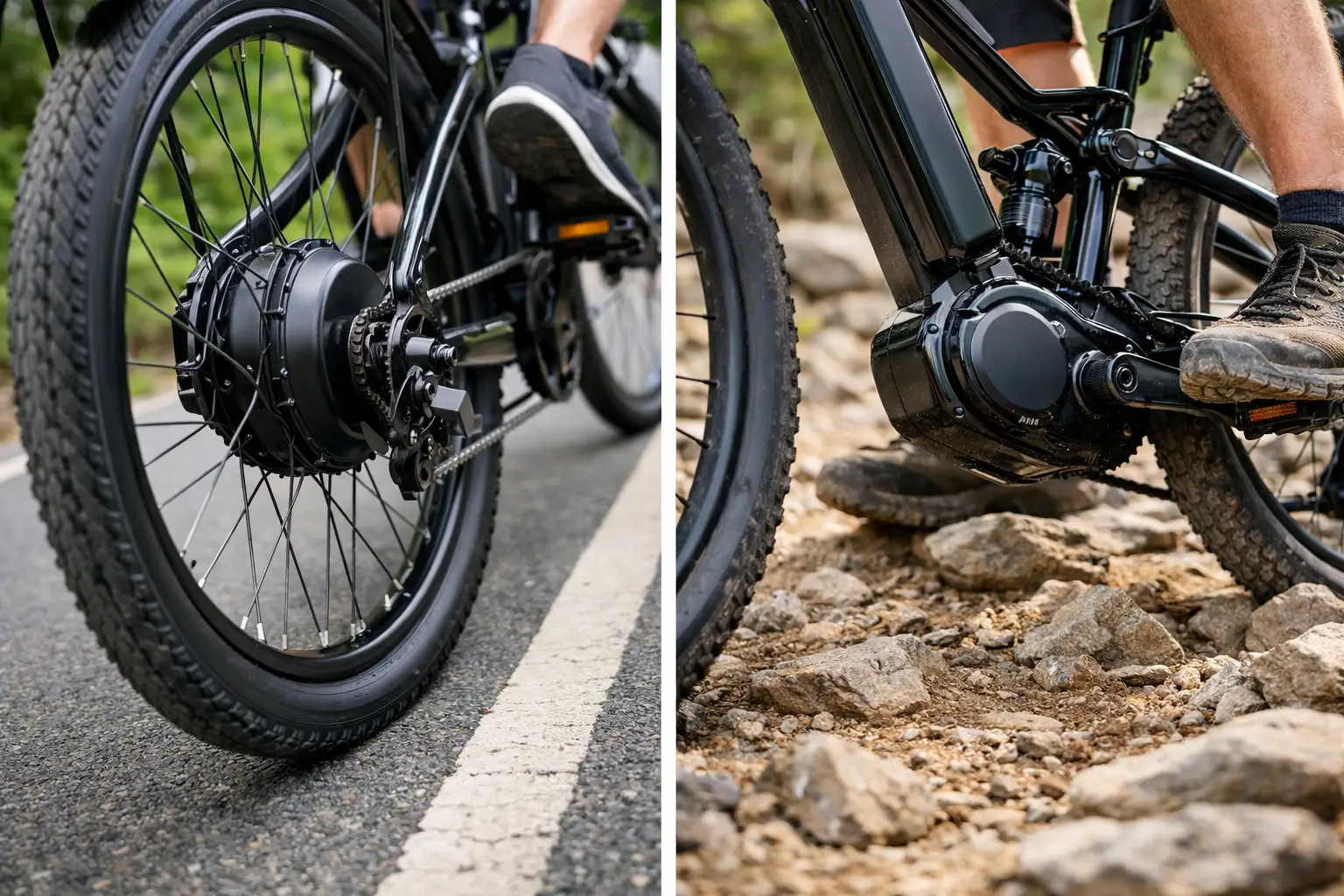
A hub motor vs mid drive ebike comes down to where the motor delivers power. A hub motor turns a wheel directly, while a mid-drive motor adds power through the bike’s chain and gears. Neither layout is automatically safer or better for every rider, but each changes how the bike climbs, handles, wears components, and responds when you pedal.
For everyday ownership, the practical difference is simple: hub motors usually ask less of the drivetrain, while mid-drives make gear choice more important. Knowing which system is on your e-bike helps you ride more smoothly, spot normal wear, and know when a problem needs professional attention.
Hub Motor vs Mid Drive Ebike: How Power Reaches the Wheel
A hub motor sits in the center of either the front or rear wheel. Most are rear hub motors. When the system provides assistance, the motor spins that wheel independently of the chain, pedals, and bicycle gears. You can stop pedaling and, depending on the e-bike’s settings, the motor may still provide assistance.
A mid-drive motor is mounted near the bottom bracket, where the pedal cranks attach to the frame. It applies power to the chainring, chain, cassette or freewheel, and rear wheel. In other words, it uses the same drivetrain that you use when pedaling.
That difference matters most when resistance changes. A mid-drive can take advantage of the bike’s lower gears for climbing and its higher gears for speed on flatter ground. A hub motor generally runs at a speed set by the wheel, regardless of which gear you select.
| What changes | Hub motor | Mid-drive motor |
|---|---|---|
| Power path | Motor turns the wheel directly | Motor drives the chain and rear gears |
| Hill riding | May slow on long, steep climbs | Benefits strongly from lower gears |
| Drivetrain wear | Motor does not add force through the chain | Chain and rear gears carry motor and rider force |
| Weight location | Added weight is in a wheel | Weight is low and near the frame center |
| Riding technique | Gear choice mainly affects your pedaling | Gear choice affects both pedaling and motor load |
What You Will Feel on the Road
On level pavement, either system can provide calm, useful pedal assistance. The differences become clearer on hills, when starting from a stop, and when carrying cargo.
A rear hub motor often feels like a steady push from behind. Because the motor is part of the wheel, it can add noticeable weight to the rear end when lifting or maneuvering the bike. A front hub motor can feel like the front wheel is pulling you forward. On loose gravel, wet leaves, or sharp turns, use gentle power input and avoid sudden acceleration that could reduce front-tire traction.
A mid-drive often feels more connected to your pedal pressure. When you shift to an easier gear before a hill, the motor can spin more efficiently while helping turn the rear wheel. This can make climbing feel controlled and capable, provided you shift and pedal appropriately.
That does not mean a mid-drive eliminates the need for rider effort or good technique. A steep hill still requires traction, balance, and a low enough gear. If you approach the hill in a hard gear and press heavily on the pedals, the drivetrain is under more strain and the shift may be rough.
Gear Habits Matter More With a Mid-Drive
With a hub motor, shifting changes how hard your legs work, but it usually does not change the motor’s mechanical load in the same direct way. You should still shift thoughtfully to keep pedaling comfortable and avoid grinding the chain.
With a mid-drive, proper shifting is part of protecting the motor and drivetrain. Select an easier gear before the hill becomes steep or before you come to a full stop. As you shift, briefly reduce pedal pressure. Some e-bikes have a shift-sensing feature that momentarily reduces motor output, but you should not assume your bike has one.
Avoid forcing a shift while applying maximum pedal and motor power. Repeated hard shifts can wear the chain, chainring, cassette, derailleur, and shifter more quickly. It can also cause a chain skip, a sharp lurch, or a dropped chain.
Use these habits on a mid-drive e-bike:
- Downshift to an easier gear as you slow for a stop, especially before an intersection or steep climb.
- Ease off pedal pressure for a moment when shifting under assistance.
- Start smoothly rather than stomping on the pedals in a high gear.
- On long climbs, choose a low gear and maintain a comfortable pedaling rhythm instead of pushing a large gear slowly.
Your owner’s manual takes priority over general advice. Follow its instructions for shift operation, approved cleaning methods, and any motor-specific warnings.
Maintenance: The Real Trade-Offs
Both motor types need the same basic bicycle care: properly inflated tires, working brakes, secure fasteners, clean lights and reflectors, and a battery charged with the approved charger. The difference is where the added wear tends to appear.
A hub motor does not send its power through the chain and rear gears, so those parts may experience less motor-related wear. However, the motor wheel is heavier than a standard wheel. Spoke tension, rim condition, and tire condition deserve regular attention. If the wheel develops a wobble, broken spoke, rubbing brake rotor, or unusual clicking noise, stop riding if handling or braking is affected and have a qualified bicycle mechanic inspect it.
For a hub motor with a cable exiting the axle, be careful when removing the wheel. The cable and connector can be damaged if pulled, twisted, pinched, or routed incorrectly. Do not force connectors or attempt electrical repairs. A mechanic familiar with e-bikes can handle wheel service safely.
A mid-drive concentrates more wear on the chain, chainring, cassette, and derailleur. Check the chain regularly for dirt, rust, stiffness, and lubrication needs. A dry, dirty chain can shift poorly and accelerate wear. Clean it with a bike-appropriate method, apply the lubricant recommended for your riding conditions, and wipe away excess.
A chain-wear checker is inexpensive and easy for many owners to use, but replacement decisions can be confusing because drivetrain standards vary. If shifting becomes unreliable, the chain skips under load, teeth look sharp or hooked, or the chain measures worn, schedule service. Replacing a worn chain early may help protect the more expensive rear gears.
Handling, Braking, and Transport
Motor location changes weight distribution, but it does not override basic riding fundamentals. Start with a low assist setting until you know how the bike responds. Look ahead, use both brakes smoothly, and leave more stopping distance in rain, loose surfaces, and traffic.
A hub motor adds rotating mass to a wheel. This can make a wheel feel slower to accelerate or stop compared with a non-motorized wheel, especially on heavier e-bikes. A mid-drive keeps motor weight closer to the center of the frame, which many riders notice when moving the bike around at low speed or navigating a tight turn.
Before putting any e-bike on a vehicle rack, check the rack’s per-bike weight rating and the bike manufacturer’s transport guidance. Remove the battery if the instructions permit it and protect exposed battery contacts from moisture and debris. Because motorized wheels are heavy, do not lift an e-bike alone if doing so feels unsafe. Ask for help rather than risking a strain or dropping the bike.
Troubleshooting Without Guesswork
A sudden loss of assistance, grinding noise, or repeated error message is not something to solve by opening the motor or battery. Motor systems contain sealed electrical components, and lithium-ion batteries should never be opened, rebuilt, or repaired by an owner.
You can safely begin with a basic external check. Confirm that the battery is properly seated and charged, the display is on, and no visible cable is loose or damaged. Inspect the chain and rear derailleur on a mid-drive for an obvious derailment. Check that nothing is rubbing the wheel or brake rotor on a hub-motor bike.
Stop using the e-bike and contact the manufacturer or a qualified e-bike mechanic if you notice a damaged cable, burning smell, unusual heat, repeated electrical shutoffs, a swollen battery, or assistance that surges unpredictably. If a battery shows signs of fire, smoke, or rapid heating, move away from it if you can do so safely and call emergency services. Do not attempt to handle a burning or damaged battery.
The useful question is not which motor layout wins. It is how your e-bike’s system changes the habits that keep it reliable. Learn where the motor puts its force, shift early when your bike uses a mid-drive, inspect wheels and cables when it uses a hub motor, and let qualified service handle problems beyond routine bicycle care.