Ebike service intervals should be based on time, mileage, riding conditions, and the bike’s actual condition. There is no universal mileage schedule for every e-bike.
For many everyday riders, a sensible routine is a safety check before each ride, a closer owner inspection about monthly, and a professional review about once a year if the manufacturer does not require earlier service. Daily commuters, cargo riders, and people who ride in rain, salt, dust, or steep terrain should shorten those intervals.
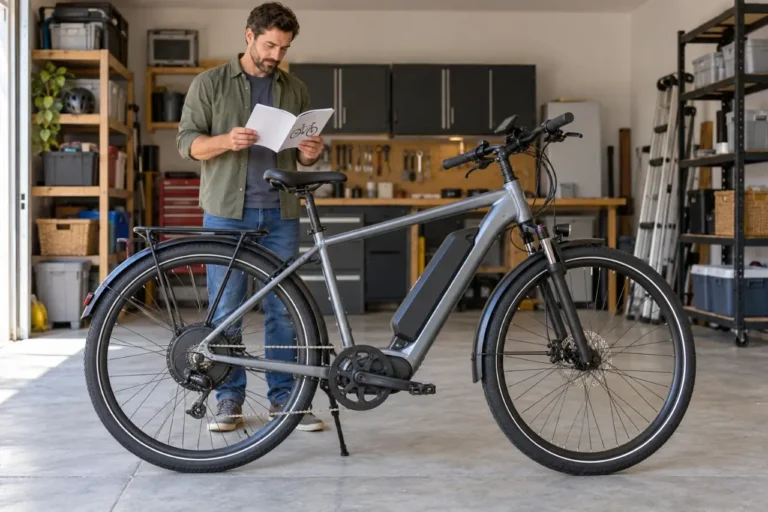
Your e-bike owner’s manual and the instructions for its brakes, drivetrain, suspension, battery, and drive system always take priority over a general schedule.
Quick ebike service interval schedule
Use this as a planning guide, not a replacement for model-specific instructions.
| When | What to check or plan | Usually handled by |
|---|---|---|
| Before every ride | Tires, wheel security, brakes, steering, battery attachment, lights, controls, and obvious damage | Rider |
| Weekly for frequent riders | Tire pressure, brake feel, drivetrain contamination, loose accessories, and visible tire or wheel issues | Rider |
| About monthly | Brake-pad wear, tire condition, chain wear/cleanliness, shifting, wheel condition, fastener movement, battery mount, cables/hoses, and visible wiring | Rider or shop |
| First service / break-in interval | Follow the maker’s specified first inspection for wheels, brakes, shifting, hardware, and system faults | Usually shop |
| About annually for typical use | More complete mechanical and electrical-system inspection, plus any component service already due | Qualified shop |
| Whenever a fault appears | Braking loss, loose steering, wheel problems, structural damage, recurring electrical faults, or battery warning signs | Stop riding; qualified help as appropriate |
For a repeatable departure routine, use our 3-minute e-bike pre-ride safety checklist.
Why mileage alone does not determine service
Mileage is useful for reminders, but it should not be the only trigger. A lightweight e-bike ridden on dry weekend paths does not wear at the same rate as a heavy cargo bike used every day in city traffic.
Brake wear changes with load, speed, terrain, and weather. Chain wear depends on drivetrain design, motor type, shifting habits, contamination, and lubrication. Suspension may have hour-based service requirements rather than mileage limits.
Treat generic mileage figures as planning reminders, not promises that a part will last that long or that the bike is safe until a certain odometer reading.
Plan an early first service if the manufacturer calls for one
New bikes can need an early check after normal break-in because spokes, cables, fasteners, shifting, and brake adjustments may settle during the first weeks of use.
The timing varies. Bosch, for example, says many dealers offer an initial inspection at about four weeks or after roughly 186 miles (300 km). Other manufacturers may specify a different time or mileage, so check your owner’s manual first.
An early inspection can be especially useful for cargo e-bikes, folding bikes, suspension-equipped bikes, and bikes used on rough pavement.
What to inspect before every ride
With the e-bike powered off, look at both tires for obvious low pressure, cuts, bulges, or exposed casing. Confirm that the wheels appear securely installed and that the handlebar and stem do not have unexplained movement. Squeeze each brake lever and make sure each brake can hold its wheel while you stand beside the bike.
Check that the battery is securely latched and that its case is not cracked, swollen, leaking, unusually hot, or producing an abnormal odor. Then power the bike on and confirm that the display, lights, and controls behave normally.
If braking feel changes, use our more detailed guide to inspecting e-bike brakes before a ride.
What to inspect about monthly
For many recreational and moderate-use riders, a monthly inspection is a practical checkpoint. High-mileage riders should use the same checklist more often.
Tires and wheels


Measure tire pressure with a gauge and stay within the limits specified by the tire, rim, and e-bike manufacturer. Inspect the tread and sidewalls for damage and look for recurring pressure loss, broken or clearly loose spokes, rim damage, or noticeable wheel wobble.
Do not use a fixed mileage rule for tire replacement. Tire construction, load, pressure, terrain, braking, weather, and storage all affect wear. Our e-bike tire guide covers pressure, wear, and damage in more detail.
Brakes
Inspect pad wear using the brake manufacturer’s limits rather than one universal thickness number. Check rotors or rim braking surfaces for damage or contamination, and inspect mechanical cables or hydraulic hoses for visible problems.
Do not wait for the next scheduled interval if a lever suddenly pulls close to the grip, braking power drops, you hear metal-on-metal grinding, or hydraulic fluid is visible. Stop riding and have the brake system assessed.
Chain and drivetrain

Clean and lubricate a chain when conditions require it rather than waiting for an arbitrary mileage number. Wet, salty, sandy, or dusty riding can shorten the interval significantly. Measure chain wear with a compatible tool and follow the drivetrain manufacturer’s replacement criteria.
If the chain skips under load, shifting repeatedly misses gears, or the drivetrain develops a new grinding noise, the cause may be wear or misalignment. See our e-bike drivetrain cleaning guide for safe cleaning steps.


Fasteners and attachments
Look for movement or damage at the handlebar, stem, pedals, crank arms, saddle, rack, fenders, kickstand, folding joints, and cargo or child-seat mounts. Do not tighten critical bolts by feel. Use the specified torque and procedure when owner adjustment is permitted, or have a shop handle it.
E-bike-specific checks stay external
Routine electrical maintenance should not involve opening components. Inspect the battery case and mount, charge-port cover, display, charger cable, and visible wiring for damage, crushed cables, loose routing, corrosion, or an insecure battery latch.
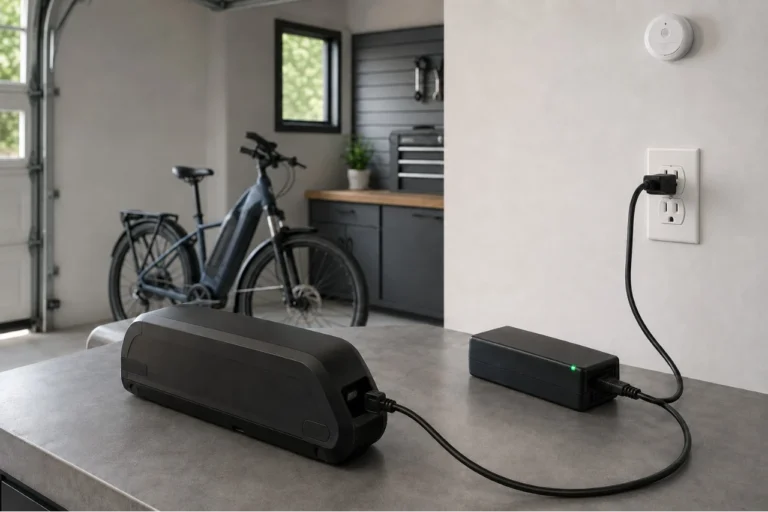
Do not open the battery, motor, controller, display, or charger housing to investigate a problem. Use only the charger supplied with the e-bike or a replacement specifically approved for that battery and system. A matching plug does not establish compatibility.
Persistent error codes, intermittent power, unusual motor noise, a display that cuts out over bumps, or a loose battery mount should be diagnosed by a service provider familiar with the system.
Specialty components have their own intervals
Suspension forks, rear shocks, suspension seatposts, internally geared hubs, belt drives, hydraulic brakes, and tubeless systems may have separate time- or hour-based service schedules.
Do not assume one annual tune-up covers every component at the correct interval. Follow each component maker’s manual. Work that requires opening suspension, hydraulic, motor, controller, or battery components should be left to a qualified technician unless the manufacturer explicitly lists it as an owner procedure.
When to shorten your service schedule
Inspect and service more often if you regularly ride in:
- Rain, mud, snow, or road salt
- Beach air, sand, or fine dust
- Gravel, potholes, or rough trails
- Heavy rider or cargo loads
- Child-seat or trailer use
- Frequent steep climbs or descents
- Stop-and-go delivery or commuting
- High weekly mileage
After wet or salty rides, remove residue using the cleaning method approved for your bike, dry it thoroughly, and service the drivetrain as needed. Avoid pressure washers and high-pressure jets around bearings, battery mounts, displays, motors, and electrical connectors.
Signs your e-bike needs service now
A schedule only applies while the bike is operating normally. Stop riding and arrange service before the next ride if you notice brake failure or major brake fade, loose steering, a cracked frame or fork, an insecure wheel, repeated drivetrain skipping under load, a loose battery mount, or a serious recurring electrical fault.
Stop using and charging a battery that is swollen, leaking, unusually hot, physically damaged, producing a strong or unusual odor, or behaving abnormally. Do not open, repair, or modify it. Contact the manufacturer or a qualified battery/e-bike service provider for a non-emergency damaged battery.
If there is smoke, fire, rapidly increasing heat, or another immediate battery emergency, move away if you can do so safely, keep others clear, and contact emergency services. Do not approach an actively failing battery to unplug, move, or inspect it.
For a full yearly review, use our annual e-bike safety inspection checklist.
Keep a simple service log
A note on your phone is enough. Record the date and mileage, tire and brake work, chain cleaning or replacement, wheel service, specialty-component service, battery or electrical symptoms, shop visits, and the next manufacturer-required service date or mileage.
The most useful ebike service interval is one you can actually follow. Use time and mileage as reminders, inspect safety-critical parts by condition, and shorten the schedule whenever your riding environment or workload is harder on the bike.
Frequently Asked Questions
How often should an e-bike be professionally serviced?
For many everyday riders, an annual professional inspection is a reasonable planning point if the manufacturer does not require earlier service. High-mileage commuters, cargo riders, and bikes used in severe conditions may need shop attention more often.
Is 1,000 miles a universal e-bike service interval?
No. Some riders may reach 1,000 miles before a major shop visit, while others may need service much sooner. Follow the bike and component manufacturers’ intervals and respond immediately to wear, damage, braking changes, or electrical faults.
GoEBikeLife is reader-supported. We test and review e-bikes, create detailed comparisons, and publish practical buying guides for riders. Some links on this page are affiliate links, which means we may earn a commission at no extra cost to you.