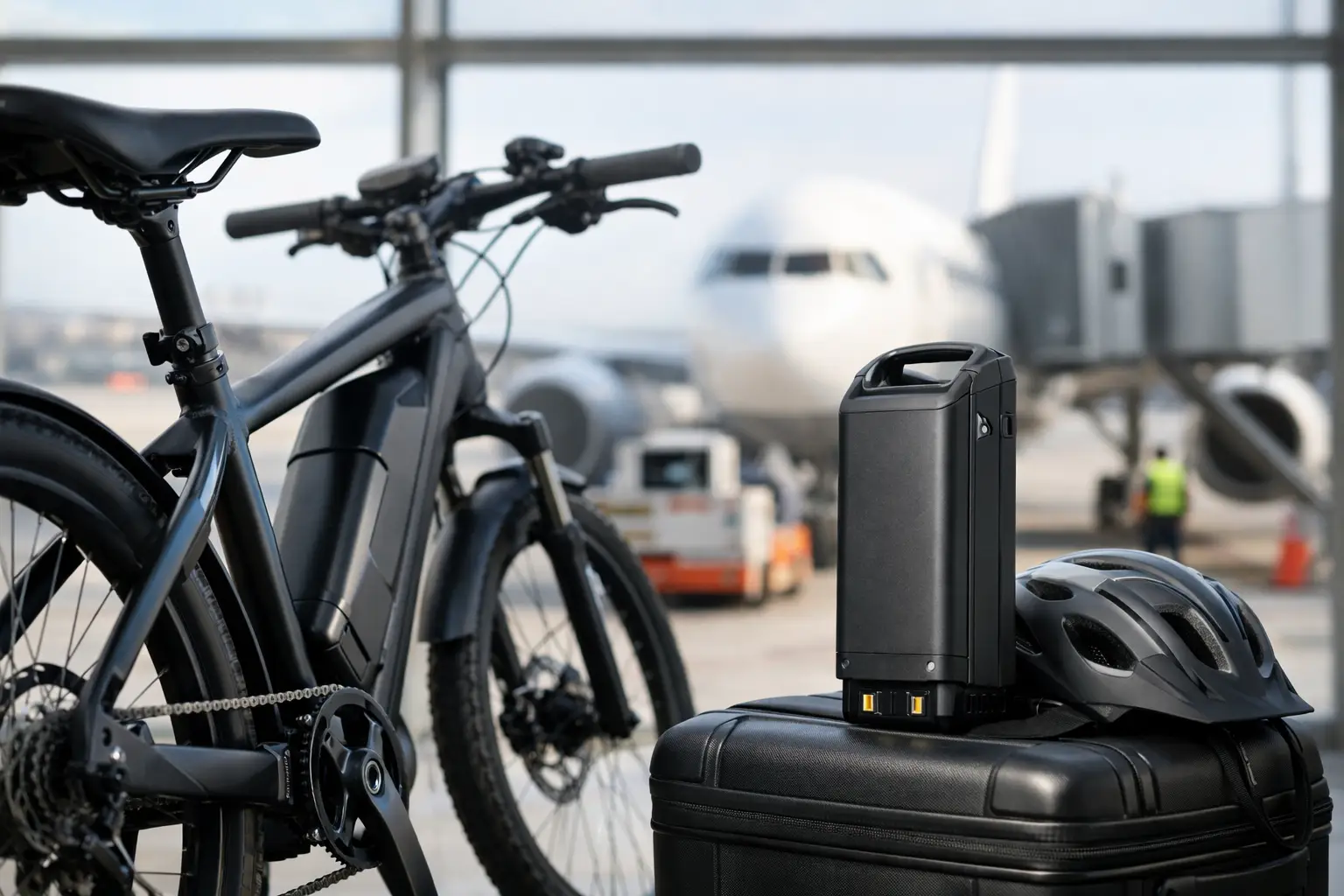
The direct answer to “can you fly with ebike” is usually no – at least not with the battery that powers a typical e-bike. Most removable e-bike batteries exceed the lithium-ion battery limits for passenger aircraft. You may be able to fly with the bicycle itself after removing the battery, but the battery needs its own compliant travel plan.
That distinction matters. A standard e-bike battery can look like ordinary luggage, but airlines and aviation safety rules treat it as a regulated lithium-ion battery. Do not assume that wrapping it well, disconnecting it, or placing it in checked baggage makes it acceptable.
Why e-bike batteries usually cannot fly
Air travel rules use watt-hours (Wh), not just battery voltage or amp-hours, to determine whether a lithium-ion battery may be carried on a passenger aircraft. Watt-hours describe how much energy a battery stores.
For most passenger flights, lithium-ion batteries up to 100 Wh are generally allowed in carry-on baggage, subject to airline rules. Batteries from 101 Wh to 160 Wh may be allowed only with airline approval, and limits on the number of batteries can apply. Batteries above 160 Wh are generally not permitted in passenger baggage or as carry-on batteries.
Most full-size e-bike batteries are well above that 160 Wh threshold. For example, a 36-volt, 14-amp-hour battery stores about 504 Wh:
36 volts × 14 amp-hours = 504 watt-hours
A 48V 15Ah battery is about 720 Wh. Those capacities are common because an e-bike needs enough stored energy to provide useful riding range. They are also far beyond the usual passenger-aircraft allowance.
The watt-hour rating may be printed on the battery label. If it is not, multiply the battery’s nominal voltage by its amp-hour rating. Use the rating on the battery or in the owner’s manual, not an estimate based on range claims.
Can you fly with an ebike if you remove the battery?
Often, yes. An e-bike without its battery may be accepted as a bicycle or oversized sporting item, provided it meets the carrier’s packing, size, weight, and fee requirements. But acceptance is not automatic. Each airline sets its own rules for bicycles, e-bikes, and equipment with removed batteries.
Before booking or packing, contact the airline and describe what you are bringing plainly: an electric bicycle with the lithium-ion battery completely removed. Ask whether the airline accepts e-bikes with no battery installed and how it wants the bike packed.
Some carriers may accept a boxed bike, bike case, or properly prepared bicycle as checked baggage or cargo. Others may have more restrictive policies for electric bicycles regardless of whether the battery is present. Connecting flights can complicate the answer, because every airline on the itinerary may have different conditions.
Do not leave the battery mounted on the frame and hope it will be overlooked. Do not place it in a checked suitcase, bicycle box, or carry-on bag if it exceeds the airline’s limit. A removed battery is still a battery subject to the same rules.
Check the battery before you make travel plans
Use this short process before you commit to bringing your e-bike.
- Find the watt-hour rating. Read the label on the actual battery. If the label lists volts and amp-hours only, calculate the watt-hours. Photograph the label for your records.
- Read the airline’s current battery and bicycle policies. Check the carrier operating each flight, not only the airline that sold the ticket. Policies can change, and airline approval for batteries in the 101-160 Wh range should be obtained before travel.
- Confirm the travel direction. Rules can differ for a return flight, an international partner airline, or a regional carrier. A plan that works on the outbound flight may fail on the way home.
- Ask about the battery-free bicycle. Confirm packing requirements, checked-baggage fees, weight limits, tire deflation instructions if any, and whether pedals, handlebars, and accessories must be secured or removed.
- Build a battery plan separately. If your battery is over 160 Wh, plan to leave it at home, arrange compliant ground transportation through an appropriate provider, or use another e-bike at your destination.
Keep the battery out of your packing plan until the airline has confirmed that it is allowed. Airport staff make the final decision at check-in and security, even when a policy appears to allow an item.
If your battery is 160 Wh or less
A battery at or below 160 Wh is not automatically approved for flying. Airline policy still controls, and some airlines may impose tighter restrictions than general aviation guidance.
If the airline confirms that the battery is permitted, follow its instructions exactly. Lithium-ion spare batteries are generally carried in the cabin, not checked baggage, because cabin crews can respond more quickly if a battery overheats or is damaged. Protect exposed terminals from short circuits, such as by using the original terminal cover or a manufacturer-approved protective method. Keep the battery in a way that prevents crushing, punctures, and contact with metal objects such as keys or tools.
Only bring a battery that is in normal condition. Do not fly with a battery that is swollen, cracked, leaking, unusually hot, water-damaged, involved in a crash, or giving repeated error messages. Stop using a damaged battery and contact the e-bike manufacturer or a qualified battery service provider for next steps.
A very small battery may meet the watt-hour limit, but it may not be practical for your e-bike. It also must be compatible with your bike and approved by its manufacturer. Never modify battery wiring, combine packs, bypass a battery management system, or use improvised adapters to create a travel-sized setup.
Prepare the battery-free e-bike for the flight
Once the battery is removed, treat the e-bike as a bicycle with extra attention to its electronics and weight. Follow the airline’s bike-packing instructions first, then your owner’s manual.
Turn the e-bike fully off. Remove the key if your model has one, and take off the battery according to the manufacturer’s instructions. Secure loose cables, protect the display and controls from impact, and prevent the pedals or handlebars from shifting during transit. If the manual allows it, remove accessories such as lights, mirrors, baskets, bags, and phone mounts so they are less likely to break.
The motor, controller, and frame do not normally create the same air-travel restriction as the battery. Still, a heavy hub motor, fat tires, racks, and suspension can push an e-bike beyond a carrier’s bicycle weight limit. Weigh the packed bike before leaving for the airport. A regular bike box may not be strong enough for a heavier e-bike, particularly if the bike has a rear hub motor or cargo rack.
Keep a copy of the airline’s written confirmation with your travel documents if you received one. It can help explain that the bike is traveling without its battery, though it does not override an airport employee’s safety decision.
Better options for traveling with e-bike power
For many riders, flying with the bicycle but not the battery is more trouble than it is worth. The practical option may be to rent an e-bike at the destination, use a conventional bicycle for that trip, or select transportation that allows you to carry the complete e-bike legally and safely.
If you need your own battery at the destination, do not mail or ship it casually. Large lithium-ion batteries are regulated as hazardous materials. Shipping requirements can involve approved packaging, labels, carrier acceptance rules, documentation, and restrictions based on battery condition and destination. The manufacturer, a qualified hazardous-materials shipping provider, or a carrier that specifically accepts these shipments can explain the available options.
Ground travel can be simpler, but battery safety still applies. Transport the battery out of direct sun and away from loose metal items. Secure the bike so it cannot tip or slide, and never leave the battery in a hot vehicle for long periods. Follow local and property-specific rules when using trains, ferries, buses, or other public transportation, since these operators may restrict e-bikes or large batteries.
A realistic way to plan the trip
Think of the e-bike and its battery as two separate travel items. The bicycle may be accepted as checked equipment after proper packing. The battery may not be accepted at all if it exceeds 160 Wh, which most e-bike batteries do.
Confirm the rules before you buy a ticket, not while standing at the baggage counter. A battery-free bike, a destination rental, or a different way to travel can save a stressful airport surprise and help protect the battery you rely on every day.
Frequently Asked Questions
Can you take an e-bike on a plane?
You may be able to check an e-bike after removing its battery. However, acceptance depends on the airline’s rules for electric bicycles, oversized baggage, weight, and packing.
Confirm the policy with every airline operating your itinerary before traveling.
What size e-bike battery is allowed on a plane?
Lithium-ion batteries up to 100 Wh are generally allowed in carry-on baggage.
Batteries between 101 Wh and 160 Wh require airline approval, while batteries over 160 Wh are generally prohibited in passenger baggage.
Most full-size e-bike batteries exceed 160 Wh.
Can you put an e-bike battery in checked baggage?
No. A removable e-bike battery is treated as a spare lithium-ion battery and cannot be placed in checked baggage.
Even in carry-on baggage, it must meet the applicable watt-hour limit and the airline’s requirements.
Can you check an e-bike after removing the battery?
Some airlines accept a battery-free e-bike as checked sporting equipment or oversized baggage.
The bicycle must still meet the airline’s size, weight, fee, and packing requirements.
Some carriers may refuse electric bicycles even when the battery has been removed.
How do you calculate the watt-hours of an e-bike battery?
Multiply the battery’s nominal voltage by its amp-hour rating:
Volts × amp-hours = watt-hours
For example, a 36V 14Ah battery has a capacity of 504 Wh. Use the ratings printed on the battery or listed in the owner’s manual.
Can you bring a spare e-bike battery on a plane?
A spare battery up to 100 Wh is generally permitted in carry-on baggage, subject to airline rules.
Batteries from 101 Wh to 160 Wh require airline approval and are usually limited to two per passenger.
Spare batteries over 160 Wh are not permitted in passenger baggage.
Can you fly with a damaged e-bike battery?
No. Do not fly with a battery that is swollen, cracked, leaking, recalled, unusually hot, water-damaged, or involved in a crash.
Contact the manufacturer or a qualified battery service provider for safe handling instructions.
What should you do if your e-bike battery exceeds 160 Wh?
Leave the battery at home and ask whether the airline will accept the battery-free bicycle.
Other options include renting an e-bike at your destination or arranging regulated hazardous-material transportation through a qualified provider.
Do not place the battery in ordinary mail or luggage.