A little joy belongs in every day.

U.S. e-bike rules depend on federal product law, state vehicle law, local ordinances, and the agency managing each road, path, or trail before every ride.
Legal information checked: August 26, 2026.
There is no single U.S. rule that tells you where every e-bike may be ridden. Federal law sets a consumer-product definition for certain low-speed electric bicycles, while states regulate vehicle classification and operation. Cities, counties, park agencies, and land managers can then control access to particular roads, sidewalks, paths, and trails. Before riding somewhere new, identify your bike’s legal category and check the current rule for that exact location.
This guide provides general information, not legal advice. Laws and access policies change, so verify the official rule close to your ride date.
Think of e-bike regulation as four separate layers:
| Layer | What it usually covers | Where to verify it |
|---|---|---|
| Federal product law | The consumer-product definition and bicycle safety requirements | U.S. Code, CPSC, and eCFR |
| State law | E-bike definitions, operating rules, licensing, registration, helmets, and age limits | State legislature, DMV, or transportation agency |
| Local law | Streets, bike lanes, sidewalks, speed limits, and local paths | City or county code and transportation department |
| Land-manager policy | Access to a particular park, trail, forest, or public property | The agency that manages the site |
A legal e-bike on a neighborhood street may still be prohibited on a nearby sidewalk or natural-surface trail. Likewise, a state law that treats an e-bike like a bicycle does not automatically open every trail in that state.
Under 15 U.S.C. § 2085, a “low-speed electric bicycle” is a two- or three-wheeled vehicle with fully operable pedals, an electric motor of less than 750 watts (1 horsepower), and a maximum motor-only speed of less than 20 mph on a paved, level surface when ridden by a 170-pound operator.
That definition places a qualifying low-speed e-bike within the federal consumer-product framework. The CPSC’s bicycle requirements appear in 16 CFR Part 1512.
The federal definition is not a nationwide road or trail access law. It does not tell a city whether e-bikes may use sidewalks, require a state to adopt the three-class system, or force a park to open a trail. State vehicle laws and location-specific rules still control operation and access.
The federal test also should not be simplified into “all legal e-bikes are limited to 20 mph.” Its wording concerns motor-only speed under specified conditions. Many state laws separately recognize pedal-assist e-bikes that provide assistance up to 28 mph.
Many states and federal land agencies use some version of the following framework, but exact definitions and restrictions can differ:
| Class | Typical motor operation | Typical assistance limit |
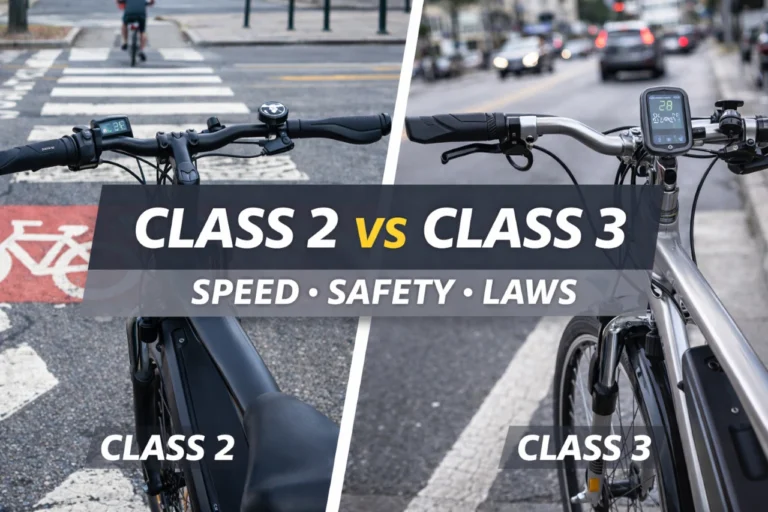
| Class 1 | Pedal assist only | Motor assistance ends at 20 mph (32 km/h) |
| Class 2 | May use a throttle without pedaling | Motor assistance ends at 20 mph (32 km/h) |
| Class 3 | Pedal assist only | Motor assistance ends at 28 mph (45 km/h) |
Class 1 and Class 2 are therefore not interchangeable. A trail manager may permit pedal-assist bikes but exclude throttle-capable bikes. See our detailed comparison of Class 1 and Class 2 e-bikes for the practical differences.
Do not treat this table as the law in every state. A state may use different categories, impose a different motor-power limit, require a speedometer or label, set a minimum rider age, or regulate a throttle-equipped bicycle differently. New Jersey illustrates how quickly the landscape can change: its 2026 rules require e-bike licensing and registration, and the New Jersey Motor Vehicle Commission distinguishes low-speed electric bicycles from motorized bicycles for insurance purposes.
For a current state-by-state starting point, use the PeopleForBikes state law directory, then confirm important details through the state legislature, DMV, or transportation agency. An advocacy summary is useful for finding the rule, but the official state source should control your decision.
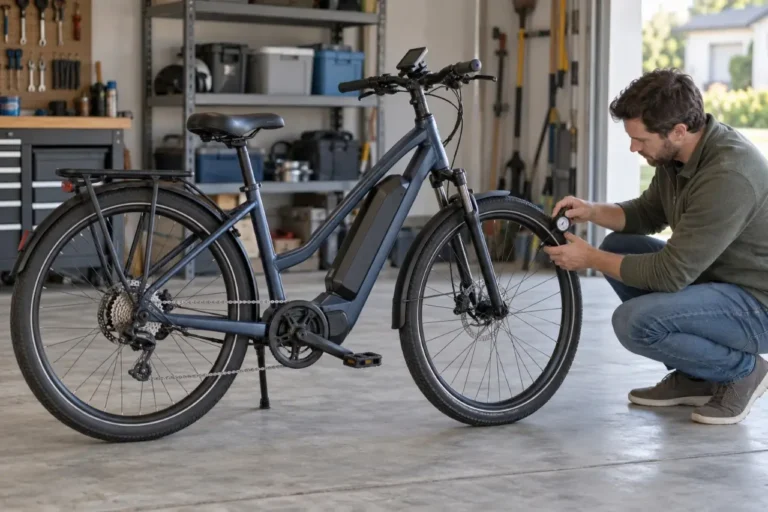
Check the frame label, owner’s manual, and manufacturer specifications. Record:
An advertised peak wattage figure does not by itself establish legal status. Laws may refer to motor power, assisted speed, throttle behavior, pedals, or a required class label. Do not assume that selecting a lower display setting turns a higher-speed or out-of-class vehicle into a legally classified e-bike.
If a bike exceeds the applicable e-bike definition, it may fall into a moped, motorized-bicycle, motorcycle, or off-highway-vehicle category. Licensing, registration, insurance, equipment, and access requirements may then apply. Our guide to e-bike license requirements explains why the answer depends on both the bike and the state.
State law often gives a qualifying e-bike many of the same rights and duties as a conventional bicycle, but do not assume that rule has no exceptions. Controlled-access highways, bridges, tunnels, business districts, and other designated locations may have special restrictions. A local authority may also regulate particular classes or devices.
Bike lanes are part of the roadway, while a separated shared-use path may operate under different rules. Check each part of a route rather than assuming one permission covers the entire trip.
Sidewalk rules are frequently local. A state may permit bicycle operation generally while a city prohibits riding on sidewalks, limits it in a business district, or treats throttle-equipped devices differently. Read our guide to e-bikes on sidewalks before relying on a statewide summary.
Shared-use paths can also have class restrictions, posted speed limits, or rules that require riders to yield to pedestrians. Our separate guide explains how to check whether electric bikes are legal on a bike path.
The agency managing a trail matters as much as the state where the trail is located.
For a broader planning process, use our e-bike trail access guide, then confirm the specific route with its manager.
Helmet and minimum-age requirements vary by state, class, and location. Some laws focus on minors; others add requirements for faster categories. A properly fitted bicycle helmet is a sensible safety measure even where it is not legally required.
Lighting, reflectors, bells or other audible devices, passenger equipment, and nighttime operation may also be regulated. Check the state vehicle code and any local ordinance. Federal bicycle product requirements are not a substitute for the operating-equipment rules that apply where you ride.
Only carry a passenger if the bicycle and the installed seat or child-carrying system are designed and rated for that use. Follow the manufacturer’s load, fit, and installation limits even if local law permits passengers.
If the official wording is unclear, contact the responsible agency before riding. Do not rely solely on a retailer description, an old blog post, a map comment, or the absence of a “no e-bikes” sign.
Your e-bike’s class is only the beginning. Legal operation depends on the bike’s actual configuration, current state law, local traffic rules, and the policy of the agency managing the route. Verify all four layers before an unfamiliar ride, and recheck them after moving, modifying the bike, or returning to a trail after a long gap.