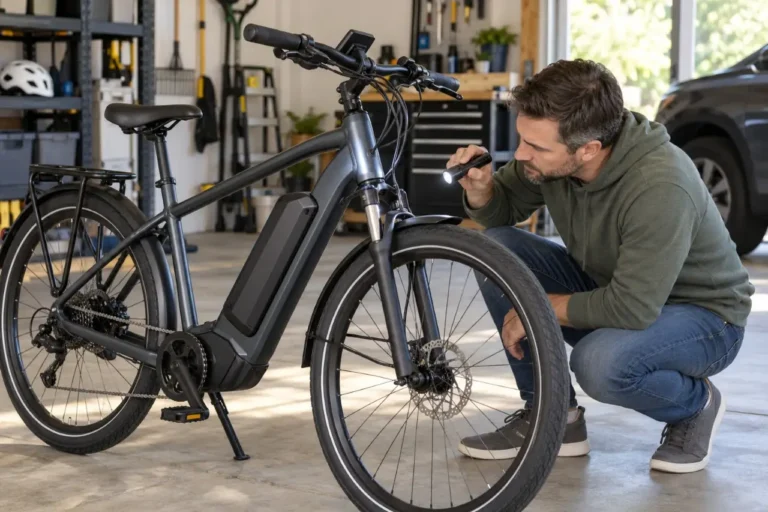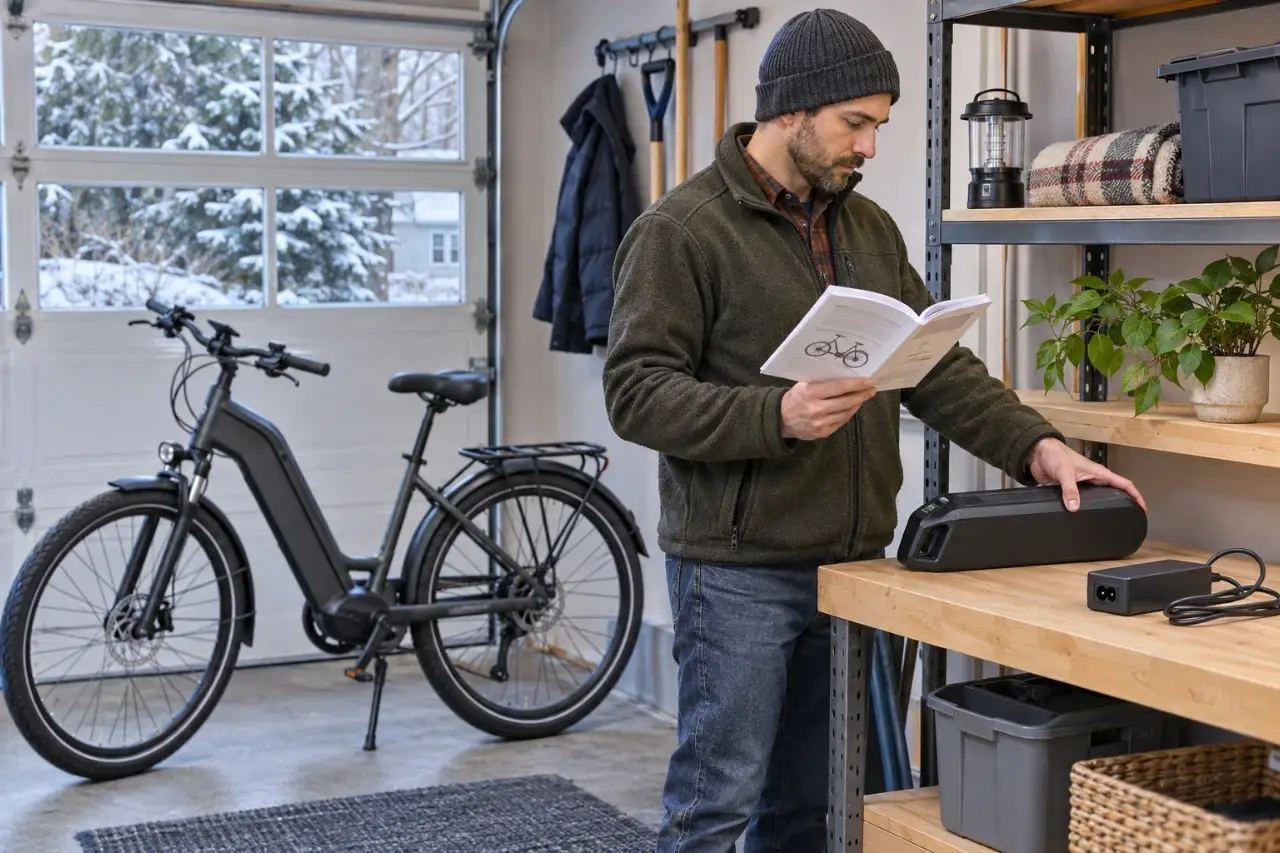
To store an e-bike battery for winter, set it to the storage charge specified in its manual, turn it off, disconnect the charger, and keep it in a dry place within the manufacturer’s storage-temperature limits. Remove it only if the battery is designed for owner removal. Check its condition and charge during the break as directed by the manufacturer, and let a cold battery reach an approved charging temperature before plugging it in.
The exact routine matters because e-bike batteries do not all use the same storage settings. Here is a practical way to prepare your battery for several weeks or months off the road without relying on one-size-fits-all percentages or charging schedules.
Winter E-Bike Battery Storage Checklist
Before putting your bike away:
- Identify the battery. Match its model number to the correct owner’s manual, check for applicable recalls, and locate its storage and charging instructions.
- Inspect it. Do not charge or store a visibly damaged, swollen, leaking, or unusually hot battery as though it were in normal condition.
- Set the specified storage charge. Use the manufacturer’s percentage, indicator-light guidance, or built-in storage mode.
- Power down and unplug. Switch off the bike and disconnect the charger once the required charge is reached.
- Choose a suitable location. Keep the battery dry, stable, protected from impact, and away from heat sources, combustibles, and exit routes.
- Set a reminder. Record the storage date and state of charge, then follow the specified inspection and recharge schedule.
If the battery is built into the frame and not intended for owner removal, store the entire e-bike in conditions approved for that battery. Do not dismantle an integrated battery compartment to make removal possible.
What Charge Level Is Best for Winter Storage?
For many lithium-ion e-bike batteries, partial charge is preferable to leaving the pack completely empty or fully charged for months. But the correct storage level depends on the battery system.
| Battery system | Manufacturer’s long-term storage guidance |
|---|---|
| Bosch eBike batteries | Bosch recommends approximately 30%–60% charge. |
| Shimano STEPS batteries covered by its published guidance | Shimano recommends approximately 70% charge. |
| Other systems, including batteries with different cell chemistries | Follow the specific battery manual or the manufacturer’s written instructions. |
These are manufacturer examples, not interchangeable settings. Consult Bosch’s battery care guidance and Shimano’s battery FAQ for the instructions applicable to their systems.
Why not store it empty or full?
A nearly empty battery can continue losing charge during storage. If it becomes excessively discharged, the battery management system (BMS)—the electronics that monitor and protect the pack—may prevent normal operation, and the cells may be damaged.
Spending a long time at a very high charge, particularly in warm conditions, can also accelerate lithium-ion battery aging. Neither problem is solved by routinely charging the pack to 100% or deliberately running it down to zero.
If you cannot find a storage target, contact the bike or battery manufacturer. Avoid leaving a nearly empty battery unattended while you seek the correct instructions. A display showing only bars provides an approximate reading, so do not treat each bar as an exact percentage unless the manual explains it.
Where Should You Store an E-Bike Battery in Winter?

Choose a dry, well-ventilated, temperature-stable location that meets the battery’s instructions. A garage or basement may be suitable, but only if its actual temperature and moisture conditions stay within the approved range.
For example, Bosch describes storage conditions that depend partly on moisture, while Shimano’s published guidance for certain systems recommends approximately 50°F–68°F (10°C–20°C). Neither figure should replace the limits for another brand or model.
A practical storage area should have:
- A stable surface where the battery cannot fall, be crushed, or be struck by stored objects.
- Separation from paper, clothing, fuels, heaters, and other combustible materials.
- A working smoke alarm nearby and no blocked doors, stairs, or other escape routes.
- Protection from leaks, flooding, condensation, direct sunlight, and unnecessary handling.
- A way to keep exposed terminals from contacting keys, tools, or other metal objects; use the manufacturer’s terminal cover where supplied.
For apartment or shared-space considerations, see our guide to safe indoor e-bike storage. Also follow applicable building rules and your manufacturer’s requirements.
Can you leave the battery in an unheated garage or shed?

Only when the measured conditions remain inside the battery’s approved storage limits and the area stays dry. A garage can become much colder overnight than it feels during the day. If temperatures fall outside those limits, move an owner-removable battery to an approved location. If it cannot be removed, the whole bike needs a suitable storage environment.
Do not rely on a blanket or insulated bike cover to maintain a safe battery temperature throughout a prolonged cold spell.
Do you need a fireproof battery bag or box?
No accessory should be treated as a guarantee against a lithium-ion battery fire. A bag advertised as fireproof may not contain the heat, flames, smoke, or gases produced by a failing e-bike battery. Do not use an improvised airtight container or assume a storage box makes unsafe indoor charging acceptable.
If considering a purpose-designed accessory, verify what was actually tested, its limitations, its ventilation requirements, and whether the battery manufacturer permits its use. The priority remains a sound battery, a suitable location, and correct charging and storage practices.
How to Prepare the Battery and Bike for Winter
1. Check for damage before doing anything else
With the bike powered off, visually inspect the battery case, visible connectors, and charging port. Stop if you notice swelling, cracks, deformation, leaking fluid, melting, or signs of a significant impact or water intrusion. Do not test a suspicious battery by attempting to charge it.
For more detail, review the warning signs of a damaged e-bike battery.
2. Clean and dry the exterior
Use the cleaning method specified by the manufacturer, usually a soft cloth for the case. Keep water jets, metal tools, and unapproved cleaning sprays away from contacts and the charging port. Do not scrape corroded terminals or open the case.
If moisture or corrosion is visible at an electrical connection, leave the equipment disconnected and ask the manufacturer or a qualified technician what to do next.
3. Adjust the charge using approved equipment
Use the battery’s own charger or one specifically approved by its manufacturer. A matching connector alone does not establish compatibility. Battery chemistry, nominal battery voltage, charger output voltage, charging current, connector, polarity, and manufacturer approval all matter.
Follow the manual’s storage mode or indicated charge target. Never attach improvised electrical loads or jumper wires to drain the battery. If the pack is cold, wait until it has reached the approved charging temperature before attempting to adjust the charge.
4. Switch off, disconnect, and remove only if permitted
Unplug the charger using the manufacturer’s connection and disconnection sequence. Power off the e-bike. If the battery is designed for owner removal, release it according to the manual and support its weight as you lift it out.
Keep the charger dry and unplugged during storage unless the specific manufacturer expressly instructs otherwise. Protect the cord from sharp bends, pinching, and damage.
5. Put the battery in its prepared location
Place it on a stable surface where it will not be knocked over. Do not put other items on top of the pack. Keep its terminals protected and do not leave the battery where it blocks an exit.
For nonremovable packs, park the complete bike in suitable conditions. Secure it against falling and keep the charging port closed as directed.
6. Give the parked bike a basic maintenance check
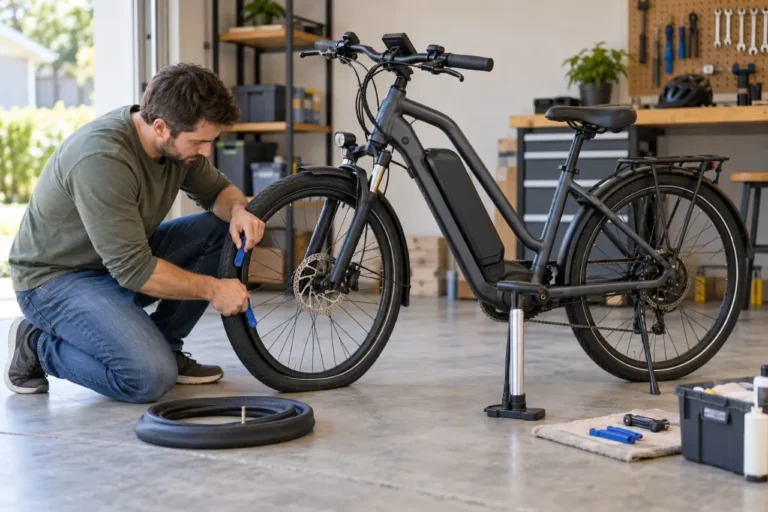
Clean and dry the chain, lubricate it with an appropriate bicycle lubricant, and keep oil off brake rotors and pads. Check tire pressure periodically rather than leaving tires visibly underinflated for months. Make sure the bike is stable and that no rack, cover, or stored item presses on its controls or cables.
These tasks protect the bike, but they do not replace the battery’s separate storage instructions.
How Often Should You Check or Recharge the Battery?
Use the inspection interval and recharge threshold specified for your battery. There is no universal requirement to recharge every month.
For example, Shimano’s published guidance for certain batteries calls for checking and recharging at approximately six-month intervals; some Bosch manuals also describe a six-month state-of-charge check. Those schedules are not permission to ignore different instructions for your own model.
At each scheduled check:
- Look for case damage, moisture, corrosion, unusual odor, or other changes without opening the battery.
- Read the battery indicator or app as the manufacturer directs. Note that temperature can affect the displayed reading.
- Recharge only if required, using the approved charger and charging conditions, then return to the prescribed storage level.
- Record the date, reading, and any unusual behavior.
A sudden unexplained charge drop, repeated charging failures, or new error messages should prompt a manufacturer or qualified-service inquiry. Do not repeatedly try different chargers or attempt to override the BMS.
For year-round practices beyond winter, see how to store an e-bike battery safely for weeks or months.
When Is a Cold E-Bike Battery Safe to Charge?
A battery that has been stored in cold conditions should not be charged until the pack has reached its manufacturer’s approved charging-temperature range and any condensation has dried. Storage, riding, and charging temperature limits are different; permission to store or ride in the cold does not automatically mean charging is safe there.
Move an undamaged, owner-removable battery into a suitable dry indoor environment if the manufacturer permits. Let it warm gradually, without connecting the charger. Its exterior may feel warm while internal cells are still cold, so follow any waiting or temperature-indicator instructions rather than assuming a fixed number of hours works for every pack.
Do not use a radiator, heating pad, hair dryer, or improvised heater to speed the process. Charging lithium-ion cells below their approved temperature range can cause lithium plating—an unwanted buildup of metallic lithium inside the cells that can damage the battery and contribute to safety problems.
When charging, follow the safe e-bike battery charging procedure: use an approved charger, stay home and awake, keep the equipment uncovered and away from combustibles, and disconnect it when charging is complete. The U.S. Consumer Product Safety Commission (CPSC) specifically advises against charging while asleep or away from home.
Battery Warning Signs: When to Stop and Get Help
Do not ride, charge, or continue ordinary storage with a battery that is swollen, cracked, leaking, unusually hot, or showing signs of a serious impact or water exposure. Contact the manufacturer or a qualified battery service provider for safe next steps. Do not open the case or attempt to repair the BMS or internal wiring.
If you notice smoke, flames, hissing, rapid swelling, strong chemical odors, or rapidly increasing heat, leave the area, keep others away, and call 911 from a safe location in the United States. Do not touch, carry, or try to relocate a battery showing signs of active failure.
For a damaged battery without active emergency signs, obtain instructions before transporting or disposing of it. Confirm that the receiving service or hazardous-waste facility accepts damaged lithium-ion e-bike batteries; never place one in household trash or ordinary recycling.
How to Bring Your E-Bike Back Into Use in Spring
- Inspect first. Check the battery case, charging port, visible contacts, and charger cable for damage or moisture before connecting power.
- Acclimate and charge correctly. Let the battery reach approved charging conditions, then charge as directed for your planned ride. Do not force a full charge solely to “balance” the cells unless your manufacturer instructs you to do so.
- Secure the battery. Reinstall owner-removable packs using the correct latch and lock. Confirm the pack is firmly seated and any charging-port cover is closed.
- Check the bike. Inspect tires, wheels, steering, and brakes before riding. If a safety-critical component is damaged, loose, or unreliable, do not ride until it has been corrected.
- Start with a short local ride. Watch for unusual error messages, power cutouts, abnormal charge drops, or braking problems. Stop riding if any appear.
Our e-bike pre-ride safety checklist covers the mechanical checks in more detail. Cold spring weather can temporarily reduce range, but persistent problems after the battery returns to normal operating conditions deserve professional evaluation.
Quick Answers to Common Winter Storage Questions
Does freezing weather automatically ruin an e-bike battery?
Not necessarily. A period of cold exposure does not by itself prove permanent damage. Check the manufacturer’s storage limits, let an undamaged battery acclimate while disconnected, and seek guidance if the limits were exceeded or the battery behaves abnormally. Do not charge it while it is outside its approved charging-temperature range.
Should you leave an e-bike battery plugged in all winter?
Generally, no. Disconnect it after reaching its specified storage charge, unless the exact manufacturer instructions say otherwise. Check and recharge according to the schedule for that pack, rather than leaving an ordinary charger attached continuously.
What if the battery will not turn on after winter?
Check the manual for approved wake-up or power-on instructions and verify that the battery is dry, undamaged, and within its operating conditions. If it remains unresponsive, contact the manufacturer. Never jump-start the pack, open it, bypass protection electronics, or use an unapproved charger.
Manufacturer and Safety References
- Bosch eBike Systems: Battery care and storage guidance
- Shimano: E-bike system battery FAQ
- U.S. Consumer Product Safety Commission: Micromobility battery and charging safety
The battery label, model-specific manual, and current manufacturer instructions take priority over general guidance in this article.
GoEBikeLife publishes independent e-bike reviews, comparisons, and practical buying guides. Some links on this page are affiliate links. If you make a purchase through an eligible link, we may earn a commission at no additional cost to you.