The right e-bike size should let you stand, start, stop, pedal, and steer without feeling stretched out or cramped. If you are asking, “what size electric bike do I need,” start with your inseam and the specific manufacturer’s size chart, then confirm that the bike’s standover height, reach, and riding position work for your body and intended use.
A frame labeled small, medium, or large is only a starting point. Electric bikes vary widely in frame geometry, tire size, seat-tube design, and handlebar position. Two bikes marked medium can fit very differently. A proper fit matters because an e-bike is heavier and can accelerate faster than a conventional bicycle, so you need confident control when getting on, braking, and putting a foot down.
What Size Electric Bike Do I Need for My Height?
Height is useful for narrowing the range, but it is not enough to choose a frame by itself. People of the same height can have different leg, torso, and arm lengths. A rider who is 5 feet 8 inches (173 cm) with longer legs may need a different setup than another rider of the same height with a longer torso.
Use the size range published for the exact e-bike model, not a generic online chart. Manufacturers measure frames differently and may design a bike around an upright comfort position, a forward commuting position, or a compact utility layout. If the owner’s manual, product specifications, or manufacturer sizing guidance conflicts with general sizing advice, follow the manufacturer’s instructions.
For many adult e-bikes, height charts provide an overlap range. That overlap is normal. When you fall between sizes, your riding position and body proportions usually matter more than the label on the frame.
A smaller frame often gives a shorter reach and can be easier to manage at stops. A larger frame may offer more room between the saddle and handlebars, which can suit riders with longer torsos or arms. Neither choice is automatically better. The goal is stable, relaxed control, not the largest frame you can straddle.
Measure Your Inseam Before Checking Frame Size
Your inseam is the distance from the floor to your crotch while standing in the shoes you normally ride in. It helps you assess both frame clearance and saddle height.
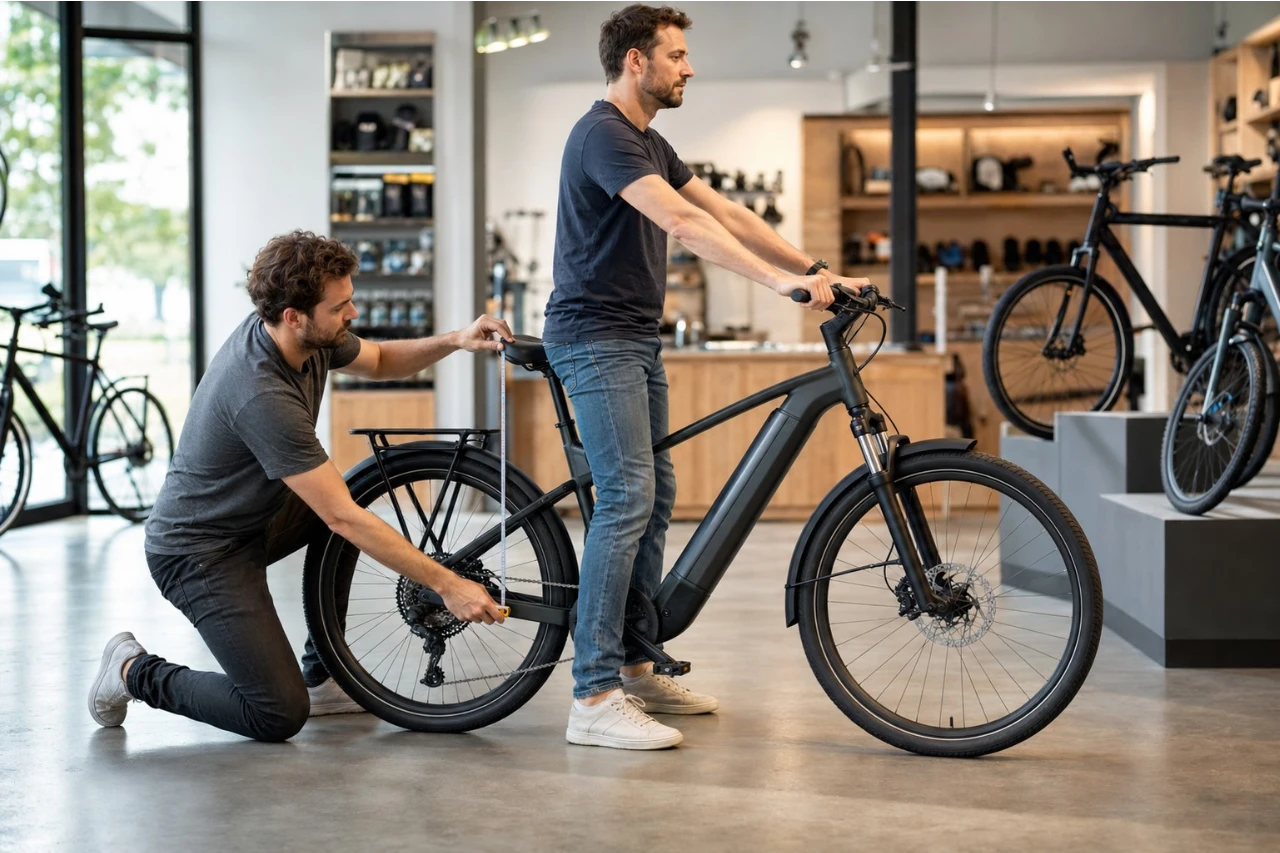
To measure it at home, stand with your back against a wall and place a hardcover book between your legs, spine-up, as if it were a bicycle saddle. Raise it gently until it is snug, keep it level, and measure from the top edge of the book straight down to the floor. Repeat the measurement once or twice for consistency.
Write down the result in inches and centimeters. For example, an inseam of 30 inches is about 76 cm. This number is particularly helpful for riders with shorter or longer legs relative to their height.
Your inseam does not create one universal frame-size answer. Instead, compare it with the e-bike’s listed standover height and the saddle-height adjustment range. A bike can have a low standover height but still be too long in the reach. It can also have a comfortable reach but not enough seat-post adjustment for efficient pedaling.
Check standover height
Standover height is the distance from the ground to the top tube or the lowest part of the frame between your legs. Straddle the e-bike on level ground while wearing your usual shoes. You should be able to stand over the frame without the top tube pressing uncomfortably into you.
Traditional diamond frames generally need more clearance than step-through frames. For a conventional frame, some space between your body and the top tube is useful, especially if you may need to stop quickly on uneven ground. A step-through frame has a lower opening, making mounting and dismounting easier, but you should still make sure you can stand securely with the bike beneath you.
Do not judge standover clearance while the bike is on a kickstand or leaned against a wall. Hold it upright, ideally with another person steadying it while you check. Because e-bikes can be heavy, avoid trying to balance, lift, or maneuver an unfamiliar bike in a crowded area.
Reach Often Determines Whether a Bike Feels Right
Reach is the distance from the saddle area to the handlebars. It affects your shoulders, wrists, back, and ability to steer comfortably. It is also one of the most overlooked parts of e-bike sizing.
When seated with your hands on the grips, your elbows should have a natural, slight bend. Your shoulders should not be pulled forward, and you should not have to lock your arms to reach the bars. You should be able to look ahead and turn your head to check traffic without feeling like your neck is carrying your upper-body weight.
An overly long reach can cause hand numbness, wrist pressure, shoulder discomfort, or a feeling that the front wheel is too far away. A reach that is too short may make your knees feel crowded near the handlebars or leave you sitting too upright for the riding you do.
Handlebar height changes the experience too. Higher bars generally create a more upright position that many recreational and comfort-focused riders find easier on the neck and back. Lower bars place more weight forward and can feel more efficient at speed, but they may be less comfortable for riders with limited flexibility. The right position depends on the bike’s intended use and your comfort over a real ride, not just a few seconds in a parking lot.
Set the Saddle for Pedaling and Stopping Control
Once the frame has reasonable standover height and reach, adjust the saddle. Start with the saddle roughly level and set it so your knee has a small bend at the bottom of the pedal stroke. If your leg is completely straight when the pedal is at its lowest point, lower the saddle slightly. If your knees remain deeply bent throughout the stroke, raise it gradually.
A common beginner concern is whether both feet must rest flat on the ground while seated. Usually, no. On many properly fitted e-bikes, you will slide forward slightly off the saddle or lean the bike a little at a stop so one foot can plant firmly. Being able to put one foot down securely is more important than sitting flat-footed with both feet down.
There is a trade-off. A lower saddle can feel reassuring at stops, particularly for new riders, but it may reduce pedaling efficiency and place extra strain on your knees during longer rides. A higher saddle improves leg extension but can make starts and stops feel less secure. Make small changes, then test them in a quiet, flat area.
Never raise a seat post above its minimum-insertion mark. If you need substantially more saddle height than the frame allows, the bike may be too small or may require a manufacturer-approved fit adjustment. A qualified bicycle mechanic can help assess the setup.
Match the Frame Style to How You Ride
Frame size is not only about body measurements. It is also about how easily you can control the e-bike in your normal riding conditions.
A step-through frame can be practical for riders who frequently stop in traffic, carry items on a rear rack, have limited hip mobility, or wear everyday clothing. It reduces the need to swing a leg high over the rear wheel. A high-step or diamond frame can feel very stable and may provide more room for certain battery placements, but it requires a higher leg swing to mount and dismount.
Tire size can also affect the fit. Larger wheels can raise the bike’s overall height, while smaller wheels may allow a lower step-over height. That does not mean one wheel size fits every rider better. Look at the complete bike: where the saddle sits, how high the handlebars are, and whether you can manage the bike comfortably at low speed.
Cargo, child seats, and accessories change the picture as well. Added weight can make an e-bike harder to hold upright at a stop. If you plan to carry loads, prioritize a setup that lets you mount, dismount, and place a foot down with confidence. Follow the manufacturer’s weight limits and accessory instructions.
A Practical E-Bike Fit Check
Before making a final sizing decision, use this short check on level ground. Wear the shoes and clothing you expect to ride in, since thick soles and restrictive pants can change how a bike feels.
- Straddle the frame and confirm you have comfortable clearance and stable footing.
- Sit on the saddle, hold the grips, and check that your elbows are slightly bent rather than locked.
- Turn the handlebars fully left and right. Your knees, hands, cables, and accessories should not interfere with steering.
- Pedal slowly and check for a slight knee bend at the bottom of each stroke.
- Practice stopping, placing one foot down, and starting again with pedal assist set to its lowest level or turned off.
- Test the bike at walking speed and make a few gentle turns. Low-speed control reveals fit problems that are easy to miss while standing still.
If you feel unstable, stretched, crowded, or unable to stop confidently, do not assume you will “get used to it.” Check the saddle position, handlebar adjustment, and manufacturer guidance. A qualified bicycle mechanic can evaluate fit and make approved adjustments such as saddle position, handlebar angle, or control placement. They should not modify the frame, battery system, or other safety-critical parts to force a fit.
A well-fitted e-bike should feel manageable before the motor adds speed. Take the time to confirm the basics, then practice starts, stops, and turns in a low-traffic area. Comfort is valuable, but confident control is the fit feature that matters most every time you ride.
Frequently Asked Questions
What size electric bike do I need for my height?
Use the manufacturer’s size chart for the exact e-bike model as your starting point. Compare your height and inseam with the recommended range, then confirm that the standover height, reach, and saddle adjustment range suit your body.
How do I measure my inseam for an electric bike?
Wear your usual riding shoes and stand with your back against a wall. Place a hardcover book firmly between your legs, keep it level, and measure from the top of the book to the floor. Repeat the measurement to confirm the result.
What should I do if I am between two e-bike sizes?
A smaller frame usually provides a shorter reach and may be easier to control at stops. A larger frame can offer more room for riders with longer torsos or arms. Compare the geometry of both sizes and test them when possible before deciding.
How much standover clearance should an e-bike have?
You should be able to stand over the bike on level ground without the frame pressing uncomfortably against your body. Traditional high-step frames usually require more clearance, while step-through frames have a lower opening for easier mounting and stopping.
Should both feet touch the ground while I am sitting on an e-bike?
Both feet do not normally need to rest flat on the ground while you are seated. On a properly adjusted e-bike, many riders slide forward from the saddle or lean the bike slightly to place one foot securely on the ground.
Can saddle and handlebar adjustments correct the wrong frame size?
Saddle height, saddle position, handlebar angle, and approved stem adjustments can improve a close fit. However, they cannot fully correct a frame that is too tall, too long, or too short. Never raise the seat post beyond its minimum-insertion mark.
Does wheel size determine whether an electric bike will fit me?
Wheel size affects the bike’s overall height, handling, and step-over clearance, but it does not determine fit by itself. Frame geometry, reach, standover height, saddle range, and handlebar position are more important when evaluating a specific model.