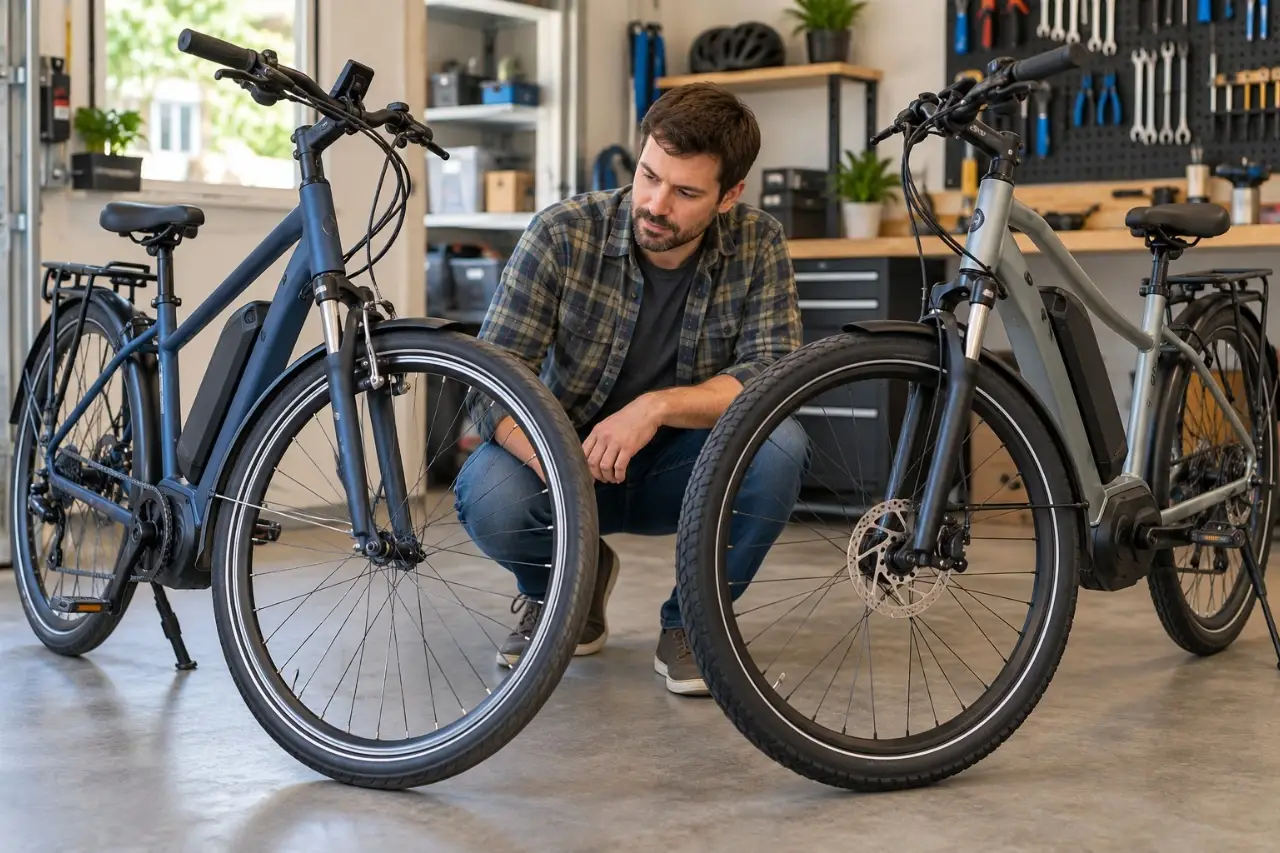
For most e-bikes, disc brakes are the better all-around choice, especially on heavier bikes, cargo e-bikes, hills, wet roads, and higher-speed rides. Rim brakes can still be appropriate on lighter e-bikes used mostly on flat, dry routes when the system is correctly sized, adjusted, and maintained.
The brake label alone does not determine stopping distance. Tire grip, total bike-and-rider weight, brake condition, road surface, speed, and rider technique all matter. A well-maintained rim brake can outperform a neglected disc brake, but disc systems generally give e-bike riders more braking consistency and heat-management margin in demanding use.
Why E-Bikes Put More Demand on Brakes
Brakes slow a bicycle by converting motion into heat. The more mass and speed the system has, the more energy the brakes must manage during a stop.
That matters on an e-bike because the motor, battery, reinforced frame, cargo, and accessories can add weight compared with a conventional bicycle. Motor assistance can also bring the bike to cruising speed quickly, so repeated stops in traffic or long descents can create substantial heat.
Under the three-class framework used in many U.S. states, Class 1 and Class 2 assistance ends at 20 mph and Class 3 pedal assistance at 28 mph. Local definitions can differ. Regardless of class, stopping performance depends on tire grip, total load, grade, brake setup, component condition, and rider input.
E-Bike Rim Brakes vs. Disc Brakes at a Glance
| Factor | Rim brakes | Disc brakes |
|---|---|---|
| Braking surface | Wheel rim | Metal rotor at the wheel hub |
| Wet-weather behavior | More affected when the rim is wet or dirty | Usually more consistent, but wet pavement still reduces tire grip |
| Heat location | Heat enters the rim and nearby tire area | Heat is concentrated in the rotor, pads, and caliper |
| Effect of wheel trueness | Rim wobble can affect pad clearance and braking | Less affected by rim trueness, though rotor alignment matters |
| Routine maintenance | Pad position, rim condition, cable tension | Pad wear, rotor condition, cable or hydraulic system |
| Typical e-bike use | Lighter, lower-demand, mostly dry riding | Heavier, faster, hilly, cargo, and all-weather riding |
| Main advantage | Simplicity and easy visual inspection | Consistency, braking force, and heat management |
These are general tendencies, not guarantees. Brake quality, rotor or rim size, pad material, tire traction, and maintenance can change the result.
How Rim Brakes Work
Rim brakes use brake pads or shoes that press against the wheel rim. Common bicycle designs include V-brakes, caliper brakes, and cantilever brakes. Most use a cable from the lever to move the brake arms.
A properly adjusted rim brake can provide strong, predictable braking in dry conditions. Its parts are easy to see, and many common problems—such as worn pads, poor pad alignment, or excessive cable slack—are relatively easy to identify.
The main trade-off is that the wheel rim is also the braking surface. Water, grit, mud, and contamination can reduce friction. In rain, response may be delayed while the pads clear water from the rim, so riders should slow down and leave more stopping room.
Repeated hard braking can also heat the rim, while abrasive grit accelerates wear of both the pads and braking surface. A worn, cracked, damaged, or excessively concave rim needs inspection before continued riding.
How Disc Brakes Work
Disc brakes use pads inside a caliper to clamp a metal rotor mounted at the wheel hub. The braking surface is separate from the wheel rim, which helps preserve more consistent braking when the rim is wet, dirty, or slightly out of true.
There are two common actuation types:
- Mechanical disc brakes use a cable to move the caliper.
- Hydraulic disc brakes use fluid pressure through a sealed hose to move the caliper pistons.
Hydraulic systems generally require less lever effort and can make it easier to modulate braking force smoothly, while mechanical systems are often simpler to inspect and service. If you are deciding between those two disc systems, see our guide to hydraulic vs. mechanical e-bike brakes.
Disc brakes still have limitations. Rotors can bend, pads can wear or become contaminated, cables can fray, and hydraulic systems can leak. A poorly adjusted or contaminated disc brake is not automatically safer than a rim brake in good condition.
Which Brake Type Is Better for an E-Bike?
For most current e-bike use, disc brakes are the more practical choice because they provide more braking reserve when conditions become demanding.
Disc brakes are usually the better fit when you:
- ride a heavy or cargo-oriented e-bike;
- regularly carry a passenger, child seat, or loaded rack;
- descend long or steep hills;
- commute in rain or changing weather;
- make frequent stops in traffic; or
- ride at higher assisted speeds.
Rim brakes can still make sense when you:
- ride a lighter e-bike;
- use mostly flat, dry routes;
- ride at moderate speeds;
- value simple visual inspection and cable service; and
- have a brake system that is properly sized and approved for the bike.
This does not mean every rim-brake e-bike is unsafe or every disc-brake e-bike is superior. The useful question is whether the complete system provides controlled, repeatable stopping for the bike’s weight, speed, load, and riding environment.
What Matters More Than the Brake Label
Tire grip
Brakes can only use the traction available at the tire. A worn, underinflated, damaged, or poorly suited tire can lose grip before the brake reaches its full capability.
Use the permitted tire and rim pressure limits, then follow the e-bike manufacturer’s guidance for the rider and cargo load. Our e-bike tire pressure guide explains how load, tire width, and terrain affect the right setting.

Brake condition
Lever feel should be predictable, and the lever should develop braking force before reaching the handlebar grip. Mechanical cables should not be frayed or corroded. Hydraulic systems should not show fluid leakage.
For a more complete routine, follow the five-minute e-bike brake inspection before relying on the bike in traffic or on a descent.
Pad and braking-surface condition
Rim-brake pads should contact the braking surface rather than the tire, and they should not be cracked, hardened, or worn beyond the manufacturer’s indicator.
Disc-brake pads, rotors, and calipers must be clean and within the brake maker’s wear limits. Those limits are model-specific; do not apply one brand’s pad-thickness number to another system. See our guide on when to replace e-bike brake pads for the warning signs and measurement differences.
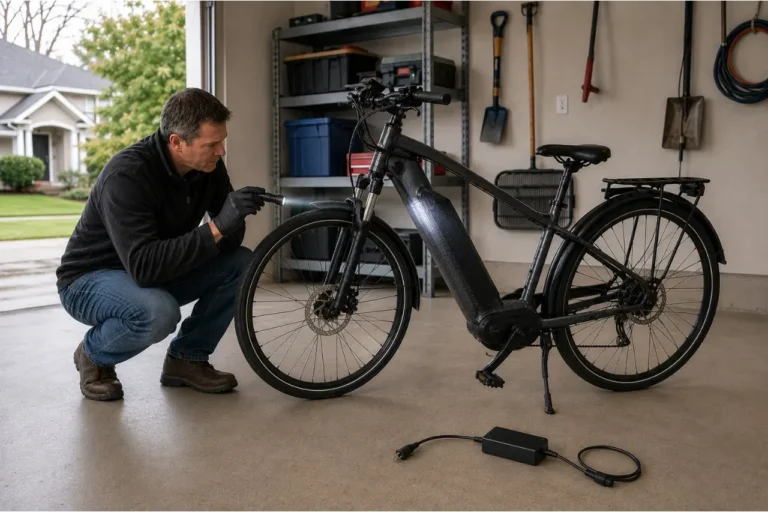
Keep chain lubricant, grease, tire dressing, polish, and general-purpose oily sprays away from braking surfaces. Oil contamination can sharply reduce disc-brake performance.
Safer Braking Habits for Either System
Good technique matters with both rim and disc brakes.
Use both brakes progressively during normal stops. As weight shifts forward, the front brake can provide substantial stopping force. Avoid abruptly grabbing the front lever, which can lock the wheel or upset balance on a low-grip surface.
Slow down before loose gravel, wet leaves, painted road markings, metal covers, or sharp turns. Wet pavement can reduce tire traction even when a disc brake itself remains consistent.
On long descents, control speed early rather than waiting for one hard stop at the bottom. If braking becomes unusually weak, the lever feel changes, you smell overheated brake material, or performance fades, stop in a safe place and allow the system to cool. If the problem repeats, have the brakes inspected before riding again.
If you experience sudden loss of braking, read our guide to e-bike brake failure warning signs and stop riding until the cause is identified.
Quick Pre-Ride Brake Check
A short inspection can catch many problems before you enter traffic:
- Power the e-bike off and keep it stable on level ground.
- Squeeze each brake lever separately. The lever should move smoothly, return normally, and develop firm braking force before touching the grip.
- Roll the bike and test each brake. Each wheel should stop firmly when its brake is applied.
- Inspect the braking surface. Check rim-brake pads and rims, or disc pads and rotors, for obvious wear, damage, contamination, or misalignment.
- Spin each wheel. Investigate severe rubbing, scraping, wobble, or a wheel that does not turn freely.
- Do a low-speed test in a clear area, especially after service, wheel removal, transport, or adding cargo.
CPSC recommends checking brakes and other major components for damage before riding. Your e-bike and brake manuals take priority over this checklist.
When to Stop Riding and Get Professional Service
Do not continue riding if:
- braking power suddenly drops or becomes unpredictable;
- a lever pulls to the handlebar or changes feel abruptly;
- hydraulic fluid is visible at the lever, hose, fitting, or caliper;
- a brake cable is badly frayed, corroded, or damaged;
- a rotor is cracked, severely deformed, or visibly damaged;
- a rim has deep wear, cracking, or a pronounced concave braking surface;
- a rim-brake pad contacts the tire;
- braking produces harsh metal-on-metal grinding; or
- a crash has damaged the wheel, fork, brake lever, caliper, or brake mount.
Do not bypass a brake-activated motor cutoff or alter unfamiliar brake wiring. If the system includes an electrical cutoff and it no longer works as designed, follow the e-bike manufacturer’s instructions or use a qualified e-bike technician.
Bottom Line
For most e-bike riders, disc brakes are the stronger all-around choice, especially when the bike is heavy, loaded, used on hills, ridden in rain, or operated at higher assisted speeds. Rim brakes can still be suitable for lighter, lower-demand e-bikes when they are correctly specified and kept in good condition.
Whichever system you have, do not judge braking safety by the label alone. Tire grip, adjustment, component condition, total load, and technique determine whether the bike can stop predictably.
GoEBikeLife publishes independent e-bike reviews, comparisons, and practical buying guides. Some links on this page are affiliate links. If you make a purchase through an eligible link, we may earn a commission at no additional cost to you.