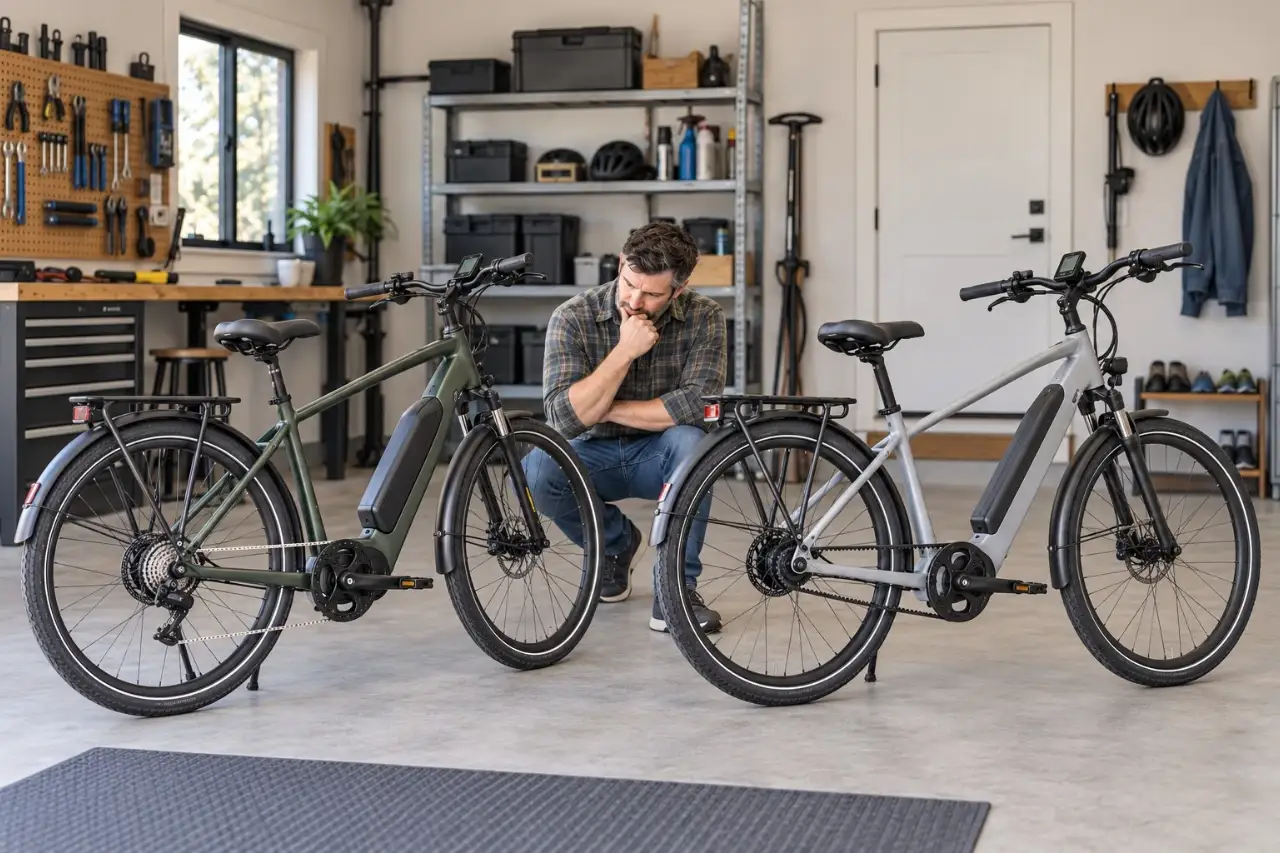
A belt-drive e-bike is usually cleaner, quieter, and easier to maintain day to day. A chain-drive e-bike generally offers more gearing choices, widely available replacement parts, and simpler roadside repairs.
Neither is automatically better: the right drivetrain depends on your terrain, motor placement, access to service, and willingness to do routine maintenance.
Belt Drive vs. Chain Drive: The Practical Difference
A conventional bicycle chain uses linked metal rollers that engage with a front chainring and rear sprockets. It works with derailleur gearing, internal gear hubs, and single-speed setups. Because its moving joints are exposed, it needs periodic cleaning, lubrication, and wear checks.
A belt drive uses a continuous, toothed belt and matching front and rear sprockets. Many bicycle belts have a polymer body reinforced with carbon-fiber cords. They run without chain lubricant, so they do not leave the same oily residue on clothes or hands. They still require correct alignment, tension, and occasional cleaning.
Motor placement also matters. On a typical rear-hub-motor e-bike, the motor drives the wheel separately from the rider’s chain or belt. On a mid-drive e-bike, motor power passes through the drivetrain, placing additional demands on the chain or belt and its associated gearing. See our hub motor vs. mid-drive explanation for the practical differences.
Belt Drive vs. Chain Drive: Side-by-Side Comparison
| Factor | Belt drive | Chain drive |
|---|---|---|
| Daily cleanliness | Runs dry; little oily residue | Lubricant can collect grit and mark clothing |
| Routine maintenance | Clean debris; inspect alignment, condition, and tension | Clean, lubricate, and check for wear |
| Gearing | Commonly paired with a single-speed setup, internal gear hub, or gearbox | Works with derailleurs, internal gear hubs, and single-speed setups |
| Hills and carrying loads | Depends on the available gear range and system’s approved torque capacity | Depends on gearing; derailleurs offer many familiar options |
| Replacement and repair | Requires a system-specific belt and appropriate frame access | Replacement chains and compatible repair parts are widely available |
| Frame compatibility | Most continuous belt systems require a frame designed with an opening for installation | Compatible with conventional chain-drive frames |
| Noise | Often quiet when aligned and tensioned correctly | Can be quiet when clean and correctly adjusted |
| Efficiency and range | Depends on belt setup, tension, and transmission | Depends on lubrication, chain condition, and transmission |
These are typical characteristics, not guarantees for every e-bike.
Which Drivetrain Needs Less Maintenance?
Belt drive: cleaner, but not maintenance-free
A belt’s main ownership advantage is that it needs no chain oil. For an everyday commuter, that means fewer greasy cleaning jobs and a lower chance of staining work clothes. After a gritty or wet ride, remove loose dirt with a soft brush or a damp cloth. Where the bike manufacturer permits, use a gentle, low-pressure water rinse and let the bike dry.
Do not apply chain lube, grease, or an unapproved solvent to the belt. Check for stones trapped in the sprocket teeth, unusual rubbing, damaged teeth, and changes in how the belt tracks. A belt can skip if tension is too low, while excessive tension can increase drag and load the hub bearings. Follow the instructions for the specific bike and belt system rather than a universal tension number.
Carbon-reinforced belts should not be twisted, sharply folded, pried onto a sprocket, or bent backward during handling. Such treatment can damage the reinforcing cords even when the exterior looks intact. Gates provides belt-system guidance and manuals; other belt manufacturers may have different requirements.
Chain drive: more routine care, familiar servicing

A chain needs a little more attention. Road grit mixed with old lubricant can accelerate wear on the chain and sprockets. Wet-weather riding and road salt also make cleaning more important. On a mid-drive e-bike, shifting or pedaling hard under heavy motor load can further stress the drivetrain.
For basic care, turn off the e-bike, remove visible grime using an appropriate bicycle cleaning product, let the chain dry, and apply a lubricant approved for that chain. Wipe off the excess; more oil is not necessarily better. Keep cleaning products and lubricant away from brake pads, rotors, and tire contact surfaces.
Chain wear is not always obvious from appearance. A compatible chain-wear gauge or a bicycle shop can help determine when replacement is due. For a detailed owner-level routine, see how to clean an e-bike drivetrain safely.
Neither system has a universal maintenance interval. Mileage, weather, riding surfaces, drivetrain design, and manufacturer requirements all matter.
Gearing, Hills, and Everyday Riding Feel
Chains are commonly paired with rear derailleurs that move the chain across multiple cogs. This provides familiar shifting and can offer a broad choice of gears for climbs, descents, and changing loads. It also makes chain-drive e-bikes appealing to riders who want parts that many shops can service.
Belt drives cannot shift sideways across a conventional derailleur cassette. They are therefore commonly paired with a single-speed arrangement, an internally geared hub, or a gearbox. Some internal hubs and continuously variable transmissions allow shifting while stopped, but that feature depends on the specific unit. Their gear ranges, torque ratings, and service requirements differ.
Do not assume a belt drive is unsuitable for hills or that a chain automatically climbs better. A well-matched belt-drive e-bike with enough low gearing can handle hills, while a poorly geared chain-drive e-bike may struggle. For a mid-drive system, confirm that the belt, rear hub or gearbox, and other components are approved for the motor’s torque and intended riding conditions.
Whatever the system, follow the manufacturer’s shifting instructions. Briefly easing pedal pressure during shifts can reduce drivetrain stress on systems that require it.
Does a Belt or Chain Affect E-Bike Range?
A clean, lubricated chain can transfer power efficiently, and a correctly set up belt can also perform efficiently. But comparing belt efficiency with chain efficiency in isolation misses other variables, including the internal hub or gearbox, belt tension, chain condition, and riding load.
There is no reliable, universal battery-range gain from choosing one over the other. Speed, assistance setting, hills, wind, tire pressure, temperature, cargo, and rider weight can have substantial effects on real-world range. Avoid any claim that simply switching to a belt will add a fixed number of miles per charge.
For useful range improvements, start with the basics: maintain appropriate tire pressure, accelerate smoothly, choose sensible assist settings, and use gears that let you pedal comfortably instead of forcing a high gear on a climb.
Can You Convert a Chain-Drive E-Bike to a Belt Drive?
Usually not as a simple parts swap. The common continuous belt needs a frame with a designed opening—often called a frame split—so the belt can pass through the rear triangle. The bike must also have matching sprockets, suitable belt alignment, and a manufacturer-approved way to set tension.
A conventional derailleur cannot move a belt between rear cogs. Converting a derailleur bike may therefore require a different transmission, and motor, frame, wheel, and axle compatibility can become limiting factors. Do not modify or cut a frame or improvise a motor/drivetrain conversion to make a belt fit.
Replacement belts are not interchangeable just because they look similar. Match the manufacturer’s specified belt system, length, tooth profile, sprockets, and compatible torque application. If any part of that compatibility is uncertain, consult the bike manufacturer or a qualified shop.
What Happens if a Belt or Chain Fails Away From Home?
A broken or badly damaged chain can sometimes be repaired with an approved compatible link and suitable tools, depending on the damage and drivetrain. This is one reason chains appeal to riders who travel away from major towns. However, incorrect links or poor repairs can fail under load, so a rider without the correct parts or experience should arrange transport or shop service instead.
A continuous belt cannot be opened and rejoined like a conventional bicycle chain. Replacing it generally requires access through the frame’s designed belt opening and the correctly specified replacement belt. Those parts may be harder to find at an unfamiliar shop, making a damaged belt especially inconvenient during a remote ride.
Never try to temporarily patch a damaged belt, force it over sprockets, or continue riding through repeated skipping. Stop and arrange service.
Which Setup Fits Your Riding?
Consider a belt-drive e-bike if you commute regularly, value clean clothing, store the bike indoors, dislike frequent lubrication, and have dependable access to a shop that supports its belt and transmission. A belt can also work for hilly or higher-mileage rides if the particular system has appropriate gearing and is approved for the load.
Consider a chain-drive e-bike if you prefer derailleur gearing, ride in places where replacement parts and roadside assistance may be limited, or want to perform basic drivetrain care yourself. A chain may also be the more practical option if your local shops do not support the particular belt or internal-hub system you are considering.
The choice should reflect the complete e-bike drivetrain, not just whether the part between the crank and rear wheel is metal or reinforced polymer.
Safe Drivetrain Checks Before You Ride
With the e-bike switched off and the bicycle stable, make a brief visual inspection. Keep fingers, loose clothing, and tools away from the chain or belt and sprockets. Never use the throttle or pedal assist to spin the drivetrain during inspection or cleaning.
- On a belt drive: Look for fraying, cracks, deep cuts, missing teeth, exposed cords, embedded debris, or unusual tracking against a sprocket flange.
- On a chain drive: Look for stiff or damaged links, heavy corrosion, excess grime, dropped-chain marks, or visible damage to the chainring and rear cogs.
- On either system: Check for an obviously loose rear wheel, new rubbing, persistent grinding, or unusual shifting behavior. Do not try to diagnose these issues by riding harder or increasing motor assistance.
If a chain skips under normal pedal pressure, stop riding and follow our e-bike chain-skipping troubleshooting guide or have a shop inspect it. If belt tracking or tension seems wrong, use a qualified technician familiar with the specified system.
After a wet or muddy ride, clean away deposits using the method approved for your drivetrain and avoid high-pressure water around bearings, hub seals, electrical connections, and the motor. Reapply lubricant only to chain systems as directed. For ongoing inspection timing, refer to our e-bike service interval guide.
When to Stop Riding and Get Professional Help
Do not ride if a belt shows exposed cords, significant cuts, missing teeth, or repeated skipping; if a chain is broken, severely damaged, jammed, or repeatedly derails; or if the rear wheel is loose or drivetrain components bind. These problems can cause sudden loss of propulsion or interfere with wheel movement.
A persistent grinding noise, harsh or unreliable shifts, or a belt that walks toward or off a sprocket also calls for inspection before further riding. Do not rely on extra lubricant to fix damaged chain parts, and do not try to solve a belt-alignment problem by guessing at its tension.
A qualified bicycle mechanic should handle uncertain belt tension and alignment, internal hub faults, recurring chain skipping, or any repair involving wheel retention or unfamiliar motor-related parts. Manufacturer instructions always take priority over general maintenance advice.
Bottom Line
Choose a belt drive for its cleaner, lower-maintenance routine—provided the complete gearing and drive system suits your routes and local service options. Choose a chain for widely supported gearing and easier access to replacement parts, accepting that it needs more cleaning, lubrication, and wear checks. Either can be dependable when correctly specified and maintained.
GoEBikeLife publishes independent e-bike reviews, comparisons, and practical buying guides. Some links on this page are affiliate links. If you make a purchase through an eligible link, we may earn a commission at no additional cost to you.