A little joy belongs in every day.

Local e-bike rules depend on your bike and route. Check official laws, access policies, speed limits, and current closures with the responsible authority.
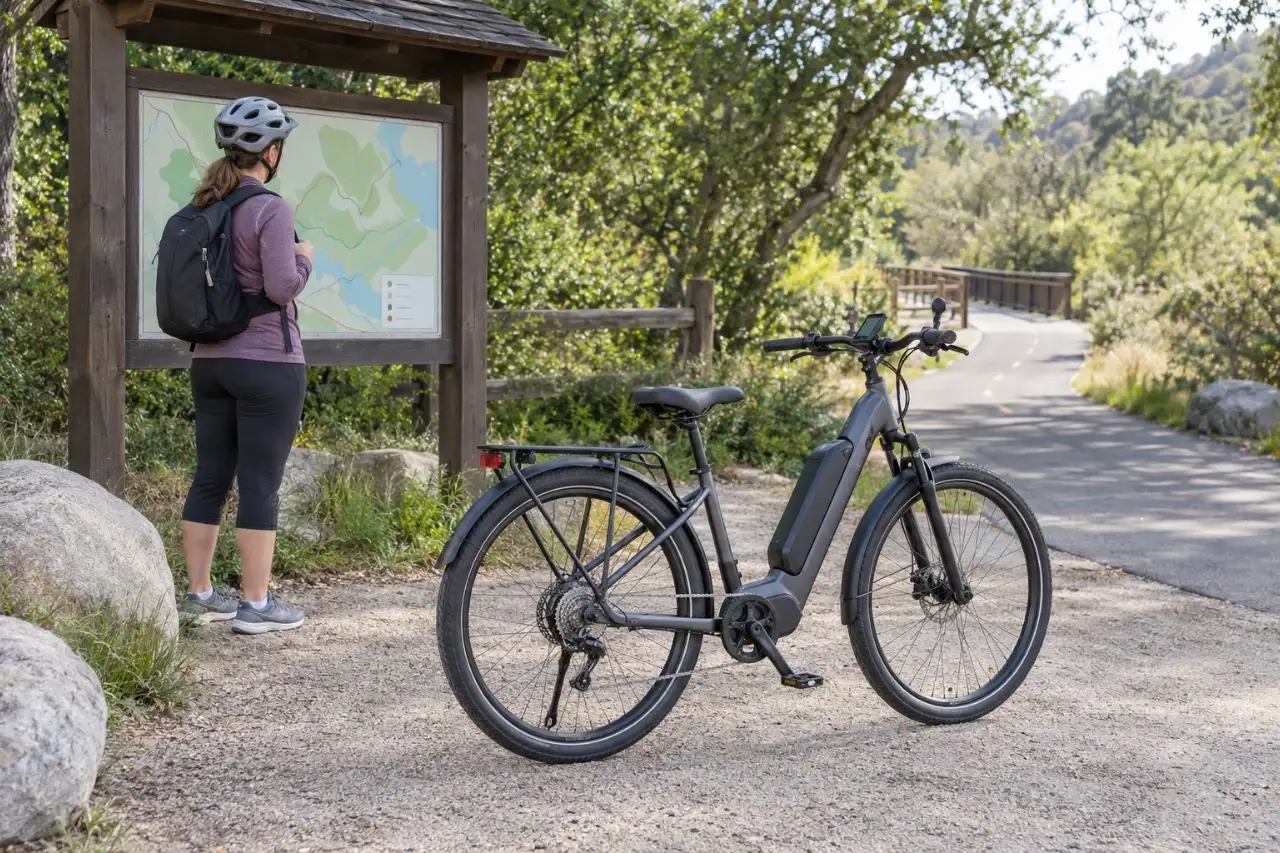
To check local ebike rules, identify your bike’s legal category, divide your route into the streets and paths you will use, and consult the official rules for each location. Confirm access, riding speed, rider requirements, and current closures. A class label or permission to ride on one street does not establish permission for the next park, sidewalk, or trail.
Legal information checked: September 9, 2026. This guide explains how to research a route; it is not a determination that a particular bike or trip is lawful. Recheck the relevant authorities before riding.
Have the frame label, owner’s manual, and manufacturer specifications available. Record the model, motor specifications, maximum assisted speed, whether the motor can propel the bike without pedaling, and any modifications.
These familiar class descriptions are a starting point:
| Class | Common assistance behavior |
|---|---|
| Class 1 | Pedaling is required; assistance cuts out at 20 mph (32 km/h). |
| Class 2 | The motor can propel the bike without pedaling; assistance cuts out at 20 mph (32 km/h). |
| Class 3 | Pedaling is required; assistance cuts out at 28 mph (45 km/h). |
Washington’s current definitions use this framework and require a speedometer for Class 3. Other states differ: New York’s Class 3 definition permits motor-only propulsion with a 25 mph (40 km/h) assistance cutoff and applies solely within a city of at least one million people.
Compare your bike’s documented capabilities with the applicable definition. A seller’s class label is not conclusive, and an advertised peak wattage alone does not establish legal status. Ask the manufacturer for missing specifications.
Write down the street, path, park, and trail names, including the connections between them. A route app can help you locate these segments, but its bicycle routing option is not proof of e-bike access.
| Route segment | Official starting point |
|---|---|
| Public street or on-street bike lane | State vehicle law, then the responsible city, county, or state transportation agency |
| Sidewalk or downtown pedestrian area | State law and the city’s or county’s applicable code |
| Greenway, rail trail, or park path | The named parks department, trail authority, or managing agency |
| State or federal recreation land | The specific park, forest, district, or other managing unit |
| Private trail, campus, or managed property | The owner or operator’s access policy, alongside applicable law |
Start on the agency’s main website and follow its links to maps, regulations, and municipal codes. Some governments publish their codes through outside hosting services; following the government’s own link helps identify the official edition.
Federal product requirements are a separate issue. The CPSC bicycle definition includes two- or three-wheeled vehicles with fully operable pedals, a motor below 750 watts, and a motor-only maximum speed below 20 mph on a paved, level surface with a 170 lb (77 kg) rider. Those product criteria do not provide route permission. Our federal and state e-bike law guide explains the broader framework.
Search the official site or linked code for “electric bicycle,” “electric-assisted bicycle,” “bicycle,” “motorized vehicle,” and the exact route name. Read the definitions section as well as the operating rule.
Check three details before relying on what you find:
A recently published news release may describe a future change. Look for the effective date and any later amendments. For a temporary order, check its location, start date, expiration, and whether it has been replaced.
Do not interpret “bicycles allowed” or “no motorized vehicles” without checking how the rule treats e-bikes. Also avoid assuming that every city can override state law. For example, Washington’s access statute expressly addresses local restrictions and different treatment of Class 3 bikes on shared-use paths. That is a Washington rule, not a nationwide permission system.
Permission to enter a route answers only one question. Record the operating conditions separately so you do not confuse the bike’s assistance cutoff with a riding speed limit.
| What to check | Questions your sources should answer |
|---|---|
| Vehicle access | Is this class or vehicle category allowed on this exact segment? Is throttle operation restricted? |
| Speed and behavior | What riding speed limit, yielding rule, passing requirement, or direction of travel applies? |
| Rider and equipment | Are there age, helmet, lighting, reflector, audible-device, or passenger requirements? |
| Paperwork and stopping | Does this vehicle require a license, registration, or insurance? Where may it be parked? |
For a concrete example, NYC DOT currently lists a 15 mph (24 km/h) riding limit for e-bikes, even though its chart shows higher vehicle capabilities. Riding below the bike’s assistance cutoff is therefore not enough to establish compliance.
Check sidewalk access separately from street access, and distinguish a sidewalk from a shared-use bike path. Do not assume that permission for one covers the other.
Keep parked bikes clear of curb ramps, doors, and pedestrian movement. Verify designated parking rules at your destination. If carrying a passenger, follow the bike and carrier manufacturers’ seating and load limits as well as the applicable law.
For parks and public land, use the specific property’s access documents and current alerts. A general agency policy may explain who can authorize access without establishing that your chosen trail is open.
Two federal examples show why this matters:
Use the responsible agency’s own policy for other public lands; these examples are not interchangeable. Our e-bike trail access guide covers additional trail planning considerations.
Check for construction, events, seasonal restrictions, weather closures, and emergency orders close to departure. Read entrance signs when you arrive. Plan an alternative route whose access you have also checked.
If a website and entrance sign appear inconsistent, pause before entering. Compare the exact route segment, bike category, dates, and any temporary order. Neither “the newest webpage wins” nor “every sign overrides state law” is a reliable legal rule.
Contact the responsible transportation department, parks office, or land manager. Give the route name, entry and exit points, ride date, and your bike’s documented class, assisted speed, and throttle capability. Ask which current written rule applies and request its link or section number.
For example: “Does this rule allow my bike on the segment between these two entrances? Are there class, throttle, speed, or time restrictions that the general map does not show?”
Save the response for reference, but do not treat an informal answer as an exemption from the law or a later closure. Use your checked alternative while an important access question remains unresolved. If you plan to walk through a restricted section, confirm that bringing the bike through on foot is permitted too.
Turning off assistance or selecting a slower mode does not necessarily change the vehicle’s legal category. Washington’s current statute, for example, excludes vehicles designed or marketed to be easily configured beyond its e-bike definition. See RCW 46.04.169(2).
If your bike’s capabilities do not fit the local definition, ask the state motor vehicle agency about its category and road eligibility. Do not assume it can automatically be registered as a moped. Avoid altering controllers, speed limiters, or safety equipment to try to qualify for access.
For each segment, save the route name, managing authority, official source link, relevant section or order, date checked, access conditions, and backup route. This makes a future recheck easier without treating an old screenshot as permanent permission.
Before leaving, complete a physical pre-ride safety check. Wear a properly fitted helmet regardless of whether local law requires one. Do not ride with weak braking, loose steering or wheels, tire bulges or exposed casing, or unexpected motor behavior. Have unresolved faults checked by a qualified mechanic. On the route, respect speed limits and slow further when visibility, pedestrians, or surface conditions require it.