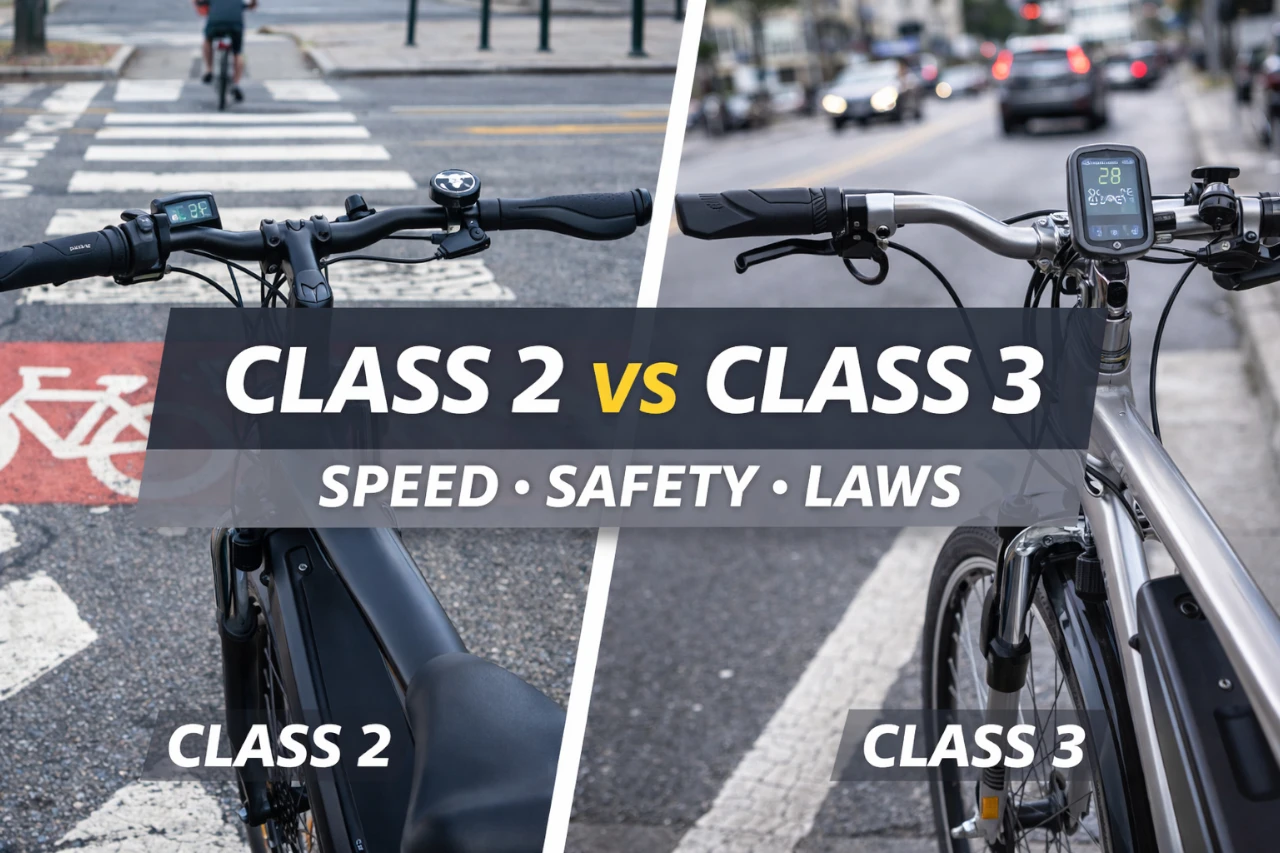
Most buyers aren’t really deciding between “20 mph vs 28 mph.” They’re deciding between a throttle-first, lower-speed bike that feels easy and forgiving and a faster, traffic-capable bike that asks more of your skills, your setup, and your local rules.
I’ve watched the same misunderstanding repeat: people buy Class 3 because they think they’ll cruise at 28 mph everywhere, then discover their real average speed is limited by stoplights, crowded paths, or comfort. Meanwhile, plenty of riders who “need speed” actually needed better brakes, better tires, and a smarter route.
Assumption: USA (2026). E-bike class rules vary by state, city, and land manager, and they can change—so treat “legal” as verify locally.
Quick Verdict
Choose Class 2 if:
- You want throttle convenience for starts, hills, or fatigue management (especially in stop-and-go).
- You ride mixed environments (neighborhoods, bike lanes, some paths) where 20 mph is already plenty most of the time.
- You want fewer skill and setup demands—Class 2 is generally more forgiving at typical riding speeds.
Choose Class 3 if:
- Your commute is longer and mostly roads/bike lanes, and you genuinely benefit from holding 20–28 mph for meaningful stretches.
- You’re comfortable riding with traffic and you’ll treat speed as a responsibility (braking, scanning, positioning).
- You’re willing to pay for (or prioritize) better brakes, tires, and lighting, because the margin for error shrinks fast.
Skip both / reconsider if:
- Most of your riding is on busy multi-use paths with kids, dogs, and unpredictable movement (a slower, pedal-assist-only approach often creates fewer conflicts).
- You’re chasing “moped speed.” If you want well above 28 mph, you’re drifting into a different legal and safety category.
One-line trade-off: You gain speed headroom with Class 3, but you give up simplicity and access consistency (and you must upgrade your safety mindset).
Comparison Snapshot
| Decision Factor | Class 2 | Class 3 |
|---|---|---|
| Speed & usefulness | Motor assist cuts at 20 mph; practical in stop-and-go | Motor assist cuts at 28 mph; best on longer open stretches |
| Throttle | Yes (core feature) | Usually pedal-assist only (throttle may be restricted depending on local rules) |
| Control & safety demand | More forgiving at typical speeds | Higher speed = higher consequences; demands better braking and scanning |
| Where it’s “easy” to ride | Often fewer headaches in mixed environments | More likely to face restrictions (paths, parks, certain trails) |
| Rider fit (who it suits) | Newer riders, casual, errands, comfort-first | Confident commuters, road riders, time-sensitive routes |
| Cost / ownership friction | Often better value; lower wear at lower speeds | Often costs more to get “stable at speed”; more wear if ridden fast |
| Best use case | Urban errands, starts/hills, casual rides | Longer commutes, bike lanes, keeping pace with faster traffic flow |
Define the Terms
Class 2 (plain language): A bike that can be propelled by the motor without pedaling (throttle), and motor assistance stops at 20 mph.
Class 3 (plain language): A pedal-assist bike where the motor helps only while pedaling, and assistance stops at 28 mph.
What people confuse:
- “Class 3 means I’ll ride 28 mph everywhere.” In reality, real-world average speed is often limited by stops, congestion, comfort, and caution.
- “Class 2 is slow.” In practice, 20 mph is already quick in many urban situations (and safer on mixed-use areas).
- “If it has pedals, it’s an e-bike.” Federal consumer safety law defines a “low-speed electric bicycle” around fully operable pedals, <750W, and <20 mph on motor power alone.
Also worth knowing: even in states that use class labels, you can often pedal faster than the assist limit—the motor just won’t help beyond it.
Real-World Differences
1) Speed: What You Actually Gain (and When You Don’t)
The honest math: the jump from 20 → 28 mph is meaningful only if you can actually hold it.
Example time savings (best-case, steady speed):
- 5 miles:
- 20 mph → 15:00
- 28 mph → 10:43
- Savings: ~4:17
- 10 miles:
- 20 mph → 30:00
- 28 mph → 21:26
- Savings: ~8:34
Now the real world: a single long red light, a few stop signs, or a congested path can erase most of that. When I look at commuter rides in actual cities, the average often lands around 14–18 mph unless the route is unusually uninterrupted.
Where Class 3 speed really matters
- Longer commutes with extended bike lanes, frontage roads, or consistent shoulder riding.
- Areas where traffic routinely runs 25–30 mph and you want to reduce speed differential.
- Riders who already have decent handling and won’t “panic brake” at speed.
Where it doesn’t
- Multi-use paths, beach paths, park loops, campus routes.
- Dense downtown grids (stop-and-go).
- Any situation where you should slow down for safety and courtesy.
Trade-off you’ll feel immediately: range
Riding faster punishes the battery because air resistance ramps hard. Even without getting nerdy, the practical takeaway is simple: a Class 3 ridden at 25–28 mph drains noticeably faster than a Class 2 cruising around 16–20 mph. If your daily ride is near the edge of your battery, speed becomes a range decision.
2) Safety & Control: Stability, Braking, and Rider Skill
This is the part most buyers underweight.
Speed multiplies consequences. Kinetic energy scales with the square of speed. A 28 mph impact carries about (28² / 20²) ≈ 1.96× the energy of a 20 mph impact. Nearly double. That shows up as:
- longer stopping distance,
- harsher crashes,
- less time to react to potholes, cars pulling out, or pedestrians drifting.
Typical risks that increase with speed
- Cornering errors (entering too hot, target fixation)
- Wet paint / metal plates / leaves (low-traction surprises)
- Potholes and curb cuts (front-wheel deflection)
- Door zones (you close distance faster than you scan)
What actually improves safety (more than “class”)
- Brakes: hydraulic discs, properly bedded pads, and rotors sized for your weight and terrain (especially if you ride fast or hilly).
- Tires: puncture resistance and wet-traction matter more than top speed specs.
- Lighting: real output + daytime visibility (not tiny “be seen” dots).
- Fit: if the bike doesn’t fit, your braking and steering suffer (this matters at 28 mph).
- Habits: scanning, lane positioning, and speed discipline near people.
Who should be cautious about Class 3
- Brand-new riders who haven’t practiced emergency braking and quick swerves.
- Anyone riding around kids/pets areas or crowded mixed-use paths.
- Riders on heavy fat-tire bikes with mediocre brakes (heavy + fast is where mistakes get expensive).
A practical rule: if you want Class 3, budget mental and actual dollars for a “stable at speed” setup—not just a faster motor.
Read also: How to ride an electric bike (step-by-step).
3) Legal Reality: Where You Can Ride Without Headaches
This is where Class 2 vs Class 3 becomes less about the bike and more about where you plan to use it.
The big picture
- Many states use a 3-class framework, but local rules vary (cities, campuses, HOAs, trail systems).
- Even on federal lands, access can be designation-based—meaning the land manager decides which areas (and which classes) are allowed.
Federal land nuance (important)
Some Department of the Interior agencies adopted rules that define e-bikes by class (and keep the familiar <750W concept), but those rules don’t automatically open every trail—local land managers designate what’s allowed.
So “it’s a Class 3” doesn’t guarantee “it’s allowed here.”
Common real-world pattern
- Class 3 tends to be treated as more “road/commuter oriented,” and it’s more likely to trigger restrictions on certain paths or trail systems.
- Class 2 can also get restricted in some places because of the throttle (even if it’s capped at 20 mph), especially where managers want “pedal-only behavior.”
What to check before buying (seriously)
- Your state e-bike definitions and any equipment requirements.
- Your city/county rules (especially for multi-use paths).
- The trail or park manager (rules + signage + seasonal changes).
- Your building/HOA/campus policy (storage, indoor charging, where you can ride).
One more legal sanity check: if a bike’s specs drift beyond “low-speed e-bike” concepts (power/speed), the ownership obligations can change fast. The federal baseline definition for low-speed electric bicycles is a useful reference point even though riding rules are mostly state/local.
Read also:
Do you need a license for an electric bike?
How to remove an e-bike’s speed limit (and legally)
4) Buying Mistakes (and How to Avoid Them)
Mistake #1: Buying Class 3 for a route that forces Class 2 speeds
What happens: You paid for 28 mph assist, but you spend 80% of the ride braking for people, crossings, or congestion.
Fix: Map your route first. If your ride is mostly interrupted, prioritize comfort, brakes, visibility, and range over top assist speed.
Mistake #2: Treating throttle like a “replacement for skill”
What happens: New riders rely on throttle in corners or on slick surfaces and get surprised by traction loss.
Fix: Use throttle for starts and controlled climbs—not for powering through turns. Practice slow-speed handling and emergency stops.
Mistake #3: Ignoring brakes and tires because “it’s just an e-bike”
What happens: Fade, squeal, panic stops, and scary moments—especially on heavier bikes.
Fix: If you ride fast or hilly, upgrade the “contact with reality” parts first: brakes, pads, rotors, tires.
Mistake #4: Assuming “Class label = allowed everywhere”
What happens: You buy the “right class,” then find local signage or enforcement doesn’t match your assumptions.
Fix: Verify your key riding locations (parks, paths, trails, campus). On federal lands, access can depend on local designation even within class frameworks.
Mistake #5: Chasing speed when you really needed efficiency
What happens: Battery anxiety, frequent charging, and frustration because real range drops when you ride near top assist speeds.
Fix: If range matters, ride the bike you have like a range-optimized commuter: smoother acceleration, moderate speed, correct tire pressure, and realistic expectations.
Read also:
Checklist before buying your first e-bike.
Electric bike charging guide.
Who Should Choose Class 2
- Urban errand riders & stop-and-go commuters
Why Class 2 fits: throttle makes starts easy, 20 mph is plenty, and it’s less stressful day to day.
Compromise: you’re not getting sustained 25–28 mph cruising. - Comfort-first riders, casual riders, and return-to-cycling folks
Why it fits: lower speed ceiling + throttle option reduces fatigue and decision load.
Compromise: if you later want to ride with faster road traffic, you may outgrow it. - Hills with frequent stops (short ramps, intersections, steep driveways)
Why it fits: throttle helps you restart smoothly without grinding.
Compromise: long sustained climbs still demand good gearing/thermal headroom. - Riders prioritizing “less drama”
Why it fits: fewer situations where you feel pressured to ride at traffic pace.
Compromise: longer commutes may take longer.
Who Should Choose Class 3
- Longer-distance commuters (the “time matters” crowd)
Why Class 3 fits: when your route supports it, 28 mph assist meaningfully reduces commute time.
Compromise: range drops and component quality matters more. - Confident road riders sharing space with faster traffic
Why it fits: less speed differential can feel safer in certain road contexts.
Compromise: you must ride defensively and assume drivers still don’t see you. - Riders who already value braking and handling
Why it fits: if you’re the kind of rider who maintains tires, checks pads, and practices braking, Class 3 is a tool you can use responsibly.
Compromise: restrictions/headaches can be higher depending on where you ride. - Heavier riders or cargo riders on open routes
Why it fits: extra assist headroom helps maintain speed on flats with load.
Compromise: stopping distance and brake heat become very real—plan your setup.
Decision Checklist
- My typical riding environment is mostly: bike lanes / roads / mixed-use paths / mixed
- My realistic average speed target is: __ mph
- My local rules clearly allow: Class 2 / Class 3 / both / uncertain
- I’m comfortable riding with traffic at: yes / no
- My braking and tire setup is: adequate / needs upgrade I can accept these trade-offs: (range loss at speed / more restrictions / higher safety demands / higher cost)
If you checked “uncertain” on rules or “needs upgrade” on brakes/tires, that’s a strong signal to slow down your purchase and validate the basics first.
FAQ
Can I ride a Class 3 on bike paths?
Sometimes—but don’t assume. Rules vary by jurisdiction and by the agency managing the path or trail. Some federal land access is designation-based, and class alone doesn’t guarantee access.
Is Class 3 worth it for short commutes?
Usually not. If your ride is under a few miles with lots of stops, the time savings often shrinks, while the safety and range trade-offs remain.
Does the faster class reduce range noticeably?
Yes—especially if you actually ride near top assist speeds. Faster cruising increases drag and power demand; many riders feel it immediately as “battery drops faster than expected.”
What upgrades matter more than class?
Brakes, tires, and lighting. A well-set-up Class 2 often feels safer and more enjoyable than a poorly set-up Class 3.
What’s the #1 mistake first-time buyers make here?
Buying for a top-speed headline instead of their real route (stops, congestion, where they’re allowed to ride) and their real priorities (comfort, braking, range).
Conclusion
If your riding is mixed, stop-and-go, and path-adjacent, pick Class 2. The throttle convenience is real, and 20 mph is plenty for most practical riding.
If your riding is longer, road-heavy, and you can truly sustain higher speeds, pick Class 3—but only if you’re prepared to ride it like a responsible commuter and prioritize braking/tires/visibility over speed bragging rights.
If you want fewer headaches, prioritize legal clarity + safety setup + comfort over chasing top speed. Next step: use your internal quiz to match your route and riding style to the right class, then sanity-check with the commuting and hills guides above.