There is no universal, risk-free way to remove the speed limit on an electric bike. If your bike offers a manufacturer-documented class, region, or speed setting, follow the owner’s manual or ask an authorized dealer to configure it. Do not cut wires, move or disconnect the speed sensor, install a tuning device, or rewrite controller firmware. Those changes can cause faults, affect warranty coverage, and change where the bike may legally be operated.
This guide explains what the cutoff does, how to tell whether your e-bike is actually underperforming, and which compliant options to consider when you need more assisted speed.
Legal information checked August 28, 2026: E-bike operation is governed mainly by state and local rules, and access rules can differ for roads, bike lanes, trails, parks, and private land. Confirm the current rules where you plan to ride. This article is general information, not legal advice.
What an E-Bike Speed Limit Actually Controls
An e-bike’s speed limit is usually an assist cutoff, not a mechanical brake. At the programmed threshold, the motor reduces or stops assistance. The wheels do not lock, and you may still travel faster by pedaling or descending.
The controller determines when to reduce assistance by using information from the bike’s sensors and software. The display or companion app may show some settings, but a visible value is not proof that the manufacturer authorizes the rider to change the bike’s class or maximum assisted speed.
Do not confuse these two terms:
- Assisted speed: The speed up to which the motor provides help.
- Maximum riding speed: The fastest the bicycle travels from motor assistance, human effort, gravity, or a combination of those forces.
Can You Legally Remove the Speed Limiter?
There is no single nationwide yes-or-no answer for every e-bike and every place of use. The federal consumer-product definition and state operating classifications serve different purposes.
Under 15 U.S.C. § 2085, a federal “low-speed electric bicycle” has two or three wheels, fully operable pedals, a motor of less than 750 watts, and a motor-only maximum speed of less than 20 mph on a paved, level surface under the test conditions stated in the law. The U.S. Consumer Product Safety Commission treats qualifying low-speed e-bikes as consumer products subject to bicycle requirements; see the CPSC’s official bicycle requirements guidance. This federal definition does not create a universal rule for where every e-bike may be ridden.
Many states use some version of a three-class system:
| Common class | Typical motor operation | Typical assistance cutoff |
|---|---|---|
| Class 1 | Pedal assist | 20 mph (32 km/h) |
| Class 2 | Throttle-assisted propulsion | 20 mph (32 km/h) |
| Class 3 | Pedal assist | 28 mph (45 km/h) |
Exact definitions, labeling requirements, age limits, helmet rules, throttle treatment, and access restrictions vary. Read GoEBikeLife’s guide to federal and state e-bike laws and its comparison of Class 2 and Class 3 e-bikes, then verify current state and local government rules.
If a modification makes the bike fall outside the applicable e-bike definition, it does not automatically become a lawful Class 3 e-bike. It may instead fall into another vehicle category or be ineligible for the road, lane, or trail you intended to use. Registration, licensing, equipment, and insurance requirements depend on the jurisdiction. Private-property use is not a blanket exemption; the owner’s rules and liability considerations can still apply.
First Confirm That the Bike Is Actually Underperforming
A bike that feels slow may have a setup, maintenance, battery, or sensor problem rather than an intentional low cutoff. Work through these checks before assuming the limiter needs attention.
1. Check the Manual, Model Specification, and Class Label
Confirm the assisted-speed specification for your exact model. Do not rely on a listing for a similar model. Check whether the display uses miles or kilometers per hour; 20 mph is about 32 km/h, and 28 mph is about 45 km/h.
Also verify that you are using the intended assist mode. Eco modes, low assist levels, battery-saving settings, and some app profiles can reduce acceleration or assistance without indicating a fault.
2. Check Battery State and Temperature
Charge the battery with the manufacturer-specified compatible charger. Low charge, extreme temperature, aging cells, or a battery-management protection response can reduce available power.
Stop using the battery and contact the manufacturer or a qualified battery service provider if you notice swelling, leakage, smoke, a strong unusual odor, crackling, or abnormal heat. Do not continue a speed test with a damaged or suspect battery.
3. Set Tire Pressure Correctly
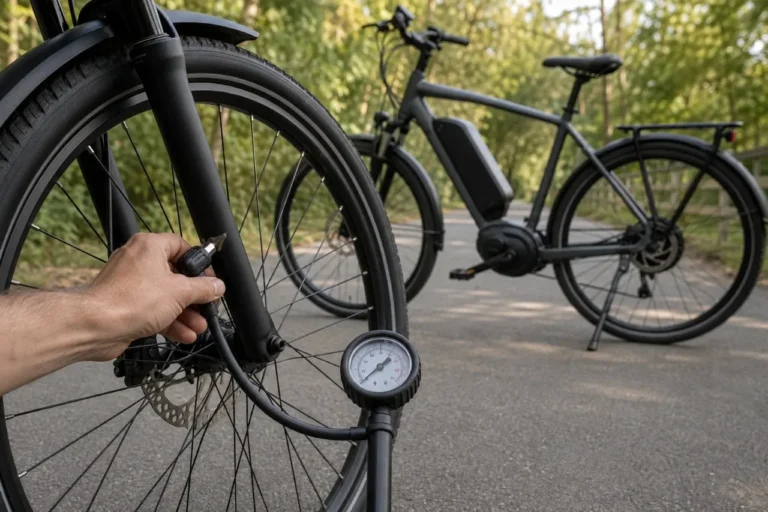
Underinflated tires increase rolling resistance. Use the bike or tire manufacturer’s permitted pressure range and adjust for tire size, load, and riding conditions. Do not use one generic PSI value for every e-bike. GoEBikeLife’s e-bike tire pressure guide explains how to choose a starting pressure safely.
4. Look for Brake or Drivetrain Drag
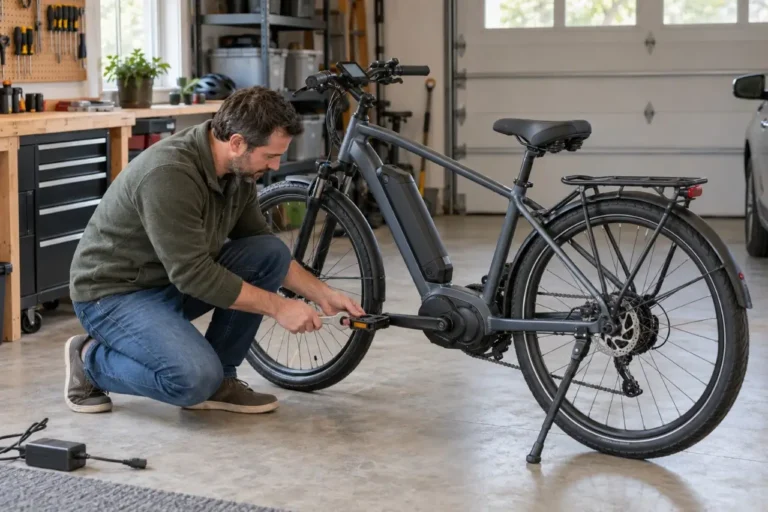
With the bike powered off and secured according to the manual, check for persistent brake rubbing, a damaged tire, a misaligned wheel, or a binding drivetrain. Do not activate the throttle while a wheel is elevated. If the wheel, brake, fork, frame, or steering feels loose or damaged, stop riding until a qualified technician inspects it.
Use the pre-ride brake inspection guide for a safe visual and functional check. Brake repairs that require hydraulic work, rotor correction, electrical brake-cutoff diagnosis, or uncertain adjustments should go to a technician.
5. Check for Error Codes and Incorrect Speed Readings
An implausible speed reading, intermittent assistance, or a sudden early cutoff can point to a sensor, connector, display, controller, or configuration fault. Record the exact code and symptoms, then consult the model-specific manual and GoEBikeLife’s e-bike error code guide.
Do not relocate the wheel-speed magnet, change wheel-size data to deceive the controller, disconnect a sensor, or probe live connectors. If the displayed speed is clearly wrong, ask the manufacturer or an authorized dealer to verify the approved wheel-size and regional configuration.
Safe Options When a Setting Is Available
Only use a speed- or class-related setting when all three conditions are met:
- The option is documented for your exact bike, motor system, and market.
- The manufacturer authorizes the owner or dealer to make the change.
- The resulting configuration is lawful for the location where the bike will be operated.
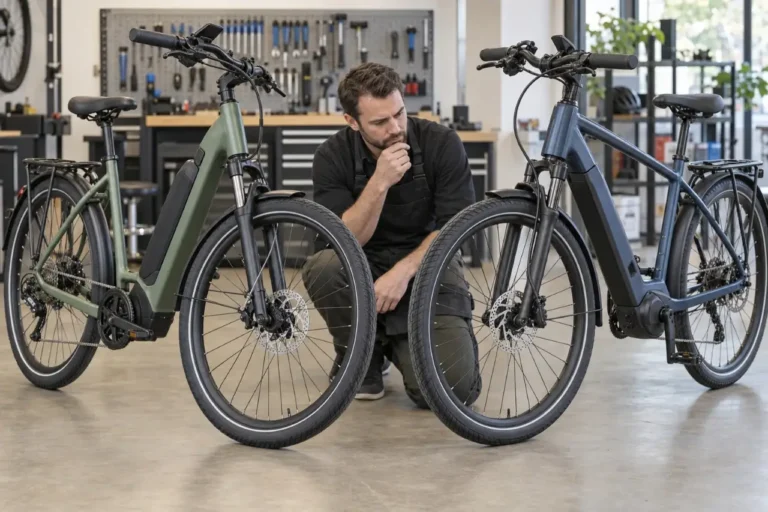
Some manufacturers sell one platform in more than one approved configuration. An authorized dealer may need to confirm the hardware, firmware, labeling, and local-market requirements before applying an official configuration. A menu that can be opened is not, by itself, manufacturer approval.
If the manual does not document the setting, contact the bike manufacturer with the model name, serial number, motor/display version, current class label, and a description of the problem. Ask whether an authorized configuration exists and whether it affects the label, warranty, or permitted use.
Why GoEBikeLife Does Not Provide Bypass Instructions
Online tutorials commonly suggest tuning chips, sensor manipulation, wire changes, or controller reprogramming. This article does not provide those procedures because they defeat a safety- and classification-related control and can create model-specific hazards.
Possible consequences include:
- Incorrect speed data, error codes, or loss of assistance
- Unexpected motor behavior and difficult fault diagnosis
- Higher energy use and reduced range at greater speeds
- Greater loads on brakes, tires, wheels, fork, frame, and steering components
- Loss of warranty coverage for damage connected to unauthorized modification
- A change in the vehicle’s legal treatment or permitted riding locations
The outcome is system-specific. It is inaccurate to claim that every modification automatically voids an entire warranty or always produces the same legal classification. Read the actual warranty terms and ask the manufacturer and insurer how a proposed change would be treated.
Bosch, for example, warns that tuning can create technical and legal consequences, expose components to unplanned loads, and trigger anti-tuning detection on supported systems. That warning is manufacturer-specific. See Bosch’s official e-bike tuning guidance.
Better Ways to Get the Performance You Need
If your bike is not reaching its documented performance, restore it to proper operating condition rather than bypassing a control. Correct tire pressure, eliminate brake drag, use the correct riding mode, maintain the drivetrain, install current manufacturer-approved firmware, and have battery or sensor faults professionally diagnosed.
If you need motor assistance above 20 mph for regular road use, consider a manufacturer-labeled Class 3 model that is lawful for your route. Confirm local access rules first; Class 3 e-bikes may be restricted from some paths and trails even when they are lawful on certain roads.
For power beyond recognized e-bike categories, choose a vehicle designed and legally equipped for the applicable moped, motorcycle, or off-highway category. Do not assume an altered bicycle can be registered after the fact.
Frequently Asked Questions
Can changing the wheel-size setting increase assisted speed?
Entering false wheel-size data may make the controller calculate speed incorrectly. That is sensor manipulation, not a legitimate performance upgrade. Only correct wheel-size data according to the manual or an authorized dealer’s instructions.
Can a Class 2 e-bike be changed to Class 3?
Only when the manufacturer supports that exact configuration and the resulting bike meets applicable labeling and operating requirements. An unsupported speed change does not automatically create a lawful Class 3 e-bike.
Will removing the limiter void the warranty?
It can affect coverage, especially when the modification causes or contributes to the failure. Warranty language varies, so check the written terms instead of assuming the entire warranty is automatically void in every case.
What should I do if assistance cuts out below the specified speed?
Stop trying to increase the limit. Confirm the mode, units, battery state, tire pressure, brake drag, display reading, and any error code. If the problem remains, contact the manufacturer or an authorized e-bike technician for diagnosis.
Bottom Line
Do not cut, disconnect, relocate, or reprogram parts to remove an e-bike speed limit. Use only settings explicitly documented for your exact model and market. When a bike assists below its published cutoff, treat that as a setup, maintenance, battery, or electrical diagnosis—not as a reason to defeat the control. For more assisted speed, a compliant Class 3 e-bike or another properly regulated vehicle is the safer path.