An e-bike battery can seem to drain too quickly for two very different reasons. If charge drops while the bike is parked, look first at shutdown behavior, connected accessories, storage temperature, and battery condition. If range falls mainly while riding, high assist, hills, headwinds, low tire pressure, heavy loads, cold weather, and battery age are more likely causes.
The goal is to reduce avoidable energy use, charge safely, and recognize when unusually fast drain may indicate a maintenance or battery problem.
First, Identify When the Battery Is Losing Charge
Before changing your riding habits, separate parked battery drain from shorter riding range.
- Charge drops while parked: Check whether the bike was fully shut down, whether lights, alarms, trackers, USB accessories, or other electronics can remain active, and whether the owner’s manual describes a sleep or standby mode.
- Charge drops mainly during rides: Look at assist level, throttle use, speed, terrain, wind, tire pressure, cargo, temperature, and riding style.
- Charge drops much faster than it used to under similar conditions: Battery aging, a dragging brake, a tire problem, an electrical fault, or battery damage may be involved.
A smaller-than-expected range does not automatically mean the battery is defective. Range varies with battery capacity, rider and cargo weight, terrain, temperature, wind, tire condition, speed, and assist level. See our guide to why e-bike range drops for a deeper explanation.
Fully Shut the E-Bike Down After Riding
Do not assume a dark display always means every electrical accessory is off. Depending on the e-bike, separately powered or connected equipment such as an alarm, tracker, light system, USB outlet, or communication module may continue to use some energy.
At the end of a ride:
- Use the normal shutdown procedure described in the owner’s manual.
- Confirm that lights and accessory ports are off.
- Disconnect removable USB devices or other accessories that do not need to stay connected.
- If the manufacturer permits battery removal and indoor storage is appropriate, remove the battery before a long period of non-use.
Do not repeatedly power-cycle the bike during normal riding just to save tiny amounts of energy. Proper shutdown after the ride matters more.
Charge Safely With the Correct Charger
Use the charger supplied with the e-bike or a replacement specifically approved by the e-bike or battery manufacturer. A plug that fits does not prove that a charger is compatible. Battery chemistry, charger output voltage and current, connector, polarity, communication requirements, and the manufacturer’s compatibility rules all matter.
For routine charging:
- Follow the charging sequence in the owner’s manual.
- Charge only when you can be present and aware of the charging process.
- Do not charge while sleeping or when nobody is home.
- Unplug the charger when the charge cycle is complete.
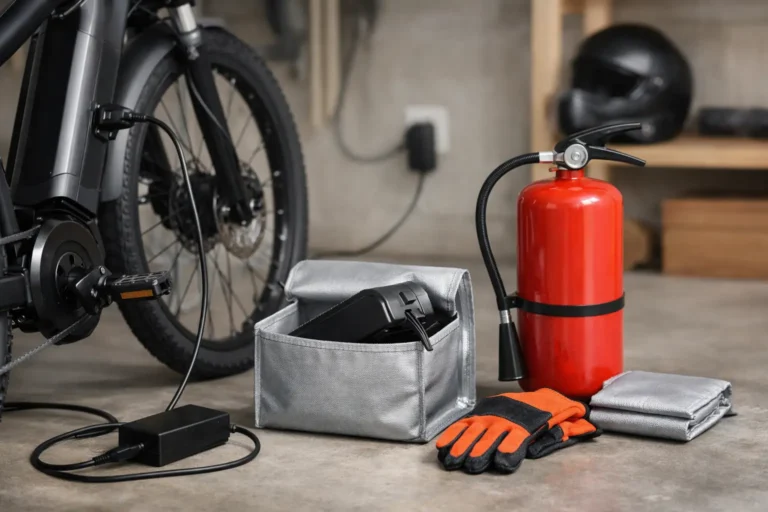
- Charge in a dry, stable area away from heat sources, combustible clutter, and exit paths.
- Do not cover the charger or battery while charging.
Lithium-ion e-bike batteries do not need to be intentionally run to empty before every recharge. Recharge as needed unless the manufacturer says otherwise.
For a fuller charging procedure, read our electric bike charging guide.
Let Battery Temperature Return to a Safe Range Before Charging
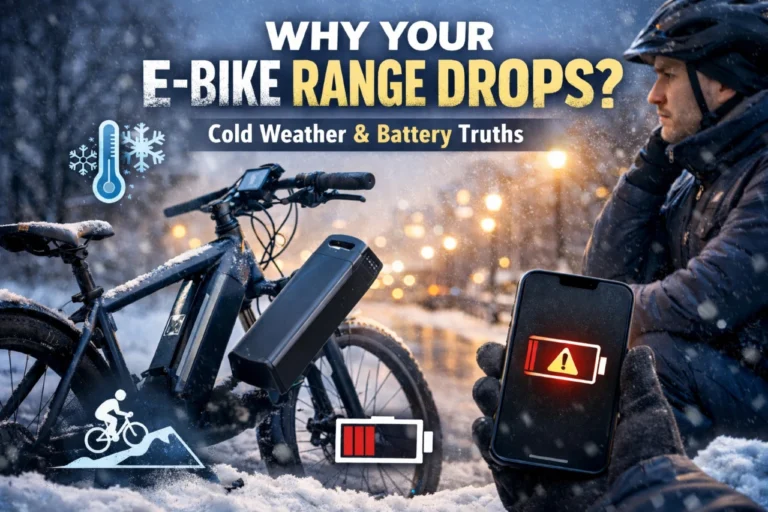
Cold weather can temporarily reduce usable battery power without meaning the pack is permanently damaged. If the manufacturer allows it, storing a removable battery indoors before a cold-weather ride can help preserve range.
More importantly, do not charge a battery outside the charging-temperature range specified by its manufacturer. Limits vary by system. A very cold, unusually hot, wet, or damaged battery should not be charged until the manufacturer’s guidance says it is safe. After a demanding ride, let a warm battery return to its permitted charging range before connecting the charger, and avoid leaving a battery in a closed vehicle or direct sun.
Reduce Battery Drain While Riding
The motor uses more energy when it must provide more assistance or overcome more resistance. Focus on four habits.
Match Assist to the Terrain
Use lower or moderate pedal assist on easier sections and save higher assist for hills, headwinds, heavy loads, or other situations that need it. On a multi-speed e-bike, start in a lower mechanical gear and pedal smoothly before shifting up.
Use the Throttle With Range in Mind
On throttle-equipped e-bikes, extended throttle-only riding generally uses more battery energy than sharing the workload with pedaling. Heavy throttle use can shorten range noticeably.
Keep Tires Properly Inflated
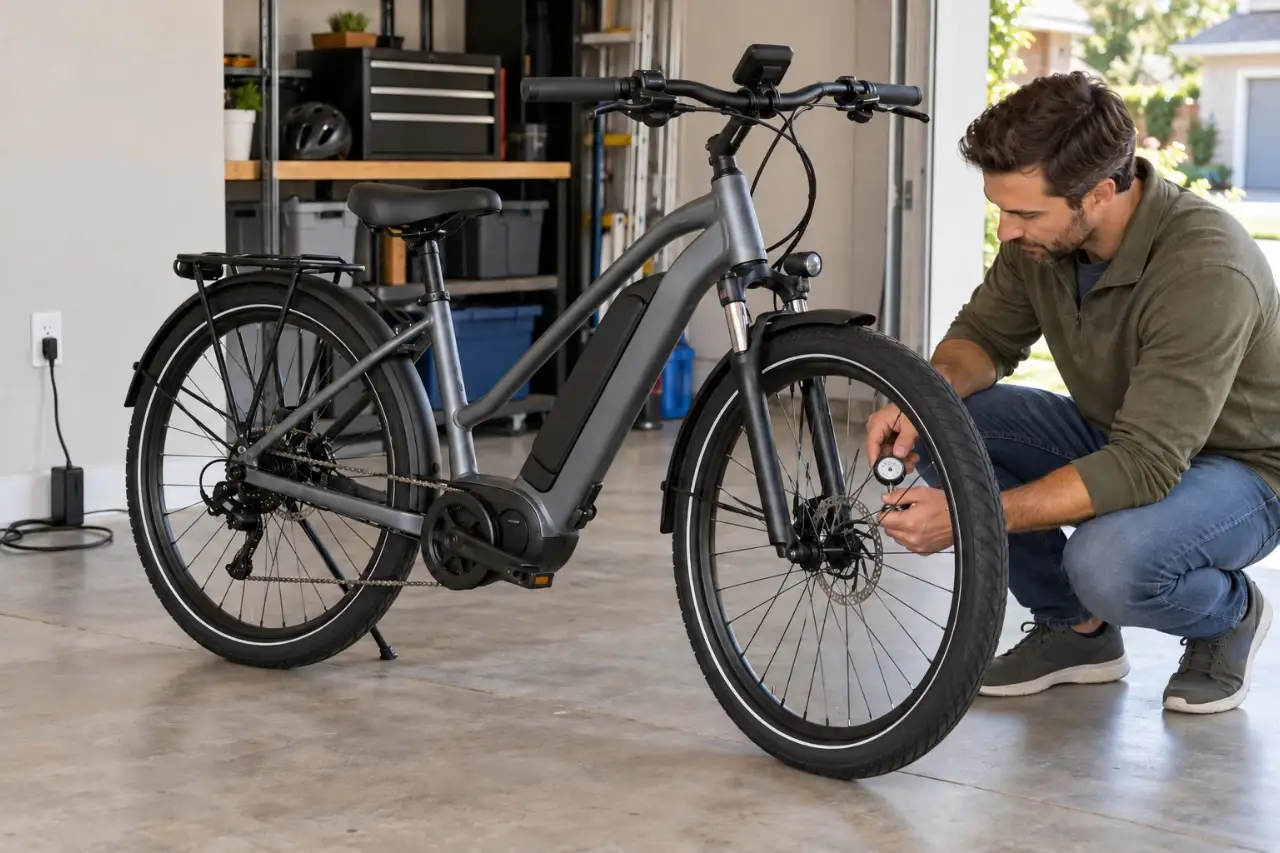
Underinflated tires increase rolling resistance and make the motor work harder. Check pressure with an accurate gauge and follow the tire and e-bike manufacturer’s recommended range. Adjust within that range for rider weight, cargo, tire size, and riding surface rather than automatically using the highest sidewall number.
| Preview | Product | Price | |
|---|---|---|---|

| Airmoto Tire Inflator Portable Air Compressor for Cars, Bikes and Bicycles | Cordless Air… | $89.00 $79.99 | View on Amazon |
Plan for Demanding Conditions
Steep climbs, headwinds, cargo, frequent acceleration, and higher speeds all increase energy use. If several apply to your route, plan for less range than an advertised maximum. Our e-bike range calculator can help compare battery size with terrain, assist level, rider weight, weather, and cargo.
Store the Battery for the Length of the Break
For short gaps between rides, the main priorities are a dry location, moderate temperature, proper shutdown, and protection from damage. For storage lasting weeks or months, follow the battery manufacturer’s stated storage charge and inspection schedule.
Many lithium-ion e-bike systems recommend a partial state of charge for long-term storage, but the exact target varies. Bosch, for example, specifies 30–60%. Do not apply that number automatically to every battery system.
Avoid leaving a lithium-ion battery fully depleted for an extended period. Stored batteries can continue to lose charge, and excessive discharge may eventually prevent normal operation. Keeping some packs at maximum charge for months can also increase cell stress.
Choose a dry location away from sustained heat, direct sunlight, combustible materials, and areas where the battery could be knocked over or damaged. Do not store an e-bike or battery where it blocks an exit.
For seasonal storage details, see how to store an e-bike battery for winter.
Use This Checklist When the Battery Drains Faster Than Expected
| What you notice | What may be happening | What to do next |
|---|---|---|
| Charge falls while the bike is parked | Bike or accessory may not be fully shut down | Follow the normal shutdown procedure and check lights, alarms, trackers, and accessory ports |
| Range drops mostly in cold weather | Temporary cold-related reduction in battery performance | Start with a battery stored within the manufacturer’s permitted temperature range and plan extra range margin |
| Motor seems to work unusually hard | Low tire pressure, dragging brake, heavy load, or difficult terrain | Check tire pressure and have persistent brake drag or mechanical resistance inspected |
| Range has declined gradually over months or years | Battery aging or changes in riding conditions | Compare similar rides and ask the manufacturer or service provider about battery-health diagnostics |
| Battery percentage falls sharply on hills and partly recovers afterward | The display may be estimating state of charge differently under heavy load | Judge the pattern over a full ride and follow any battery-gauge calibration procedure in the owner’s manual |
| Battery loses a large amount of charge while completely shut down | Possible battery, BMS, or electrical-system issue | Stop guessing and contact the manufacturer or a qualified e-bike service provider |
Battery state-of-charge displays are estimates, so plan a reserve for longer rides instead of relying on the final few percent.
Know When Battery Drain Becomes a Safety Issue
Fast drain alone is usually a performance or diagnostic concern. Fast drain combined with physical damage or abnormal heat can be a safety concern.
Stop using and charging the battery if you notice:
- swelling or a change in shape;
- leaking or visible case damage;
- damaged terminals or connectors;
- unusual odor;
- repeated abnormal overheating;
- hissing, popping, or other unusual sounds;
- signs of water intrusion after severe exposure;
- smoke or flames.
Do not open the battery, repair the BMS, replace internal cells, bypass protection circuits, or test damaged internal components yourself.
If a battery is smoking, burning, hissing, or rapidly heating, do not touch or move it. Move people away from the immediate area and follow local emergency-service instructions. For non-emergency damage signs, stop using the battery and contact the manufacturer or a qualified battery service provider. See our guide to e-bike battery damage warning signs for more detail.
When to Ask for Professional Diagnosis
Contact the manufacturer or a qualified e-bike service provider if the battery loses charge much faster than it previously did under similar conditions, loses substantial charge while fully shut down, repeatedly cuts out under ordinary loads, or produces inconsistent behavior that cannot be explained by temperature or riding conditions.
Have the following information ready:
- e-bike make and model;
- battery model, label information, or serial number if available;
- charger model and output information;
- approximate battery age and purchase date;
- recent riding conditions;
- how much charge is lost and over what period;
- whether the drain happens while riding, parked, or both.
That information helps separate normal range variation from a battery, charger, accessory, or electrical-system fault.
Bottom Line
To reduce unnecessary e-bike battery drain, fully shut the bike down after riding, use only the correct manufacturer-approved charger, keep tires properly inflated, match assist to the terrain, and avoid temperature extremes. For long storage, follow the battery maker’s recommended state of charge. If charge disappears while the bike is fully shut down—or the battery shows heat, swelling, odor, leakage, or smoke—stop using it and have the system evaluated.
GoEBikeLife publishes independent e-bike reviews, comparisons, and practical buying guides. Some links on this page are affiliate links. If you make a purchase through an eligible link, we may earn a commission at no additional cost to you.