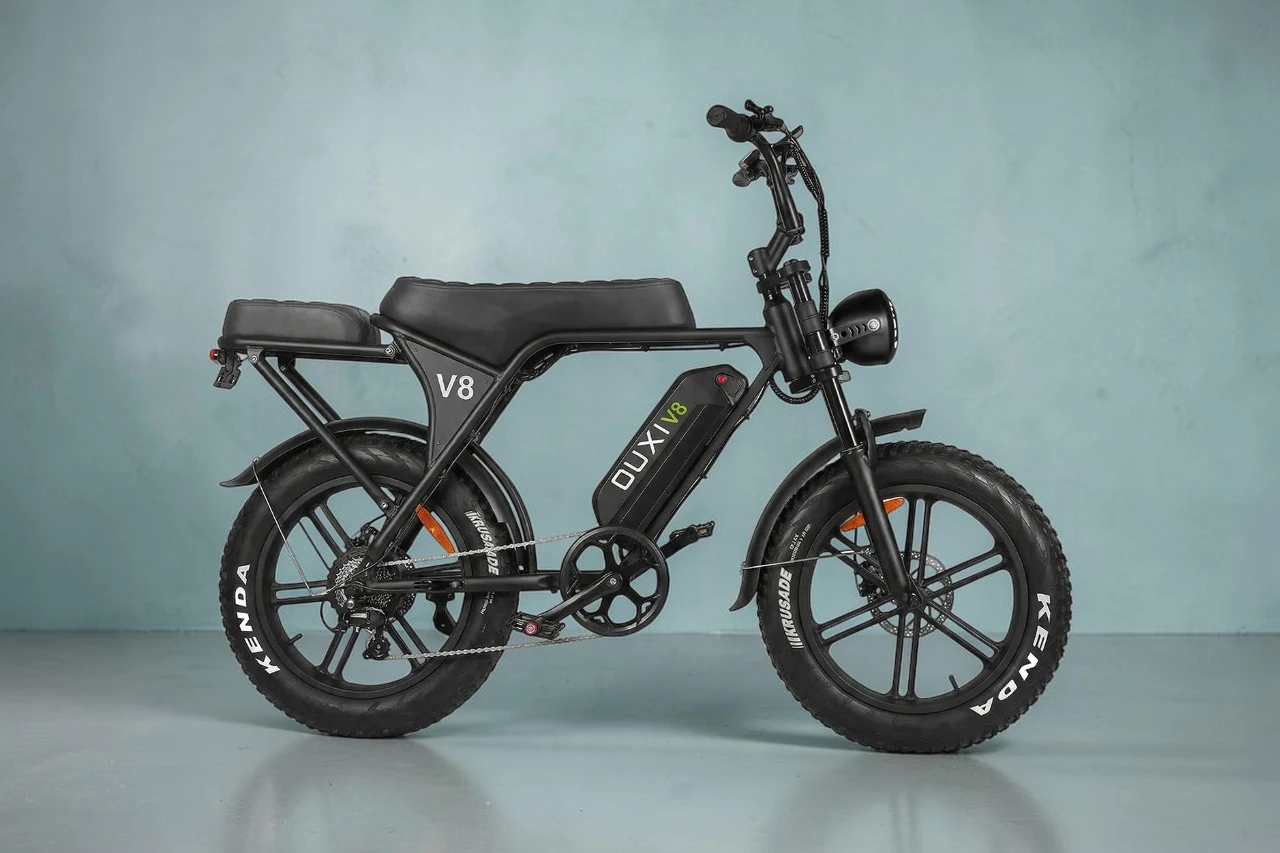
The OUXI V8 is the kind of electric bike that makes a strong first impression. It combines a moped-style frame, a 750W rear hub motor, 20 × 4-inch fat tires, a removable 48V battery, and a long bench seat in a package that is often priced below many conventional commuter e-bikes.
After assembling and riding the V8 on paved trails, neighborhood roads, gravel, grass, and several hills, I came away with a clear view of what this bike does well—and where its low price shows.
The short version is that the OUXI V8 is a fun, comfortable, and reasonably quick budget e-bike for relaxed pavement riding. Its motor handled ordinary hills better than I expected, and its unusually tall riding position gave me more useful pedaling room than most moped-style models. However, the bike is heavy, top-heavy over bumps, and equipped with 160 mm mechanical disc brakes that feel modest for its weight and speed potential.
If you want an affordable neighborhood cruiser, campground bike, or casual moped-style e-bike, the V8 offers a lot for the money. If you want precise handling, strong hydraulic braking, easy portability, or serious off-road capability, this is not the model I would choose.
OUXI V8 Review: Quick Verdict
Overall rating: 7.5/10
The OUXI V8 delivers the style, speed, and equipment many riders want from a budget moped-style e-bike. In my testing, it was comfortable on pavement, provided a usable pedaling position, and reached approximately 27 mph according to GPS. The 750W motor also climbed moderate hills without pedal input.
Its biggest limitations are the 160 mm mechanical disc brakes, heavy 83.77-pound build, optimistic speedometer, and high center of gravity. Those compromises do not ruin the bike, but they define how it should be used: as a casual cruiser rather than an aggressive off-road machine.
What I Like
- Strong value for a moped-style fat-tire e-bike
- Comfortable upright riding position
- Better pedal stroke than many fixed-seat moped-style bikes
- Approximately 27 mph GPS-tested top speed
- Capable 750W motor for ordinary hills and everyday riding
- Removable 48V 15Ah battery
- 20 × 4-inch fat tires provide stability on pavement and mild loose surfaces
- Five pedal-assist levels plus throttle control
- Integrated headlight, taillight, brake light, horn, and turn signals
- Rear rack, passenger-style pad, and foot pegs add versatility
- Alarm system and key fob included on the tested bike
What Could Be Better
- 160 mm mechanical disc brakes are undersized for a bike this heavy and fast
- Tall, top-heavy feel reduces confidence over rough or uneven terrain
- Built-in speedometer became increasingly inaccurate at higher speeds
- At 83.77 pounds, the bike is difficult to carry and unpleasant to pedal without assistance
- Rear rack and taillight installation required extra cable routing work
- Passenger pad fit was awkward on the tested bike
- Battery gauge is not precise enough to validate the advertised range
- Official product information conflicts over whether the bike uses a cadence or torque sensor
- High handlebar and seat position may not suit shorter riders or low-roof vehicle transport
OUXI V8 Specifications
| Specification | OUXI V8 |
|---|---|
| Bike type | Moped-style fat-tire electric bike |
| Motor | 750W brushless rear hub motor |
| Claimed peak output | 1,000W |
| Claimed torque | Up to 80 Nm |
| Claimed top speed | Up to 32 mph |
| GPS-tested top speed | Approximately 27 mph |
| Battery | Removable 48V 15Ah lithium-ion |
| Battery capacity | 720Wh |
| Claimed throttle range | Up to 37 miles |
| Claimed pedal-assist range | Up to 60 miles |
| Charging time | Approximately 5–7 hours |
| Pedal assist | Five levels |
| Throttle | Quarter-twist throttle on the tested bike; listings may vary |
| Drivetrain | Shimano 7-speed |
| Rear derailleur | Shimano Tourney |
| Brakes | Front and rear 160 mm mechanical disc brakes on the tested bike |
| Tires | 20 × 4.0-inch fat tires |
| Suspension | Front suspension fork |
| Frame | High-carbon steel |
| Lights | LED headlight, taillight, brake light, and rear turn signals |
| Display | M5-style LCD |
| Water-resistance rating | IP54 |
| Bike weight | 83.77 lbs |
| Maximum load | 330 lbs |
| Recommended rider height | 5’4″–6’5″ |
| Seat height | 33.46 inches |
| Overall dimensions | 65 × 25.6 × 43.3 inches, according to the main specification table |
Specifications and included equipment can change between production batches and sellers. The official page also lists a 66.14-inch total length and 45.66-inch handlebar height. Confirm the current Amazon listing before ordering.
How I Tested the OUXI V8
My riding included paved multi-use trails, neighborhood streets, grass, gravel, moderate inclines, and two more demanding hill-climb attempts. The primary test rider was 5’10” with a 30-inch inseam and weighed approximately 200 pounds. The bike weighed about 84 pounds with the rear rack installed.
I used the built-in display and a separate GPS device to compare speed readings. I also tested all five pedal-assist levels, a throttle-only start, braking, practical pedaling, moderate off-pavement riding, and climbing from both a dead stop and a rolling start.
This was not a laboratory range test. The 14-mile ride included full-power acceleration, speed testing, and faster riding, so it should not be treated as a maximum-range result.
Assembly: Mostly Manageable, With One Frustrating Detail
Basic assembly was not especially difficult, but the V8 had a few quirks worth knowing about before you begin.
The handlebar stem on the tested bike appeared upside down and backward in the box, so I had to remove it, rotate it, and reinstall it in the correct orientation. The front fork uses open dropouts, which made positioning the front wheel relatively straightforward. I slid the wheel into place, carefully aligned the brake rotor between the pads, installed the axle hardware, and tightened everything securely.
The rear rack itself also mounted without much trouble. The frustrating part was moving the taillight from its original position to the back of the rack. The available wire was too short to reach comfortably while retaining the original routing. I removed the main seat, cut several zip ties, repositioned the controller, rerouted the taillight cable, and secured the wiring again.
That solved the immediate problem, but it put more tension on other wires than I would prefer. A few extra inches of taillight cable would have made the installation much cleaner and easier.
The removable rear passenger-style pad was another awkward fit. Its locating tabs must drop into the rack and slide forward, but the front of the pad pressed closely against the main seat support. I was able to secure it with the locking screw, although I would probably remove the pad and use the area as a cargo rack for everyday riding.
My advice is to allow extra assembly time, inspect all cable routing, and have a professional bicycle mechanic check the brakes, axle hardware, handlebar, and electrical connections if you are not comfortable assembling a heavy e-bike yourself.
Motor Performance: Useful Power, Not Extreme Acceleration
OUXI lists the V8 with a 750W brushless motor, up to 1,000W peak output, and up to 80 Nm of torque. On the road, the motor felt appropriately strong for an affordable single-motor fat-tire bike.
A throttle-only launch from a stop had respectable pull, although it was not violently quick. The acceleration is suitable for casual street and trail use, and the bike has enough extra power to build speed without feeling strained on flat ground.
The motor’s strongest practical advantage was hill climbing. From a dead stop and without pedaling, the V8 climbed my moderate test hills successfully. It also reached the top of a steeper gravel incline, though the climb was slow.
The bike did not climb my steepest test hill on throttle power alone. With a rolling start, first gear, and substantial pedal effort, I was eventually able to make it up. That is a fair result for this price and motor class, but it does not support treating the V8 as a machine that will effortlessly conquer every 35-degree slope.
OUXI advertises a maximum climbing angle of up to 35 degrees. In real riding, grade length, surface grip, rider weight, battery charge, and whether the rider pedals all make a major difference. I would consider the V8 capable on ordinary neighborhood hills, but not a substitute for a higher-torque mid-drive or more powerful dual-motor e-bike on sustained, extremely steep terrain.
Speed Test: About 27 MPH by GPS
The official maximum-speed claim is up to 32 mph. The V8’s display showed a little over 31 mph during my test and had previously indicated approximately 32 mph. My separate GPS device, however, showed a top speed of about 27 mph.
The display was reasonably close at lower speeds but drifted further from the GPS reading as speed increased. Here is what I observed while pedaling through the assistance levels:
| Assist level | Display reading | GPS reading |
| PAS 1 | About 9 mph | About 8 mph |
| PAS 2 | About 13 mph | About 12 mph |
| PAS 3 | About 18 mph | About 17 mph |
| PAS 4 | About 23 mph | About 22 mph |
| PAS 5 | About 31 mph | About 27 mph |
These are observations from one bike under one set of conditions, not guaranteed speeds for every rider. Even so, I would use approximately 27 mph—not the display’s 31–32 mph reading—as the more credible real-world result from this test.
That is still plenty of speed for a budget moped-style e-bike. It also makes the braking limitations more important. Riders should check their local e-bike laws before using the V8 on public roads or trails, because a throttle-equipped bike capable of exceeding 20 mph may not fit local Class 2 rules, and speeds above 28 mph can fall outside the standard three-class e-bike framework.
Battery and Real-World Range
The V8 uses a removable 48V 15Ah battery with 720Wh of nominal capacity. It can be charged on or off the bike, which is useful if the bike is stored away from an electrical outlet. OUXI lists an approximate charging time of five to seven hours and rates the battery enclosure at IP54.
OUXI claims up to 37 miles in electric-only mode and up to 60 miles with pedal assist. I did not reproduce either figure during this test, and those numbers should be treated as best-case manufacturer estimates.
On my 14-mile test ride, I used full-power starts, top-speed runs, and PAS 3 for much of the route. The display showed four of ten battery bars near the end. Because basic bar-style battery gauges can drop unevenly and are affected by voltage sag under load, that result cannot be reliably converted into a total range estimate.
What it does show is that the bike completed 14 demanding miles without running out of power. A lighter rider using PAS 1 or 2 on flatter terrain should go farther. A heavier rider relying on the throttle, riding quickly, climbing hills, or using low tire pressure should expect less than the advertised maximum.
For practical planning, I would build in a generous reserve rather than assuming the bike will deliver 37 or 60 miles on every charge. Temperature, stop-and-go acceleration, wind, terrain, payload, battery age, and tire pressure can all change the result substantially.

Pedaling and the Five Assist Levels
One of the biggest surprises was how usable the pedals felt. Moped-style e-bikes often position their fixed bench seats too close to the crank, leaving the rider’s knees bent and making the pedals feel like little more than a legal formality.
The V8 sits higher and gives the rider more distance between the seat and pedals. I could not achieve the full leg extension of a correctly fitted conventional bicycle, but I could produce meaningful pedal force at moderate speeds. At approximately 17 mph in PAS 3, I was able to contribute instead of simply spinning the cranks without resistance.
That makes the V8 more enjoyable on longer casual rides and can reduce battery consumption. In PAS 4 and 5, motor speed becomes too high for comfortable pedaling with the stock 7-speed gearing, so ghost pedaling is still likely at the upper end.
With assistance switched off, I could maintain roughly 6 mph in a lower gear, but moving an 84-pound fat-tire bike under leg power alone was not enjoyable. Owners should keep the battery charged and avoid planning routes that leave no energy reserve for the return trip.
Cadence Sensor or Torque Sensor?
OUXI’s current product page contains conflicting information. A promotional feature tile says “Torque Sensor,” while the detailed specification table lists “5 Levels (Cadence Sensor).” The step-like way assistance increased between levels during my ride was consistent with a cadence-based system, but that observation is not enough to identify the installed sensor conclusively.
Until OUXI or the seller confirms the exact hardware for the production batch being sold, I would not buy the V8 specifically for torque-sensor assistance. Ask the seller to confirm the sensor type in writing if this feature matters to you.
Ride Comfort: Very Good on Pavement
On pavement and smooth crushed-gravel trails, the V8 was comfortable. The extended seat, upright torso position, 20 × 4-inch tires, and front suspension reduced vibration and made relaxed cruising easy. I could imagine using it for long campground loops, boardwalk-style paths where permitted, neighborhood errands, or an unhurried weekend ride.
The tall seat and handlebar position also gave me a roomy cockpit. Taller riders may appreciate that extra space, especially compared with compact moped-style e-bikes that feel cramped.
There is an important trade-off: the same height that improves legroom raises the center of gravity. At higher speed, a sharp bump can make the bike feel bouncy and less settled. The front suspension absorbs some impact, but the overall chassis still feels stiff and top-heavy on rough ground.
For my 5’10” height and 30-inch inseam, the bike was manageable, but it clearly did not feel like a low-slung mini bike. OUXI recommends riders from 5’4″ to 6’5″; I would urge someone near the lower end of that range to confirm the 33.46-inch seat height and test their ability to balance the bike before buying.
Handling and Off-Road Performance
The V8 looks rugged, and the fat tires can handle pavement, grass, firm dirt, and moderate gravel. That does not make it a true aggressive off-road e-bike.
When I entered rougher wooded terrain, every larger dip and bump emphasized the bike’s high center of gravity. I reduced the assistance level and slowed down because the chassis could bounce and change direction more abruptly than I wanted. On loose gravel, the same height and weight made careful speed control important.
The V8 is acceptable for occasional mild off-pavement use, particularly if the surface is predictable and the rider remains conservative. I would not use it for technical trails, jumps, deep ruts, fast descents, or high-speed riding over repeated bumps.
Its best environment is smooth pavement, residential roads, paved or well-maintained multi-use trails where e-bikes are allowed, and mild campground surfaces. That is where the stable fat tires and comfortable seating work in its favor without exposing the handling limitations.
Braking: The Main Weak Point
The biggest issue in my review was braking. The tested V8 used 160 mm mechanical disc brakes. Mechanical brakes can be perfectly serviceable, but 160 mm rotors are modest for a bike that weighs roughly 84 pounds before adding a rider or cargo and can approach 27 mph by GPS.
The brakes were not fully bedded in at the beginning of the test, so I expected some improvement with use. Even with properly bedded pads, however, larger rotors or hydraulic brakes would provide a more appropriate level of power and control for this platform.
On ordinary flat-ground riding, the brakes were adequate when I planned my stops. On the steepest descent, I deliberately reduced my speed because I did not want to rely on them for a hard, high-speed stop. That caution is especially important in rain, with extra cargo, or if the bike is loaded near its 330-pound maximum.
New owners should bed in the pads correctly, check rotor alignment, verify cable tension frequently, and leave more stopping distance than they would on a lighter bicycle. If the levers feel spongy, the pads are contaminated, or braking power is inconsistent, stop riding and have the system inspected.
For me, the brakes are the clearest reason not to treat the V8’s speed as an invitation to ride aggressively.
Drivetrain and Controls
The Shimano Tourney rear derailleur and 7-speed shifter are basic but familiar. They are not premium components, yet they are widely used, easy to understand, and suitable for the V8’s price point. The relatively large front chainring helps make pedaling useful at moderate assisted speeds.
The tested bike used a quarter-twist throttle. The control cluster also included buttons for the headlight, horn, and rear turn signals. Five pedal-assist levels are selected from the handlebar controls, and the M5-style LCD shows speed, trip data, mileage, assistance level, and battery status.
The display was easy enough to read, but the high-speed inaccuracy means I would not rely on it as a precise speed measurement. The battery bars are also better treated as a general status indicator than a dependable remaining-range estimate.
Lights, Turn Signals, Alarm, and Security
The V8 includes more electronic features than I normally expect at this price. The large front LED light was bright, and the rear light on the tested bike also functioned as a brake light. Integrated rear turn signals can make a rider’s intentions more visible, although they do not replace checking behind you or using hand signals where appropriate.
The tested bike also came with an alarm and remote key fob. After arming the system, movement or an attempted startup triggered an audible warning. This is a useful deterrent, but it is not a replacement for a high-quality lock secured to an immovable object. The remote also included buttons for locating or controlling the bike.
The official page advertises NFC unlocking, while the tested bike’s most obvious security feature was the remote alarm system. This may reflect a model-year or production-batch change. Confirm exactly which unlocking method and accessories are included with the listing you plan to purchase.
Rear Seat and Cargo Practicality
The rear rack, padded passenger-style section, and foot pegs give the V8 a two-seat appearance. In practice, I preferred the idea of removing the small rear pad and using the rack for cargo. The pad’s fit was tight against the main seat structure, and the rack installation complicated the taillight wiring.
Before carrying another person, verify that the rack, pad, pegs, frame, and brakes are specifically rated for passenger use—not merely shown that way in promotional photos. The 330-pound maximum load should include the rider, any passenger, accessories, and cargo. Local laws may also restrict passengers on e-bikes, particularly when the bike lacks equipment required for passenger transport.
Given the braking performance I observed, I would be especially conservative about adding a passenger or heavy load.
Fit, Weight, and Portability
At 83.77 pounds, the V8 is not easy to lift. The long frame, fat tires, tall handlebar, and fixed bench-style seat also make it awkward to fit into a small vehicle or onto many standard bicycle racks.
The tall handlebar position was high enough that I would not assume the bike could stand upright inside a van simply because another moped-style e-bike can. Any vehicle rack must be rated for the V8’s actual weight, and many racks are not designed for an 84-pound bike. Removing the battery before lifting can reduce weight, but the remaining bike is still heavy.
OUXI lists a rider-height range of 5’4″ to 6’5″. The roomy layout should work particularly well for average-height and taller riders who find other moped-style bikes cramped. Shorter riders should pay close attention to balance at stops because the seat is not adjusted like a conventional saddle and the bike carries substantial weight.
Build Quality and Value
The V8 feels built to reach an aggressive price, and that is both its appeal and its limitation. The steel frame, fat tires, lights, rack, alarm, removable battery, Shimano drivetrain, and 750W motor form an impressive equipment list for the money. The bike delivered a genuinely enjoyable ride on the surfaces that suited it.
At the same time, cost-cutting is visible in the mechanical brakes, basic drivetrain, plastic fenders and chain guard, awkward accessory fit, and tight wiring around the rear rack. None of those details is surprising on a budget e-bike, but buyers should understand that low purchase price does not eliminate the need for careful assembly, adjustment, and ongoing maintenance.
The V8 is good value if you judge it as an inexpensive casual cruiser. It is less compelling if you expect the refinement, braking confidence, handling, and dealer support of a more expensive e-bike.
Who Should Buy the OUXI V8?
The OUXI V8 makes the most sense for riders who:
- Want a low-cost moped-style fat-tire e-bike
- Primarily ride on pavement, neighborhood roads, or smooth paths
- Value an upright position and long, supportive seat
- Want throttle control and enough speed for lively casual riding
- Appreciate lights, turn signals, an alarm, and a rear rack
- Are comfortable maintaining mechanical brakes and checking hardware
- Have secure ground-level storage for a heavy bike
Who Should Skip It?
I would look elsewhere if you:
- Plan to ride technical or aggressive off-road trails
- Regularly descend steep hills or need strong hydraulic braking
- Need to carry the bike upstairs or load it into a vehicle frequently
- Want a lightweight, nimble commuter
- Are a shorter rider who is uncomfortable balancing a tall fixed-seat bike
- Need a verified torque-sensor system
- Expect the advertised 32 mph display reading to equal GPS speed
- Need a fully confirmed long-distance range without carrying out your own route-specific test
OUXI V8 Review: Final Verdict
The OUXI V8 is not a premium e-bike disguised by a budget price. It is an affordable moped-style cruiser that succeeds because it concentrates on the features many casual riders notice first: a strong-looking frame, fat tires, comfortable seating, a useful 750W motor, throttle control, integrated lighting, and near-28-mph real-world speed.
I enjoyed the V8 most on pavement, where the upright position and usable pedal stroke made it easy to settle into a relaxed ride. Its motor handled normal hills well, and the bike offered more practical pedaling than I expected from this style.
The trade-offs are equally clear. The high center of gravity makes rough terrain feel bouncy, the bike is heavy and difficult to transport, and the 160 mm mechanical brakes deserve caution. The speedometer also overstated my top speed, and the product information leaves unresolved questions about the pedal-assist sensor and some included security features.
For a rider who understands those limitations and wants an inexpensive neighborhood or campground cruiser, the OUXI V8 can be a fun, worthwhile purchase. I would keep it on relatively smooth surfaces, ride within the brakes’ limits, and verify the exact specifications and warranty offered by the seller before ordering.
| Preview | Product | Price | |
|---|---|---|---|

| OUXI V8 Electric Bike – 20″ Fat Tire Peak 1500W Ebike for Adults | $669.99 | View on Amazon |
Frequently Asked Questions
How fast is the OUXI V8?
OUXI advertises a top speed of up to 32 mph. During my test, the bike’s display showed approximately 31 mph while a separate GPS showed about 27 mph. Actual speed will vary with rider weight, battery charge, terrain, settings, tire pressure, and production configuration.
How far can the OUXI V8 travel on one charge?
OUXI claims up to 37 miles using electric power and up to 60 miles with pedal assist. I completed a demanding 14-mile ride with battery bars remaining, but I did not perform a controlled full-discharge test and cannot independently verify the maximum claims.
Can the OUXI V8 climb hills?
The 750W motor climbed moderate paved hills from a stop without pedaling during my test. It also climbed a steeper gravel hill slowly. The bike could not climb my steepest test hill on motor power alone and required a rolling start, low gear, and substantial pedal effort.
Is the OUXI V8 good for off-road riding?
It can handle grass, firm dirt, and moderate gravel at conservative speeds, but I do not recommend it for technical trails or aggressive off-road riding. Its tall seating position and high center of gravity make it feel bouncy and less predictable over large bumps and dips.
Does the OUXI V8 have hydraulic brakes?
No. The tested bike had front and rear 160 mm mechanical disc brakes. They were adequate for planned stops during casual riding, but I would prefer larger rotors or hydraulic brakes on a bike of this weight and speed.
Does the OUXI V8 use a torque sensor?
The official product page is inconsistent. One feature graphic advertises a torque sensor, while the detailed specification table lists a cadence sensor. Confirm the sensor type with the seller for the exact bike and production batch before ordering.
Is the battery removable?
Yes. The 48V 15Ah battery can be charged on or off the bike. Always use the supplied compatible charger and follow the manufacturer’s charging and storage instructions.
Is the OUXI V8 suitable for shorter riders?
OUXI recommends a rider height of 5’4″ to 6’5″, but the fixed seat is approximately 33.46 inches high and the bike weighs nearly 84 pounds. Riders near the lower end of the range should verify that they can balance and control the bike comfortably at a stop.
Does the OUXI V8 carry a passenger?
The bike is shown with a rear pad and foot pegs, but buyers should confirm that the current model is officially rated for passenger use and that the combined load remains within the 330-pound limit. Local passenger rules vary, and the braking system should also be considered before adding weight.
Is the OUXI V8 UL certified?
OUXI’s current product page states that its electric bicycles have passed UL 2849 electrical-system and UL 2271 battery certification. Certification can be model- and production-specific, so buyers who require proof should confirm that the exact V8 listing and battery they receive are covered by a valid certification record.
What warranty does the OUXI V8 include?
Warranty information appears to vary. OUXI’s current product page advertises a two-year warranty, while some supplied or retailer information may show one year. Check the seller’s written warranty, coverage exclusions, return terms, and responsibility for shipping before purchase.
GoEBikeLife publishes independent e-bike reviews, comparisons, and practical buying guides. Some links on this page are affiliate links. If you make a purchase through an eligible link, we may earn a commission at no additional cost to you.