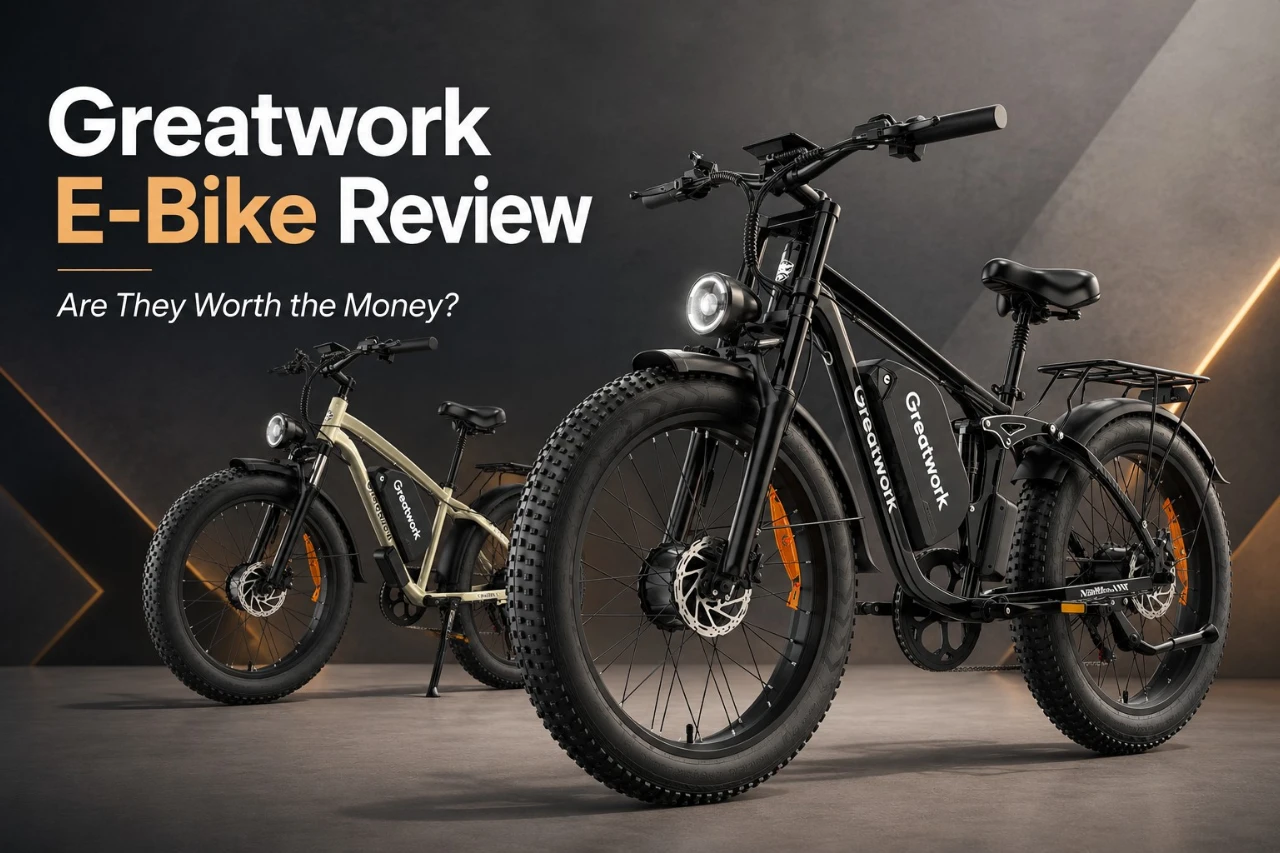
Greatwork is a Chinese e-bike brand that has gained attention in the US market by pairing large battery capacities and high peak motor ratings with competitive price points. If you’re researching whether Greatwork e-bikes deliver real value, the short answer is: they can, for the right rider.
GoEBikeLife’s quick verdict: Greatwork offers strong specification value for riders who prioritize power, battery size, and fat-tire capability, but the right model depends on your vehicle type preference, intended terrain, and realistic expectations about build quality and long-term support.
Before comparing models, one distinction matters a lot. The M8 Pro, M8, and R8 are electric bicycles with pedals, gears, and pedal-assist systems. The K7 and K7 Pro are seated electric scooters built on a motorcycle-inspired frame with no traditional pedaling drivetrain. They are not the same type of vehicle, and choosing between them comes down to whether you want a bike or a scooter.
All five models use peak power ratings in their names rather than continuous output. A “5000W peak” motor typically runs at a lower continuous wattage during normal riding. Keep that in mind when evaluating speed and hill-climbing claims.
Best for high-performance off-road and mountain riding: GREATWORK M8 Pro Dual Motor E-Bike
Best for value-focused high-power fat-tire riding: GREATWORK M8 Dual Motor E-Bike
Best for motorcycle-style comfort and long-range commuting: GREATWORK R8 Motorcycle-Style E-Bike
Best seated electric scooter for extended range urban use: GREATWORK K7 Pro Seated Electric Scooter
Best seated electric scooter for casual short-trip commuting: GREATWORK K7 Seated Electric Scooter
1. GREATWORK M8 Pro Dual Motor Fat-Tire E-Bike

The M8 Pro is Greatwork’s highest-spec electric bicycle, combining a dual-motor drivetrain with a large battery and full suspension for riders who want maximum off-road capability in the lineup.
Best for: Riders who need dual-motor traction on steep or technical terrain and want the most powerful Greatwork e-bike available.
Not ideal for: Urban commuters, riders who need a lightweight bike, or anyone who primarily rides paved roads.
Key strength: Switchable dual-motor system with manufacturer-rated 5000W peak output and 180 Nm of torque.
Main trade-off: At 87 pounds, the M8 Pro is heavy enough that portability becomes a genuine concern for storage, transport, and lifting.
| Spec | M8 Pro Details |
|---|---|
| Peak Power | 5000W (dual motor) |
| Battery | 52V 25Ah (1300Wh) |
| Claimed Top Speed | 45 mph |
| Claimed Range | Up to 100 miles (PAS), 60 miles (electric) |
| Tire Size | 26″ x 4.0″ fat tire |
| Suspension | Full (front fork + rear shock) |
| Brakes | Dual hydraulic disc |
| Weight | 87 lbs |
| Payload | 330 lbs |
The dual-motor system is one of the M8 Pro’s defining features. A button on the left handlebar switches between single and dual motor modes, so riders can conserve battery on flat ground and engage both motors for climbs or loose terrain. Manufacturer-rated hill-climbing is not explicitly stated in degrees for this model, though the torque figure suggests strong capability on grades.
The 1300Wh battery is large for this price range. Claimed range of 100 miles in PAS mode is optimistic under real-world conditions; expect meaningful reduction at higher assist levels, in hilly terrain, or at heavier rider weights. The 8 to 9 hour charge time is longer than many competitors.
Hydraulic disc brakes are the right choice at the speeds this bike is capable of reaching. The 3.5-inch LCD display covers all key ride metrics. Integrated turn signals and a rear rack add practical daily-use value.
Compared to the M8 (the standard dual-motor variant), the M8 Pro adds approximately 5 pounds of weight and offers slightly different build specifications in the same power class.
Pros:
- Switchable single/dual motor adds flexibility for battery management
- 1300Wh battery is large relative to the price point
- Hydraulic brakes appropriate for 45 mph-rated speeds
- Full suspension with rear shock absorber included
- Rear rack, turn signals, and mudguards included at no extra cost
Cons:
- 87 lbs makes storage and transport difficult without a dedicated space
- 8 to 9 hour charge time is longer than average
- Claimed range figures are optimistic under real riding conditions
The M8 Pro is worth considering if you want the most capable Greatwork e-bike and have a place to store something this heavy. If you ride primarily on pavement or need a bike you can move easily, the standard M8 or R8 are better fits.
2. GREATWORK M8 Dual Motor Fat-Tire E-Bike

The M8 is the standard dual-motor model in Greatwork’s lineup, sharing the core power platform with the M8 Pro while coming in slightly lighter and carrying UL 2849 battery safety certification.
Best for: Riders who want high-power dual-motor performance with a UL-certified battery and all-terrain fat-tire capability.
Not ideal for: Casual commuters looking for a lighter, easier-to-manage bike.
Key strength: UL 2849 battery safety certification, which provides documented electrical safety assurance that the M8 Pro listing does not explicitly mention.
Main trade-off: At 82 pounds, the bike is still heavy, and claimed range figures need to be treated as best-case numbers.
| Spec | M8 Details |
|---|---|
| Peak Power | 5000W (dual motor) |
| Battery | 52V 25Ah (1300Wh), UL 2849 certified |
| Claimed Top Speed | 45 mph |
| Claimed Range | Up to 100 miles (PAS), 60 miles (electric) |
| Tire Size | 26″ x 4.0″ fat tire |
| Suspension | Dual front fork |
| Brakes | Dual hydraulic disc |
| Weight | 82 lbs |
| Payload | 250 lbs |
The M8 runs the same 5000W peak dual-motor platform and 1300Wh battery as the M8 Pro. The main specification difference is that the M8 uses dual front fork suspension rather than the full front-plus-rear setup on the M8 Pro, and it is listed at 82 pounds versus 87 pounds.
The UL 2849 certification is meaningful for US buyers. It indicates the battery and electrical system have been independently tested against a recognized safety standard, which is relevant for home charging and insurance considerations.
Six riding modes give the M8 more flexibility than many competitors: dual motor electric, single motor electric, pedal assist, normal bike, cruise, and walk mode. The 7-speed gear system adds further range to terrain adaptability.
Manufacturer-rated hill-climbing is 40 degrees, which is steep for an e-bike claim. Treat that figure as a best-case rating under ideal conditions.
Pros:
- UL 2849 certified battery adds electrical safety assurance
- Six riding modes including dual and single motor switching
- Slightly lighter than the M8 Pro at 82 lbs
- Hydraulic brakes with 2-second stopping claim
- 1300Wh battery capacity is competitive
Cons:
- No rear suspension (dual front fork only, unlike the M8 Pro’s full suspension)
- 82 lbs is still heavy for everyday handling
- Claimed 40-degree hill-climbing angle is aggressive and may not reflect typical conditions
The M8 is the more practical choice between the two dual-motor options for most buyers. The UL battery certification adds peace of mind, and the slightly lower weight is a small but real advantage. If rear suspension matters to you, the M8 Pro has it; the M8 does not.
3. GREATWORK R8 Motorcycle-Style Fat-Tire E-Bike

The R8 is a retro motorcycle-style electric bike built around a comfort-forward design: a long padded seat, a steel frame, and a six-point full suspension system that prioritizes smooth riding on rough surfaces.
Best for: Riders who want a moped-inspired format, a comfortable long-distance ride feel, and everyday commuting capability without the complexity of a dual-motor system.
Not ideal for: Mountain trail riders who need maximum traction or riders who want to reach speeds above 37 mph.
Key strength: Six-level full suspension system including two front fork absorbers, a rear spring shock, and fat tires that collectively reduce road impact more aggressively than simpler suspension setups.
Main trade-off: Single 2500W peak motor versus the dual-motor M8 and M8 Pro, meaning less raw power for steep climbs and faster acceleration.
| Spec | R8 Details |
|---|---|
| Peak Power | 2500W (single motor) |
| Battery | 48V 25Ah (1200Wh) |
| Claimed Top Speed | 37 mph |
| Claimed Range | Up to 100 miles (PAS), 40 to 60 miles (electric) |
| Tire Size | 20″ x 4.0″ fat tire |
| Suspension | Full (6-level: 2 front fork, 1 rear spring, 2 fat tires, 1 long soft seat) |
| Brakes | Front and rear disc |
| Frame | Carbon steel |
| Weight | 80.5 lbs |
| Payload | 330 lbs |
The R8 uses a 20-inch fat tire rather than the 26-inch tires on the M8 and M8 Pro. Smaller wheels lower the center of gravity and can improve low-speed handling, but they reduce roll-over capability on rough terrain compared to larger-diameter tires.
The steel frame adds durability and a solid ride feel, but steel is heavier than aluminum. At 80.5 pounds, the R8 is only slightly lighter than the M8 Pro despite having a smaller motor and battery.
Manufacturer-rated hill-climbing is 35 degrees. Five riding modes cover pure electric, pedal assist, normal bike, cruise, and walk. The thumb-style gear shifter is a practical choice for the commuter-focused format.
Disc brakes on both ends are appropriate for a bike rated to 37 mph. The LCD display, turn-indicator taillights, and bright LED headlight support daily commuting and night riding.
Pros:
- Six-point suspension system is the most comprehensive in the Greatwork lineup
- Moped-inspired design with long padded seat is comfortable for extended rides
- Well-rated relative to the M8 and M8 Pro based on available reviews
- 1200Wh battery supports long-range PAS riding
- 90% pre-assembled, slightly easier than the M8 Pro’s setup
Cons:
- Single-motor 2500W peak is significantly less powerful than the dual-motor M8 siblings
- 20-inch wheels limit capability on technical mountain terrain
- Steel frame adds weight without saving cost meaningfully
- Disc brakes rather than hydraulic brakes, which is a downgrade from the M8 and M8 Pro
The R8 suits riders who want comfort and commute-friendly design more than raw off-road performance. If you need maximum climbing power or higher top speeds, the M8 or M8 Pro are the better picks. For relaxed, longer-distance rides on mixed terrain, the R8’s suspension comfort and riding format are its strengths.
4. GREATWORK K7 Seated Electric Scooter

The K7 is a seated electric scooter, not an electric bicycle. It has no pedal drivetrain, no gear shifter, and no pedal-assist system. It is a throttle-operated scooter designed for short urban trips and casual commuting.
Best for: Urban riders who want a compact, motorcycle-style seated scooter for errands, short commutes, and neighborhood riding at moderate speeds.
Not ideal for: Anyone expecting bicycle-style pedaling capability, longer trips, or hill-heavy routes.
Key strength: Motorcycle-inspired styling with a large basket, padded dual seat, and removable battery that charges away from the scooter, making it practical for apartment or office charging.
Main trade-off: The 750W continuous motor (1200W peak) and 480Wh battery offer limited range and modest hill-climbing compared to the e-bike models in this lineup.
| Spec | K7 Details |
|---|---|
| Motor | 750W continuous (1200W peak) |
| Battery | 48V 10Ah (480Wh), removable |
| Claimed Top Speed | 20 mph |
| Claimed Range | Up to 30 miles |
| Tire Size | 16″ x 3.0″ |
| Suspension | Front fork only |
| Brakes | Front and rear disc |
| Weight | 59.5 lbs |
| Payload | 300 lbs |
The K7 is the lightest vehicle in the Greatwork lineup at 59.5 pounds, which makes it meaningfully easier to handle than any of the e-bikes. The removable 480Wh battery is mounted under the seat rather than on the footboard, which is a practical design choice for water resistance and weight balance.
Claimed range of 30 miles is under ideal conditions. Heavier riders, hilly terrain, or sustained higher speeds will reduce that figure. The 4-hour charge time is the fastest in the lineup.
Five speed levels allow riders to cap their top speed for specific environments. Dual disc brakes deliver adequate stopping power for 20 mph urban riding.
The K7 is not legal in all US jurisdictions as a moped or scooter without registration depending on local regulations. Buyers should verify local rules before purchasing.
Pros:
- Lightest vehicle in the Greatwork lineup at under 60 lbs
- Removable battery supports flexible charging locations
- Large basket is a practical utility feature for errands
- Motorcycle-inspired design stands out from generic scooters
- Fastest charge time in the lineup at around 4 hours
Cons:
- No pedal capability; purely throttle-operated
- 480Wh battery and 30-mile range is limited compared to the e-bike models
- Front suspension only; no rear shock
- May require registration or licensing depending on local laws
The K7 is the right choice if you want a seated scooter for short urban trips and like the motorcycle-inspired look. If you need longer range, more power, or the ability to pedal, one of the e-bike models is a better fit.
5. GREATWORK K7 Pro Seated Electric Scooter

The K7 Pro is a higher-spec version of the K7 seated electric scooter, offering a larger battery, faster top speed, and longer claimed range for riders who need more from an urban scooter.
Best for: Urban commuters who want a seated scooter with extended range and a higher top speed than the base K7 model.
Not ideal for: Riders expecting e-bike pedaling capability or those who need more than 45 miles of range per charge.
Key strength: The 720Wh battery (48V 15Ah) and 1500W peak motor deliver 50 percent more range than the base K7 and a 25 mph top speed, meaningfully expanding the K7 Pro’s commuting usefulness.
Main trade-off: Early buyers have flagged fragile foot pegs and rear tire puncture issues, which is worth weighing against the otherwise positive early feedback.
| Spec | K7 Pro Details |
|---|---|
| Motor | 1000W continuous (1500W peak) |
| Battery | 48V 15Ah (720Wh), removable |
| Claimed Top Speed | 25 mph |
| Claimed Range | Up to 45 miles |
| Tire Size | 16″ x 3.0″ |
| Suspension | Front fork only |
| Brakes | Front and rear disc |
| Weight | 61.4 lbs |
| Payload | 300 lbs |
The K7 Pro adds approximately 2 pounds over the K7 in exchange for a significantly larger battery. The 5-hour charge time reflects the larger capacity. At 25 mph, the K7 Pro is fast enough to keep pace with light urban traffic, which the 20 mph K7 cannot always do.
Buyer feedback mentions the foot pegs as a specific durability concern. At higher speeds, riders report the foot pegs flex inward under pressure. One buyer reported going through six rear tubes. These are not universal experiences, but they are worth noting as early ownership signals.
Customer service has received positive mentions from buyers, which aligns with Greatwork’s stated 24/7 support commitment. Setup feedback is generally positive given the 90% pre-assembled delivery.
Like the K7, the K7 Pro is a scooter, not a bicycle. It requires throttle operation only and has no pedal or pedal-assist system.
Pros:
- 720Wh battery and 45-mile claimed range is a meaningful step up from the K7
- 25 mph top speed is more practical for mixed urban riding
- Removable battery supports flexible charging
- Customer service responsiveness noted positively by early buyers
- Larger battery capacity for the modest weight increase
Cons:
- Foot pegs reported as flimsy by multiple buyers
- Rear tire puncture issues noted in early reviews
- Front suspension only; no rear shock absorber
- No pedal capability
- May require local registration or moped licensing depending on jurisdiction
The K7 Pro is worth the upgrade over the K7 if your commute is longer than 15 to 20 miles round-trip or if 25 mph matters for your route. The foot peg durability concern is real; check for updated hardware revisions before buying if this is a known issue at time of purchase.
Buying Guide
Choosing between these five Greatwork models comes down to three clear questions: Do you want a bicycle or a scooter? How much power do you need? And how much weight can you reasonably manage?
Bicycle vs. Scooter
The M8 Pro, M8, and R8 are electric bikes. They have pedals, gear systems, and pedal-assist modes. You can ride them like a conventional bike, use electric assist at varying levels, or run on pure electric throttle. The K7 and K7 Pro are seated electric scooters with no pedal drivetrain. They operate via throttle only.
This distinction matters for legal reasons too. E-bikes are generally regulated at the federal and state level as bicycles if they meet Class 1, 2, or 3 specifications. Seated scooters with no pedal capability may require registration, insurance, or a driver’s license depending on your state. Check local regulations before purchasing either K7 model.
How to Read Peak Motor Ratings
All five models are marketed using peak power figures. Peak power is the maximum output the motor can deliver for short bursts, typically during hard acceleration. Continuous power is what the motor sustains during normal riding, which is lower. A 5000W peak motor does not run at 5000W continuously. This affects speed, hill-climbing endurance, and real-world performance expectations.
Matching Power to Terrain
| Rider Type | Recommended Model |
|---|---|
| Technical off-road, steep climbs | M8 Pro or M8 |
| Long-distance mixed terrain comfort | R8 |
| Urban commuting under 30 miles/day | K7 Pro |
| Short errand runs under 15 miles | K7 |
| All-terrain with maximum torque | M8 Pro |
Battery and Range Realism
All claimed range figures are best-case: flat terrain, moderate temperature, lighter rider weight, and lower assist levels. For realistic planning, reduce any claimed range by 20 to 35 percent under typical riding conditions. The 1300Wh batteries on the M8 Pro and M8 give the most buffer for range variance. The K7’s 480Wh battery has the least.
Weight and Storage
None of these are light vehicles. The K7 and K7 Pro are the most manageable at around 60 pounds. The e-bikes range from 80 to 87 pounds. If you live in an apartment without elevator access or need to load the bike into a vehicle frequently, weight is a real ownership concern that specs sheets do not address.
Warranty and Support
All models carry a one-year limited warranty covering core components and non-human-caused quality issues. Greatwork lists 24/7 customer support, and early K7 Pro buyers specifically called out strong service response. That said, the brand is relatively new to the US market, and long-term parts availability is not yet established.
Frequently Asked Questions
How does the Greatwork M8 compare to the M8 Pro in performance and value?
Both the M8 and M8 Pro share the same 5000W peak dual-motor platform and 1300Wh battery, so top speed and raw power output are effectively equal.
The M8 Pro adds rear suspension and weighs about 5 pounds more, while the M8 carries a UL 2849 battery safety certification that the M8 Pro listing does not explicitly mention.
For most buyers, the M8 offers a better balance of safety certification and slightly lower weight at a comparable spec level.
What real-world range can you expect from a Greatwork e-bike on a single charge?
Manufacturer-claimed range figures assume flat terrain, moderate temperatures, lighter riders, and low assist levels.
In typical US riding conditions, expect 20 to 35 percent less range than the listed maximum.
The 1300Wh bikes (M8 Pro and M8) will deliver more usable buffer than the R8’s 1200Wh or the K7’s 480Wh when conditions vary.
How reliable are Greatwork e-bike batteries, and what is the typical replacement cost?
Greatwork is a relatively new brand in the US market with limited long-term data available.
The M8’s UL 2849 certification provides documented safety testing for its battery and electrical system, which is a positive signal.
Replacement battery costs are not published, and parts availability from a newer brand is a realistic ownership risk to factor in before purchasing.
What are the main differences between the Greatwork R8 and K7 Pro models?
The R8 is a pedal-capable electric bicycle with a 2500W peak motor, 1200Wh battery, and a moped-inspired frame built for mixed terrain riding up to 37 mph.
The K7 Pro is a throttle-only seated electric scooter with a 1500W peak motor, 720Wh battery, and a 25 mph top speed suited for urban commuting.
They serve fundamentally different rider needs and are not interchangeable.
How does a 2500W peak-rated e-bike translate to actual speed, torque, and hill-climbing ability?
A 2500W peak motor, like the one in the R8, delivers strong initial acceleration and can handle moderate hills effectively.
The R8 is manufacturer-rated for 35-degree inclines with 125 Nm of torque.
In practice, continuous climbing performance at steep grades will depend on rider weight and battery state of charge. The peak figure applies to short bursts, not sustained output.
Which e-bike brands or model types are commonly recommended to avoid, and why?
Buyers should generally be cautious with any e-bike brand that does not provide UL 2849 or equivalent battery certification, has no accessible US-based customer support, or lists only peak power without disclosing continuous motor ratings.
New-to-market brands with fewer than 50 reviews also carry higher reliability uncertainty.
Within the Greatwork lineup, buyers with heavy daily commuting demands should be aware that long-term parts availability from this brand is not yet proven.
GoEBikeLife publishes independent e-bike reviews, comparisons, and practical buying guides. Some links on this page are affiliate links. If you make a purchase through an eligible link, we may earn a commission at no additional cost to you.