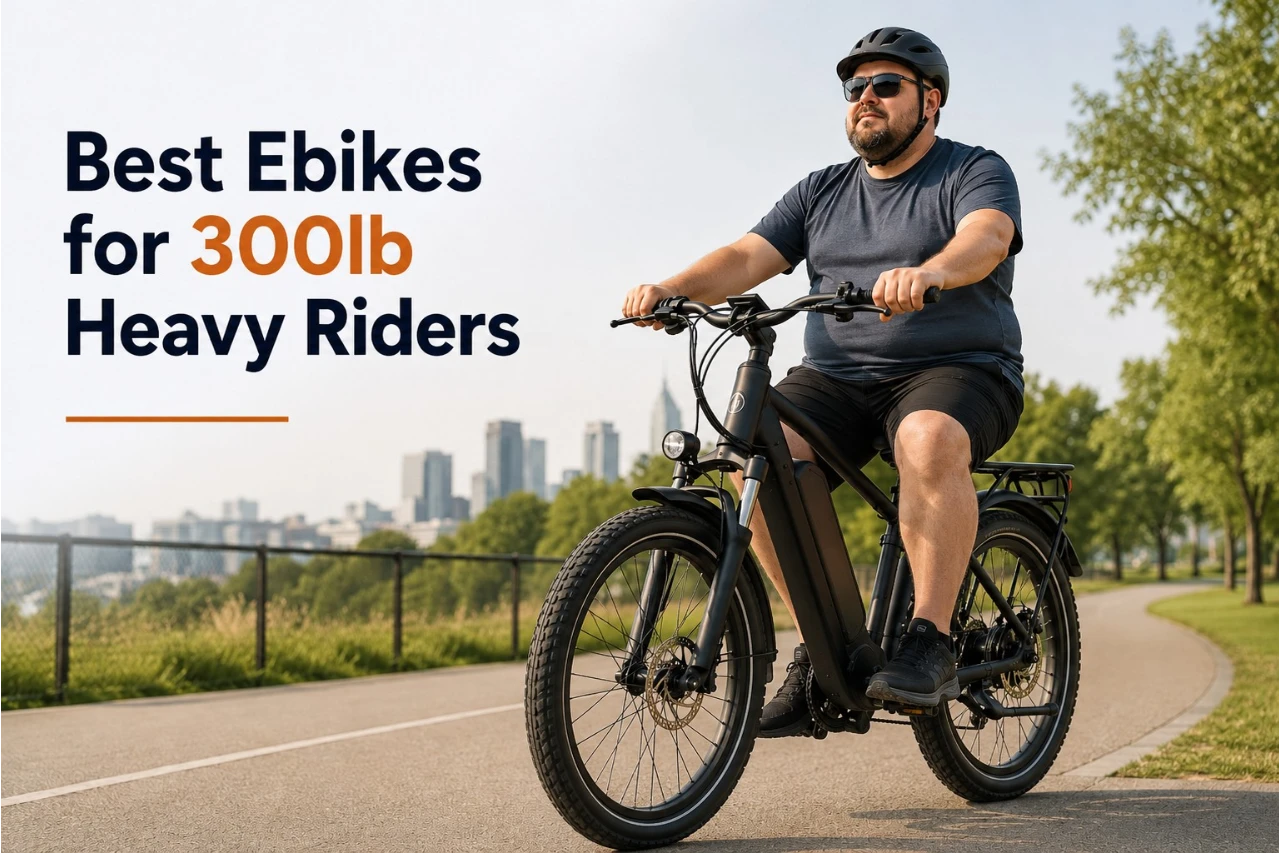
Finding a reliable e-bike as a heavier rider takes more than scanning motor specs. A 300 lb rider should choose a bike rated well above 300 lbs, ideally with a payload capacity of 400 lbs or more, to stay within a safe structural margin. Bikes rated exactly at your body weight leave no room for cargo, clothing, a helmet, or the dynamic stress that comes from bumps, acceleration, and hard braking.
Frame strength, braking power, tire volume, and suspension tuning all matter more than raw wattage for riders in the 300 to 350 lb range. A 750W motor on a properly rated frame will serve a heavy rider better than a 2000W motor on a frame that was never designed for the load. GoEBikeLife recommends evaluating payload margin first, then brakes, then motor torque, and treating advertised range as an optimistic ceiling rather than a real-world promise.
Heavier riders should expect 20 to 40 percent less range than advertised, especially when using throttle mode, riding hills, carrying cargo, or running high assist levels. That 80-mile figure on the box likely applies to a 165 lb rider in pedal-assist mode on flat pavement. Plan your real range accordingly.
Best for powerful daily commuting and adventure: Jasion Thunder Electric Bike
Best for maximum payload capacity: Aipas M1 Pro Electric Bike
Best step-through for commuters and seniors: Aipas C1 Max Electric Bike
Best compact fat tire for urban riding: TST Electric Bike
Best for off-road power and long range: FREESKY 3500W Electric Bike
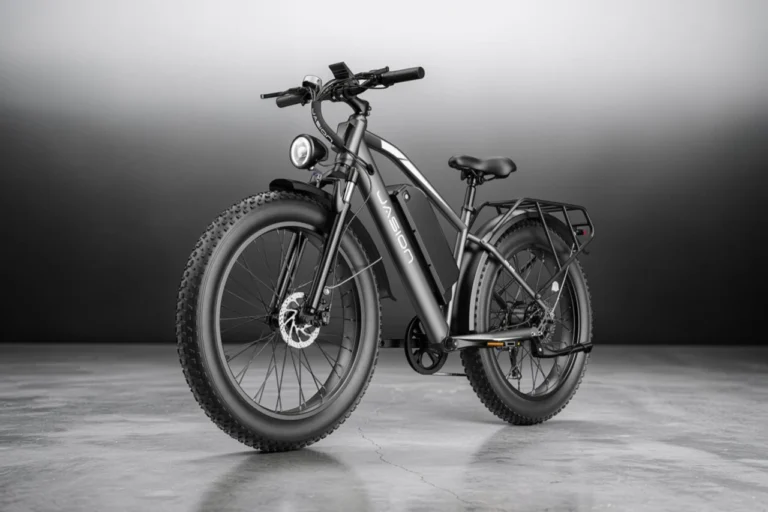
1. Jasion Thunder Electric Bike – 1800W, 26″ Fat Tire, 400 lb Capacity

Best for: Heavier riders who want a capable commuter and adventure bike with strong motor torque and solid real-world range.
Verdict: The Jasion Thunder is a well-rounded fat tire e-bike for riders up to 300 lb, with a 400 lb payload rating that gives a meaningful safety buffer. Based on listed specs, it delivers strong torque and a respectable battery for longer rides.
| Spec | Detail |
|---|---|
| Peak Motor | 1800W |
| Torque | 85 N·m |
| Battery | 48V 18Ah (864Wh) |
| Advertised Range | Up to 80 miles |
| Payload Capacity | 400 lbs |
| Tire Size | 26″ x 4″ |
| Brakes | Hydraulic disc |
| Speeds | 7-speed Shimano |
Why it works for heavier riders: The 400 lb payload rating gives a 100 lb margin for a 300 lb rider, which is the minimum we consider acceptable. Hydraulic disc brakes provide more reliable stopping force under heavier loads than mechanical discs. The 26″ x 4″ fat tires distribute weight and improve stability on loose or uneven surfaces.
Real-world range note: A 300 lb rider using throttle mode on hills can realistically expect 35 to 50 miles per charge, not 80. Plan routes accordingly.
Trade-offs: The 400 lb cap leaves less margin for cargo. Remote security and smart features add convenience but also add complexity. Some user reviews note quality control inconsistencies such as bent sprockets out of the box, so inspect the bike thoroughly on arrival.
Buy it if: You weigh up to 300 lb, want hydraulic brakes, and need a capable all-terrain commuter.
Skip it if: You carry significant cargo regularly or need a payload rating above 400 lbs.
2. Aipas M1 Pro Electric Bike – 1800W, 26″ Fat Tire, 500 lb Capacity

Best for: Heavier riders who need the extra reassurance of a 500 lb payload rating and full dual suspension.
Verdict: The Aipas M1 Pro stands out in this category for its 500 lb payload rating, which is among the highest you will find at this price tier. It combines dual suspension with fat tires and a high-torque motor, making it a strong option for riders in the 300 to 380 lb range who want real structural margin.
| Spec | Detail |
|---|---|
| Peak Motor | 1800W |
| Torque | 110 N·m |
| Battery | 48V 17.5Ah (840Wh) |
| Advertised Range | 25 to 85 miles |
| Payload Capacity | 500 lbs |
| Tire Size | 26″ x 4″ |
| Brakes | 180mm mechanical disc |
| Speeds | 7-speed |
| Frame | High-carbon steel |
Why it works for heavier riders: A 500 lb payload rating gives a 200 lb margin for a 300 lb rider, which is significantly more than most competing bikes. The 110 N·m torque rating is strong for climbing with extra load. Dual suspension absorbs road shock, which matters more as rider weight increases. The high-carbon steel frame is durable, though heavier than aluminum alternatives.
Real-world range note: Expect 30 to 50 miles in practical use for a 300 lb rider on mixed terrain with assist.
Trade-offs: Mechanical disc brakes are less powerful than hydraulic under repeated heavy-load braking. The steel frame adds weight. Based on listed specs, the step-thru frame design is suited to riders 5’5″ and taller.
Buy it if: You want maximum payload margin, dual suspension, and strong torque for hilly terrain.
Skip it if: You prioritize a lightweight build or need hydraulic braking for steep descents.
3. Aipas C1 Max Electric Bike – 1100W, 24″ Step-Through, 500 lb Capacity
Best for: Heavier commuters and riders who want easy mount and dismount, a high payload rating, and a city-friendly design.
Verdict: The Aipas C1 Max is a commuter-focused step-through with a 500 lb payload rating that makes it one of the most structurally permissive options in this guide for heavier riders. GoEBikeLife recommends it specifically for urban and suburban riders who prioritize accessibility and load margin over off-road performance.
| Spec | Detail |
|---|---|
| Peak Motor | 1100W |
| Torque | 90 N·m |
| Battery | 48V 18Ah (864Wh) |
| Advertised Range | Up to 85 miles |
| Payload Capacity | 500 lbs |
| Tire Size | 24″ x 2.6″ |
| Brakes | Dual mechanical disc |
| Speeds | 7-speed |
| Frame | Carbon steel, step-through |
Why it works for heavier riders: The 500 lb payload rating gives exceptional structural margin. The step-through frame removes the need to lift your leg over a high top tube, which improves safety and comfort for heavier or less flexible riders. The removable 48V 18Ah battery is a practical feature for those who cannot easily carry the entire bike indoors to charge.
Real-world range note: Expect 40 to 55 miles in real use for a heavier rider on flat to moderate terrain.
Trade-offs: The 24″ x 2.6″ tires are narrower than fat tire options, offering less cushioning on rough surfaces. The motor output is lower than other picks, meaning less reserve power on sustained climbs. This model has very limited user reviews at present, so long-term reliability is harder to assess.
Buy it if: You weigh up to 350 lb, want easy step-through access, and ride primarily on paved or light gravel routes.
Skip it if: You need strong off-road capability or frequently tackle steep, sustained hills.
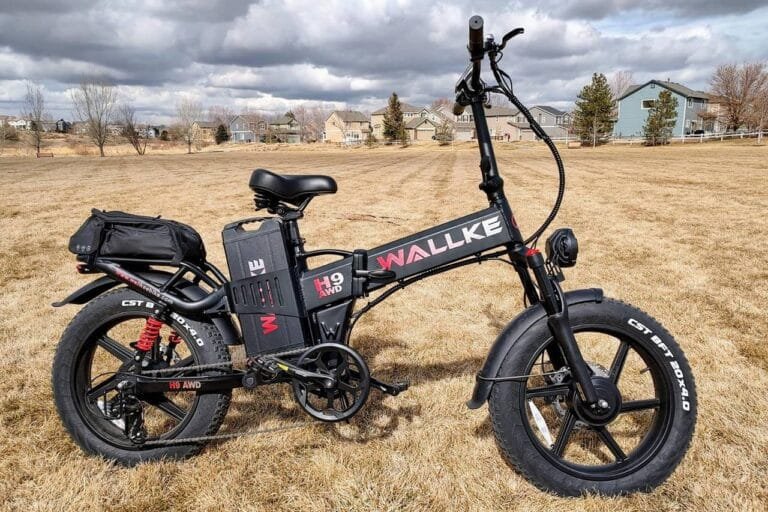
4. TST Electric Bike – 1500W, 20″ Fat Tire, 450 lb Capacity
Best for: Heavier riders who want a compact, maneuverable fat tire bike for city use and light off-road riding.
Verdict: The TST R9 uses a 20″ fat tire format that makes it shorter and easier to handle in urban settings. With a 450 lb payload rating, it provides a 150 lb margin for a 300 lb rider. The dual suspension setup and beefy tires offer reasonable comfort, though the smaller wheel size trades some stability for compactness.
| Spec | Detail |
|---|---|
| Peak Motor | 1500W |
| Battery | 48V 15Ah (720Wh) |
| Advertised Range | Up to 60 miles (PAS) |
| Payload Capacity | 450 lbs |
| Tire Size | 20″ x 4″ |
| Brakes | Mechanical disc |
| Speeds | 7-speed |
| Suspension | Dual |
Why it works for heavier riders: The 450 lb rated payload is adequate for riders up to 300 lb with moderate cargo. Dual suspension at this weight class improves ride quality and reduces frame fatigue over time. The 20″ fat tires still provide a wide contact patch for stability despite the smaller diameter.
Real-world range note: Expect 30 to 45 miles for a 300 lb rider. The 720Wh battery is the smallest in this roundup, so plan accordingly.
Trade-offs: The 180-day warranty is notably short compared to other options in this guide. Mechanical disc brakes require more maintenance under heavy-rider braking. The smaller wheel size can feel less planted at higher speeds.
Buy it if: You want a compact, storable fat tire bike for urban commuting with occasional trail use.
Skip it if: You need strong long-range capability, a longer warranty, or frequently ride at high speeds on open roads.
5. FREESKY 3500W BAFANG Electric Bike – 26″ Fat Tire, 400 lb Capacity

Best for: Riders who want maximum motor power, long range, and premium safety certifications for all-terrain riding.
Verdict: The FREESKY X-6E is the most powerful option in this guide, built around a genuine BAFANG motor with 140 N·m of torque and a massive 48V 35Ah battery. It carries UL 2849 certification from TUV, which is a meaningful safety credential. GoEBikeLife notes that the 400 lb payload is lower than some competitors, so it suits riders up to 300 lb with light cargo, not those carrying heavy loads.
| Spec | Detail |
|---|---|
| Peak Motor | 3500W (BAFANG) |
| Torque | 140 N·m |
| Battery | 48V 35Ah (1,440Wh) Samsung cells |
| Advertised Range | 85 to 140 miles |
| Payload Capacity | 400 lbs |
| Tire Size | 26″ x 4″ |
| Brakes | 4-piston hydraulic disc |
| Speeds | 7-speed |
| Suspension | Full (dual) |
Why it works for heavier riders: The 4-piston hydraulic disc brakes are the strongest braking setup in this roundup, which is critical for heavy riders descending hills. The full suspension system absorbs significant terrain variation, reducing fatigue. The BAFANG motor handles sustained climbs under load better than generic hub motors, based on the brand’s established torque characteristics.
Real-world range note: Even with the large battery, a 300 lb rider in throttle mode on hills may see 60 to 90 miles, not the maximum figure. The high-PAS mode will stretch range noticeably further.
Trade-offs: This is the heaviest and most motorcycle-like bike in the guide. Check local e-bike classification laws before purchasing, as bikes exceeding Class 3 specs may require licensing or registration in some states.
Buy it if: You want top-tier braking, full suspension, a powerful BAFANG motor, and the longest range battery in this group.
Skip it if: You need payload above 400 lbs, want a lightweight commuter, or live in a state with strict e-bike classification rules.
Buying Guide
What to Look for in an E-Bike for 300 lb+ Riders
Buying an e-bike at 300 lbs or more requires a different checklist than what most product pages lead with. GoEBikeLife recommends working through these factors in order.
Payload Capacity First
Never buy a bike rated exactly at your body weight. Add at least 50 to 100 lbs of margin to account for clothing, a helmet, a bag, water, and the real-world stress of riding over bumps and braking hard. For a 300 lb rider, target a bike rated at 400 lbs minimum. For a 350 lb rider, look for 450 lbs or above.
Frame Material and Design
Aluminum frames are lighter and resist corrosion well. High-carbon steel frames are heavier but can be very strong and are easier to repair if damaged. Avoid bikes with unclear frame specifications or no stated payload rating.
Motor Torque, Not Just Wattage
Peak wattage is a marketing figure. Torque in Newton-meters (N·m) is what actually moves a heavy rider uphill. Look for 80 N·m or more for flat-to-moderate terrain; 100 N·m or more for regular hill climbing.
Braking Power
Heavier riders generate significantly more kinetic energy, which means stopping distances increase. Hydraulic disc brakes are preferable to mechanical disc brakes. Four-piston hydraulic calipers are the strongest option and worth prioritizing for riders over 300 lbs.
Tire Width and Pressure
A 4-inch fat tire is the best option for heavier riders. The wider contact patch distributes weight more evenly and improves stability. Run tire pressure at the lower end of the recommended range to improve cushioning and grip.
Battery Size and Realistic Range
Heavier riders should add at least 30 percent to the battery size they think they need. Expect real-world range to fall 20 to 40 percent below advertised figures, especially on hills or in throttle mode. A 48V 18Ah (864Wh) battery is a reasonable minimum; 48V 20Ah or larger is preferable for long-range riding.
Warranty and Support
A 180-day warranty is minimal. Look for bikes with at least 12 months of motor and battery coverage. Some brands offer 24-month coverage, which is a meaningful advantage for a high-use component like a hub motor under regular heavy loads.
Frequently Asked Questions
What weight capacity should an e-bike have for a 300 lb rider to stay within safe limits?
A 300 lb rider should choose a bike rated for at least 400 lbs. This margin accounts for clothing, gear, cargo, and the dynamic stress placed on the frame during acceleration, braking, and riding over rough terrain. Bikes rated exactly at your body weight leave no structural buffer.
Which frame materials and designs hold up best for heavier riders over time?
Aluminum alloy frames (particularly 6061 aluminum) offer a good balance of strength and corrosion resistance. High-carbon steel frames are also durable and can handle heavier loads, though they add weight. Avoid frames with unclear ratings or those made from low-grade steel without a verified payload rating.
What motor wattage and torque are recommended for a heavier rider on hills and in headwinds?
Torque matters more than peak wattage for heavier riders. Look for at least 80 N·m for flat commuting and 100 N·m or more for regular hill climbing. A continuous motor rating of 500W to 750W with a 1500W to 2000W peak is a practical range for most heavier adult riders.
Which wheel size, rim type, and spoke count are most reliable for heavier riders?
A 26-inch wheel with a 4-inch fat tire is the most reliable choice for heavier riders, offering better load distribution and stability. Double-walled alloy rims and a higher spoke count (36 spokes or more) improve durability under sustained heavier loads. Avoid single-wall rims, which can deform or crack more easily under stress.
What suspension, seatpost, and saddle features improve comfort and stability for heavier riders?
Full dual suspension is the most comfortable option for heavier riders, as it absorbs impacts from both the front fork and rear shock. A suspension seatpost adds additional cushioning. A wide, well-padded saddle with a solid rails and post connection reduces pressure and fatigue on longer rides.
What are the most important specs to compare when buying a heavy-duty e-bike under $1,000?
Prioritize payload rating, brake type (hydraulic disc over mechanical), tire width (4 inches for fat tire models), and battery capacity (at least 720Wh). Also check the warranty length, as some budget models offer only 180 days of coverage. Avoid models that do not clearly state a maximum payload rating, as this is a basic safety disclosure every reputable manufacturer should provide.
GoEBikeLife publishes independent e-bike reviews, comparisons, and practical buying guides. Some links on this page are affiliate links. If you make a purchase through an eligible link, we may earn a commission at no additional cost to you.