A little joy belongs in every day.

An e-bike battery label lists voltage, capacity, energy, and identification details. Learn what these ratings mean and what they cannot prove about safety.
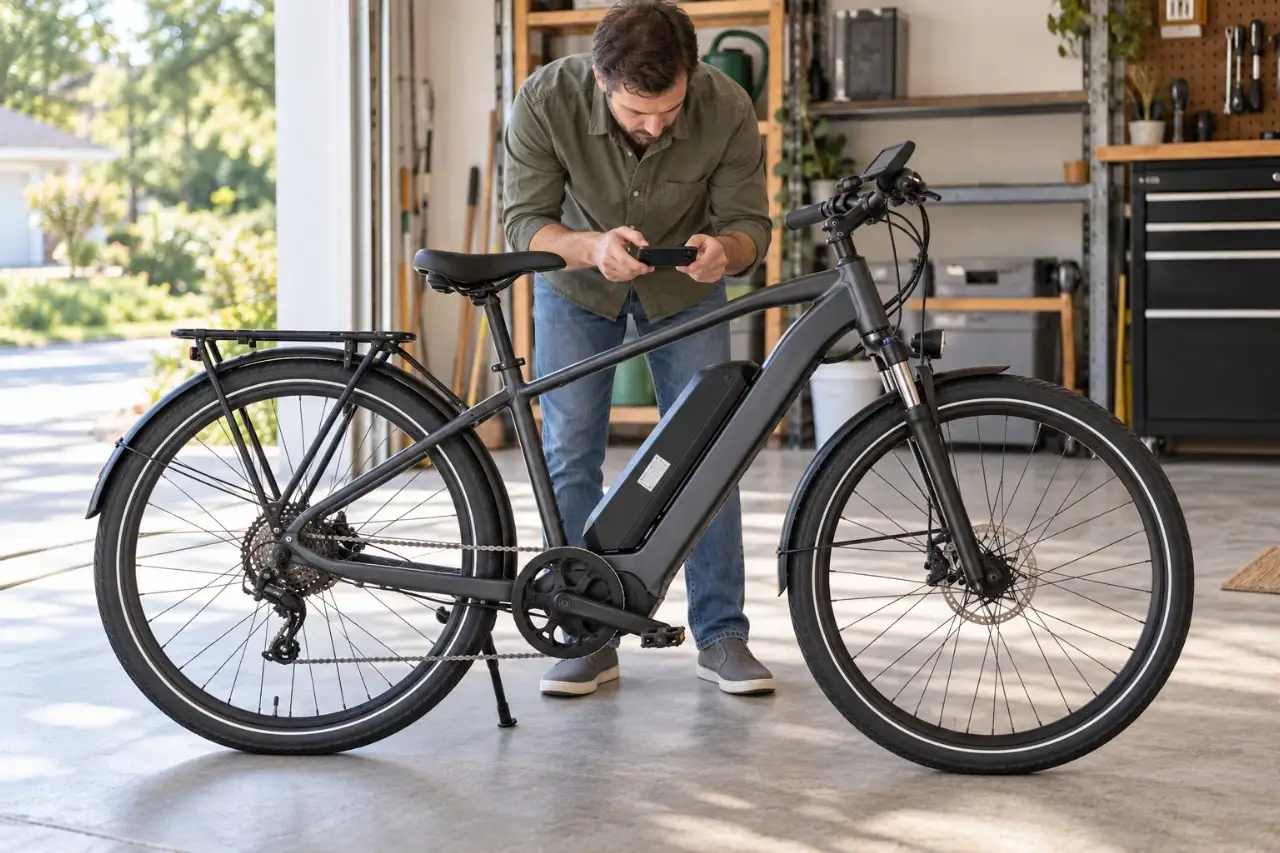
An e-bike battery label identifies the pack and lists ratings such as nominal voltage (V), charge capacity (Ah), and energy (Wh). It may also show charging limits, a model number, a serial number, and safety marks. These details help you check the manufacturer’s instructions, but the label alone cannot prove that a replacement battery or charger is compatible.
Start with the battery already supplied or approved for your bike. If its label, the charger label, and the manual disagree, pause charging and ask the manufacturer to resolve the discrepancy. Do not choose whichever number seems closest.
Turn the bike off and disconnect the charger before a routine label check. Look on the outside of the battery case or near its mounting interface. Remove a user-removable battery only as described in the owner’s manual. If accessing the label requires service disassembly, ask an authorized shop for help.
Do not open the battery housing, peel away protective material, or insert tools into the contacts. A phone camera or flashlight can help with small print when the label is safely accessible.
Photograph the complete label, including warnings and identification codes. Keep the image with your purchase records. Record serial numbers privately rather than posting them in public comments.
Not every label includes every field. Missing details may be in the manual or manufacturer’s documentation.
| Label field | What it tells you | What it does not establish |
|---|---|---|
| Nominal voltage, V | The battery’s rated voltage category | Its exact voltage at every charge level or compatibility by itself |
| Capacity, Ah | Rated electrical charge capacity | Motor power or guaranteed riding time |
| Energy, Wh | Rated energy storage | Guaranteed range or current battery health |
| Chemistry | Battery type, such as lithium-ion | The exact charging requirements by itself |
| Charge voltage/current | Specified charging limits, when listed | Approval to use any charger with similar numbers |
| Model/part number | The battery version to identify in support records | Compatibility with every bike from that brand |
| Serial/date code | Individual identity or production information | Remaining service life |
The nominal voltage describes the battery system; actual battery voltage changes during use and charging. The charger’s DC output voltage can therefore be higher than the nominal voltage printed on the battery without indicating a fault.
That difference is not a mismatch you should “correct” by buying a different charger. Check the charging specification for the exact pack. Chemistry, cell configuration, and manufacturer requirements determine the correct charging voltage.
Do not substitute a 36V, 48V, or 52V battery for another voltage category without explicit manufacturer approval for the exact system. A matching mount or connector is insufficient.
Amp-hours describe charge capacity. Watt-hours describe energy. A useful check is:
Nominal voltage × amp-hours ≈ rated watt-hours
For example, 48V × 14Ah is approximately 672Wh. Use nominal voltage for this calculation, not the charger’s output voltage. Rounding and rating conventions can produce small differences from the printed Wh value; a substantial unexplained discrepancy deserves a manufacturer inquiry.
A label reports rated capacity, not a measurement of how much energy an aging battery holds today. It also cannot predict miles on its own. Temperature, terrain, assist level, rider and cargo weight, and battery condition affect range.
Amps (A) describe current. Amp-hours (Ah) describe charge capacity. A charger marked 2A does not mean that the battery has a 2Ah capacity.
If the label lists maximum discharge current, that refers to current supplied to the bike. It is not the permitted charging current. Do not treat a discharge rating as a fast-charging limit or an invitation to install a higher-power controller.
The following is an illustrative example, not a real product label or a charger-selection specification:
| Example entry | How to read it |
|---|---|
| Lithium-ion | Battery chemistry; further charging details are still required |
| Nominal voltage: 48V | Rated system voltage, not a constant measured voltage |
| Rated capacity: 14Ah | Rated charge capacity |
| Rated energy: 672Wh | Consistent with 48 × 14 |
| Model: EXAMPLE-48-14 | A fictional identifier illustrating where a model number appears |
| Use specified charger only | Obtain the approved charger model from the manufacturer |
This example does not establish a charging voltage, permitted current, connector pinout, or approved charger model. Those omissions mean it cannot support a compatibility decision. Never infer missing information from another battery that looks the same.
Copy the model or part number exactly, including suffixes. Similar housings may contain different versions with different charging or communication requirements.
The serial number helps the manufacturer identify your individual pack and may be needed for warranty support or a recall check. A production date provides context, but age alone cannot establish safety or remaining capacity. Do not guess the meaning of an undocumented date code.
For a support request, provide the bike model and year, battery model and serial number, charger model, and clear label photos. Ask the manufacturer to confirm the exact approved pairing in writing. Do not buy a replacement based only on voltage, capacity, or physical fit.
The battery label describes the pack. The charger label describes power accepted from the outlet and power supplied to the battery.
AC input concerns the wall supply. DC output concerns the battery. A broad AC input range does not make a charger universal.
Use the original approved charger or a replacement the manufacturer confirms has been tested and approved for your exact battery. A compatibility review needs all of these:
Numbers that appear to match are necessary information, not permission to experiment. Do not use adapters, alter wiring, or try charging briefly to “see if it works.” If a required detail is missing, obtain confirmation before connecting anything.
The e-bike charger compatibility guide explains the next checks. The CPSC’s charger safety guidance also warns that plug fit does not prove compatibility.
UL 2271 addresses batteries for light electric vehicle applications. UL 2849 addresses e-bike electrical systems, including the combination of the electrical drive system, battery, and charger. Battery certification alone does not establish certification of the complete e-bike electrical system.
A printed standard number or seller’s “tested to” claim is not enough to verify certification. Identify the certification body and check its official directory for the relevant company, model, and scope. UL Solutions provides Product iQ for its certifications; use the named certifier’s directory for other marks.
Our guide to verifying an e-bike’s UL certification covers that process. Certification does not authorize mixing unrelated batteries and chargers or guarantee that a damaged pack is safe.
Charging, riding, and storage may have different temperature limits. Follow the exact instructions for each activity. Do not charge outside the permitted range or use an external heater to force a cold battery to warm up.
An IP rating describes enclosure protection under specified test conditions. It is not a general promise that a battery is waterproof, safe to submerge, or suitable for pressure washing. Follow the manufacturer’s water-exposure instructions and keep charging connections dry.
Do not put an e-bike lithium-ion battery in household trash or a curbside recycling bin. Contact a collection program that specifically accepts e-bike batteries, and disclose damage before arranging a drop-off. A damaged pack may require a different procedure.
See e-bike battery recycling options before arranging disposal. Do not transport an actively failing battery to a shop or collection site.
If you cannot identify the pack or its approved charger reliably, pause riding and charging until the manufacturer or an authorized service provider confirms the system. Check purchase records and earlier label photos. Never guess specifications from case size, indicator lights, or connector shape.
Stop riding and charging if the battery is swollen, cracked, leaking, has damaged terminals, or shows unusual heat or odor. Significant impact, immersion, or suspected water intrusion also requires manufacturer or qualified professional guidance before reuse. Ordinary exposure within the manufacturer’s stated limits is different from immersion or water entering the pack.
If there is smoke, fire, hissing, rapid heating, or another sign of imminent failure, move away, get others out, and call 911 from a safe location. Do not touch, carry, unplug, or attempt to extinguish an actively failing battery. Follow emergency responders’ directions.
The battery damage warning signs guide explains additional reasons to stop using a pack. Do not open, rebuild, or bypass battery protection systems. A readable label never overrides physical signs of damage.
Sources checked September 26, 2026. Follow the instructions for your exact battery and e-bike.