E-bike safety means checking that your bike is ready, wearing a properly fitted helmet, staying visible, and choosing a speed that leaves room to stop. Use predictable movements around traffic and pedestrians, secure cargo within the bike’s limits, and charge only with manufacturer-approved equipment while you are awake and present. Stop riding when braking, steering, tires, motor response, or battery condition becomes unsafe.
Your owner’s manual and equipment labels take priority over general advice. This guide covers everyday safety decisions for U.S. riders; it does not replace model-specific instructions, maintenance, or local riding rules.
Start With a Bike That Is Ready to Ride
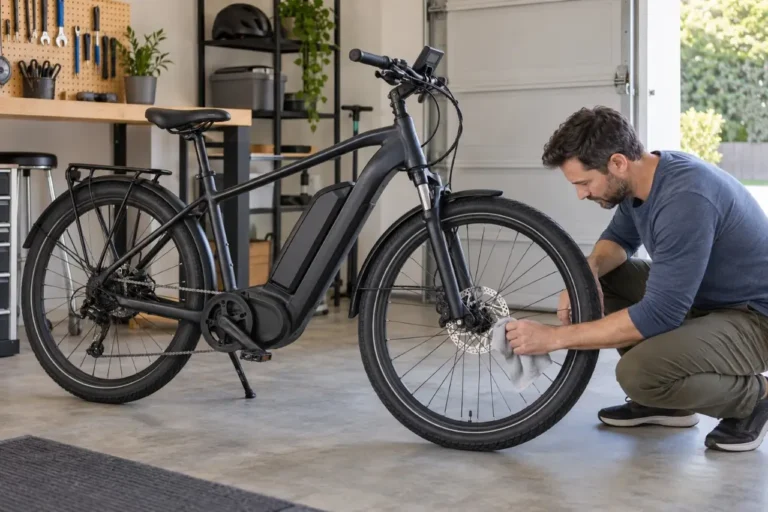
Inspect the bike on level ground with the electrical system off and the charger disconnected. Confirm that the wheels, handlebar, stem, saddle, pedals, and cargo attachments are secure. Make sure the battery is properly seated and latched. Look for damage to the frame, fork, tires, cables, hoses, and visible wiring.
Test each brake separately while standing beside the bike. Each should hold its wheel, and the lever should develop firm resistance before reaching the grip. Weak braking, a hydraulic leak, metal-on-metal grinding, or a suddenly soft lever requires service before riding.
Use a gauge to check tire pressure. Stay within all applicable tire, rim, and bike limits; a sidewall maximum is not necessarily the correct riding pressure. If the rim permits less pressure than the tire, do not exceed the rim’s limit. Schwalbe’s pressure guidance emphasizes respecting both tire and rim maximums.


Turn on the system only after these checks. Confirm that the lights work and there are no unexplained warnings. In a clear area, finish with a very low-speed check of braking, steering, and assist response. Use our complete e-bike pre-ride safety checklist for the detailed sequence. Never rush an unresolved problem to meet a time target.
Wear a Fitted Helmet and Make Yourself Visible
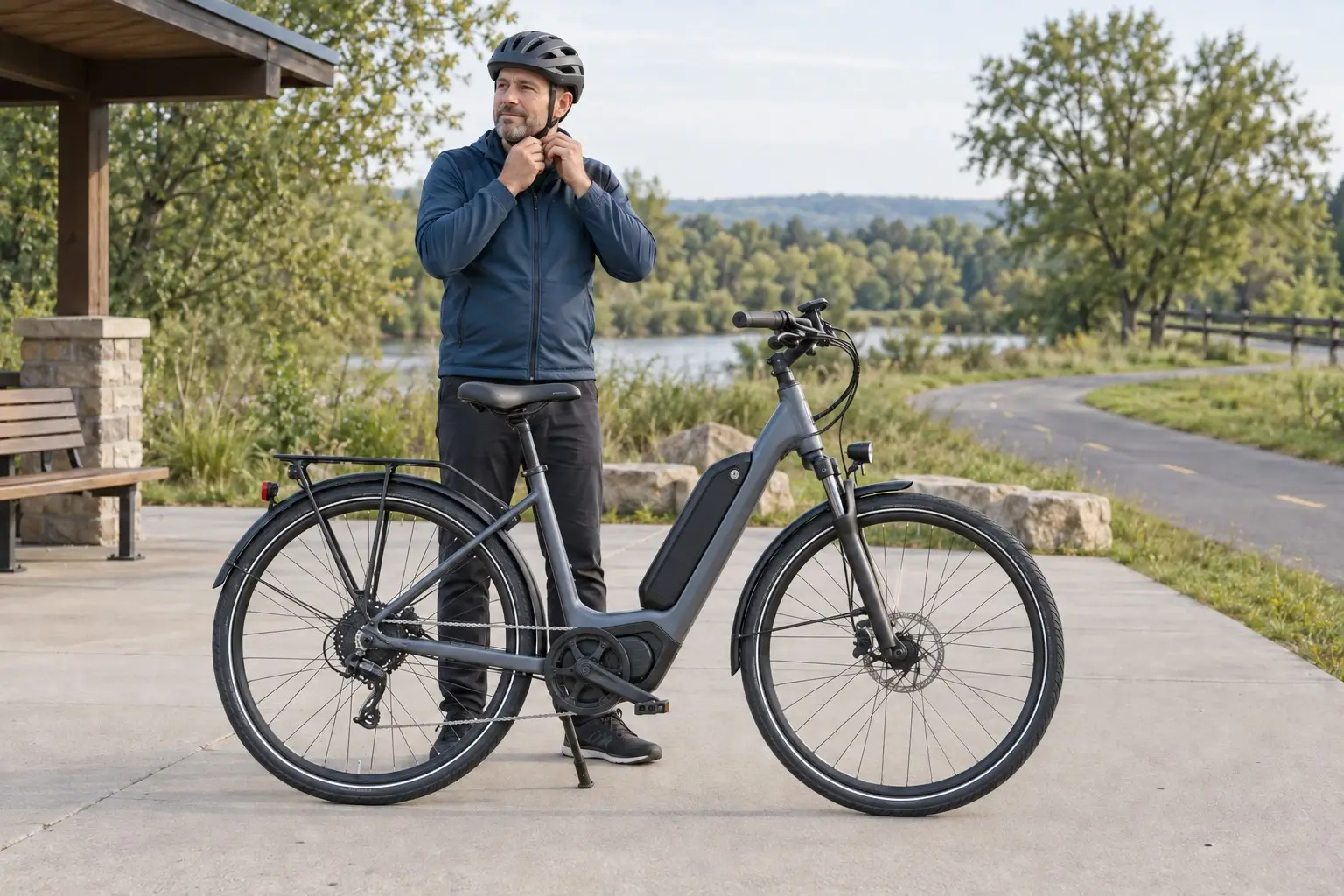
Choose a bicycle helmet with the U.S. CPSC compliance label and a fit appropriate for your head. It should sit level, low on your forehead, with the chin strap fastened and adjusted so the helmet stays in position. Follow any additional helmet requirements for your vehicle type and location.
Replace a helmet after a crash impact to the helmet or head, even if it looks intact. CPSC explains that impact damage may be invisible. Our e-bike helmet fit and selection guide covers what to check before riding.


Use a white front light, red rear light, and reflectors at night or when visibility is poor. Check that bags and clothing do not cover them. Bright clothing helps in daylight; reflective material adds visibility when illuminated. Neither replaces working lights. These measures align with NHTSA’s bicycle safety guidance.

Wear secure shoes and keep loose clothing away from moving parts. Clear or light-tinted glasses can protect your eyes without making dim conditions harder to see. Gloves should let you grip the bars and operate every control comfortably.
Control Acceleration, Braking, and Turns
Learn the response before entering traffic
E-bike weight and power delivery vary. Practice starts, stops, shoulder checks, and wide turns in a legal, traffic-free area. Begin with low assistance and learn which lever operates each brake. Do not assume the lever layout matches a previous bike.
Use enough fingers to brake effectively while maintaining control of the handlebar; a fixed one- or two-finger rule does not suit every brake or rider. Apply both brakes progressively, avoiding abrupt inputs that could skid a tire or pitch you forward, as explained in Trek’s braking guidance. Extra speed and cargo reduce your margin for error, so allow more space and learn the bike’s stopping behavior under controlled conditions.
Keep the motor off while handling or inspecting the bike. If assistance continues unexpectedly or the throttle sticks, bring the bike to a controlled stop, switch it off when safe, and arrange service before riding again. Do not bypass a brake cutoff or other safety feature.
Slow before a corner
Reduce speed before leaning into a turn. Look toward your exit and use smooth steering. Sand, wet leaves, paint, metal covers, and gravel can reduce grip. On questionable surfaces, use a slower approach and keep the bike more upright.
Avoid grabbing either brake mid-turn. If you need to reduce speed, use gentle, progressive braking within the available traction. Our guide to cornering an e-bike safely explains pedal position and practice in more detail.
Leave Room for Other Road and Path Users
Choose a speed that lets you stop within the clear distance ahead. Reduce it before driveways, crosswalks, blind bends, parked cars, and busy path entrances. A motor’s assistance limit is not a safe-speed recommendation.
Give parked vehicles enough clearance to avoid opening doors where conditions permit. Watch for turning vehicles at intersections and driveway exits. Eye contact can help communication, but it does not guarantee that a driver will yield.
Ride with traffic, obey applicable signs and signals, and signal turns when you can do so without losing control. Avoid weaving between parked cars. Choose a visible, predictable lane position consistent with local law and the available space. Consider another route if traffic speed or road design exceeds your comfort and skill.
On shared paths, slow early, yield as required, and pass only with adequate space and sight lines. Announce your approach politely; a bell does not grant priority. If someone does not respond or the path is narrow, wait. Stop somewhere safe before using your phone, and do not ride while impaired.
Check Access Rules for the Actual Route
Access guidance checked September 6, 2026.
Federal product definitions do not establish permission to ride everywhere. State and local requirements can govern equipment, rider age, helmets, and road use. Park and trail managers may impose additional access, class, throttle, and speed restrictions; private land requires the owner’s permission.
Check the responsible state agency, local government, or land manager before an unfamiliar ride. For example, the National Park Service directs visitors to check individual park rules because superintendents can restrict e-bike use. Permission for conventional bicycles is not automatic permission for every e-bike.
Our guide to federal and state e-bike laws explains the different layers. Confirm current route-specific rules before leaving; this overview does not provide a state-by-state legal determination.
Secure Cargo and Use Approved Passenger Equipment
Keep heavy items low and centered where the bike’s carrying system allows. Secure straps so they cannot enter a wheel, chain, or brake. Check the total bike load limit as well as separate rack, basket, seat, and trailer limits. A stronger accessory does not increase the bicycle’s capacity.
Carry a passenger only on a bike and seating system designed for that purpose. A rack or long saddle alone does not establish passenger suitability. Follow bicycle and accessory instructions for installation, rider or passenger size, restraints, foot protection, and helmets, plus local requirements.
Practice with a new load in a clear area before entering traffic. Never leave a child unattended on a parked bike, even with a kickstand deployed; Tern’s child-seat guidance warns that a moving child can upset the bike’s balance.
Charge Safely and Respond to Battery Warning Signs
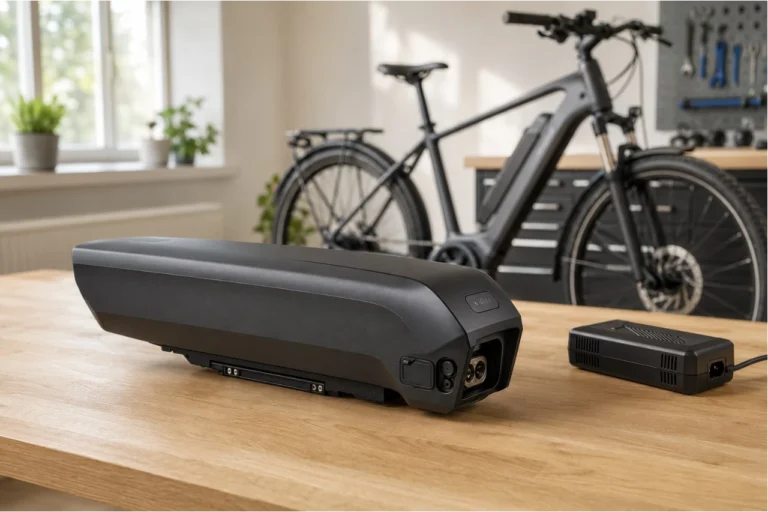
Use the supplied or specifically manufacturer-approved battery and charger. A fitting plug does not establish compatibility. Approval must cover battery chemistry, nominal voltage, charger output voltage, charging current, connector, polarity, and any communication requirements. Do not improvise adapters or open a battery or charger.
Charge only while awake and present. Follow the manufacturer’s temperature limits and disconnect when charging is complete. Keep the setup dry, ventilated, on a stable noncombustible surface, away from combustible materials and escape routes. Let a hot battery cool naturally before charging. CPSC’s micromobility guidance advises staying present and using the manufacturer’s supplied or recommended charger.
Stop using and charging a swollen, leaking, cracked, unusually hot, or abnormal-smelling battery. After submersion or a substantial impact to the battery, keep it out of use until the manufacturer or qualified battery service provider advises on inspection and next steps. A normal-looking exterior does not establish safety. See the warning signs of e-bike battery damage.
If there is smoke, hissing, sparking, fire, or rapidly worsening heat, move yourself and others away, leave the building if indoors, and call 911 from a safe location. Do not touch, unplug, remove, or carry the battery, or re-enter to retrieve the bike. Follow emergency responders’ instructions. NYC’s emergency guidance advises leaving the area and calling 911 in a battery fire. FDNY’s battery safety guidance explains the warning signs and emergency response.
Adjust for Weather and Know When to End the Ride
Water resistance varies by model and component. Follow the manual; avoid deep standing water, submersion, and pressure washing. In rain, allow more stopping space and use gentle control inputs. If braking becomes ineffective, stop riding.
In hot weather, carry water and avoid exposing the battery to excessive heat, including a hot parked vehicle. In cold weather, plan a shorter route or extra reserve because available range may decrease. At night, slow enough to stop within the road your lights clearly reveal.
End the ride for a loose wheel, unstable steering, frame or fork damage, tire bulge or air loss, weak brakes, repeated chain skipping, unexplained electrical warnings, or abnormal motor response. Do not ride home to test whether the problem clears. Arrange recovery and qualified service; for battery danger, keep your distance and get emergency guidance before any transport.
GoEBikeLife publishes independent e-bike reviews, comparisons, and practical buying guides. Some links on this page are affiliate links. If you make a purchase through an eligible link, we may earn a commission at no additional cost to you.