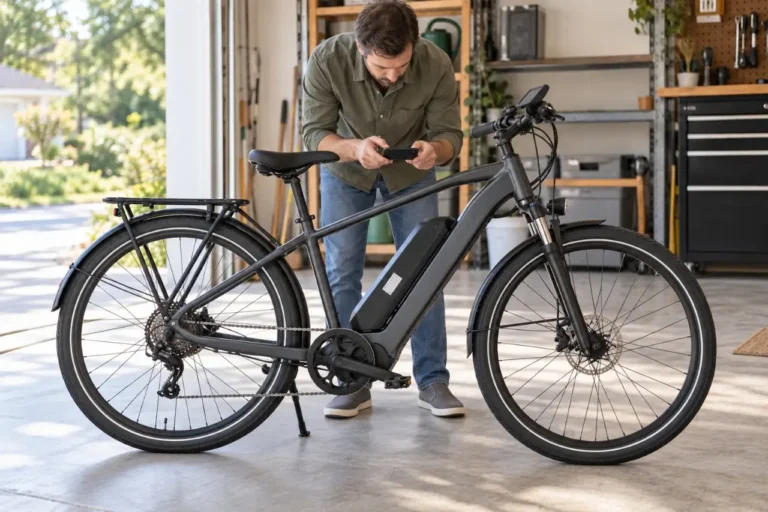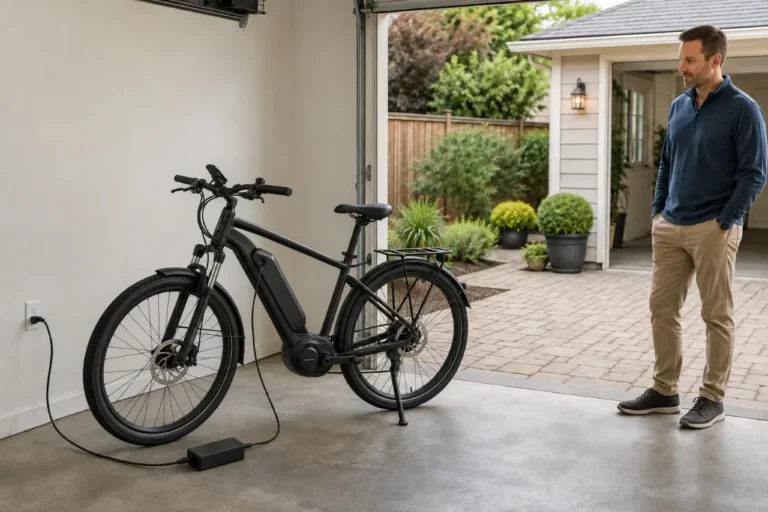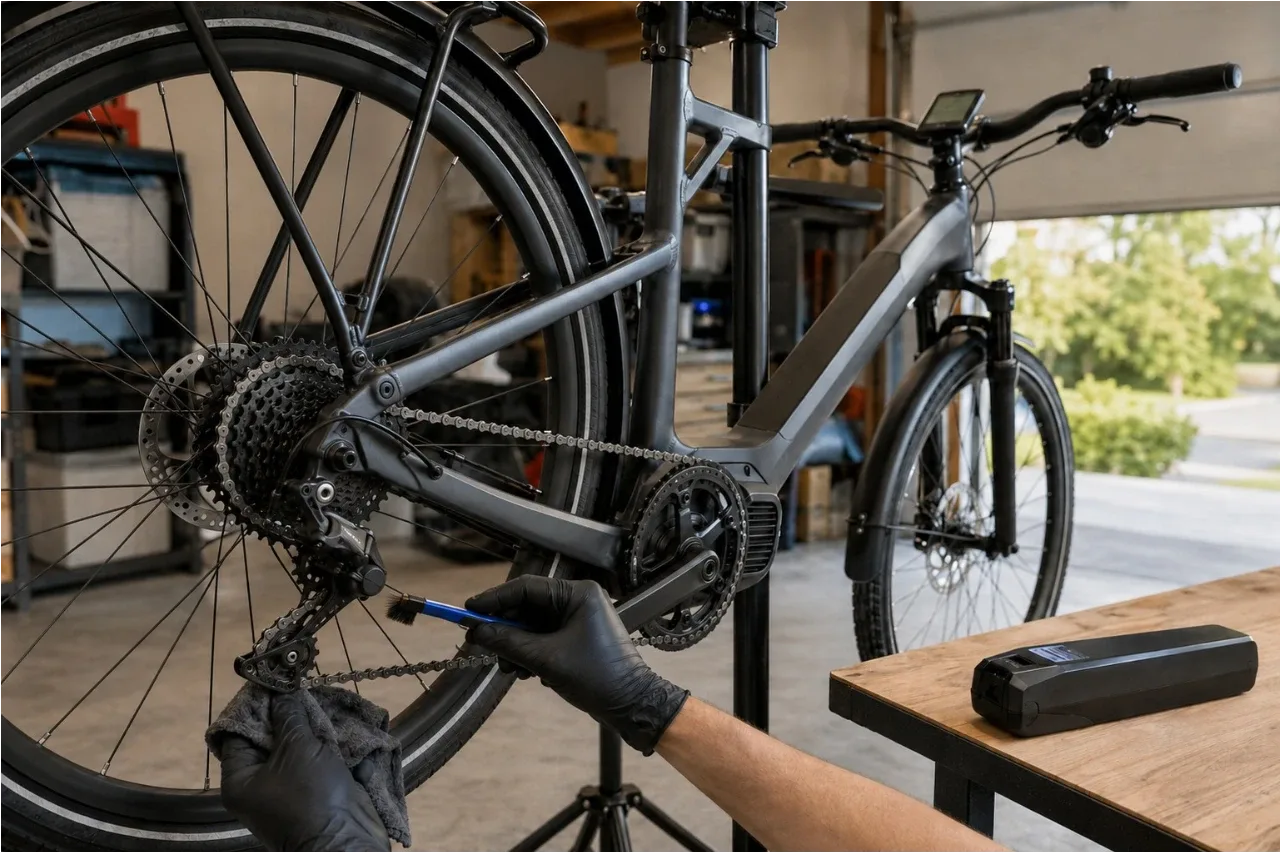
To clean an e-bike drivetrain safely, switch the electrical system off, protect the battery and electronics, brush away loose grit, and use a small amount of bicycle-safe cleaner on the chain, rear cogs, chainring, and derailleur pulleys. Wipe away the residue, let the drivetrain dry completely, then apply bicycle chain lubricant to the chain rollers and remove the excess. Never use the motor to spin the drivetrain while cleaning, and keep degreaser and lubricant away from every brake surface.
This guide applies primarily to chain-driven e-bikes with an external derailleur. If your bike has a belt drive, internally geared hub, coaster brake, enclosed chain case, or an unusual automatic-shifting system, follow its owner’s manual instead of assuming the same method applies.
What Counts as the E-Bike Drivetrain?
The drivetrain transfers power to the rear wheel. On a typical derailleur-equipped e-bike, it includes:
- The chain
- The front chainring
- The rear cassette or threaded freewheel
- The rear derailleur and its two pulley wheels
These parts work differently depending on motor location. A hub motor generally drives the wheel independently of the chain, although the rider still uses the bicycle drivetrain when pedaling. A mid-drive motor sends both rider and motor power through the chain and gears, which can increase drivetrain loads. See our explanation of hub motors versus mid-drive systems for a closer look at that difference.
Cleaning removes abrasive grit and old lubricant. It can improve a rough-sounding drivetrain, but it will not repair worn, damaged, bent, or misadjusted parts.
Supplies You Will Need

Gather the following before you begin:
- Bicycle-specific drivetrain cleaner, degreaser, or a neutral cleaner approved by the component manufacturer
- Bicycle chain lubricant suited to your riding conditions
- A stiff drivetrain brush and a smaller brush for narrow spaces
- Several clean rags or microfiber cloths
- Clean water for dampening a cloth
- Nitrile gloves and eye protection, as directed by the cleaner label
A chain-cleaning tool and repair stand are optional. Make sure any chain-cleaning tool will fit around the chain and chain guard.
Do not use gasoline, paint thinner, automotive brake cleaner, rust remover, or strongly acidic or alkaline cleaners. Shimano instructs riders to use neutral detergent on chains and warns against acidic or alkaline products. Always follow the cleaner and component manufacturer’s directions.
Before Cleaning: Make the E-Bike Safe
Turn off the electrical system
Switch the e-bike off and disconnect the charger. Do not activate walk mode, the throttle, pedal assist, or any other powered function while a hand, rag, or brush is near the drivetrain.
If the battery is designed for routine user removal and the manual recommends removing it for cleaning, take it off with dry hands and store it in a secure, dry place. Do not force an integrated battery out of the frame. Bosch, for example, recommends removing its battery when possible, using a damp cloth, and avoiding direct water jets and pressure washers. Your own manufacturer’s instructions take priority.
Close the charging-port cover and any connector covers. Do not direct water or cleaner at the battery mount, contacts, display, controls, motor housing, wiring connections, wheel hubs, headset, or bottom bracket.
Stabilize the bike
A repair stand must be rated for the e-bike’s weight and clamped only at a frame area approved by the manufacturer. Never clamp the battery, a cable, a brake hose, a thin frame tube, or a dropper-post stanchion.
Without a stand, support the bike securely on a level surface and clean one accessible section at a time. Do not lift a heavy e-bike by the saddle while turning the cranks; the bike can fall, and the chain creates pinch points.
Protect the brakes
Keep drivetrain brushes and rags separate from brake-cleaning supplies. Do not spray degreaser or chain lubricant across the bike. If practical, shield the rear disc rotor with a clean, nonabsorbent cover, then remove it before operating the bike.

How to Clean an E-Bike Drivetrain Step by Step
1. Brush off loose grit
Begin with the drivetrain dry. Use a brush or rag to remove dust, sand, dried mud, leaves, and loose clumps of oily residue from the chain, rear cogs, chainring, and derailleur pulleys.
Keep fingers, clothing, rags, and brush bristles clear of the points where the chain enters a sprocket or chainring.
2. Clean the chain
Apply a small amount of bicycle-safe cleaner to a rag or brush instead of spraying the chain freely. Hold the rag around the lower run of chain and rotate the cranks slowly by hand only if the drivetrain can backpedal normally. Move the rag to a clean section and repeat until it no longer lifts heavy grime.
If the bike cannot backpedal normally, do not force it. Use a suitable repair stand to lift the driven wheel and turn the cranks forward by hand, or clean the chain in sections with both wheels on the ground. The e-bike must remain switched off throughout the process.
A compatible chain scrubber can provide a deeper clean. Follow the cleaner’s amount and contact time, and keep fluid away from the hub, bottom bracket, motor, bearings, and brakes.
3. Clean the rear cogs, chainring, and derailleur pulleys
Put cleaner on the brush and work it between the cassette or freewheel sprockets. Brush the chainring teeth and accessible faces, then remove packed residue from the derailleur pulley wheels.
Do not flood the freehub, freewheel body, derailleur pivots, crank area, or motor seals. Do not remove a motor cover or electrical component merely to clean it. On a mid-drive, keep liquid away from the drive-unit and crank interfaces.
4. Remove the dirty cleaner with minimal water
Wipe the drivetrain with a clean, damp cloth until the cleaner and loosened grime are gone. If the label requires rinsing, use only a small amount of low-pressure water on the drivetrain—not on the motor, rear hub, bearings, electrical connections, or brakes.
A pressure washer is never appropriate for this job. High-pressure water can push contamination past seals and into bearings or electrical parts. For a full-bike wash rather than a drivetrain-only cleaning, use our separate guide to washing an e-bike without damaging its electrical components.
5. Dry the drivetrain completely
Wipe the chain, rear cogs, chainring, and derailleur pulleys with a dry cloth, then allow them to air-dry. Do not apply chain lubricant over visible water or wet cleaner residue; moisture can dilute the lubricant and contribute to corrosion.
Do not use a heat gun or force compressed air into bearings, seals, electrical connectors, or the motor area.
6. Apply chain lubricant correctly
Use lubricant made for bicycle chains. Apply one small drop to each chain roller while turning the cranks slowly by hand. The roller is the cylindrical part in the center of each chain link. Do not pour lubricant over the cassette, chainring, derailleur, or outside of the chain.
Allow the lubricant to penetrate for the time on its label. Then run the chain through a clean rag to remove excess from its outer surfaces. The working lubricant should remain inside the chain’s moving interfaces.
Dry-condition lubes usually attract less dust but may wash off sooner. Wet-condition lubes generally last longer in rain but can collect more grit. Follow the product label for application and waiting time.


7. Reassemble and test safely
Confirm that the battery mount, contacts, charging port, and surrounding areas are completely dry. Reinstall the battery as directed and make sure it locks securely.
Before riding, squeeze both brake levers and inspect the drivetrain. In a clear, flat area away from traffic, take a short, low-speed test ride. Shift one gear at a time while easing off pedal force, especially on a mid-drive.
Stop riding if the chain skips under load, binds, repeatedly drops, or makes a persistent grinding sound. Also stop if either brake feels weak or abnormal. Our pre-ride e-bike brake inspection explains the basic checks owners can perform safely.
How Often Should You Clean the Drivetrain?
There is no reliable mileage interval for every e-bike. Conditions, lubricant, drivetrain design, and motor location affect how quickly contamination builds.
Use condition-based cues:
- Wipe the chain after a wet, dusty, muddy, or salty ride.
- Clean it when grit is visible or the chain sounds dry and squeaky.
- Relubricate after a thorough cleaning or when the lubricant manufacturer’s guidance calls for it.
- Perform a deeper cleaning when a routine wipe no longer removes the buildup.
Use visual inspection, sound, and a clean rag rather than touching a dirty chain with bare fingers.
Include this task within a broader year-round e-bike maintenance routine that also covers tires, brakes, battery care, fasteners, and storage.
Common Mistakes to Avoid
- Using the motor to spin the drivetrain: Unexpected movement can pull fingers, clothing, rags, or brushes into the chain and sprockets.
- Spraying cleaner freely: Overspray can contaminate brake surfaces and carry cleaner into bearings, seals, or electrical parts.
- Using too much degreaser: More product does not produce a safer or better result. Follow the label’s amount and contact time.
- Lubricating a wet chain: Water and cleaner residue can prevent the lubricant from working as intended.
- Coating the whole drivetrain with lube: Lubricant belongs on the chain rollers, not on the cassette, chainring, brake rotor, or tire.
- Mixing brake and drivetrain rags: A trace of chain oil can reduce braking performance.
- Assuming cleaning will fix wear or misalignment: Skipping and poor shifting may require adjustment or component replacement.
What If Degreaser or Lubricant Reaches the Brakes?
Do not ride until the brakes have been restored according to the manufacturer’s procedure. Avoid touching a disc rotor with bare hands. Some manufacturers permit cleaning a rotor with fresh isopropyl alcohol and a lint-free cloth, but contaminated pads may require replacement. SRAM, for example, instructs users to replace pads contaminated by oil or brake fluid.
Do not burn, bake, sand, or soak contaminated pads unless the manufacturer specifically provides that procedure. If braking is weak, contamination is visible, or you do not know what reached the brake, use a qualified bicycle mechanic. See when e-bike brake pads need replacement for additional warning signs.
When Cleaning Is Not Enough
Cleaning can remove dirt, but it cannot correct mechanical damage. Arrange a professional inspection if you find:
- A chain that skips, binds, has seized links, or repeatedly comes off
- Significant rust or cracked, bent, or missing drivetrain parts
- Rear cogs or chainring teeth that appear damaged
- A derailleur or hanger that looks bent
- Side-to-side play in the crank, rear cogs, or derailleur pulleys
- Shifting that remains inconsistent after cleaning
- New electrical errors or power loss after cleaning
A chain-wear gauge can help with monitoring, but use the chain manufacturer’s wear limits because drivetrain systems differ. A mechanic can identify whether the chain, rear cogs, chainring, derailleur, or adjustment is responsible.
The safest cleaning routine is controlled and uncomplicated: keep the e-bike switched off, use minimal liquid, keep chemicals away from the brakes and electronics, dry the drivetrain, and lubricate only the chain rollers. Those steps remove abrasive contamination without creating a new electrical, braking, or wear problem.
GoEBikeLife publishes independent e-bike reviews, comparisons, and practical buying guides. Some links on this page are affiliate links. If you make a purchase through an eligible link, we may earn a commission at no additional cost to you.