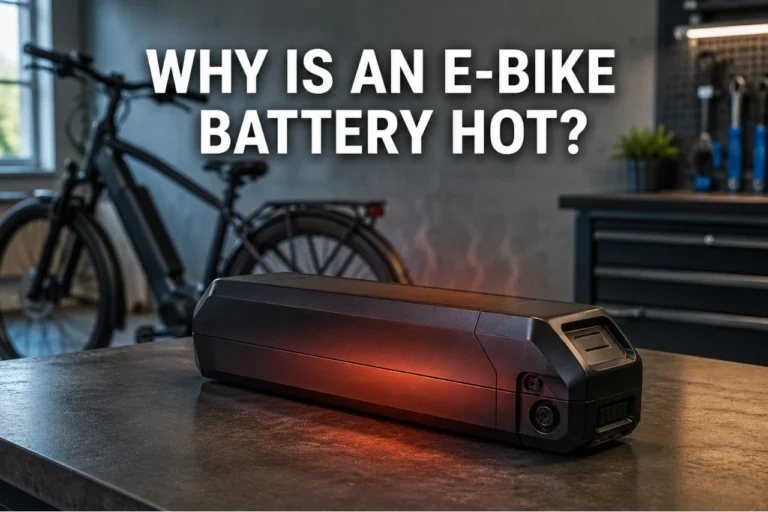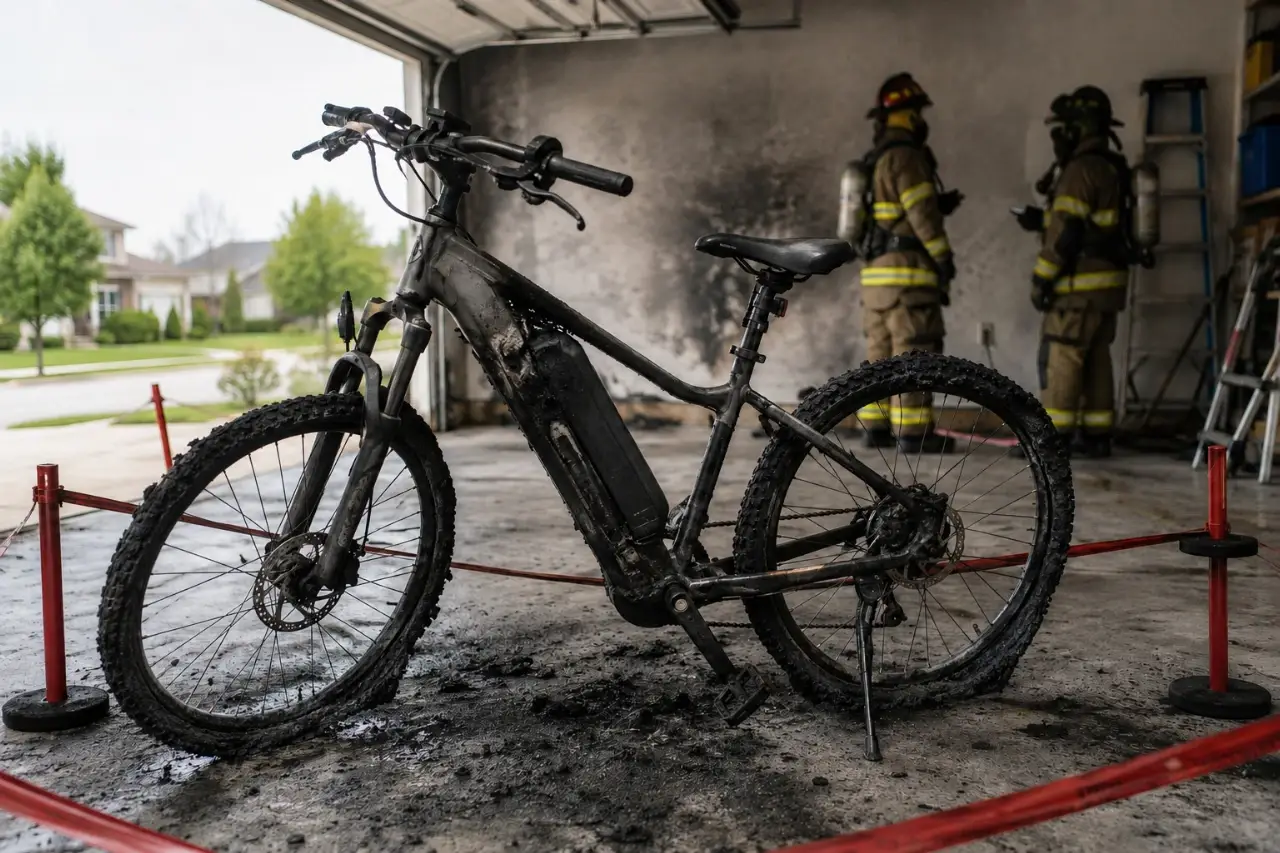
If an e-bike battery is smoking, burning, hissing, popping, venting gas, or producing a strong chemical odor, move everyone away and call 911 from a safe location. Do not touch or move the bike, battery, or charger, and do not reenter a building to retrieve them. After emergency responders release the scene, keep all affected equipment out of service, document the damage, report the incident, and arrange inspection and disposal through qualified professionals.
An e-bike fire can remain hazardous after visible flames stop. Damaged lithium-ion cells may retain energy, heat up again, or release flammable gases. Treat the battery as unsafe until qualified authorities provide direction.
First: Decide Whether It Is Still an Emergency
Do not wait for visible flames before taking a battery event seriously. Smoke, vapor, rapid or extreme heating, hissing, popping, sparking, or a strong unusual odor can indicate an active failure.
| What you observe | What to do |
|---|---|
| Smoke, flames, vented gas, hissing, popping, sparking, or rapidly increasing heat | Leave the area, call 911, and warn others to stay away. |
| A fire alarm sounds or smoke is spreading through a building | Evacuate using the building’s emergency plan. Do not stop to collect the bike or battery. |
| A swollen, cracked, leaking, or impact-damaged battery with no smoke or heat | Stop using and charging it. Do not handle it unnecessarily. Contact the manufacturer and local fire or hazardous-waste authority for instructions. |
| Ordinary warmth after riding, with no damage, odor, smoke, or abnormal behavior | Let the system cool in the location and manner permitted by the owner’s manual. Review the separate guide to e-bike battery damage warning signs if you are uncertain. |
If conditions are changing, the battery is indoors near combustible materials, or you are unsure whether the situation is stable, move people away and call 911.
What to Do During an Active E-Bike Battery Fire
1. Get people and pets out
Leave the immediate area and help others evacuate. Keep clear of smoke and do not block firefighters’ access. If the incident is in an apartment, workplace, shared garage, or other multi-unit property, follow the building’s evacuation plan.
2. Call 911 from a safe location
Tell the dispatcher that an e-bike lithium-ion battery may be involved. Give the bike’s location, whether it is indoors, and whether anyone is injured or may have inhaled smoke. Follow the dispatcher’s instructions.
3. Do not handle or move the equipment
Do not touch, carry, disconnect, cover, charge, or transport a smoking, burning, swollen, leaking, flooded, or severely overheated battery. Do not open the battery case or attempt to repair the battery-management system. Moving a failing pack can expose you to heat, toxic smoke, electrical hazards, or a sudden escalation.
Do not delay evacuation to search for a fire extinguisher or try to save the bike. Lithium-ion battery events can spread quickly and may restart after the visible fire appears to be out. Leave fire control to emergency responders and follow the 911 dispatcher’s directions.
4. Do not reenter
Never go back into a home, garage, shed, or other enclosed area for the bike, charger, keys, purchase records, or photographs. Wait until the fire department says the area is safe to enter.
What to Do After the Fire Department Releases the Scene
The fire department’s scene-specific directions take priority over general advice. Ask whether the bike, battery, charger, or debris must remain where responders placed it and whether any follow-up fire-watch, ventilation, cleanup, or disposal precautions apply.
Then take these steps:
- Keep the entire e-bike system out of service. Do not power on the display, reconnect the battery, plug in the charger, install a replacement pack, or take a test ride.
- Do not relocate the damaged battery. If responders isolated or removed it, leave it undisturbed until the responsible authority or damaged-battery contractor gives instructions.
- Address injuries or exposure. Burns, breathing difficulty, dizziness, or other symptoms after smoke exposure require prompt medical attention. Call 911 for serious or worsening symptoms.
- Notify the property owner or manager. In a rental, workplace, condominium, or shared facility, report the incident after emergency services have been contacted and everyone is safe.
- Preserve the scene until documentation is complete. Do not begin cleanup or discard equipment if the fire department, insurer, property owner, or investigator asks that it remain available.
Document the Incident Without Disturbing Evidence
Photograph the scene only after responders permit entry. Do not move damaged parts to obtain a better angle. Useful records may include:
- The bike, battery, charger, outlet, and charging area
- Fire, heat, smoke, and water damage to nearby property
- The battery and charger labels, model numbers, and serial numbers, if visible without handling them
- Purchase receipts, order confirmations, manuals, and warranty records
- The date, approximate time, and sequence of events
- Whether the battery was charging, recently ridden, dropped, modified, wet, or stored in unusual heat
- The charger and battery that were connected, if applicable
- The fire department incident or report number
Record what you observed rather than guessing at the cause. A clear timeline is more useful to investigators, the manufacturer, and an insurer than an unsupported theory.
Who to Contact After an E-Bike Fire
Once the immediate emergency is over, contact the following as applicable:
The e-bike or battery manufacturer
Give the manufacturer the model and serial information, a factual account, and any fire department report number. Ask about recalls, investigation procedures, warranty handling, and approved damaged-battery disposal. Do not ship the battery back unless the manufacturer provides a compliant, authorized process.
Also check the CPSC recalls and product safety warnings for the bike, battery, and charger.
Your insurer and property manager
Contact your homeowners, renters, vehicle, or business insurer when property was damaged. Follow its instructions before removing or disposing of evidence. Tenants and occupants of shared properties should also notify the owner or manager.
The U.S. Consumer Product Safety Commission
Consumers can report an unsafe product or product-related incident through SaferProducts.gov, helping CPSC identify possible product hazards.
A local waste or damaged-battery authority
Contact your municipal solid-waste agency or household hazardous-waste program and clearly state that the battery is fire-damaged. Confirm that the facility accepts damaged e-bike batteries before taking anything there. Ordinary retail battery drop boxes may not accept damaged, defective, or recalled packs.
How to Dispose of a Fire-Damaged E-Bike Battery
Never place an e-bike lithium-ion battery in household trash, curbside recycling, or an unattended retail collection box. The EPA’s lithium-ion battery guidance directs consumers to separate battery collection or household hazardous-waste channels, but a fire-damaged e-bike pack requires special handling.
Do not tape terminals, bag, package, mail, or transport a burned, leaking, hot, swollen, or otherwise unstable battery on your own. General terminal-taping advice is intended for suitable end-of-life batteries, not for a pack that may still be dangerous to touch. Ask the fire department, manufacturer, or local hazardous-waste authority to identify a service that specifically accepts damaged micromobility batteries.
Damaged, defective, and recalled lithium batteries are subject to special transportation requirements. The Pipeline and Hazardous Materials Safety Administration warns that these batteries have a greater potential to release heat or start a fire. Do not mail or ship one unless an authorized program provides compliant packaging and transport instructions.
Can the E-Bike Be Used Again?
Not until it has been professionally evaluated. A battery involved in smoke, fire, severe overheating, or significant water exposure should remain out of service and should not be recharged or reused.
Heat, smoke, suppression water, and electrical faults can damage more than the battery. A qualified e-bike technician may need to inspect the battery mount, wiring, connectors, controller, motor system, display, frame, fork, wheels, tires, and brakes.
Do not assume that installing a new battery makes the bike safe. If replacement is authorized, use only a battery and charger specifically approved for that e-bike system. A plug that fits is not proof of compatibility; the battery chemistry, nominal voltage, charger output voltage and current, polarity, connector, charge profile, and manufacturer requirements must match. See the e-bike charger compatibility guide before replacing charging equipment.
Get the inspection findings and repair recommendations in writing when possible. If the manufacturer or qualified service provider cannot confirm that the bike is safe to return to service, do not ride it.
Reduce the Chance of Another Incident
Do not resume charging until the cause has been investigated and all affected equipment has been cleared or replaced. For the next battery and charger:
- Use only the charger supplied or specifically recommended by the manufacturer.
- Use only an approved replacement battery pack; never use a rebuilt pack made with repurposed cells or modified by unqualified personnel.
- Follow the owner’s manual and remain present while charging. Never charge while sleeping or when no one is home.
- Keep the charging area away from exits and combustible materials.
- Stop using equipment that shows swelling, cracking, leaking, unusual heat, odor, hissing, popping, or smoke.
The full electric bike fire safety guide explains prevention and storage, while the safe home charging guide covers routine charging steps.
The Bottom Line
After an e-bike fire: evacuate, call 911, stay out, and do not handle the battery. After responders release the scene, keep affected equipment out of service and use qualified inspection and disposal services.