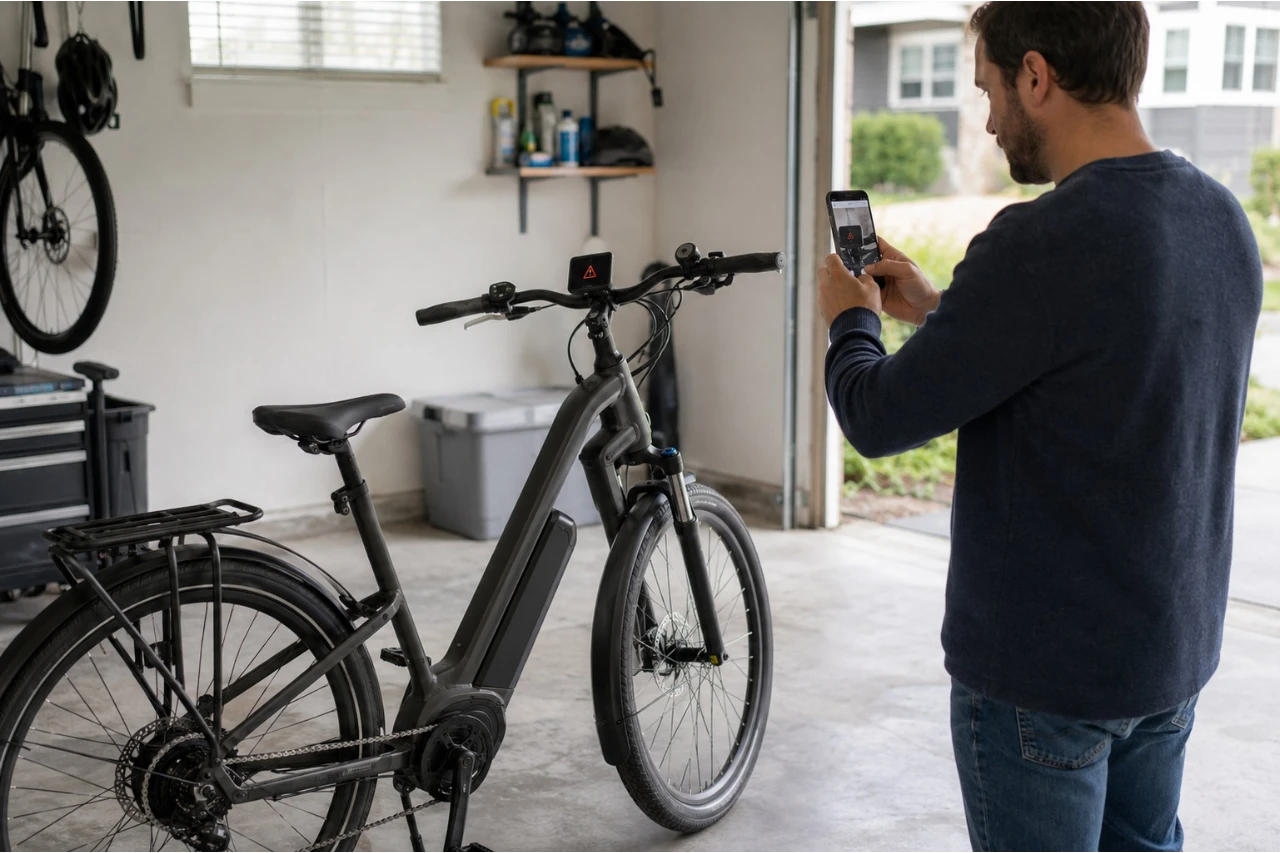
An ebike error code means the electrical system detected a condition outside its expected range.
It does not identify the failed part by itself, and the same number can mean different things on different bikes.
Stop in a safe place, record the exact code, turn the bike off normally, and check the manual or manufacturer’s support page for your model before riding again.
Limit your own troubleshooting to safe external checks unless the manufacturer gives specific instructions.
The quick response when an error code appears
If a code flashes while you are riding, use this order:
- Stop safely. Release the throttle, stop pedaling, brake smoothly, and move out of traffic.
- Record the complete message. Photograph the display. Note any letters, icons, or leading zeros—not just the main number.
- Write down what happened. Include recent charging, rain, washing, transport, a crash, a steep climb, a hard bump, unusual noise, or sudden power loss.
- Turn the system off normally. Follow the shutdown procedure in the owner’s manual. Do not repeatedly cycle the power to force the message away.
- Check for stop-use warning signs. Heat, swelling, smoke, a strong or unusual odor, leaking, melted plastic, exposed conductors, or erratic motor behavior require a more cautious response.
- Look up the model-specific code. Use the bicycle manufacturer’s manual or support page first. If the bike uses a Bosch, Shimano, or another named drive system, also use the documentation for that exact system and display.
If the code is not explained clearly, contact the manufacturer or a qualified e-bike service provider. For related symptoms, see these common e-bike issues and safe next steps.
Why ebike error codes are not universal
An e-bike is a connected electrical system. Its display, controller, battery-management system, motor, sensors, and brake cutoffs exchange data. A code may report that a signal is missing or outside its expected range. That does not prove the component named in a code description has failed.
Manufacturers assign codes differently. Similar-looking codes can refer to communication, sensor, motor, or battery conditions on different systems. Some systems use letter-and-number codes; others show icons or plain-language messages. One code may permit a restart, while another may require dealer diagnostics.
Avoid third-party “universal” charts unless they identify your bike brand, drive system, display model, and manual version. The bicycle maker’s instructions take priority because its component and software combination may differ from a supplier’s generic setup.
Common error categories and the safest next step
The categories below help you judge urgency. They are not substitutes for the definition in your manual.
| Error category | What the system may be reporting | Safe next step |
|---|---|---|
| Display or communication | Expected data is not moving between the display, controller, battery, motor, or another connected unit. | Turn the bike off normally, inspect only visible external wiring, and use the model-specific instructions. Arrange service if the code returns. |
| Brake cutoff | The controller is receiving a signal that a brake lever is applied. | Confirm that each lever moves and returns freely. Do not disconnect, bypass, or defeat the brake cutoff to restore motor power. |
| Speed sensor or motor | Wheel-speed data or motor-related feedback is missing or outside the expected range. | Stop using assist. Inspect only visible damage or an obviously displaced external sensor or magnet if the manual identifies it. Seek service for a recurring code, unusual noise, or harsh motor behavior. |
| Throttle or pedal-assist sensor | The controller cannot confirm the expected rider input. | Leave the bike off until you have checked the exact instructions. Do not probe wires or substitute an unapproved component. |
| Battery, voltage, or temperature | The system detected a battery connection, voltage, current, or temperature condition. | Do not restart, ride, or charge until you have checked the manual. Stop immediately if the battery is hot, damaged, swollen, leaking, smoking, or producing an unusual odor or sound. |
| Charger or charging | The battery or charger did not begin, continue, or finish charging as expected. | Unplug safely if there is no heat, smoke, sparking, or damage. Do not try a charger merely because its plug fits; follow the e-bike charger compatibility checks. |
| Software or system configuration | An update, initialization, pairing, or system setting did not complete correctly. | Follow the manufacturer’s exact recovery instructions. Do not install unofficial firmware or change protected settings. |
Safe external checks an owner can make
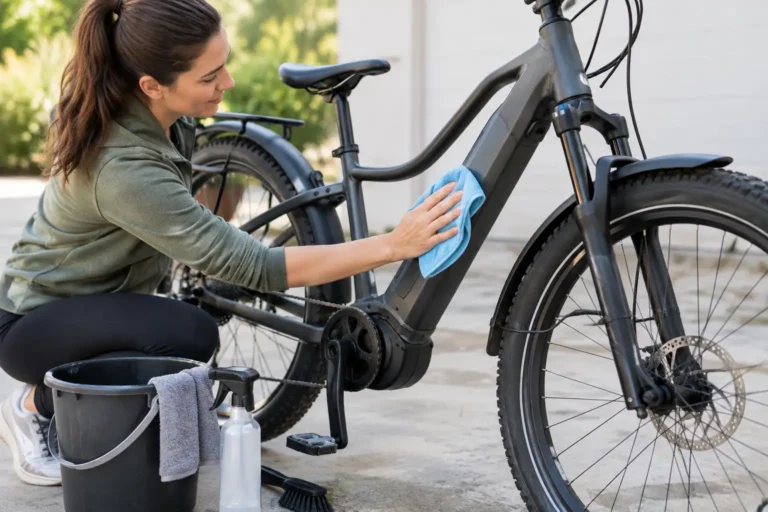
A limited inspection is reasonable only when the bike is cool, dry, undamaged, powered off, and the manual does not classify the code as critical. Remove the battery only as the manufacturer directs.
Check the following without disassembly:
- The removable battery is fully seated and locked, if it is safe to touch and the manual permits this check.
- The display and handlebar controls are secure on their mounts.
- Brake levers are not obstructed and return normally when released.
- Visible cables are not cut, crushed, sharply kinked, pulled tight, or trapped by an accessory.
- Accessible external connector covers appear closed and undamaged.
- A visible wheel-speed sensor and its magnet have not obviously shifted, if your manual identifies their location.
Do not pull on cables, push tools into connectors, short terminals, probe live wiring with a meter, open an electrical housing, or disconnect safety sensors unless the manufacturer’s procedure explicitly tells the owner to do so. Never open or attempt to repair the battery, charger, controller, display, or motor.
Should you restart the e-bike?
A single normal restart may be reasonable if all of the following are true:
- The manual permits a restart for that exact code.
- There is no battery, charging, temperature, or critical-system warning.
- The bike is cool, dry, and free of visible damage.
- There is no burning smell, smoke, leaking, sparking, surging, or unexpected power loss.
If the code clears, that does not prove the fault is fixed. Test the controls while stationary and ride only if the manual permits it. If the code returns, stop using assist and arrange support.
Codes after rain, washing, transport, or a crash
The event before the warning often helps support identify the cause.
After transport, inspect areas where rack arms, straps, doors, or covers could have pressed on the display, brake levers, or wiring. Do not reconnect a plug unless the manual provides an owner procedure and the bike is fully powered down.
After rain or washing, do not assume an e-bike is waterproof. Do not charge while the battery, port, plug, or surrounding area is wet. If moisture entered an electrical area, leave the system off and follow the manufacturer’s instructions. See the e-bike rain protection guide for safe drying steps.
After a significant fall, collision, battery drop, or hard impact, do not use or charge a damaged battery even if the display works. Internal damage may not be visible. Ask the manufacturer or a qualified service provider how it should be evaluated.
When to stop riding and stop charging
Stop using motor assist and do not charge the battery when the manual identifies a battery, temperature, charging, or critical-system fault. Also stop when the bike loses power unpredictably, the motor surges, electrical components make unusual sounds, the display repeatedly shuts down, or wiring and connectors are visibly damaged.
Treat unusual heat, swelling, leaking, hissing, popping, smoke, melted plastic, or a strong unusual odor as battery danger signs. Do not touch, move, open, or try to repair a battery that is smoking, burning, rapidly heating, or making unusual sounds. Move people away, leave the building if applicable, and call 911 from a safe location when there is smoke, fire, or immediate danger. Follow instructions from emergency responders and the battery manufacturer. See the full list of e-bike battery damage warning signs.
Can you pedal home with an error code?
Only consider pedaling without assist when the manufacturer does not classify the code as critical and all mechanical safety functions still work normally. The brakes, steering, wheels, tires, and drivetrain must feel secure; there must be no battery warning, heat, odor, smoke, damaged wiring, motor resistance, or unexpected power behavior.
Walk the bike or arrange transportation if you are uncertain. Do not continue riding merely because the motor has shut off—the code may have followed a crash, brake fault, loose wheel-speed component, or another condition that also affects safe bicycle operation.
Give support the details needed to diagnose the fault
A clear report can reduce guesswork. Provide:
- E-bike brand, model, serial number, and approximate purchase date
- Display and drive-system model, if shown in the manual or on an external label
- Exact code, message, icon, and a clear photo of the display
- Whether the warning is constant or intermittent
- Battery charge level and whether the bike was riding, parked, or charging
- Weather, hill load, assist level, and approximate distance before the code appeared
- Recent washing, rain, transport, impact, or service
- Any heat, odor, noise, power loss, surging, or visible damage
Do not repeatedly recreate a fault involving heat, charging, power loss, or unexpected motor operation just to collect more information.
Reduce avoidable electrical alerts
Routine care cannot prevent every fault, but it reduces avoidable connection and moisture problems. Follow the manual, protect wiring during transport, avoid pressure washing, keep the charging-port cover closed, and use a consistent e-bike maintenance routine.
Use only the charger supplied with the e-bike or one specifically approved by the manufacturer. The U.S. Consumer Product Safety Commission also advises owners to use only manufacturer-recommended chargers and replacement battery packs confirmed as suitable for the device.
Sources and further reading
- CPSC Micromobility Information Center
- Bosch eBike Systems Help Center
- Shimano E-Bike Error and Warning Code Lookup
- UL Solutions: UL 2849 Electrical-System Certification for E-Bikes
Safety information and source availability checked August 20, 2026. Always use the latest instructions for your exact e-bike and electrical system.