A little joy belongs in every day.

This ebike tire guide explains how to check pressure, inspect tread and sidewalls, prevent flats, and know when a tire needs professional attention early.
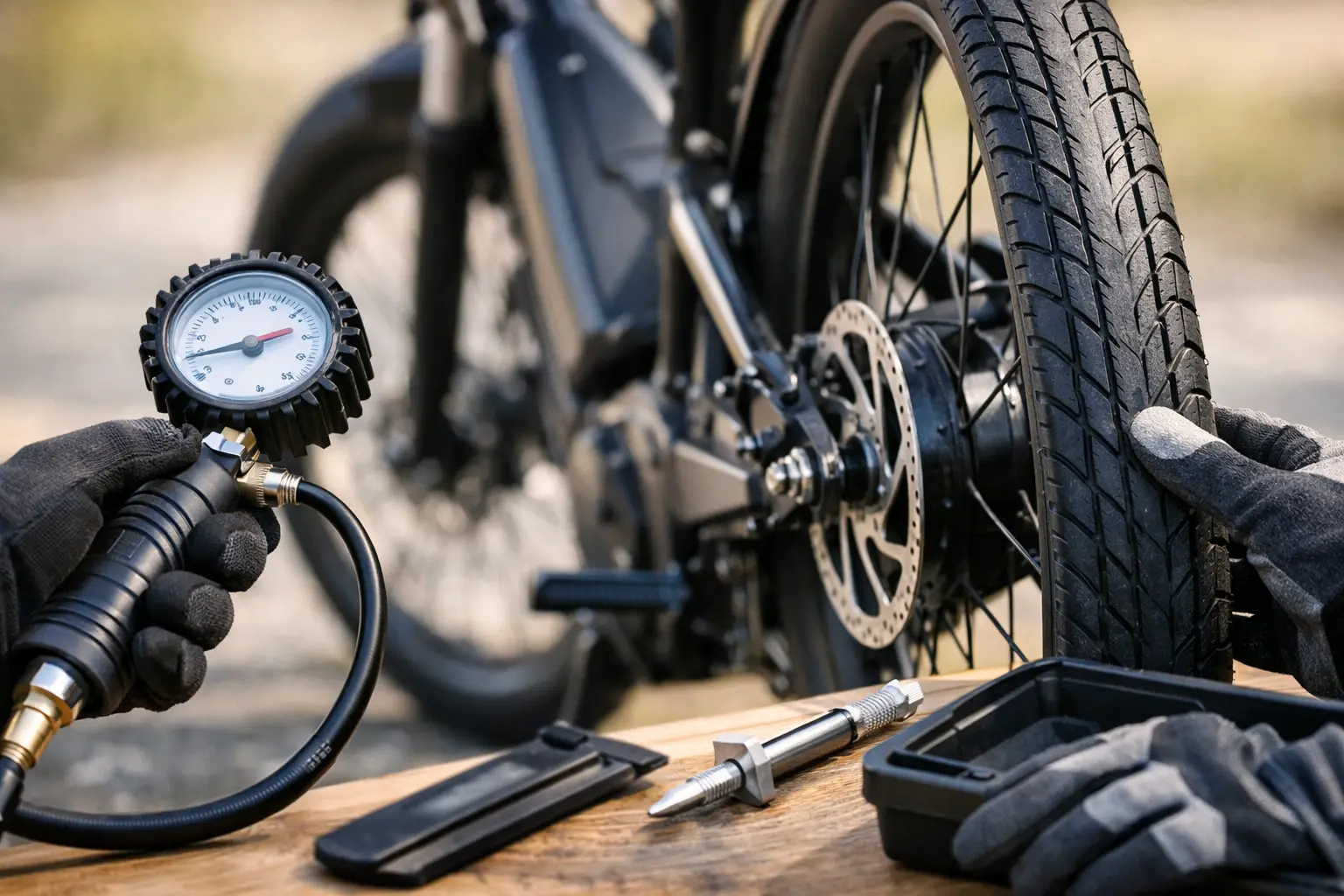
Your tires are the only parts of an e-bike that touch the road. Correct pressure, intact rubber, and secure wheel hardware affect braking, cornering, comfort, battery range, and flat resistance. This ebike tire guide covers the checks most owners can perform at home and the warning signs that call for a qualified bicycle mechanic.
E-bike tires deserve more attention than many riders give them. An e-bike is often heavier and faster than a non-electric bicycle, and motor assistance can make it easier to ride farther with a tire problem developing unnoticed. A quick inspection before regular rides is simple preventive maintenance, not advanced bike repair.
The pressure range molded into a tire’s sidewall is the starting point. It is usually listed in pounds per square inch (psi), bar, or both. Do not use a pressure number printed on the wheel rim, an online recommendation, or a friend’s setting in place of the tire’s stated range.
Use a bicycle pump with a reliable gauge. Pressing a tire with your thumb can reveal a completely flat tire, but it cannot tell you whether a tire is safely inflated. On many e-bikes, a difference of 5 to 10 psi can noticeably change handling and ride feel.
The right pressure depends on the tire’s approved range, rider and cargo weight, tire width, road surface, and the e-bike manufacturer’s instructions. As a general pattern, higher pressure rolls more easily on smooth pavement but transmits more bumps and may reduce traction on loose or wet surfaces. Lower pressure can improve comfort and grip, but too little pressure increases the chance of pinch flats, rim damage, squirmy handling, and tire bead problems.
The rear tire commonly carries more weight because it supports the rider’s weight and may also support a hub motor, rack, cargo, or child seat. It may need a somewhat higher pressure than the front tire, as long as both remain within their printed ranges. Follow the owner’s manual if it gives front and rear pressure targets.
Check pressure when the tires are cool, ideally before riding. Air pressure changes with temperature, so a tire inflated in a warm garage can read lower outside on a cold morning. This is normal, but it is a reason to check rather than guess.
| What you notice | Likely tire-related concern | Practical next step |
|---|---|---|
| Bike feels sluggish or wanders in turns | Pressure may be too low | Check both tires with a gauge |
| Harsh ride and reduced grip on rough pavement | Pressure may be too high for conditions | Reduce pressure, staying within the sidewall range |
| Repeated loss of pressure | Puncture, leaking valve, or rim-tape issue | Inspect the tire and arrange service if the cause is not clear |
| Thumping or side-to-side wobble | Tire may not be seated evenly or may be damaged | Stop riding and have the wheel inspected |
Do a visual inspection at least weekly if you ride often, and before any long ride. Rotate each wheel slowly and look over the full tire surface. Remove small stones, glass, thorns, or wire that are lodged in the tread before they work deeper into the tire. Use care around sharp debris, and do not put your fingers near moving spokes, brake rotors, or a powered wheel.
Tread helps channel water and provide traction, but a tire can be worn out before it looks completely smooth. Replace or have a mechanic evaluate a tire with cracks that expose fabric, cuts deep enough to reveal casing threads, bulges, separated tread, or a distorted shape. These conditions can lead to a sudden failure, especially under the higher loads common on e-bikes.
Check the sidewalls closely. Fine surface aging lines may appear over time, but widespread cracking, deep splits, or a bubble in the sidewall are reasons to stop riding on that tire. Sidewall damage is not a safe patch-at-home situation.
The bead is the reinforced edge that holds the tire onto the rim. Look for a consistent molded line just above the rim around the entire wheel. If that line disappears below the rim in one area or sits noticeably higher in another, the tire may not be seated correctly. Deflate the tire and follow the manufacturer’s tire-installation instructions, or have a shop correct it. Do not ride a tire that appears unevenly seated.
A tire that goes flat once may have picked up a sharp object. A tire that repeatedly loses air may have a punctured tube, a damaged tubeless setup, a leaking valve, worn rim tape, or a problem with the tire itself. Repeatedly adding air without finding the cause can leave you stranded and may damage the tire or wheel.
If you are comfortable removing a wheel and your e-bike manual permits it, a basic tube repair or replacement may be within normal bicycle maintenance. Rear-wheel work can be more complicated on e-bikes with hub motors, wiring, torque hardware, or integrated components. Disconnecting or disturbing motor wiring unnecessarily can create avoidable problems.
For a rear hub-motor wheel, a tire that will not seat properly, a damaged rim, or any uncertainty about reassembly, use a qualified bicycle mechanic. Follow manufacturer instructions for wheel removal, axle hardware, cable routing, and torque requirements. Never pull on an electrical cable to disconnect or remove a wheel.
Some e-bikes use inner tubes, while others use tubeless tires that seal directly against a compatible rim. The maintenance approach differs. A tube system may lose air from a puncture or valve issue. A tubeless system may need sealant maintained at manufacturer-recommended intervals and can lose air through a puncture, valve, bead, or rim-tape issue.
Do not assume a tire is tubeless just because it has a wide profile. Check the tire, rim, and e-bike documentation. If sealant has sprayed onto the frame or brake rotor, clean the area carefully according to the component instructions. Keep any oil or sealant contamination away from brake pads and rotors, since contaminated brakes can lose stopping performance.
Commuters should check tires frequently because potholes, road debris, curbs, and temperature swings are part of daily riding. Cargo and child-carrying riders should be especially consistent about pressure because added weight changes tire loading and handling. Before carrying passengers or heavier loads, confirm the e-bike’s weight limits and tire pressure guidance in the manual.
For gravel paths or mixed surfaces, a slightly lower setting within the approved range may improve control, while smooth road riding may feel better at a higher setting. The trade-off is real: comfort and traction increase as pressure comes down, but so does the risk of rim strikes if pressure is too low. Make small adjustments and evaluate handling in a safe, familiar area.
Avoid hopping curbs or striking potholes at speed. Even a tire that looks fine afterward can suffer a pinched tube, damaged bead, or bent rim. After a hard impact, inspect the tire and wheel before continuing. If the wheel rubs the brake, has a visible wobble, or the tire has a new bulge, stop riding.
Before leaving, take about one minute to do the following:
This routine matters even more after storage. Tires naturally lose some air over weeks or months, and a bike stored in direct sun, extreme heat, or damp conditions can show faster rubber aging. Store the e-bike in a dry area when possible, and check tire condition before returning it to regular use.
Stop riding and arrange professional inspection for a tire with exposed cords, a bulge, a major sidewall cut, severe cracking, an unseated bead, or recurring unexplained air loss. Also seek help after a significant impact if the rim is bent or the wheel no longer runs true. These are safety issues, not inconveniences to ride through.
Keep your pressure gauge near the bike or charger so the check becomes part of your regular routine. A few calm minutes before a ride can protect the tire, preserve predictable handling, and help every mile feel more controlled.