Winter E-Bike Checkup: A Practical 10-Step Guide to Safety and Range

Get your e-bike winter-ready with a 10-step checkup: battery care, tire grip, brake refresh, brighter lights, salt-proof cleaning, and range-saving tips.
Disclosure: This article may contain affiliate links. As an Amazon Associate I earn from qualifying purchases.

Use this once at the start of winter, then scan it monthly. Each step includes quick checks, actions, and what to buy if something’s off.

At a glance (what “good” looks like)

  • Battery charges at room temperature, holds charge predictably, and connectors are clean.
  • Tires show no sidewall cracks; pressure set slightly lower for grip; tread matches conditions.
  • Brakes bite early and evenly; rotors run true; pads have ≥1 mm friction material.
  • Lights are bright, well-aimed, and survive rain; reflectivity visible from the sides.
  • Drivetrain shifts quietly under load; chain wear ≤0.5% (on 11/12-speed ≤0.3%).
  • Bolts are snug to spec; wheels straight; no play in headset, bottom bracket, or hubs.
  • Cables/connectors are strain-free and weather-protected; display shows no error codes.
  • Suspension moves freely in the cold; fenders don’t rub; no salt crust on exposed parts.
  • Short shakedown ride confirms smooth braking, shifting, and stable electricals.
  • You know your winter range baseline (Wh/mi or Wh/km) and carry a simple repair kit.

Tools & supplies (keep on the bench)

Hex/Torx keys, torque wrench, chain checker, tire pump with gauge, brake cleaner/isopropyl alcohol, shop towels, wet-conditions chain lube, light threadlocker, dielectric grease, anti-seize, cable ties, spare tube/patch kit, mini-pump/CO₂, nitrile gloves, small brush.

Step 1 — Battery & charging habits

Check

  • Visual: no swelling, odor, leakage, or heat spots.
  • Charge behavior: charges normally indoors at 15–25 °C (59–77 °F).
  • Connectors: clean, tight, no greenish corrosion.
  • State of charge (SOC) after storage: still within expected range.

Do

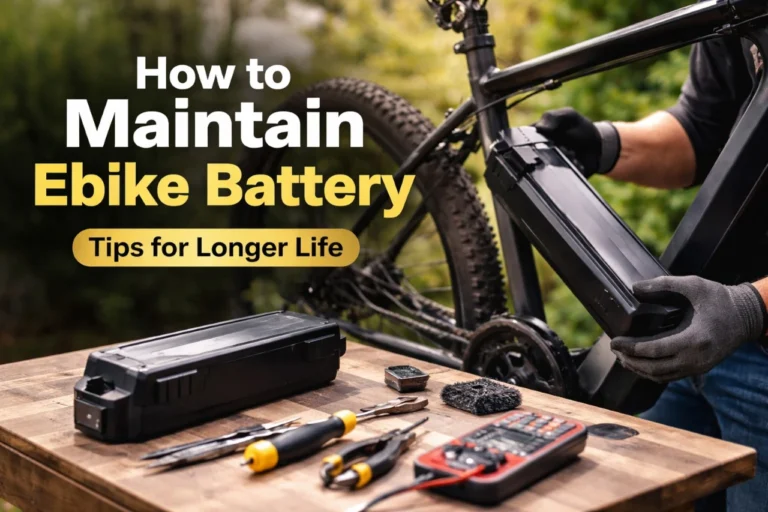
  • Charge and top-off at room temperature; never fast-charge a cold battery.
  • For weekly riding, keep daily use roughly 20–80% SOC.
  • For multi-week storage, leave ~40–60% SOC and store cool/dry.
  • Wipe contacts, add a thin smear of dielectric grease to exposed low-voltage plugs (not on high-voltage blade contacts unless specified by the manufacturer).

Fix/Buy if needed

  • Certified replacement charger (match voltage & connector), battery cover/insulating sleeve, fire-retardant charging mat, smart outlet/timer.

Step 2 — Tires, tread & pressure for winter grip

Check

  • Sidewalls for cracking/cuts; tread depth; embedded debris.
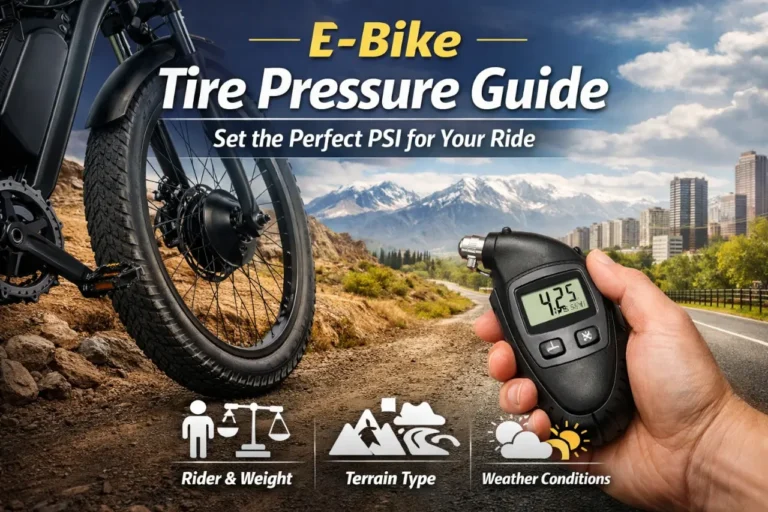
  • Pressure with a reliable gauge (expect to run 5–15% lower than summer for grip).
  • For snow/ice: consider winter compounds or studded tires.

Do

  • Set pressure to the maker’s safe range for your load and terrain; verify before each ride.
  • If you ride regular ice, choose studded tires (front first, then rear).
  • Carry a spare tube even on tubeless setups (sealant can fail in extreme cold).

Fix/Buy if needed

  • Winter/studded tires, quality gauge, tire levers, sealant, tubeless repair plugs.

Step 3 — Brakes: pads, rotors & feel

Check

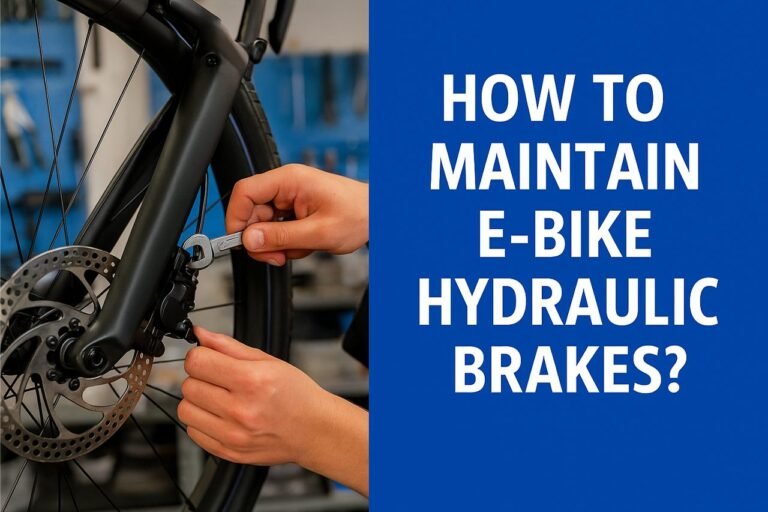
  • Pad thickness: ≥1 mm friction material (not counting backing plate).
  • Rotor true: no rub-rub sound when spun; no blue heat spots.
  • Lever feel: consistent bite point; no squishiness (may indicate air/contamination).

Do

  • Clean rotors with isopropyl alcohol; bed-in new pads (10–15 firm stops).
  • Realign calipers: loosen, squeeze lever, re-tighten evenly.
  • If hydraulic and lever pulls to the bar, bleed per manufacturer spec.

Fix/Buy if needed

  • Sintered pads (better wet performance), fresh rotors, bleed kit/fluid (correct type: mineral/DOT), rotor truing fork.

Step 4 — Lights & 360° visibility

Check

  • Front light bright enough for your speed; beam aimed to avoid dazzling.
  • Rear light stable/flash mode; visible from 100 m+; side reflectors intact.
  • Mounts tight; IP-rated for rain; cables tidy.

Do

  • Run front + rear lights at all times in winter gloom.
  • Add reflective tape to fork blades, crank arms, seatstays, and helmet edges.
  • Consider a helmet-mounted light to “look through” corners.

Fix/Buy if needed

  • High-output bar light, dedicated tail light with daytime flash, reflective stickers, USB charging dock.

Step 5 — Drivetrain: chain, cassette & shifting

Check

  • Chain wear with a checker (replace around 0.5%; for 11/12-speed many replace earlier).
  • Pulleys spin freely; cassette teeth not shark-finned.
  • Shifting under load smooth; no skipping.

Do

  • Degrease and re-lube with wet-conditions lube; wipe excess.
  • Index shifting: a quarter-turn on barrel adjuster can cure most minor hesitations.
  • Replace chain proactively to protect cassette/chainring.

Fix/Buy if needed

  • New chain, lube, quick links, pulley wheels, cable/housing kit.

Step 6 — Frame, wheels & fasteners (the quiet safety)

Check

  • Wheels: spin true; no side-to-side wobble; spokes evenly tensioned by sound/feel.
  • Headset: hold front brake, rock bike—no play.
  • Axles/through-bolts, stem/handlebar, seatpost clamp, racks/fenders: snug to spec.

Do

  • Use a torque wrench; follow the manufacturer’s torque values.
  • Anti-seize on steel-into-alloy threads; light threadlocker where specified (e.g., rotor bolts).
  • Re-tension fender stays to prevent tire rub.

Fix/Buy if needed

  • Replacement bolts/washers, torque wrench, anti-seize, threadlocker.

Step 7 — Suspension & contact points

Check

  • Fork/shock cycle smoothly in the cold; seals not weeping.
  • Set sag appropriate to your weight with winter clothing.
  • Grips dry and tacky; contact points comfortable with gloves.

Do

  • Add slightly slower rebound for icy chatter; temperature can thin/slow fluids.
  • Consider pogies/bar mitts, insulated gloves, and wider pedals or pins for winter boots.

Fix/Buy if needed

  • Service kit/seals, winter-weight gloves or pogies, grippy pedals, comfort saddle.

Step 8 — Electronics: wiring, sensors & display

Check

  • Harness routing: no tight bends; no crushed sections under zip-ties.
  • Connectors: seated fully with gasket lips in place.
  • Display/controller shows no error codes; speed sensor aligned to magnet.

Do

  • Add a tiny bead of dielectric grease around low-voltage connector gaskets.
  • Secure loose wires with soft straps; avoid sharp edges and fork crown pinch points.
  • If firmware updates are supported by the brand/app, apply stable releases before peak season.

Fix/Buy if needed

  • Replacement magnet/sensor, spare display mount, gentle cable sheathing, extra zip-ties/Velcro straps.

Step 9 — Weatherproofing, cleaning & salt control

Check

  • Fenders cover at least 40–50% of wheel arc; mudflap near ground.
  • Drip lines: water doesn’t flow toward connectors.
  • Salt residue on fork crown, chainstay bridge, motor casing, and kickstand plate.

Do

  • Never pressure-wash the motor/bearing areas; hose on “rain” setting or bucket + sponge.
  • Rinse salt promptly; dry and re-lube chain the same day.
  • Clear frame film on rub points (cable slap, bag straps).

Fix/Buy if needed

  • Full fenders with stays, frame protection tape, gentle bike wash, corrosion inhibitor (frame-safe).

Step 10 — Shakedown ride & winter range baseline

Do

  1. Take a 10–20 min ride mixing climbs, stops, and steady cruising.
  2. Listen for rubs/clicks; re-check rotor/pad clearance and fender alignment.
  3. Log distance, watt-hours used, average speed, temperature, and wind.
  4. Compute Wh/mi (or Wh/km) to set your personal winter range expectation.
  5. Pack a simple winter kit: tube, levers, pump/CO₂, multi-tool, tire plugs, gloves, space blanket.

Outcome

  • You now know how far you can go today in your local conditions, not last summer’s.

Quick troubleshooting table

SymptomLikely causeFast fix
Sudden 20–30% less rangeCold-soaked battery, soft tires, headwindCharge indoors, insulate battery, add 3–5 PSI, reduce speed by 2–3 mph
Brakes squeal when wetContaminated pads/rotor, glazed padsClean with alcohol, lightly scuff pads, re-bed
Light flickers on bumpsLoose mount/connectorTighten mount, re-seat plug, add a drop of dielectric grease
Random cut-outsLoose battery, pinched harnessRe-seat battery, inspect cable pinch points, add soft ties
Chain skips under loadWorn chain/cassette or mis-indexReplace chain (check wear), fine-tune barrel adjuster

Optional add-ons that pay off in winter

  • Studded front tire (control the steering on ice), then rear if budget allows.
  • High-output front light + separate tail light with daytime flash.
  • Full-coverage fenders with mudflaps.
  • Pogies/bar mitts to keep fingers functional for braking.
  • Dielectric grease and frame protection film.

FAQs

Q1. Can I charge the battery in a cold garage?

Charge at room temperature whenever possible. If the pack is cold, bring it indoors, let it reach room temp, then charge.

Q2. What’s the best storage level if I won’t ride for a few weeks?

Q3. Do I really need studded tires?

Q4. Can I hose-wash the bike?

Q5. How much range will I lose in winter?

Copy-paste checklist (print or save)

  • Battery charged at room temp; SOC plan set (daily 20–80%; storage 40–60%).
  • Connectors inspected and lightly greased; harness strain-free.
  • Tires free of damage; winter pressure set; flats kit packed.
  • Brakes cleaned, bedded, and rub-free; pads ≥1 mm.
  • Lights aimed; spare rear light or battery carried; reflectivity added.
  • Chain cleaned/lubed; chain wear within limits; shifting smooth.
  • Critical bolts torqued; wheels true; no headset play.
  • Suspension responsive; contact points winter-ready (gloves/pogies).
  • Fenders aligned; salt rinse routine ready; no pressure washing.
  • Shakedown ride done; Wh/mi baseline recorded; mini repair kit onboard.
Did this e-bike guide help you?
If you enjoyed this article or found it helpful, using the links in this article is a simple way to support GoEBikeLife. It doesn’t cost you anything extra.
Your support helps us keep testing more e-bikes and publishing honest, real-world reviews.
Kenny Lane - E-Bike Educator & Maintenance Pro
Kenny Lane

Kenny Lane is GoEBikeLife’s in-house e-bike educator and problem-solver. After years of building, tuning, and riding electric bikes, he turns complex tech into clear, step-by-step guides riders can actually use. From setup and maintenance to safety checks and riding techniques, Kenny’s tips are all about real-world riding, helping you keep your e-bike running smoothly and enjoy every trip with more confidence.

Leave a Reply

Your email address will not be published. Required fields are marked *