

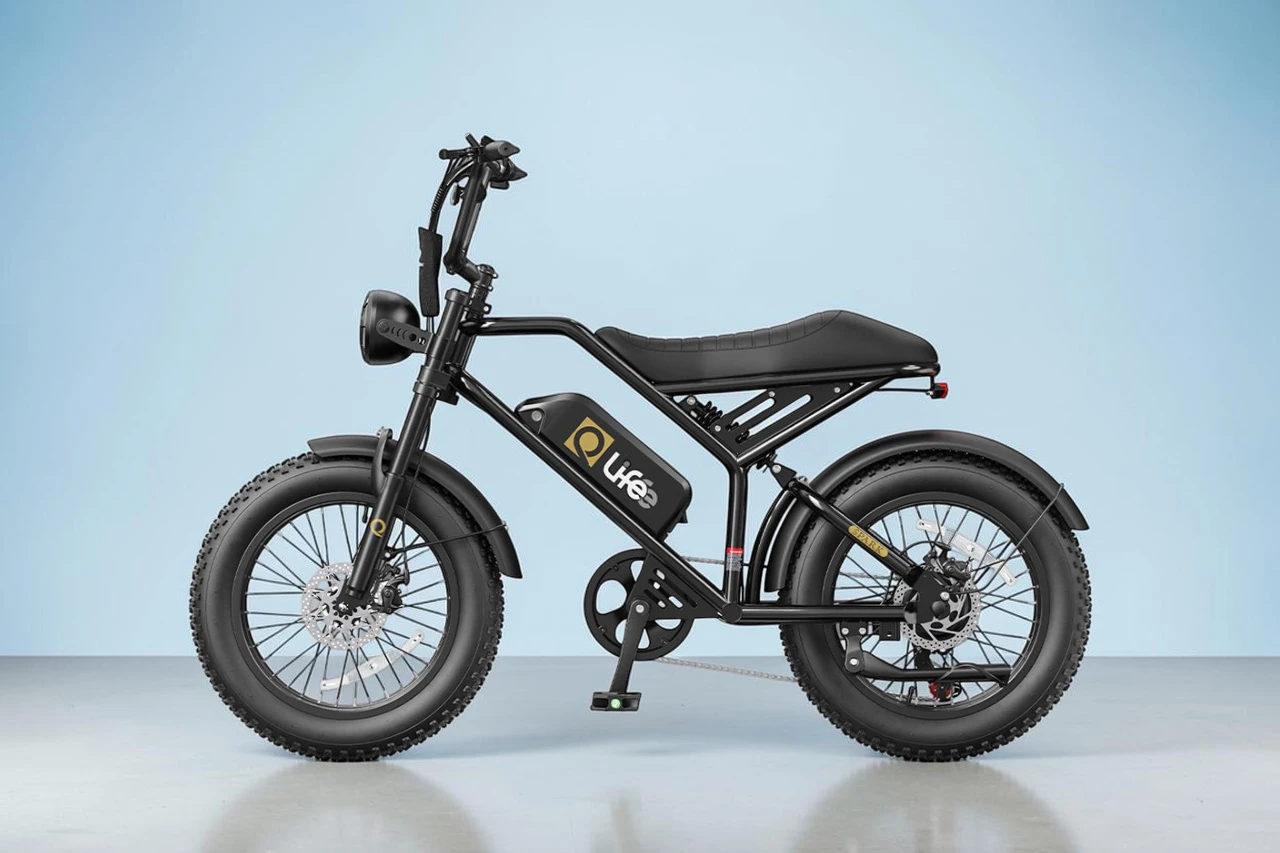
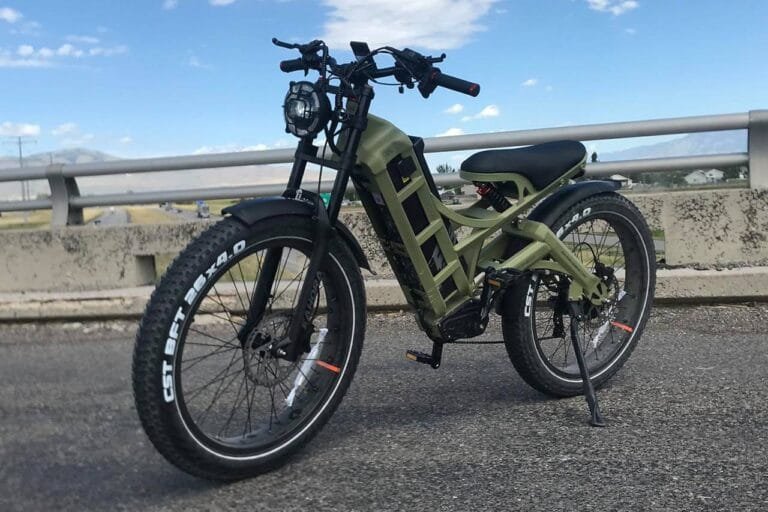
The Qlife Spark proves that a budget electric bike does not have to look generic. With its long bench seat, round motorcycle-style headlight, brown-sidewall fat tires, and compact moped-inspired frame, it has far more personality than I expected at this price.
After riding the Spark on paved roads, grass, uneven trails, and a moderate hill, I came away impressed by its comfort and street manners. The full suspension and wide tires take the sting out of rough surfaces, the bike feels composed near its top speed, and the long seat is exceptionally comfortable. However, the mechanical disc brakes feel basic, the fixed riding position can be cramped for taller riders, and this is not the model I would choose for frequent steep climbs.
The current Spark also differs from the base version I tested. My test bike used a 48V 13Ah battery and was advertised with 1,500W peak motor output. Qlife’s current standard Spark listing has been upgraded to a 48V 15.6Ah battery, 1,800W peak output, 110 Nm of claimed torque, and up to 75 miles of pedal-assist range. I have kept my ride observations tied to the tested bike and identified current manufacturer claims separately throughout this review.
Quick verdict: The Qlife Spark is a comfortable, stylish, and surprisingly capable value-oriented cruiser for shorter riders who mainly travel on streets and relatively gentle mixed terrain. Its brakes, fit, weight, and hill performance reveal its budget roots, but the overall package is compelling if retro styling and relaxed throttle-assisted riding matter more to you than natural pedaling or premium components.
Ready to Ride in Retro Style?
Check the latest Qlife Spark price, available colors, battery options, and current discounts before you buy.
Qlife Spark Pros and Cons
Pros:
- Distinctive retro moped styling
- Exceptionally comfortable long bench seat
- Full suspension and 20 × 4-inch tires smooth out rough pavement
- Stable and confidence-inspiring at normal street speeds
- Responsive handling from the compact wheelbase
- Bright, easy-to-read center display
- Thumb throttle and five pedal-assist levels
- Current model has a larger 48V 15.6Ah removable battery
- Optional rear rack adds useful cargo capacity
- Current electrical system and battery carry stated third-party safety certifications
- Strong overall value for the price category
Cons:
- Mechanical disc brakes feel soft compared with hydraulic brakes
- Fixed seat position can feel cramped for taller riders
- Awkward pedaling geometry, especially for longer legs
- Heavy at a listed 93 lb
- Tested base model struggled on a steeper hill under motor power alone
- Suspension is basic and non-adjustable
- No turn signals
- Manufacturer’s 75-mile range is an ideal pedal-assist claim, not a typical throttle range
Qlife Spark Specifications
| Specification | Current Qlife Spark listing |
|---|---|
| Bike type | Moped-style fat-tire electric bike |
| E-bike class | Class 3, according to Qlife |
| Motor | Brushless rear-hub motor |
| Peak output | 1,800W claimed |
| Maximum torque | 110 Nm claimed |
| Top speed | 35+ mph claimed |
| Battery | 48V 15.6Ah removable lithium-ion |
| Nominal capacity | Approximately 749Wh |
| Maximum range | Up to 75 miles with pedal assistance |
| Charging time | Approximately 4–6 hours |
| Charger | 54.6V, 2A |
| Drivetrain | Shimano 7-speed |
| Throttle | Thumb throttle |
| Tires | 20 × 4.0-inch puncture-resistant fat tires |
| Suspension | Front and rear suspension |
| Brakes | Front and rear mechanical disc brakes |
| Display | Center-mounted color LCD |
| Payload capacity | 360 lb |
| Bike weight | 93 lb |
| Water resistance | IPX5 listed in the specification section |
| Recommended rider height | 5’3″–6’3″ |
| Dimensions | 67.75 × 26.38 × 41.73 inches |
| Warranty | One-year limited manufacturer warranty |
Design and Build Quality
The Spark’s appearance is its immediate selling point. The black frame on my test bike, long tan seat, and brown-sidewall tires gave it the character of a small vintage motorcycle without making it feel like a novelty. Qlife also offers several other colors, so buyers are not limited to the combination I rode.
The frame felt solid during my test. I did not hear distracting squeaks or rattles, even after taking the bike across uneven ground. At this price, many components understandably feel entry-level, but the assembled bike did not feel flimsy.
The current 93-pound listed weight is substantial. That mass helps the Spark feel planted, but it also makes the bike difficult to carry up stairs, lift onto a conventional rack, or maneuver without motor assistance. Before buying, I would make sure you have ground-level storage and a transport rack rated for the bike’s weight.
The optional rear cargo rack is a worthwhile addition for errands. It gives the Spark a practical side that many style-focused moped e-bikes lack. It is not included with every configuration, however, so check the selected package carefully.
Comfort and Riding Position
Comfort was the biggest surprise of my ride. The long, high-density foam seat is soft and supportive, while its raised rear section helps keep the rider from sliding backward under acceleration. The covering has more of a grippy, rubberized texture than traditional leather, and it held me securely in place.
The seat, fat tires, and dual suspension work together well. On broken pavement, grass, and a rougher trail section, the Spark was much more forgiving than a hardtail e-bike. I still moved around over larger bumps, but the impacts were manageable and the bike remained composed.
There is an important fit limitation. The saddle does not adjust like a conventional bicycle seat, so you cannot independently change saddle height or fore-aft position. At 5’9″ with a 31-inch inseam, I already felt close to the handlebar and my knees approached it while pedaling. Although Qlife lists a recommended height range up to 6’3″, I would be cautious if you are tall or long-legged. The geometry is better suited to compact, relaxed cruising than efficient bicycle-style pedaling.

Motor Performance and Acceleration
My test bike provided useful rather than explosive acceleration. It did not lurch or try to lift the front wheel when starting, which made it approachable, but it still built speed confidently on level pavement.
During testing, the display generally reached about 30 mph while my separate GPS showed approximately 28 mph. The motor-power readout peaked around 1,250W on the tested 1,500W-peak version. On one brief run, the display unexpectedly climbed to roughly 36 mph, but I could not reproduce that result consistently, so I would not treat it as a reliable tested speed.
The current product page advertises 1,800W peak output, 110 Nm, and a top speed above 35 mph. Those figures apply to the updated listing, not necessarily to the earlier 13Ah base bike I rode. Rider weight, battery state, wind, grade, tire pressure, controller programming, and local restrictions will all affect performance.
For ordinary street cruising, I found the tested bike’s output sufficient. It got beyond 25 mph and held speed comfortably, which is plenty for the type of riding this platform handles best. Buyers seeking forceful launches or sustained high-speed performance should consider a higher-spec model rather than expecting the standard Spark to behave like a dual-motor machine.
Hill-Climbing Test
The tested Spark struggled when I attempted a steeper incline under motor power. It began to lose momentum and could not complete the climb without meaningful rider input. Shifting to a lower gear can help when pedaling, but the result made the bike’s priorities clear: this is primarily a street cruiser, not a dedicated hill climber.
The current motor has higher advertised peak power and torque than my test version, so it may perform better. Still, peak wattage alone does not guarantee strong climbing. Controller tuning, sustained motor output, gearing, rider weight, and heat management matter too. If your regular route includes long or steep grades, I would choose a model with verified hill-test results and stronger brakes.
Handling and Stability
The Spark has a relatively short wheelbase and compact front-end geometry, which makes it responsive at lower speeds. It changes direction easily and feels manageable around neighborhood streets and shared paths.
Despite that responsiveness, I felt stable at approximately 28 mph by GPS. The wide tires and the bike’s weight help it stay planted, and I did not encounter headshake or unsettling frame movement. The handling is best described as nimble for a heavy moped-style e-bike rather than razor sharp.
The knobby 20 × 4-inch tires provide plenty of contact with the ground. They worked well on pavement, grass, and light off-road surfaces, while their air volume added another layer of cushioning. They also bring the usual fat-tire tradeoffs: more rolling resistance, heavier steering than narrow tires, and greater effort if you have to pedal without assistance.
Suspension and Mixed-Terrain Ride
Both ends of the Spark are suspended, and the system did a respectable job during my test. The front fork and rear shocks reduced the harshness of potholes, bumps, and uneven trail sections. Combined with the padded seat, the result was one of the more comfortable rides I have experienced in this price range.
The suspension is basic and does not offer the fine adjustment found on more expensive e-bikes. It can absorb everyday impacts, but it is not intended for jumps, aggressive trail riding, or high-speed off-road use. I would treat gravel roads, park paths, grass, and relatively smooth dirt as its realistic mixed-terrain envelope.
Braking Performance
The Spark uses cable-operated mechanical disc brakes. They stopped the bike during my ride, and I was able to lock the rear wheel in a harder braking test, but the levers felt somewhat soft and the system needed adjustment.
Mechanical brakes are easier and less expensive to maintain than many hydraulic systems, but they usually require more hand pressure and more frequent cable adjustment. On a heavy bike capable of high speed, brake setup deserves immediate attention. I recommend checking rotor alignment, pad position, cable tension, and lever feel before the first ride, then bedding in the pads in a safe area.
If you prioritize stronger lever feel and lower hand effort, hydraulic brakes would be a meaningful upgrade. Qlife lists other Spark-family models with hydraulic braking, so compare the exact variants rather than assuming they all use the same system.
Battery and Real-World Range
The current Spark has a removable 48V 15.6Ah battery, equal to roughly 749Wh of nominal energy. Qlife claims up to 75 miles of pedal-assist range. That is a best-case manufacturer estimate and should not be interpreted as a typical result at high assist or on throttle alone.
My earlier test bike had the smaller 48V 13Ah battery. After approximately 13 miles of throttle-heavy riding, the display was generally showing two to three of its five battery bars, with some temporary voltage sag under load. Based on that ride—not a full controlled discharge—I estimated that the bike might exceed 20 miles under similar throttle-heavy conditions. Because I did not ride it until automatic cutoff, this is an observation rather than a verified maximum range.
The updated 15.6Ah pack has about 20% more nominal capacity than a 13Ah pack at the same voltage. It should therefore offer more range under comparable conditions, but it would be misleading to scale my estimate directly or promise 75 miles. Terrain, speed, starts and stops, wind, temperature, payload, tire pressure, and how much you pedal make a major difference.
For realistic planning, I would keep a generous reserve until you have measured consumption on your own route. The charger is rated at 54.6V and 2A, and Qlife lists a four-to-six-hour charge time.

Pedal Assist, Throttle, and Cruise Control
The Spark uses a cadence-based pedal-assist system. On my test bike, the approximate speed limits were:
- PAS 1: 9–10 mph
- PAS 2: about 13 mph
- PAS 3: about 17–18 mph
- PAS 4: about 21 mph
- PAS 5: full available speed
These are observations from the tested configuration and may differ on the current model. The cadence sensor makes the pedals function more like an on/off command for the motor than a direct measure of rider effort. It works, but it does not feel as natural as a well-tuned torque sensor.
The thumb throttle was convenient for starts and relaxed cruising. My bike also arrived with cruise control enabled. After holding a steady input, the motor could continue without constant throttle pressure, and touching either brake lever canceled it. Some riders will appreciate that on long, open roads; others may prefer to disable it through the settings menu if supported. Learn exactly how it engages and cancels before using it in traffic.
Pedaling without assistance was possible on level ground, but the bike’s weight and compact leg position made it uncomfortable as a long-term fallback. I would not choose the Spark if traditional pedaling efficiency is a priority.
Display, Controls, and Lighting
The center-mounted color screen remained legible in bright midday conditions. It displays speed, battery level, assist setting, trip information, and motor wattage, which I found especially useful during testing. I would have liked a live battery-voltage readout because a basic bar gauge can fall under acceleration and recover afterward, making remaining range harder to judge.
The large motorcycle-style headlight suits the design and provides forward illumination for low-light riding. An integrated rear brake light brightens when a brake lever is applied, improving visibility from behind. My test bike did not include turn signals. Riders who regularly mix with traffic may want to add a suitable signal system, while still using hand signals where required.
Safety Certification and Legal Considerations
Qlife states that the battery pack has been tested to ANSI/CAN/UL/ULC 2271:2018 and that the complete e-bike electrical system has been tested and certified to ANSI/CAN/UL 2849:2022A by TÜV Rheinland. This is reassuring, but buyers should verify that the documentation and labeling apply to the exact model and battery configuration being purchased.
Qlife labels the Spark as Class 3, while also advertising a 35+ mph top speed and providing a throttle. Those attributes do not fit every jurisdiction’s standard Class 3 definition. E-bike laws vary by state, city, trail system, and land manager, and a bike may need to be limited or registered for some uses. Check local motor power, throttle, equipment, and speed rules before riding on public roads or paths.
Regardless of the legal category, a certified helmet and conservative setup are sensible. Because this is a 93-pound bike with high claimed speed, I would also inspect the brakes, fasteners, tires, and battery lock before every ride.
Who Should Buy the Qlife Spark?
The Spark makes the most sense for riders who:
- Want distinctive moped styling on a limited budget
- Prefer throttle-assisted cruising to traditional bicycle pedaling
- Mostly ride paved streets, neighborhood roads, gravel, or mild trails
- Value a cushioned seat and full suspension
- Have secure, ground-level storage for a heavy e-bike
- Are comfortable maintaining mechanical disc brakes
- Fit the compact, non-adjustable seating position
I would look elsewhere if you are tall or long-legged, regularly climb steep hills, need to carry the bike upstairs, want hydraulic brakes, or expect efficient pedaling with the battery depleted. It is also not intended to carry a passenger simply because the seat is long; follow the manufacturer’s load and passenger guidance and do not add foot pegs without an approved passenger setup.
Qlife Spark vs. Other Spark Models
Qlife sells several bikes under the Spark name, including the compact Spark D2, the higher-spec Spark Plus, and the dual-motor Spark Max. Battery capacity, motor output, brake type, tire size, and range differ among them.
The standard Spark is the value-focused choice. If the low purchase price and retro appearance are the main attractions, it delivers the core experience. If you need hydraulic brakes, more sustained power, or substantially more battery capacity, compare the Plus and Max specifications before ordering. The correct choice is not necessarily the most powerful one; extra motors and batteries increase price, weight, and charging demands.
Warranty, Shipping, and Package Contents
Qlife lists free shipping from a U.S. warehouse, an estimated delivery window of approximately three to eight days, and a one-year limited warranty for the original owner against manufacturing defects. Promotional accessories are excluded from warranty coverage, and delivery estimates vary with inventory and destination.
The listed package includes the Spark e-bike, user manual, headlight, two keys, two pedals, charger, front reflector, and assembly tool kit. The rear rack is optional unless the selected configuration explicitly includes it.
On delivery, photograph the carton before opening it, check for shipping damage, confirm that the battery and charger labels match the ordered version, and retain the packaging until the bike has been assembled and tested.
Final Verdict
The Qlife Spark is not a premium e-bike disguised by a low price. Its mechanical brakes, basic suspension, heavy construction, and compromised pedaling position make its budget status apparent. Yet it gets the fundamentals of an affordable moped-style cruiser surprisingly right.
I enjoyed the comfortable seat, forgiving ride, predictable street handling, useful throttle, and bold retro design. The tested base model felt stable near 28 mph by GPS and remained free of distracting rattles over a mixed-surface ride. Its weak points—especially braking feel, fit for taller riders, and hill performance—are significant but easy to understand before buying.
For a shorter rider seeking an affordable, comfortable e-bike for relaxed street cruising and light mixed-terrain use, the Spark offers real value. I would not buy it solely for the 35+ mph or 75-mile marketing claims. I would buy it for the combination of style, comfort, everyday usability, and low entry price—after confirming the exact current configuration and making sure the fixed riding position fits.
| Preview | Product | Price | |
|---|---|---|---|

| Qlife Spark Electric Bike for Adults/Teens, 1800W Peak Motor, 749Wh Ebike | $699.99 | View on Amazon |
Frequently Asked Questions
How fast is the Qlife Spark?
Qlife advertises a top speed of more than 35 mph for the current 1,800W-peak version. On the earlier base model I tested, I recorded about 28 mph by GPS while the bike’s display showed roughly 30 mph. Speed varies with configuration, rider, terrain, battery state, settings, and local restrictions.
What is the real-world range of the Qlife Spark?
Qlife claims up to 75 miles with pedal assistance for the current 48V 15.6Ah battery. My older 13Ah test bike had not completed a full discharge, but its battery display suggested a throttle-heavy range above 20 miles under my conditions. These results are not directly interchangeable because the current battery is larger.
Is the Qlife Spark good for tall riders?
I would be cautious. Although Qlife lists riders up to 6’3″, the fixed bench seat placed my 5’9″, 31-inch-inseam riding position close to the handlebars. Taller or longer-legged riders should verify fit before buying.
Can the Qlife Spark climb steep hills?
The earlier base version I tested struggled on a steeper hill without substantial pedal input. The updated model has higher claimed output, but riders with demanding hills should seek configuration-specific climbing tests rather than relying only on peak wattage.
Does the Qlife Spark have hydraulic brakes?
The standard Spark shown on the current product page uses disc brakes, and the hardware shown and tested is cable-operated, indicating mechanical disc brakes. Some higher-spec Spark-family variants list hydraulic brakes, so check the exact model before ordering.
Is the rear rack included?
Not with every version. Qlife offers a single-battery configuration with a rear rack as well as configurations without it. Confirm the selected option in the cart.
Is the Qlife Spark UL certified?
Qlife states that its battery pack was tested to ANSI/CAN/UL/ULC 2271:2018 and that the complete electrical system was tested and certified to ANSI/CAN/UL 2849:2022A by TÜV Rheinland. Verify that the certification and product labels match the exact bike and battery you receive.
GoEBikeLife publishes independent e-bike reviews, comparisons, and practical buying guides. Some links on this page are affiliate links. If you make a purchase through an eligible link, we may earn a commission at no additional cost to you.

Solid write-up. I tested the Qlife Spark this weekend and the motor punch is legit—quick off the line and it holds 20–25 mph without drama. Dual suspension + 20×4.0 tires soaked up potholes better than I expected, and the headlight/turn signals are actually useful in traffic.