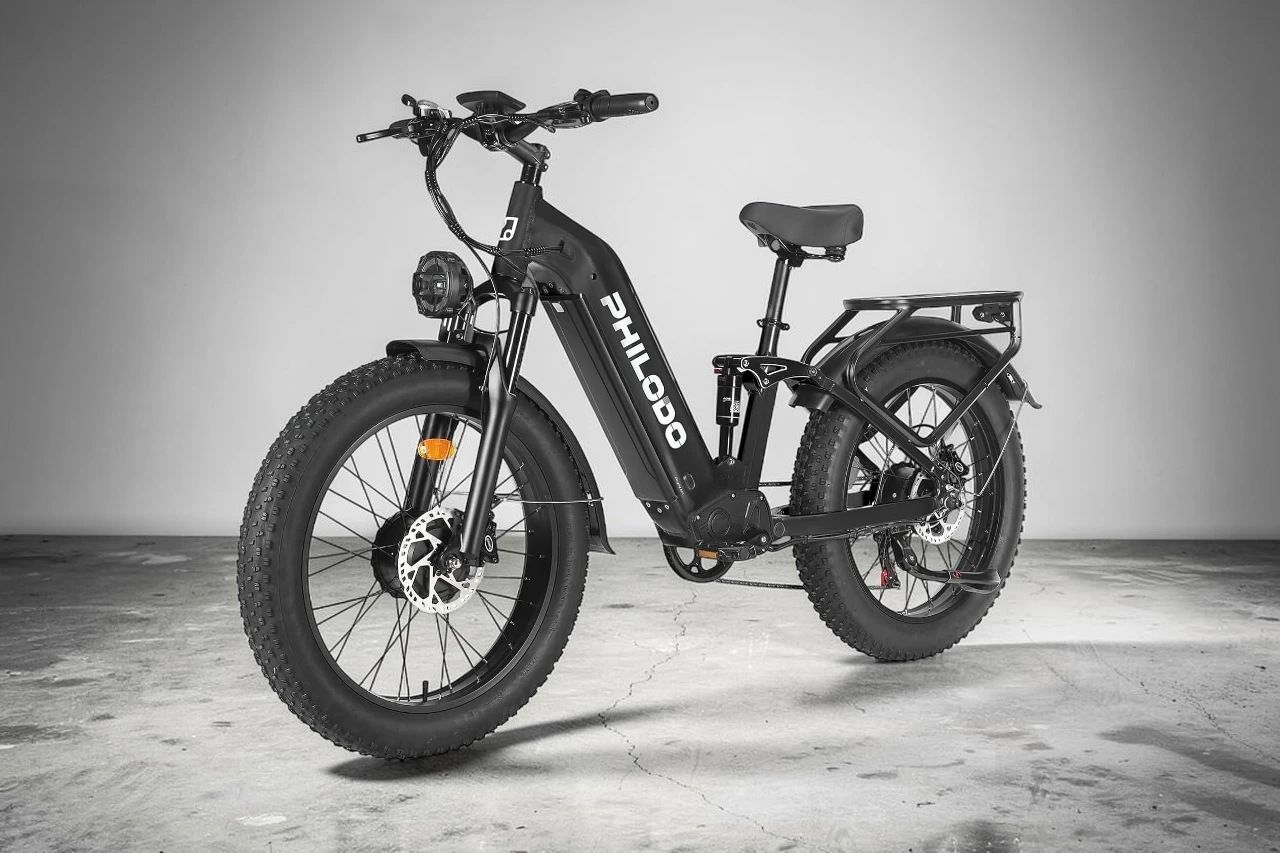
The PHILODO Falcon is one of those electric bikes that makes you rethink what $1,599 can buy. With two powerful hub motors, a massive 60V battery, full suspension, and aggressive fat tires, it promises the kind of performance usually associated with much more expensive electric bikes.
But after riding the Falcon on pavement, muddy trails, and steep hills, I discovered that having this much power isn’t necessarily the same as having a well-balanced electric bike.
The dual-motor acceleration genuinely surprised me. The hill-climbing performance was equally impressive. However, the braking performance, riding position, and somewhat unpredictable traction revealed a few compromises that prospective buyers should understand.
So, is the PHILODO Falcon a great value for performance enthusiasts, or is it simply too powerful for its own good?
Here’s my detailed review.
PHILODO Falcon Review: My Quick Verdict
The PHILODO Falcon delivers exceptional motor power and hill-climbing capability for its price, but its aggressive acceleration, relatively soft brakes, and forward-leaning riding position make it better suited to experienced riders than casual commuters.
What impressed me most was the difference between single-motor and dual-motor operation. With only the rear motor engaged, the bike felt surprisingly restrained. Activate both motors, however, and the Falcon transforms into an entirely different machine.
On a steep 15% grade, the bike climbed confidently and even continued gaining speed. That’s impressive for an electric bike in this price range.
However, I wasn’t equally impressed with its stopping performance. The hydraulic brakes required more lever pressure than I expected, especially considering how quickly this bike can accelerate.
My overall assessment: If your priority is raw acceleration, climbing power, and off-road capability, the Falcon offers compelling value. If you prioritize predictable handling, relaxed ergonomics, and confident braking, there are compromises worth considering before purchasing.
PHILODO Falcon Specifications
| Specification | Details |
|---|---|
| Motor | Dual 2,000W rated hub motors |
| Combined peak output | 5,000W (manufacturer claimed) |
| Torque | 105 Nm per motor (claimed) |
| Battery | 60V 32Ah removable lithium-ion |
| Battery capacity | 1,920Wh |
| Battery cells | LG cells (manufacturer specified) |
| Advertised top speed | 40–45 mph |
| Advertised range | 50–100 miles |
| Charging time | Approximately 10–12 hours |
| Frame | 6061 aluminum alloy |
| Frame options | Step-through and step-over |
| Tires | 24 × 4.0 inches (step-through); 26 × 4.0 inches (step-over) |
| Suspension | Lockable front fork and rear air shock |
| Brakes | Front and rear hydraulic disc brakes |
| Drivetrain | Shimano 7-speed |
| Throttle | Half-twist throttle |
| Pedal assist | Five assist levels |
| Display | 3.7-inch color multifunction display |
| Headlight | 700-lumen LED |
| Recommended rider height | 5’2″–6’2″ (step-through); 5’5″–6’5″ (step-over) |
| Manufacturer-listed payload | Up to 450 lbs; confirm for your specific configuration |
| Warranty | One-year limited manufacturer warranty |
| Price | Approximately $1,599 |
Design and Build Quality: A Serious-Looking Off-Road Machine
The first thing I noticed about the PHILODO Falcon was its substantial appearance.
This isn’t a lightweight commuter e-bike designed to disappear into a bike rack outside a coffee shop. Everything about it looks heavy-duty, from the oversized frame and fat tires to the substantial rear cargo rack.
The Falcon has a muscular, almost motorcycle-inspired appearance, particularly with the camouflage finish.
The version I rode featured the step-through frame and 24 × 4.0-inch Chaoyang fat tires. PHILODO also offers a step-over version with larger 26 × 4.0-inch tires.
I actually appreciate the smaller wheels on the step-through model. They make this bulky bike feel slightly more approachable and help reduce the overall height compared with the larger-wheel configuration.
Step-Through vs. Step-Over Frame
Both versions have their advantages, but I personally prefer the step-through design.
With a bike this substantial, being able to get on and off without swinging your leg over a high top tube makes everyday use noticeably easier.
That’s particularly useful when carrying cargo or stopping frequently on trails.
The frame itself feels substantial, and the suspension linkage gives the Falcon a purposeful off-road appearance.
The rear cargo rack is another welcome feature. It’s wide, solid-looking, and provides useful space for carrying equipment.
For hunting, fishing, camping, or outdoor exploration, a sturdy rear rack can be more valuable than another decorative accessory.
That said, I would verify its actual rated capacity in the documentation supplied with the bike before loading it heavily.
Color Options
PHILODO offers the Falcon in orange, black, and camouflage configurations.
The camouflage finish has a distinctive hunting-bike appearance, although the visible wrap seams aren’t necessarily to everyone’s taste.
Personally, I would probably choose black or orange for a cleaner appearance.
Dual-Motor Performance: The Falcon’s Biggest Selling Point
Let’s talk about the feature that makes this bike genuinely interesting: its motors.
The Falcon uses two hub motors, one in each wheel.
PHILODO advertises each motor at 2,000W rated power, with a combined peak output of up to 5,000W.
Those are serious numbers, but the most important detail isn’t simply the wattage.
It’s how dramatically the bike behaves when you activate both motors.
Single-Motor Mode: Surprisingly Mild Acceleration
When I first started riding the Falcon, I was using the rear motor alone.
To be frank, I wasn’t particularly impressed.
The bike accelerated, but it took several seconds to build meaningful speed. For something advertised as a high-performance electric bike, the initial response felt underwhelming.
With full throttle, it took roughly four or five seconds before the acceleration started feeling substantial.
Once moving, the bike could still reach relatively high speeds, but the initial torque delivery wasn’t particularly exciting.
I started wondering whether the Falcon’s advertised performance was exaggerated.
Then I activated the second motor.
Dual-Motor Mode: Completely Different Personality
Switching to dual-motor operation changed my impression almost immediately.
Even at pedal-assist level 2, the additional acceleration was dramatic.
The front motor pulls while the rear motor pushes, creating a much more aggressive response than I experienced in rear-wheel-drive mode.
The difference was especially obvious when accelerating from low speeds.
Suddenly, the Falcon felt like the powerful machine its specifications suggested.
However, that additional performance also introduced a challenge: controlling the front wheel.
Under aggressive throttle input, especially on loose or muddy surfaces, the front tire could spin before finding traction.
I quickly learned that starting in a lower assist setting and gradually increasing power was much more manageable than immediately selecting the highest level.
This isn’t the kind of electric bike where I recommend twisting the throttle aggressively without first understanding its behavior.
The Falcon has plenty of power. Learning to control that power is the bigger challenge.

Top Speed: How Fast Is the PHILODO Falcon?
PHILODO advertises a maximum speed of approximately 40–45 mph, depending on riding conditions.
That puts the Falcon well beyond the assisted-speed limits associated with conventional Class 1, Class 2, and Class 3 electric bicycles.
During one high-speed run, I saw approximately 41 mph on the bike’s display.
However, my phone’s GPS reading was closer to 36 mph at that moment.
That’s an important distinction.
The Falcon’s onboard display indicated a speed above 40 mph, but my GPS reading did not independently confirm that speed during the same run.
The battery also wasn’t completely charged, so I wouldn’t treat that run as a definitive statement about the bike’s maximum capability.
What I can say is that the Falcon accelerates into the mid-30-mph range with considerable enthusiasm once both motors are engaged.
I also noticed that the onboard speed indication and GPS reading were closer together at some lower speeds.
Does It Feel Stable at High Speed?
The bike feels substantial, helped by its wide tires and heavy-duty construction.
But substantial doesn’t automatically mean easy to handle.
At higher speeds, I became very conscious of the bike’s weight, throttle response, and braking requirements.
I didn’t feel comfortable repeatedly pushing it to its advertised maximum speed, particularly after experiencing how quickly the front motor could break traction.
For me, the Falcon’s acceleration and hill-climbing ability are more convincing strengths than its top-speed specification alone.
Important: High-speed operation should be limited to locations where it is lawful and appropriate, with suitable protective equipment and a bike that has been inspected for safe operation.
Hill-Climbing Performance: One of the Best Parts of My Ride
If there’s one area where the Falcon genuinely impressed me, it was climbing.
PHILODO advertises 105 Nm of torque per motor, and while I can’t independently verify those figures, the real-world climbing behavior certainly felt powerful.
I rode the Falcon on a steep section with approximately a 15% grade.
Rather than struggling, the bike climbed confidently and even continued picking up speed.
I was only using pedal-assist level 3 during part of the climb, which made the result even more impressive.
The contrast between single-motor and dual-motor operation was obvious here.
With both motors active, the Falcon had the kind of climbing authority that makes steep hills feel much less intimidating.
What About Loose Dirt and Mud?
I also rode the Falcon through wooded sections where the ground was damp and muddy.
The wide tires provided a substantial contact patch, but the dual-motor system could still overwhelm available traction.
In fact, the strongest acceleration sometimes made the bike more difficult to control rather than easier.
This is worth emphasizing because all-wheel drive isn’t a guarantee against wheelspin.
On slippery trails, careful throttle control matters just as much as motor output.
For steep off-road routes where motor-assisted access is permitted, the Falcon’s climbing power is a major advantage. On loose surfaces, though, I would use the lower power settings and prioritize traction over acceleration.
Full Suspension: Comfortable After Some Adjustment
The PHILODO Falcon comes with a full-suspension setup consisting of a front suspension fork and rear air shock.
For an electric bike at this price, the rear air shock is a particularly welcome feature.
Front Suspension
The front fork provides lockout and preload adjustment.
During my ride, it helped absorb uneven terrain and smaller impacts, although it isn’t a substitute for the more sophisticated suspension systems found on premium electric mountain bikes.
For recreational trail riding and rougher surfaces, it provides useful additional compliance.
Rear DNM Air Shock
The rear shock on the bike I rode was a DNM air shock.
It felt quite stiff when I first got on the bike.
After adjusting the air pressure, I noticed more movement from the rear suspension and a more forgiving response over uneven surfaces.
That adjustment made a meaningful difference to the riding experience.
However, air suspension requires proper setup. I recommend using a compatible shock pump and following the manufacturer’s pressure and sag guidance rather than making random adjustments.
Overall, the Falcon’s suspension is one of its better features, particularly when compared with basic electric bikes that offer only front suspension or use simpler rear spring systems.
Braking Performance: My Biggest Concern
This is where my enthusiasm for the Falcon starts to fade.
The bike comes with front and rear hydraulic disc brakes. The example I rode had DYISLAND-branded brake components and approximately 180mm rotors.
On paper, that sounds like a reasonable setup.
In practice, I wanted more braking authority.
The Brake Levers Required Too Much Effort
During normal riding, I noticed that the brakes felt somewhat soft.
They required more lever pressure than I expected to produce strong deceleration.
That became more noticeable as the bike’s speed increased.
At one point, I had to squeeze the levers quite firmly to bring the bike down to a comfortable speed.
During another braking maneuver from approximately 24 mph, the rear tire stepped sideways.
That certainly got my attention.
To be fair, the brakes were still relatively new, and the pads may not have completed their proper bedding-in process.
Brake performance can improve after correct bedding-in, but I wouldn’t assume that alone will resolve the concern.
Why This Matters on the Falcon
On a conventional commuter bike traveling around 20 mph, average brakes might feel acceptable.
On a powerful, heavy machine capable of much higher speeds, braking confidence becomes significantly more important.
I would like to see PHILODO equip the Falcon with a braking system that offers stronger initial bite and more reassuring modulation.
Before attempting higher-speed riding, I would recommend a proper brake inspection, bedding-in procedure, and evaluation by a qualified bicycle mechanic.
For me, the brakes are the Falcon’s most significant performance compromise.
Ride Comfort and Ergonomics: Not Quite What I Expected
Despite its large appearance, the Falcon didn’t fit me as comfortably as I expected.
I’m approximately six feet tall, and the handlebar position placed me farther forward than I would prefer.
The stem and handlebar arrangement create a relatively aggressive riding position.
Rather than sitting upright with relaxed arms, I found myself leaning forward and putting more weight on my hands.
That might suit riders who prefer a sportier posture, but it wasn’t particularly comfortable for me.
Is the Falcon Comfortable for Taller Riders?
PHILODO lists the step-through version as suitable for riders approximately 5’2″ to 6’2″.
However, being within the advertised height range doesn’t guarantee a comfortable fit.
At around six feet tall, I felt that the cockpit proportions were somewhat awkward.
I would have preferred handlebars with more rise or sweep to create a more natural riding position.
The saddle itself was reasonably cushioned, which helped.
Still, the overall riding position prevented the Falcon from feeling like a particularly relaxed cruising bike.
Anyone buying this for long recreational rides should pay close attention to the frame geometry rather than relying exclusively on the recommended height range.
Battery and Range: A Massive 1,920Wh Battery
One of the Falcon’s strongest specifications is its battery.
The bike uses a removable 60V 32Ah lithium-ion battery, providing a nominal energy capacity of 1,920Wh.
That’s substantially larger than the batteries commonly fitted to everyday commuter e-bikes.
PHILODO states that the battery uses LG cells and advertises a range of approximately 50–100 miles depending on riding mode and conditions.
Is the 100-Mile Range Realistic?
I would approach that maximum figure cautiously.
A bike with dual high-output motors, substantial weight, and aggressive acceleration can consume energy quickly.
Range will vary considerably depending on whether you’re using one or both motors, your speed, terrain, rider weight, tire pressure, and how often you accelerate.
I didn’t complete a full battery-to-empty ride, so I can’t provide a verified maximum range.
What I can say is that the 1,920Wh battery provides considerable nominal energy capacity.
I would expect gentle riding in a lower assist setting to be significantly more efficient than consistently using both motors at high power, but I wouldn’t promise any particular mileage without a complete range evaluation.
For buyers planning long trips, the manufacturer’s advertised 100-mile maximum should be treated as a best-case estimate rather than a guaranteed result.
Removing the Battery
The battery is positioned within the main frame and secured with a locking mechanism.
To remove it, I released the latch and pulled the battery from its compartment.
The process itself is straightforward, although the battery is heavy.
PHILODO lists its weight at approximately 16.6 pounds.
Reinstalling it took a little more care because of that weight. I had to align the bottom correctly before seating the battery securely.
The removable design is useful for charging and storage, provided the battery is handled according to the manufacturer’s instructions.
Charging Time
PHILODO estimates a full charge takes approximately 10–12 hours using the supplied charger.
That’s a relatively long wait, but understandable given the battery capacity.
I would plan on charging well before a planned trip rather than expecting a quick recharge between rides.
I also recommend following the manufacturer’s battery charging, storage, and temperature instructions.
Pedal Assist and Drivetrain: Power Takes Priority Over Pedaling
Although the Falcon has a seven-speed Shimano drivetrain and five levels of pedal assist, its riding personality is much more focused on motor performance than natural cycling.
During my ride, the pedal assist felt more like a cadence-based system than a sophisticated torque-sensing setup.
The motor assistance didn’t feel especially proportional to how hard I was pedaling.
At higher speeds, I also experienced some ghost pedaling, where my legs could spin without contributing much useful propulsion.
For riders who want a natural cycling experience, that’s worth considering.
Personally, I found the Falcon more enjoyable when using the throttle because it better matched the bike’s performance-oriented character.
That doesn’t mean the drivetrain is useless.
The seven-speed gearing still provides flexibility at lower speeds and allows the bike to be pedaled when assistance isn’t needed.
However, I wouldn’t choose the Falcon primarily for fitness riding or a refined pedal-assist experience.
Its strengths clearly lie elsewhere.
Display, Controls, and Everyday Features
The Falcon includes a color display, twist throttle, lighting controls, horn, and selectable motor operation.
The display shows useful basic information, including speed, battery status, assist level, and odometer readings.
I also appreciated being able to see the battery voltage.
It’s not an especially advanced display, but it provides the information I need during a ride.
Switching Between Motors
One feature I particularly like is the ability to switch between single-motor and dual-motor operation.
On the version I rode, a double press of the power button changed the drive configuration, with the display indicating the selected mode.
That flexibility is useful.
Single-motor operation offers a milder response, while dual-motor mode delivers substantially stronger acceleration and climbing performance.
I recommend familiarizing yourself with the control system while stationary before using it during a ride.
Headlight and Taillight
PHILODO advertises a 700-lumen front LED headlight.
It appeared reasonably bright, and I liked that the bike also includes a rear light with a brake-light function.
These are practical features, especially for a bike intended for outdoor riding.
Nevertheless, I would evaluate the lighting carefully before relying on it for challenging nighttime conditions.
Rear Rack and Fenders
The Falcon includes a large rear rack and integrated fenders.
Both make the bike more practical than a bare-bones performance model.
I particularly like the rear rack for carrying outdoor essentials, although I would confirm the rack’s actual load rating before transporting heavy equipment.
The fenders are also useful on damp trails, even though they can’t completely prevent mud from reaching the rider.
What I Like About the PHILODO Falcon
After riding the Falcon, several strengths stood out.
Outstanding dual-motor acceleration. Once both motors are engaged, the Falcon delivers far more aggressive acceleration than I expected at this price.
Excellent climbing capability. The bike handled a 15% grade confidently and continued gaining speed during the climb.
Large-capacity battery. The 1,920Wh battery is an attractive feature for riders who need substantial energy storage.
Full-suspension design. The adjustable rear air shock and lockable front fork provide more versatility than a basic hardtail arrangement.
Useful everyday equipment. The rear rack, fenders, integrated lights, and removable battery are meaningful additions.
Competitive performance for the money. At approximately $1,599, the Falcon offers considerable motor output and equipment for buyers who specifically want a high-powered off-road electric bike.
What I Don’t Like About the PHILODO Falcon
The bike also has some weaknesses that I wouldn’t ignore.
Brakes lack the confidence I want. The hydraulic brakes felt soft and required substantial lever effort, which is concerning on a bike with this much performance.
Front-wheel traction can be unpredictable. Aggressive dual-motor acceleration can overwhelm grip, particularly on loose or muddy surfaces.
Uncomfortable handlebar reach. The forward-leaning riding position didn’t suit me particularly well, even at approximately six feet tall.
Single-motor acceleration feels underwhelming. Most of the excitement comes from engaging both motors.
Pedaling isn’t especially natural. The assist behavior and ghost pedaling make it less appealing for riders who want a traditional cycling experience.
It’s a substantial machine. The weight and size make it less convenient for lifting, transporting, or maneuvering in tight spaces.
Is the PHILODO Falcon Legal to Ride on Public Roads?
This is an important question because the Falcon’s maximum advertised performance exceeds the limits normally associated with standard U.S. electric bicycle classes.
In the commonly used three-class framework, Class 1 and Class 2 electric bikes generally have motor assistance limited to 20 mph, while Class 3 pedal-assist bikes generally stop providing assistance at 28 mph.
The Falcon’s advertised 40–45 mph capability and high motor output place its unrestricted configuration outside those conventional classifications.
That means buyers should not automatically assume the bike can legally use public roads, shared-use paths, or designated bicycle trails.
PHILODO advertises adjustable riding settings, but changing a display setting does not necessarily make a vehicle legally compliant.
Regulations vary by state and locality, and some locations may classify a high-powered vehicle differently from a conventional e-bike.
I strongly recommend checking applicable vehicle classification, licensing, equipment, registration, and access requirements before riding.
For unrestricted performance, the Falcon is best approached as a powerful off-road-oriented vehicle for use on appropriate, legally permitted terrain.
Who Should Buy the PHILODO Falcon?
Based on my experience, I think the Falcon makes the most sense for experienced riders who specifically want substantial motor output.
I Would Recommend It For:
Experienced off-road enthusiasts: Riders who understand throttle control, traction management, and the limitations of a powerful electric bike may appreciate the Falcon’s capabilities.
Riders tackling steep terrain: The dual-motor climbing performance is a compelling advantage where powered riding is permitted.
Hunters and outdoor adventurers: The camouflage option, fat tires, large battery, and rear rack make the Falcon interesting for accessing permitted outdoor areas.
Performance-focused buyers on a budget: If maximum acceleration and motor output matter more to you than premium components and refined ergonomics, the Falcon is worth considering.
I Wouldn’t Recommend It For:
First-time electric bike buyers: The aggressive acceleration and heavy construction make the Falcon less forgiving than a conventional commuter e-bike.
Riders who prioritize braking refinement: I would prefer stronger, more confidence-inspiring brakes on a vehicle capable of these speeds.
People seeking an upright commuter: The handlebar reach and forward-leaning position aren’t ideal for relaxed everyday riding.
Cyclists who primarily want to pedal: The Falcon doesn’t offer the natural pedaling experience I would expect from a more cycling-oriented electric bike.
PHILODO Falcon Electric Bike: Frequently Asked Questions
How fast is the PHILODO Falcon?
PHILODO advertises a top speed of 40–45 mph. During my ride, I observed approximately 41 mph on the bike’s display, while my phone GPS indicated around 36 mph during that run. Actual speed depends on the riding conditions, battery charge, rider weight, and other factors.
Does the PHILODO Falcon have two motors?
Yes. The Falcon’s dual-motor configuration uses a hub motor in each wheel. PHILODO advertises two 2,000W rated motors with a combined peak output of 5,000W. The bike also allows switching between single-motor and dual-motor operation.
How far can the PHILODO Falcon travel on one charge?
The manufacturer advertises approximately 50–100 miles. However, I haven’t verified that distance through a complete battery discharge. Real-world range will depend heavily on riding speed, motor mode, terrain, and other conditions.
Does the PHILODO Falcon have hydraulic brakes?
Yes. The Falcon uses hydraulic disc brakes at the front and rear. However, the brakes on the bike I rode felt softer than I would prefer, especially given its high-performance capabilities.
Is the PHILODO Falcon good for climbing hills?
Yes. Hill climbing is one of its most impressive qualities. With both motors engaged, the Falcon climbed a 15% grade confidently and even gained speed. Traction can still become a limiting factor on loose or slippery surfaces.
Is the PHILODO Falcon suitable for tall riders?
The step-through model is advertised for riders between 5’2″ and 6’2″, while the step-over version has a taller recommended fit range. However, at approximately six feet tall, I found the step-through version’s handlebar reach uncomfortable. I recommend evaluating frame geometry carefully before buying.
Is the PHILODO Falcon worth $1,599?
For experienced riders who prioritize acceleration, climbing ability, and battery capacity, the Falcon offers compelling value around that price. However, the braking performance, ergonomics, and handling compromises prevent it from being an easy recommendation for everyone.
Final Verdict: Is the PHILODO Falcon Worth Buying?
After spending time with the PHILODO Falcon, I have mixed feelings—but not because the bike lacks performance.
Quite the opposite.
The Falcon has more motor power than many riders will ever need.
Its dual-motor acceleration is genuinely impressive, and its hill-climbing ability stands out as one of the best things about the riding experience.
I also appreciate the large 1,920Wh battery, adjustable full suspension, practical cargo rack, and accessible step-through frame option.
At approximately $1,599, that’s an appealing combination.
However, I can’t overlook the compromises.
The brakes didn’t inspire the confidence I wanted, the riding position felt awkward for my height, and the aggressive dual-motor throttle response required considerable attention to maintain traction.
In other words, the Falcon feels like a bike where the motors are the stars of the show, while some supporting components struggle to match their performance.
Would I recommend it?
Yes, but only to the right buyer.
If you’re an experienced rider looking for a powerful, off-road-oriented electric bike and you’re comfortable managing strong acceleration, the PHILODO Falcon deserves consideration.
But if you want a predictable, comfortable, everyday electric bike with refined handling and reassuring braking performance, I would look elsewhere.
The Falcon delivers extraordinary power for the price. Whether that power makes it the right bike depends on what you value most.
| Preview | Product | Price | |
|---|---|---|---|

| PHILODO Falcon 60V Off-Road Electric Bike – Dual Motor Hunting Ebike, Fat Tire Full… | $1,299.00 | View on Amazon |
Pricing and specifications may change. Confirm the exact frame configuration, wheel size, payload rating, warranty coverage, and local riding requirements before purchasing.
GoEBikeLife publishes independent e-bike reviews, comparisons, and practical buying guides. Some links on this page are affiliate links. If you make a purchase through an eligible link, we may earn a commission at no additional cost to you.