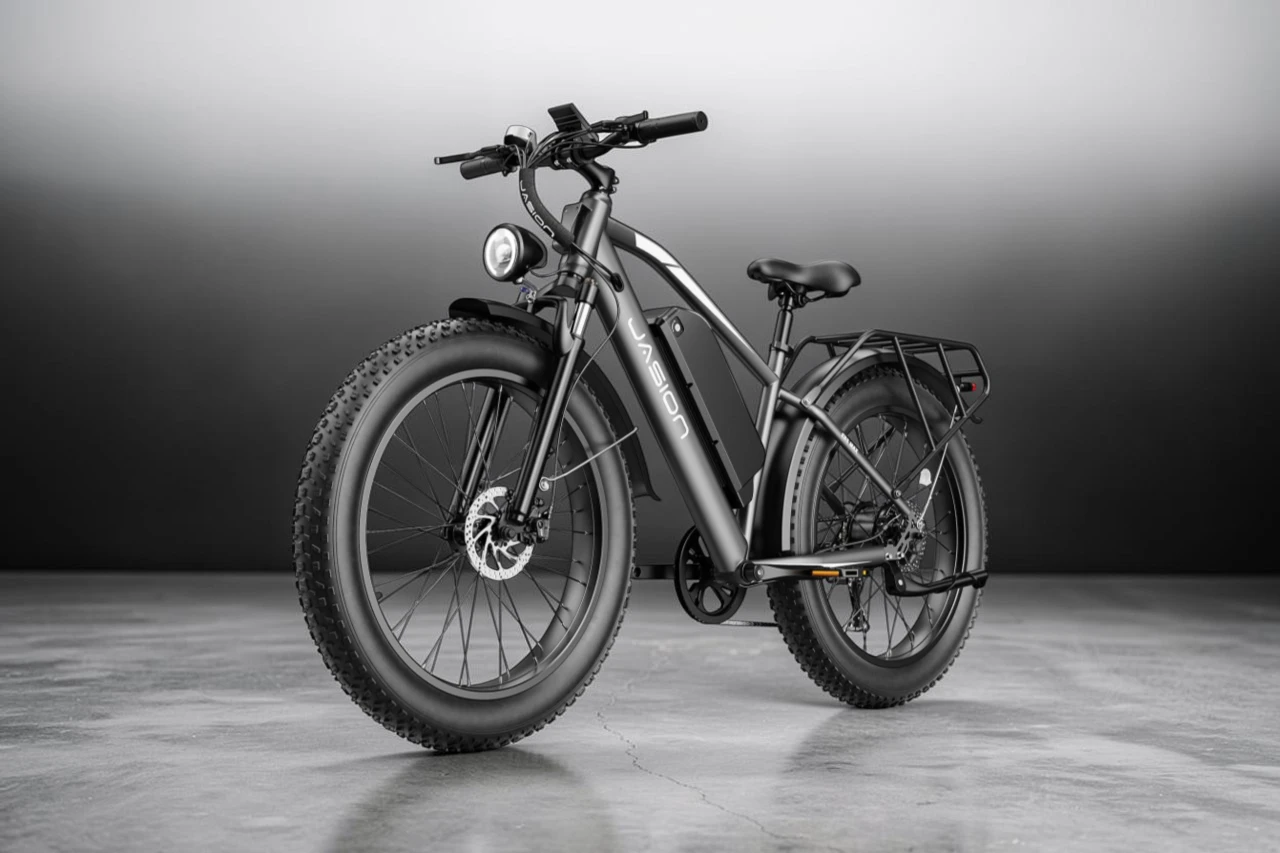
The Jasion EB5 MAX is a full-size fat-tire electric bike built for riders who want speed, hill-climbing ability, and everyday utility without paying premium e-bike prices. Its current Amazon listing highlights a 2,000W peak motor, a removable 48V 15Ah battery, 26 × 4-inch tires, a rear rack, full fenders, and a claimed top speed above 28 mph.
Those specifications make the EB5 MAX look impressive on paper. More importantly, this review show that the bike can deliver strong real-world performance. With a 230-pound rider, it reached 31.4 mph during a pedal-assist speed run, approached 30 mph on throttle, climbed a very steep paved grade without pedaling, and still held roughly 30 mph after around 10–11 miles of demanding riding.
It is not a perfect bargain, however. At 83 pounds, the EB5 MAX is difficult to lift. Its mechanical disc brakes require more planning than hydraulic brakes at the speeds this bike can reach, and the test ride ended with a flat tire. The frame may also feel tall for shorter riders despite Jasion’s stated 5’5″ minimum.
The short version: the Jasion EB5 MAX offers unusually strong speed, climbing performance, and included equipment for the money, but buyers should be comfortable managing a heavy, fast e-bike with entry-level mechanical brakes.
Jasion EB5 MAX at a Glance
| Category | Rating | What Stood Out |
|---|---|---|
| Motor and hill performance | 9.0/10 | Strong acceleration, 31.4 mph observed with pedaling, and an impressive throttle-only hill climb |
| Battery and practical range | 7.5/10 | Useful 720Wh capacity, but the full 35/65-mile claims were not independently verified |
| Ride comfort and handling | 8.0/10 | Stable frame, comfortable contact points, fat-tire cushioning, and predictable cornering |
| Braking | 6.5/10 | 180 mm rotors provide usable stopping power, but mechanical brakes feel basic for an 83-pound, 28+ mph bike |
| Features and utility | 8.5/10 | Rack, fenders, strong lights, color display, cruise control, and seven-speed gearing are included |
| Value | 8.7/10 | A lot of performance and equipment for a budget-oriented fat-tire e-bike |
| Overall | 8.1/10 | A powerful value pick for the right rider, with meaningful braking, weight, and tire caveats |
Pros & Cons
Pros:
- Excellent real-world speed for a budget fat-tire e-bike
- Strong hill-climbing performance, even with a 230-pound test rider
- Large 720Wh removable and lockable battery
- Five pedal-assist levels with useful speed separation
- Stable handling and no obvious high-speed wobble during the test
- 26 × 4-inch tires add traction and absorb road chatter
- Color display shows battery percentage as well as bars
- Bright headlight and highly visible rear brake light
- Rear rack and full fenders are included
- 400-pound stated payload rating supports larger riders and cargo
Cons:
- Heavy at approximately 83 pounds
- Mechanical disc brakes require earlier, firmer braking at higher speeds
- Test ride ended with a flat tire; “puncture-resistant” does not mean puncture-proof
- Tall frame may be awkward for some riders near the 5’5″ minimum
- Cadence sensor is less natural than a torque sensor
- Throttle operation appears tied to the selected pedal-assist level
- No obvious steering-stop bumper was observed on the tested bike
- Continuous or nominal motor output is not disclosed in the supplied specifications
Key Specifications
| Specification | Jasion EB5 MAX |
| Bike type | Adult fat-tire electric mountain/utility bike |
| Motor | Rear-hub motor, 2,000W peak claimed |
| Nominal motor power | Not stated in the materials reviewed |
| Claimed top speed | 28+ mph |
| Observed top speed | 31.4 mph with pedal assist; approximately 29–30 mph on throttle under the recorded test conditions |
| Claimed maximum climbing angle | Up to 30°; not independently verified |
| Battery | 48V 15Ah removable lithium-ion battery |
| Battery capacity | 720Wh |
| Claimed throttle range | Up to 35 miles |
| Claimed pedal-assist range | Up to 65 miles |
| Charging time | Approximately 7–8 hours |
| Drivetrain | Shimano seven-speed |
| Pedal sensor | Cadence sensor |
| Tires | 26 × 4.0-inch fat tires, described as puncture-resistant |
| Brakes | Mechanical disc brakes with 180 mm rotors |
| Suspension | Lockable front fork with preload adjustment |
| Display | Color LCD with battery percentage, speed, PAS, trip, odometer, ride data, voltage, and settings |
| Included equipment | Headlight, rear/brake light, full fenders, rear rack, horn, and kickstand |
| Claimed maximum load | 400 pounds |
| Recommended rider height | 5’5″–6’5″ |
| Bike weight | Approximately 83 pounds |
Specifications above combine the current product information for this update with observations from the recorded test bike. Manufacturers sometimes revise components without changing the model name.
Published Dimensions
| Measurement | Dimension |
| Total length | 75.6 inches |
| Handlebar height | 46.1 inches |
| Wheelbase | 45.5 inches |
| Wheel diameter | 26 inches |
| Minimum seat height | 29.1 inches |
| Maximum seat height | 35.4 inches |
| Chainstay length | 23.4 inches |
| Top-tube length | 34.4 inches |
These measurements are useful for comparing storage space and saddle height, but they do not fully describe stand-over clearance or reach. Shorter riders should pay particular attention to the fit discussion below.
How the Jasion EB5 MAX Was Evaluated
This updated review separates manufacturer claims from observed ride-test results. The supplied test notes document a real-world ride with the following conditions:
- Test rider: 5’9″ and approximately 230 pounds
- Terrain: paved roads, rolling hills, a very steep paved climb, loose roadside gravel, and a short rough off-road section
- Riding style: high assist, throttle testing, active pedaling, repeated speed runs, and hill climbing
- Distance documented before the late-ride speed test: approximately 10–11 miles
- Speed verification: bike display compared with a separate GPS reading
- Battery use: aggressive rather than range-maximizing
This was a demanding performance ride, not a controlled laboratory range test. Tire pressure, wind speed, ambient temperature, exact elevation gain, and final total distance were not documented precisely. For that reason, the results are useful for judging speed, climbing, ride feel, and short-route battery behavior—but they do not prove the manufacturer’s maximum range claims.
Motor Performance and Acceleration
The EB5 MAX’s biggest strength is its willingness to move a heavy rider quickly. The current listing calls the motor a 2,000W peak unit, and the ride test supports the broader point that this is a strong rear-hub system for its price class.
Acceleration felt energetic once the bike was rolling. In the initial speed test, the 230-pound rider reached 31.4 mph with active pedaling in PAS 5. During a throttle-only run into some wind, speed climbed more gradually and reached roughly 28.8–28.9 mph, with the rider noting that a longer road likely would have allowed it to approach 30 mph.
After approximately 10–11 miles of hard riding, the bike still held around 30 mph, with the display showing about 31 mph and the separate GPS reading slightly lower. That consistency matters more than a brief unloaded wheel-spin figure. It suggests the EB5 MAX can sustain useful performance after the battery has been partially discharged.
The dashboard’s factory speed setting appeared to be at its maximum on the test bike. Buyers should not assume that every unit or jurisdiction permits the same configuration. A bike capable of throttle speeds above 20 mph may not fit the standard Class 2 definition, and local rules may restrict where it can be ridden. Use a lower speed setting when required by law or when riding on crowded paths.
What “2,000W Peak” Really Means
Peak wattage describes a motor system’s short-duration maximum output. It does not tell buyers how much power the motor can sustain continuously without overheating. Jasion did not provide a nominal or continuous rating in the materials reviewed, so it would be misleading to label the EB5 MAX as a 2,000W continuous motor—or to guess a lower nominal number.
The safest conclusion is simple: the motor performed strongly in the recorded speed and hill tests, but the 2,000W figure should be understood as a manufacturer-stated peak rating.
Hill-Climbing Test
Hill performance was one of the clearest positives. Early in the ride, the EB5 MAX maintained approximately 28.3 mph while climbing a moderate hill with pedal assistance. The more revealing test came later on a much steeper paved climb.
The rider attempted the steep section using throttle only. Speed dropped substantially—as expected for a hub motor carrying a 230-pound rider—but the bike continued moving and completed the climb without pedaling. The rider estimated the grade at roughly 25% near its steepest point.
That estimate should not be confused with Jasion’s separate “up to 30°” climbing claim. A 30-degree incline is much steeper than a 30% grade, and the recorded ride did not scientifically verify a 30-degree slope. Still, completing the observed climb on throttle alone is a strong practical result for a budget-oriented fat-tire bike.
On a second uphill run with pedaling, the bike again climbed successfully. The rider found that maintaining momentum in a suitable gear and using PAS 5 worked better than expecting the throttle to add extra power while pedaling. Riders tackling long grades should shift before the slope becomes severe, contribute steady pedal input, and avoid holding a hub motor at very low speed under maximum load for extended periods.
Pedal Assist, Throttle, and Cruise Control
The EB5 MAX uses a cadence sensor rather than a torque sensor. Assistance begins after roughly half to three-quarters of a crank rotation on the tested unit. That delay is not excessive for an entry-level cadence system, but it is noticeable compared with more expensive torque-sensing bikes.
The five assist levels provided useful separation during the test:
- PAS 1: approximately 11.5 mph with gentle pedaling
- PAS 2: approximately 15.5–16 mph
- PAS 3: approximately 20 mph
- PAS 4: roughly 24 mph
- PAS 5: up to the low 30s with strong rider input under the test conditions
These figures are observations from one rider and route, not guaranteed speed limits. Even so, they show that the lower levels are not merely decorative. PAS 1 and 2 can be used for a calmer ride and greater rider effort, while PAS 4 and 5 are better suited to open roads where higher speeds are appropriate.
Unlike many cadence-sensor bikes that leave the rider “ghost pedaling” at speed, the EB5 MAX retained noticeable pedal resistance above 20 mph and even near 30 mph. The gearing therefore allowed the test rider to contribute meaningful effort rather than simply spinning the cranks.
The half-twist throttle was comfortable to use, but its output appeared to follow the selected assist level. The throttle did not operate in PAS 0 on the tested bike. Cruise control was present in the display settings; new owners should learn exactly how it engages and disengages in a clear area before using it around traffic or pedestrians.
Battery Capacity and Real-World Range

The removable battery is rated at 48V and 15Ah, equal to 720Wh of stated energy capacity. That is a useful size for a full-power fat-tire bike and a major reason the EB5 MAX feels like more than a short-trip novelty.
Jasion claims up to 35 miles in throttle mode and up to 65 miles with pedal assist. Those should be treated as best-case estimates, not promises. A 230-pound rider traveling near 30 mph over hills will consume energy much faster than a lighter rider using PAS 1 on flat pavement.
During the aggressive recorded test, the dashboard showed about 59% remaining after roughly 10–11 miles. The reading was taken while the system was warm, and the percentage changed as the bike rested. Battery gauges estimate state of charge from voltage and can move after a hard load is removed, so it would be unreliable to extrapolate a precise total range from this single reading.
A realistic planning approach is to expect much less than 65 miles when using high assist, climbing frequently, riding into wind, carrying cargo, or using throttle heavily. Riders who keep speeds moderate, pedal consistently, maintain proper tire pressure, and avoid repeated hard launches will have the best chance of approaching the upper end of the claim.
The battery is removable, lockable, and can be charged on or off the bike. A full charge is listed at approximately 7–8 hours, which is reasonable for a 15Ah pack with a standard charger. For safety, use only the supplied or manufacturer-approved charger, charge in a dry and ventilated location, and do not charge a pack that is damaged, swollen, unusually hot, or wet.
Ride Comfort and Handling
The EB5 MAX is a hardtail: it has a suspension fork in front but no rear suspension. Its large tires therefore do much of the comfort work. On broken pavement, gravel, and the short off-road portion of the test, the combination absorbed small impacts well enough that the bike did not feel harsh for its price.
The fork includes lockout and preload adjustment, allowing riders to firm it up on smooth pavement or leave it active on rougher surfaces. On larger bumps, however, the rider needed to rise off the saddle rather than let the rear of the bike take repeated hits. This is appropriate for a utility-oriented fat bike, not a substitute for a full-suspension mountain bike.
Handling was stable and predictable. The bike followed the rider’s line through corners instead of drifting wide, and there was no reported wobble during the faster downhill section. The wide tires also added confidence over small patches of loose gravel, although no tire can fully protect against loss of grip on sand, wet paint, ice, or deep loose material.
The round grips and half-twist throttle were comfortable, and the saddle worked well for the tester during the documented route. Comfort remains personal, so some owners may still prefer a different saddle or an adjustable stem.
Two handling details deserve attention. First, the rider’s toes came close to the front tire during tight steering inputs, especially with larger feet. Second, the tested bike did not appear to have a steering-stop bumper limiting handlebar rotation. Owners should check cable routing during assembly and avoid forcing the bars beyond their normal range.
Braking Performance
The EB5 MAX uses mechanical disc brakes with 180 mm rotors. They functioned during the test and the levers offered adjustment, but the rider consistently noted that more stopping distance was needed than with hydraulic brakes.
That distinction matters because this is an approximately 83-pound bike capable of exceeding 28 mph before adding rider or cargo weight. Mechanical brakes can be dependable and inexpensive to maintain, but they usually require more hand pressure and more frequent cable adjustment than hydraulic systems.
For normal neighborhood riding, the stock brakes should be serviceable when properly assembled, bedded in, and adjusted. Riders who regularly descend long hills, ride in wet conditions, carry heavy cargo, or use the bike’s highest speeds may reasonably view hydraulic brakes as a priority upgrade—or choose a different bike that includes them from the factory.
Regardless of equipment, owners should check both brakes before every ride, keep rotors free of oil, inspect pad wear, and begin braking early. A bright brake light improves visibility to others, but it does not shorten the bike’s stopping distance.
Fat Tires and the Flat-Tire Result
Jasion describes the 26 × 4.0-inch tires as puncture-resistant. Their large air volume helped smooth rough surfaces and provided a planted feel during the recorded ride. The bike also remained stable during light off-road use.
However, the ride ended with a flat tire. The notes do not identify whether it was caused by a sharp object, a pinch puncture, incorrect pressure, tube damage, rim-tape placement, or another issue. It would therefore be unfair to conclude that the tire itself was defective.
It is equally important not to interpret “puncture-resistant” as “puncture-proof.” Fat tires present a large contact area and can collect debris. Owners should inspect the tires after unboxing, set pressure with an accurate gauge, carry a patch kit or spare tube, and consider sealant or a compatible puncture-protection liner if roadside flats are a major concern.
Display, Controls, and Lighting
The color LCD is one of the EB5 MAX’s better everyday features. It displays:
- Current speed
- Battery bars and a numerical battery percentage
- Pedal-assist level
- Trip distance and odometer
- Maximum and average speed
- Riding time
- Battery voltage
- Power and status information
- Error, headlight, and brake indicators
The separate control pads keep the main functions within reach. One pad manages the display and assist settings, while another operates the headlight and horn. The screen includes brightness, unit, assist-level, timeout, speed-limit, and cruise-control settings. The supplied product information also lists password protection.
Owners should avoid changing wheel-size or voltage parameters without a verified reason. Incorrect settings can distort speed and distance readings or affect how the system interprets the battery.
The headlight was bright in the test, and the rear light was visible from a meaningful distance. Applying either brake caused the rear light to flash. One unusual behavior was that the lights could remain on after the display was switched off. That may help if a rider is pushing the bike in the dark, but it also means owners should confirm the lights and battery switch are off before storage.
Utility and Included Equipment
The EB5 MAX arrives configured for more than recreational riding. Full-coverage fenders help reduce road spray, while the large rear rack can carry compatible panniers, a trunk bag, or a properly secured basket. The frame also appeared to include front mounting points, although buyers should confirm accessory compatibility before ordering a front rack.
The Shimano seven-speed drivetrain is simple and widely serviceable. It does not offer the gear range or refinement of a premium mountain-bike drivetrain, but it gave the rider enough resistance to keep pedaling at high speed. A derailleur guard adds useful protection during transport or minor tip-overs.
Other practical details include a loud electronic horn, a large headlight, a rear brake light, wide platform pedals, and a kickstand. The pedals on the test bike were plastic, so riders who use the bike aggressively may eventually prefer metal platforms with replaceable pins.
Rider Fit, Weight, and Load Capacity

Jasion recommends the EB5 MAX for riders from 5’5″ to 6’5″ and states a maximum load of 400 pounds. The documented tester was 5’9″ and rode with the seat almost fully lowered. He considered the bike comfortable but felt that riders closer to 5’5″ might need to lean the bike at stops.
The lowered top-tube section provides some extra clearance, yet this remains a tall, full-size 26-inch fat bike rather than a true step-through model. Shorter buyers should compare stand-over height and seat height with a bike they already fit comfortably. If possible, test the ability to place one foot down securely before riding in traffic.
At approximately 83 pounds, the bike is also heavy before adding accessories or cargo. That mass contributes to its solid, planted feel, but it makes stairs, hitch-rack loading, tight storage, and manual pedaling without power more difficult. Confirm that any vehicle rack is rated for the bike’s weight and tire width.
The 400-pound claim is useful for larger riders, but payload capacity does not erase fit or braking considerations. A heavily loaded bike accelerates, turns, and stops differently. Heavier riders should be especially careful about tire pressure, spoke tension, brake adjustment, and rack limits.
Claimed vs. Observed Performance
| Category | Manufacturer/Listings | Observed in the Supplied Ride Test |
| Motor | 2,000W peak | Strong acceleration and climbing; nominal output not verified |
| Top speed | 28+ mph | 31.4 mph with pedaling; approximately 29–30 mph on throttle under test conditions |
| Climbing | Up to 30° claimed | Completed an estimated ~25% paved grade on throttle only with a 230-pound rider; this does not verify a 30° slope |
| Range | Up to 35 miles throttle / 65 miles PAS | Full range not tested; display showed about 59% after roughly 10–11 aggressive miles |
| Tires | Puncture-resistant | Comfortable and stable, but the ride ended with a flat of undetermined cause |
| Payload | Up to 400 pounds | Test rider weighed approximately 230 pounds; maximum load was not tested |
Who Should Buy the Jasion EB5 MAX?
The EB5 MAX is best suited to riders who:
- Want a fast, powerful fat-tire e-bike at a budget-oriented price
- Need help climbing hills or carrying a heavier rider
- Prefer a full-size frame with a planted, substantial feel
- Want a rack, fenders, lights, and horn included
- Ride a mix of pavement, gravel roads, grass, and easy recreational trails
- Do not need to carry the bike upstairs regularly
- Are comfortable maintaining mechanical disc brakes
It is less suitable for riders who:
- Need a lightweight bike for apartments, public transit, or frequent vehicle loading
- Want hydraulic brakes from the factory
- Prefer the natural response of a torque sensor
- Need a low step-through frame
- Intend to ride technical mountain-bike trails at speed
- Want a fully documented nominal motor rating or independently verified long-range result
Jasion EB5 MAX FAQ
How fast is the Jasion EB5 MAX?
Jasion claims a top speed above 28 mph. In the supplied real-world test, a 230-pound rider reached 31.4 mph with pedal assist and active pedaling. Throttle-only speed was approximately 29–30 mph under the recorded conditions. Speed varies with rider weight, battery charge, wind, terrain, tire pressure, settings, and local restrictions.
Is the Jasion EB5 MAX really a 2,000W e-bike?
The current listing describes the motor as producing 2,000W peak power. A continuous or nominal rating was not provided in the materials reviewed. Buyers should interpret 2,000W as a short-duration peak claim, not verified continuous output.
Can it climb steep hills?
Yes, it performed well in the supplied test. A 230-pound rider completed an estimated 25% paved grade on throttle alone and also climbed successfully while pedaling. That result does not independently verify Jasion’s “up to 30°” marketing claim.
What is the realistic range?
Jasion claims up to 35 miles using throttle and up to 65 miles with pedal assist. The supplied ride was not a full depletion test, so those figures were not verified. Expect less range at high speed, on hills, in cold weather, with low tire pressure, or with a heavy rider and cargo.
Are the brakes hydraulic?
No. The tested EB5 MAX used cable-operated mechanical disc brakes with 180 mm rotors. They are affordable to service but require more hand effort and adjustment than typical hydraulic brakes.
Is it suitable for a 5’5″ rider?
Jasion lists 5’5″ as the lower end of the recommended range. The 5’9″ tester had the saddle almost fully lowered and believed some 5’5″ riders might need to lean the bike at stops. Shorter buyers should verify stand-over clearance and reach before purchase.
Does the throttle work in PAS 0?
It did not operate in PAS 0 on the tested bike. Throttle output also appeared to follow the selected assist level. Settings or production revisions may vary, so confirm operation in a safe open area before entering traffic.
Are the tires puncture-proof?
No. They are marketed as puncture-resistant, but the documented ride ended with a flat tire of undetermined cause. Proper tire pressure, regular inspection, sealant, liners, and a repair kit can reduce the inconvenience of flats but cannot eliminate the risk.
Final Verdict: Is the Jasion EB5 MAX Worth It?
| Preview | Product | Price | |
|---|---|---|---|

| Jasion EB5 MAX Electric Bike for Adults 2000W Peak Motor, 48V 15Ah Battery | 720Wh Battery… | $859.99 | View on Amazon |
For riders who prioritize speed, hill-climbing strength, and included equipment, the Jasion EB5 MAX offers compelling value. The recorded performance was better than its budget positioning might suggest: it carried a 230-pound rider into the low 30s, climbed a steep paved hill without pedal input, remained stable through corners and at speed, and continued to deliver strong performance after 10–11 miles of hard use.
The compromises are just as important. The EB5 MAX is heavy, its cadence sensor is functional rather than refined, and mechanical brakes are not the ideal match for an 83-pound bike that can exceed 28 mph. The late-ride flat also means buyers should prepare for normal fat-bike tire maintenance instead of relying too heavily on the “puncture-resistant” label.
The Jasion EB5 MAX earns an 8.1/10. It is a strong choice for value-focused riders who have room to store a full-size fat bike, understand the responsibilities that come with higher speeds, and are willing to stay on top of brake and tire maintenance. Riders who need hydraulic brakes, easy lifting, a low step-through frame, or a more natural torque-sensor feel should consider alternatives.
GoEBikeLife publishes independent e-bike reviews, comparisons, and practical buying guides. Some links on this page are affiliate links. If you make a purchase through an eligible link, we may earn a commission at no additional cost to you.