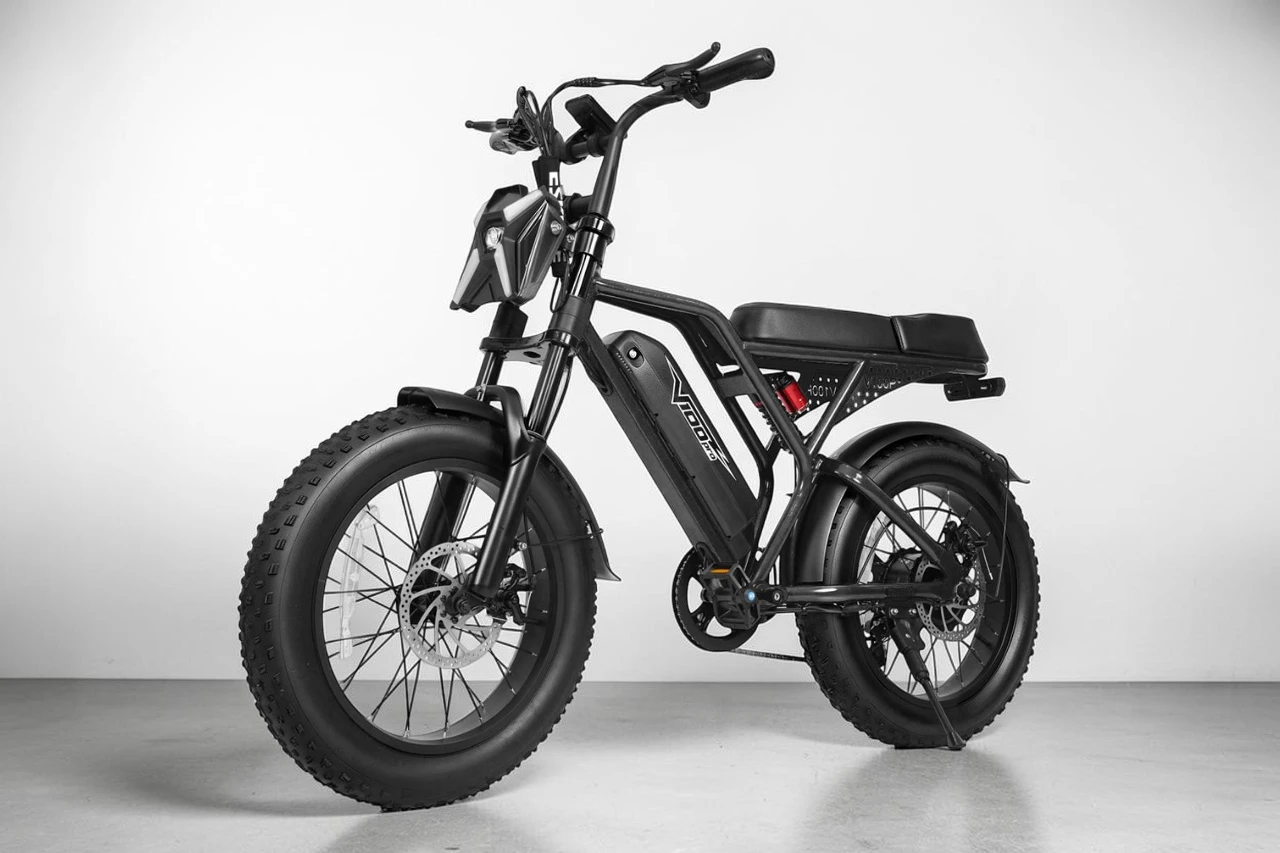
The ESKUTE V100 Pro is the kind of electric bike that immediately stands out from a typical commuter e-bike. With its motorcycle-inspired frame, oversized fat tires, extended saddle, and aggressive styling, it looks more like a compact electric moped than a conventional bicycle.
But the V100 Pro isn’t just about appearances.
Underneath that distinctive design is a 750W-rated rear hub motor with a claimed 1,500W peak output, a 48V 15.6Ah removable battery, full suspension, and a seven-speed drivetrain. ESKUTE also advertises speeds approaching 30 mph and up to 65 miles of pedal-assisted range.
On paper, that’s an appealing combination for riders who want something powerful enough for recreational riding without giving up the practicality of an everyday e-bike.
Of course, impressive specifications don’t automatically translate into a great riding experience. A heavy fat-tire bike can be comfortable but cumbersome, a powerful motor can drain its battery quickly, and suspension quality matters more than simply having two shocks.
In this ESKUTE V100 Pro review, we’ll examine its motor, battery, riding characteristics, comfort, braking system, and overall value to determine where it makes sense—and where buyers should be cautious.

ESKUTE V100 Pro at a Glance
| Specification | ESKUTE V100 Pro |
|---|---|
| Motor | Rear hub motor, 750W rated / 1,500W peak |
| Maximum Speed | Up to approximately 30 mph, claimed |
| Battery | 48V 15.6Ah, removable |
| Battery Capacity | Approximately 749Wh |
| Advertised Range | Up to 65 miles with pedal assist |
| Tires | 20 × 4.0-inch fat tires |
| Suspension | Front suspension fork and rear shock |
| Brakes | Front and rear disc brakes |
| Drivetrain | 7-speed |
| Riding Modes | Throttle, pedal assist, manual pedaling |
| Display | Multifunction LCD |
| Lighting | Front headlight and rear taillight |
| Payload Capacity | Up to 360 lbs, manufacturer specification |
| Water Resistance | IP54 advertised |
| Charging Time | Approximately 7.5–8 hours |
| Assembly | Approximately 90% pre-assembled |
| Warranty | 1 year, subject to warranty terms |
Best for: Adult riders looking for a moped-style electric bike for neighborhood cruising, commuting, and recreational riding on mixed surfaces.
Main appeal: A powerful-looking, comfort-oriented package with a relatively large battery and full suspension.
Biggest concerns: Unverified real-world range, substantial weight, uncertain brake hardware, and questions about its legal e-bike classification.
First Impressions: A Compact E-Bike With Serious Attitude
The first thing that makes the ESKUTE V100 Pro interesting is its design.
Instead of following the familiar diamond-frame layout, ESKUTE uses a moped-inspired frame with an extended bench-style saddle, upright handlebars, and a prominent battery mounted inside the main frame structure.
Combined with the wide tires and substantial front suspension, the result is a bike that looks purpose-built for relaxed electric cruising.
The dark frame, angular headlight assembly, and long seat give it a sporty character without making it look like a full-size electric motorcycle.
I particularly like the way the battery fits into the frame. Rather than appearing as an afterthought, it becomes part of the bike’s overall visual identity.
The 20-inch wheels also help keep the proportions relatively compact, even though their four-inch-wide tires give the bike a much larger visual presence.
A Frame Built Around Comfort and Stability
One clear priority is rider comfort.
The V100 Pro uses a long, padded seat instead of the narrow saddle found on traditional commuter bicycles. That arrangement should appeal to riders who primarily use the throttle or pedal casually rather than spend hours pedaling aggressively.
However, there’s an important compromise.
Because the saddle is relatively long and motorcycle-like, riders have less flexibility to adjust their pedaling position than they would with a conventional height-adjustable bicycle seat.
That can become noticeable on longer pedal-assisted rides, especially for taller riders who need more leg extension.
This is something I would carefully consider before buying.
If your riding style involves cruising comfortably with occasional pedaling, the design makes sense. If you’re looking for efficient, fitness-oriented cycling, a conventional commuter e-bike will probably provide better ergonomics.
Motor Performance: What Can a 1,500W Peak Motor Actually Deliver?
Motor power is one of the V100 Pro’s biggest selling points.
ESKUTE lists a 750W-rated rear hub motor with a peak output of 1,500W. Its promotional materials also advertise up to 85Nm of torque.
Those figures suggest a motor designed to provide relatively strong acceleration and useful assistance when climbing hills.
But it’s important to understand what those numbers actually mean.
Rated Power vs. Peak Power
A motor’s rated power generally describes the output it is designed to sustain under specified operating conditions.
Peak power refers to a higher output that may be available temporarily.
The V100 Pro’s advertised 1,500W peak output therefore shouldn’t be interpreted as 1,500W of continuous mechanical power.
In practical terms, the motor should be well suited to situations such as accelerating from traffic lights, maintaining speed on moderate hills, and carrying a heavier rider.
However, actual performance depends on the controller’s current limits, battery voltage under load, motor temperature, and riding conditions.
Acceleration and Hill Climbing
For a bike with 20-inch wheels and a reasonably powerful rear hub motor, low-speed acceleration is an important part of the appeal.
The relatively small wheel diameter can work in favor of wheel torque at the ground, while the motor’s output should reduce how much physical effort is needed to get moving.
That should be useful when restarting on an incline or riding through residential streets with frequent stops.
The promotional images claim the bike can tackle slopes up to 35 degrees.
I would treat that figure cautiously.
Extremely steep inclines place substantial demands on motor torque, traction, controller performance, and braking. Real-world climbing ability also changes dramatically with rider weight, battery charge, and surface conditions.
A controlled hill-climbing test would be needed to establish what the V100 Pro can sustain.
For everyday buyers, the more meaningful question is whether the motor can maintain steady progress on typical neighborhood hills—not whether it can briefly climb an unusually steep marketing demonstration slope.

Top Speed: Can the ESKUTE V100 Pro Really Reach 30 MPH?
ESKUTE promotes a maximum speed of approximately 30 mph, although some product titles also mention 28 mph.
These figures are close, but the difference matters.
A conventional Class 3 electric bicycle in many U.S. jurisdictions is designed to stop providing pedal assistance at 28 mph. The V100 Pro is advertised as a Class 3 bike despite its higher claimed top speed and throttle-equipped configuration.
That creates a classification question buyers should resolve before riding it on public roads or bicycle paths.
A claimed 30 mph top speed doesn’t establish that the bike is legally a Class 3 e-bike in every state.
What Determines Actual Top Speed?
Several factors influence maximum speed:
- Rider weight and cargo
- Battery charge level
- Terrain and wind
- Tire pressure
- Controller configuration
- Throttle and pedal-assist settings
A fully charged battery can behave differently from one nearing depletion, particularly under heavy acceleration.
The display’s indicated speed may also differ from independently measured GPS speed.
For a proper speed test, I would compare the bike’s display with GPS readings over repeated runs on level pavement, recording both directions to reduce the influence of wind.
Until those measurements are available, 30 mph should be considered an advertised maximum rather than a verified result.
Battery and Range: Is 65 Miles Realistic?
The ESKUTE V100 Pro uses a removable 48V 15.6Ah lithium-ion battery.
Multiplying the nominal voltage by capacity gives approximately 748.8 watt-hours of energy.
That’s a useful battery size for a relatively compact fat-tire electric bike.
It provides a reasonable foundation for commuting and recreational riding, although range ultimately depends on how efficiently the bike uses that stored energy.
Understanding the 65-Mile Claim
ESKUTE advertises up to 65 miles on a single charge when using pedal assist.
The critical phrase is up to.
Manufacturers commonly establish maximum-range figures under favorable conditions, such as relatively low assistance, moderate speeds, limited elevation changes, and lighter rider loads.
Reaching 65 miles with a 749Wh battery would require average energy consumption of approximately 11.5Wh per mile.
That’s a demanding efficiency target for a wide-tire, moped-style e-bike, especially when ridden at higher speeds.
For perspective, the following calculations illustrate how energy consumption changes the theoretical range.
| Average Consumption | Theoretical Range |
|---|---|
| 15Wh/mile | About 50 miles |
| 20Wh/mile | About 37 miles |
| 25Wh/mile | About 30 miles |
| 30Wh/mile | About 25 miles |
| 35Wh/mile | About 21 miles |
These are energy-budget calculations, not road-test results or predicted V100 Pro performance. Actual usable battery energy may be lower than nominal capacity.
What this tells us is straightforward: riding style matters enormously.
Someone who pedals regularly at moderate speeds could cover substantially more distance than someone who relies heavily on the throttle at high speeds.
Is the Battery Suitable for Commuting?
Consider a rider with a 12-mile round-trip commute.
A 749Wh battery offers enough nominal capacity to make that trip plausible under a wide range of riding conditions, but the number of commutes between charges will depend on actual consumption.
For a longer 25-mile round-trip commute, I would want verified range data before relying on the bike without intermediate charging.
The good news is that ESKUTE uses a removable battery.
That means riders who can’t conveniently bring the entire bike indoors may be able to remove the battery and charge it separately, following the manufacturer’s instructions.
ESKUTE lists a charging time of approximately 7.5–8 hours.
That makes overnight charging a practical option, provided the battery and charger are used in a suitable environment.
The battery is one of the stronger elements of the V100 Pro’s specification sheet, but a genuine range test would be necessary to determine its endurance in throttle-only and high-assistance riding.
Riding Comfort: Full Suspension Makes a Difference
One of the main reasons to consider the V100 Pro over a simpler fat-tire bike is its full-suspension arrangement.
It combines a front suspension fork with a rear shock absorber.
This is particularly relevant because comfort on an electric bike doesn’t come from the saddle alone.
Road impacts travel through the wheels, frame, pedals, handlebars, and seat. Reducing those impacts can make a meaningful difference over a longer ride.
Front Suspension
The front suspension fork is designed to absorb impacts before they reach the handlebars.
On rough pavement, broken asphalt, and uneven neighborhood roads, that should help reduce the sharpness of bumps.
However, suspension performance depends on more than appearance.
Important factors include usable travel, damping, spring rate, and how well the fork responds to repeated impacts.
ESKUTE’s specifications do not provide enough detail to evaluate those characteristics fully.
Rear Suspension
The rear shock is especially relevant because the rider sits directly above the rear portion of the frame.
Without rear suspension, impacts from potholes and uneven pavement can travel directly through a rigid frame into the saddle.
The V100 Pro’s rear shock should help reduce that effect, although the quality of the ride will depend on its actual tuning.
An overly soft rear suspension can feel bouncy, while an overly stiff unit may provide only limited improvement.
It’s also worth remembering that suspension components need periodic inspection, particularly on a heavier electric bike.
A Comfortable Cruiser Rather Than a Mountain Bike
The V100 Pro’s suspension layout is best understood as a comfort-oriented feature.
It doesn’t automatically make the bike suitable for aggressive trail riding, large jumps, or downhill mountain biking.
For its intended role—city cruising, uneven pavement, gravel roads, and moderate recreational routes—the combination of front and rear suspension is attractive.

20 × 4.0-Inch Fat Tires: Confidence Across Different Surfaces
The V100 Pro uses 20-inch wheels with four-inch-wide tires.
These are substantially wider than conventional road or commuter bicycle tires.
Their large air volume can contribute to a more cushioned ride, while the wider contact patch may improve traction under appropriate conditions.
Pavement
On ordinary city streets, the large tires should provide a planted feel.
They can also help soften some road imperfections, although wide tires often produce more rolling resistance than narrower commuter tires.
The trade-off is particularly noticeable when pedaling without motor assistance.
Gravel and Dirt Roads
For light gravel and maintained dirt paths, the combination of wide tires and full suspension should be useful.
The tire volume can help the wheels negotiate smaller irregularities, while the suspension reduces impacts transmitted to the rider.
However, tire tread and pressure remain important.
A wide tire with inappropriate pressure or tread can still lose traction on loose surfaces.
Sand and Snow
ESKUTE also markets the V100 Pro for sand and snow.
The fat-tire format makes these applications more plausible than they would be on a narrow-tire road bike.
Still, sand depth, snow conditions, and tire pressure can dramatically affect handling.
Wet ice and compacted snow remain hazardous regardless of tire width.
I would consider the V100 Pro a versatile recreational bike rather than an unlimited all-terrain machine.
Its tires make mixed-surface riding more appealing, but they don’t eliminate the need to choose appropriate routes.
Braking Performance: An Important Detail to Verify
A bike capable of approaching 30 mph needs a dependable braking system.
The V100 Pro is equipped with front and rear disc brakes.
Disc brakes are a sensible choice for this category because they can provide predictable stopping performance when properly adjusted and maintained.
However, the available product specifications don’t clearly establish whether every V100 Pro configuration uses mechanical or hydraulic calipers.
That distinction matters.
Hydraulic disc brakes commonly offer easier modulation and reduced hand effort compared with basic cable-operated systems, although properly maintained mechanical brakes can also work effectively.
Because this is a relatively heavy, high-powered electric bike, braking performance deserves particular attention.
A proper road test should examine stopping distance, lever feel, resistance to repeated-braking fade, and braking control on wet pavement.
Integrated Lighting
The bike also includes a prominent front headlight and rear taillight.
I like that ESKUTE hasn’t treated lighting as an optional afterthought.
Integrated lighting is useful for commuters riding around sunrise, sunset, or through shaded streets.
The angular front headlight also contributes to the bike’s distinctive styling.
However, headlight brightness, beam distribution, and whether the rear light functions as a brake light would need to be confirmed directly.
For night riding, visible lights are only one part of the equation. Reflective clothing, correct light adjustment, and a conservative riding speed are equally important.
Display, Riding Modes, and NFC Unlock
The V100 Pro includes a multifunction LCD display that provides basic riding information.
According to the product description, riders can monitor speed, battery level, pedal-assist settings, trip distance, and odometer readings.
These are the essentials I would expect from an electric bike intended for everyday use.
A clear display becomes particularly useful when switching between low-speed neighborhood riding and more demanding routes.
Three Ways to Ride
The V100 Pro offers three basic riding approaches.
Throttle mode: Motor assistance is activated through the throttle, allowing the rider to travel with little or no pedaling when permitted by the bike’s configuration and local regulations.
Pedal-assist mode: The motor provides assistance while the rider pedals, reducing physical effort and potentially improving range.
Manual pedaling: The rider can pedal without active motor assistance.
The seven-speed drivetrain provides additional gearing flexibility.
That is useful for adjusting pedaling cadence on hills, although this bike’s weight and riding position make it less appealing for extensive unassisted cycling.
What About NFC Unlock?
ESKUTE’s promotional imagery also shows an NFC-based unlocking feature.
The concept is appealing: instead of using a traditional ignition key, the rider may be able to unlock the electronic system with a compatible NFC device.
However, the exact operation, included accessories, and compatibility should be confirmed for the specific V100 Pro version being purchased.
NFC electronic unlocking also shouldn’t be confused with physical theft protection.
A quality lock is still necessary when parking the bike in public.
Rider Fit, Weight, and Practical Handling
The V100 Pro looks compact in its promotional photographs, but potential buyers shouldn’t assume that means it’s lightweight.
The manufacturer’s published weight figures are inconsistent across different product-page sections.
That makes it difficult to quote one reliable number without clarification from ESKUTE.
Regardless, the battery, reinforced frame, suspension components, and substantial tires suggest this is not a minimalist bicycle.
Weight matters in several everyday situations.
Lifting a bike onto a vehicle rack, maneuvering it through a narrow doorway, or carrying it upstairs can be considerably harder than riding it under motor power.
Anyone who regularly transports an e-bike should confirm its actual ready-to-ride weight and whether their rack can safely support it.
Rider Height and Payload
ESKUTE’s online sizing guide suggests the bike accommodates riders approximately 5’0″ to 6’2″.
Its published specification also lists a maximum payload of 360 lbs.
These are manufacturer figures, not independently validated measurements.
Rider height alone doesn’t guarantee a comfortable fit.
Inseam length, arm reach, knee clearance, and preferred pedaling position are equally relevant.
Because of the extended seat design, I would pay particular attention to how comfortably a rider can reach the pedals while maintaining proper control of the handlebars.
And although some promotional material suggests the bike is suitable for children, I would not recommend a high-speed, heavy moped-style e-bike for children.
Adult supervision does not eliminate the risks associated with speed, weight, and limited riding experience.
Assembly and Getting Ready to Ride
ESKUTE says the V100 Pro arrives approximately 90% assembled.
That’s encouraging for buyers who don’t want to build an electric bike from the frame up.
The supplied materials show components such as the front wheel, handlebars, pedals, lighting assembly, battery, charger, and installation tools.
The exact assembly work may vary according to shipping configuration.
Before the first ride, I would recommend checking the following:
- Confirm that the handlebar and front wheel are properly installed and secured to the manufacturer’s torque specifications.
- Inspect the brakes for proper operation and unwanted rotor rubbing.
- Set tire pressure according to the tire and manufacturer guidance.
- Confirm that the battery is locked securely in place.
- Test the throttle, pedal-assist system, and motor cutoff behavior.
- Verify that the headlight and rear taillight operate correctly.
- Check the pedals, crank arms, axles, and suspension fasteners.
A professional bicycle mechanic can be helpful if you’re unfamiliar with assembly or brake adjustment.
Even when a product arrives mostly assembled, that doesn’t mean it should be ridden immediately without a full safety inspection.
Battery Safety and Certification
ESKUTE’s supplied marketing materials claim TÜV-related UL 2849 certification for the V100 Pro’s electrical system.
UL 2849 is a recognized safety standard addressing electrical systems used in e-bikes, including the battery, charger, and drive-system combination.
That is encouraging as a stated feature, but buyers should distinguish a marketing claim from independently verified certification.
Before relying on the claim, I would request the applicable certification documentation or certificate number and confirm the exact model’s certification status through the relevant certification body.
A certification claim for one component is not necessarily equivalent to certification of the complete e-bike electrical system.
The V100 Pro also advertises IP54 water resistance.
That suggests protection against limited dust ingress and splashing water, but it does not make the bike waterproof or suitable for submersion.
Avoid pressure-washing electrical components, charging a wet battery, or exposing connectors to unnecessary moisture.
For charging, use the manufacturer-approved charger and follow the battery manual’s temperature, storage, and supervision instructions.
What I Like About the ESKUTE V100 Pro
There are several reasons the V100 Pro deserves consideration.
1. Strong motor specifications. The 750W-rated, 1,500W-peak motor gives the bike promising acceleration and hill-climbing potential.
2. A useful battery capacity. Approximately 749Wh provides a reasonable foundation for commuting and recreational rides.
3. Full suspension. Having both front and rear suspension is a meaningful advantage for a comfort-oriented cruiser.
4. Versatile fat tires. The 20 × 4.0-inch setup makes the bike more appealing for mixed pavement and maintained recreational routes.
5. Distinctive styling. The moped-inspired frame and long saddle give the V100 Pro considerably more visual personality than a typical entry-level commuter.
6. Practical equipment. The removable battery, seven-speed drivetrain, display, and integrated lights make the package more complete.
What Could Be Better?
There are also some limitations I wouldn’t overlook.
Weight and portability: This style of bike is less convenient for stairs, lifting, and frequent vehicle transportation.
Pedaling ergonomics: The extended seat may not suit riders who prioritize efficient, conventional bicycle pedaling.
Unverified maximum range: The 65-mile figure should not be treated as a guaranteed commuting distance.
Brake specifications: Buyers should confirm the exact brake hardware before purchase.
Street legality: The advertised speed and motor configuration raise questions about whether the bike meets local e-bike classifications.
Documentation inconsistencies: Conflicting published weight figures make evaluating the bike unnecessarily difficult.
None of these concerns automatically makes the V100 Pro a poor choice, but they affect who will get the most value from it.
ESKUTE V100 Pro vs. a Traditional Commuter E-Bike
The V100 Pro occupies a different part of the market from a lightweight city commuter.
A traditional commuter e-bike typically emphasizes efficient pedaling, upright practicality, and easier handling.
The V100 Pro emphasizes style, motor-assisted cruising, suspension comfort, and versatility on mixed surfaces.
| Feature | ESKUTE V100 Pro | Traditional Commuter E-Bike |
|---|---|---|
| Riding Style | Moped-inspired cruising | Conventional cycling |
| Tires | Wide 20 × 4.0-inch | Usually narrower |
| Suspension | Front and rear | Often front only or rigid |
| Saddle | Extended bench style | Adjustable bicycle saddle |
| Pedaling Efficiency | Less specialized | Generally better |
| Portability | Potentially challenging | Often easier |
| Ideal Use | Recreation and cruising | Everyday transportation |
The best choice depends largely on how you intend to ride.
If your primary goal is to cover longer distances while pedaling comfortably and efficiently, a conventional commuter may be the better purchase.
If you want a distinctive electric cruiser with a relaxed riding position and substantial motor assistance, the V100 Pro is more compelling.
Who Should Buy the ESKUTE V100 Pro?
The V100 Pro is particularly interesting for adult riders who want an electric bike that feels different from a standard bicycle.
It could be a good match for someone who rides through suburban neighborhoods, enjoys weekend outings, and wants a comfortable bike for routes involving pavement and occasional gravel.
Riders who prefer using the throttle and want a motorcycle-inspired design may also appreciate its overall concept.
The combination of a padded seat, wide tires, and two suspension elements is clearly designed around comfort.
However, I would look elsewhere if you need an ultra-lightweight commuter, regularly carry your bike upstairs, want serious mountain-bike capability, or expect highly efficient pedaling over long distances.
I would also advise buyers to confirm local regulations before purchasing the bike specifically for road commuting.
Is the ESKUTE V100 Pro Worth the Money?
Value depends on the price you’re actually paying.
The V100 Pro’s specification sheet is attractive because it combines equipment that budget-oriented electric bikes sometimes omit: a relatively substantial battery, full suspension, wide tires, integrated lighting, and a high-output motor.
Those features can make it competitive in the affordable moped-style e-bike category.
But I wouldn’t judge value based on the advertised peak wattage alone.
Braking quality, battery reliability, replacement-part availability, warranty support, and actual riding performance all matter over the life of the bike.
ESKUTE advertises a one-year warranty, which is worth reviewing carefully for coverage limitations, shipping responsibility, and replacement-part procedures.
For buyers willing to accept its weight and unconventional pedaling position, the V100 Pro has an appealing combination of features.
The remaining questions are whether its hardware performs consistently in real riding and whether its advertised capabilities match the buyer’s expectations.
| Preview | Product | Price | |
|---|---|---|---|

| ESKUTE V100 Pro Electric Bike for Adults, 20″ x 4.0″ Fat Tire Ebike, 30MPH 1500W Peak… | $599.00 | View on Amazon |
Final Verdict: A Promising Electric Cruiser With a Few Important Caveats
The ESKUTE V100 Pro is an interesting option for riders who want more personality and comfort than a conventional budget commuter e-bike typically offers.
Its biggest strengths are easy to identify.
The moped-inspired frame gives it a distinctive appearance, the 20 × 4.0-inch tires add mixed-surface versatility, and the front and rear suspension systems should contribute to a more comfortable riding experience.
The 48V 15.6Ah battery is another positive. With approximately 749Wh of nominal energy, it has enough capacity to make the bike practical for a variety of everyday trips, depending on riding conditions.
And with a 750W-rated motor capable of a claimed 1,500W peak output, the V100 Pro has promising performance potential for an affordable electric cruiser.
However, a few questions remain unanswered.
The advertised 30 mph top speed needs independent verification, the 65-mile maximum range shouldn’t be mistaken for typical throttle-only range, and the bike’s actual weight and certification details deserve clarification.
So, would I recommend it?
The ESKUTE V100 Pro is worth considering for adult riders who prioritize relaxed cruising, distinctive styling, and comfort-oriented equipment over lightweight handling and traditional pedaling efficiency.
It looks particularly appealing as a recreational electric cruiser, provided the buyer verifies local riding regulations and understands the practical limitations of a heavier, high-powered fat-tire bike.
For now, it’s a promising option based on its specifications—not a bike I would declare a proven performance winner without road-testing it first.
Frequently Asked Questions
How fast does the ESKUTE V100 Pro go?
ESKUTE advertises a maximum speed of approximately 30 mph, although some listings mention 28 mph. Actual speed depends on rider weight, terrain, battery charge, and controller settings.
How far can the ESKUTE V100 Pro travel on one charge?
The manufacturer claims up to 65 miles using pedal assist. Actual range may be substantially lower when riding at higher speeds, using the throttle frequently, climbing hills, or carrying heavier loads. The bike uses a 48V 15.6Ah battery with approximately 749Wh of nominal energy.
Does the ESKUTE V100 Pro have full suspension?
Yes. The bike includes a front suspension fork and rear shock absorber. These components are designed to reduce impacts from rough pavement and uneven riding surfaces.
Can the ESKUTE V100 Pro handle hills?
Its 750W-rated, 1,500W-peak rear hub motor suggests useful hill-climbing potential. However, actual climbing performance depends on incline, rider weight, traction, and operating conditions. The manufacturer’s maximum-slope claim has not been independently verified.
Is the ESKUTE V100 Pro suitable for off-road riding?
The four-inch-wide tires and full suspension make it suitable in concept for light recreational use on maintained gravel and dirt routes. It should not automatically be considered appropriate for technical mountain-bike trails, jumps, or extreme terrain.
Is the battery removable?
Yes. The 48V 15.6Ah battery is designed to be removable, making charging and certain storage arrangements more convenient.
How long does it take to charge?
ESKUTE lists approximately 7.5–8 hours for charging. Actual charging time depends on remaining battery capacity, charging conditions, and the supplied charger.
Is the ESKUTE V100 Pro street legal?
That depends on the bike’s actual speed and power configuration and the laws in the state or locality where it will be operated. Although ESKUTE markets it as Class 3, its advertised 30 mph capability and throttle configuration deserve additional verification. Do not assume it is permitted on every road or bicycle path.
Is the ESKUTE V100 Pro good for beginners?
It may appeal to adults who have experience handling heavier bicycles, but its advertised speed and substantial construction make it less forgiving than a slower, lighter commuter. Beginners should prioritize proper protective equipment, conservative speed settings, braking practice, and suitable riding locations.
Is the ESKUTE V100 Pro worth buying?
It is worth considering if you want a moped-style electric cruiser with fat tires, full suspension, a removable battery, and substantial motor assistance. Buyers who prioritize lightweight portability, efficient pedaling, or verified long-distance range may prefer a more conventional commuter.
GoEBikeLife publishes independent e-bike reviews, comparisons, and practical buying guides. Some links on this page are affiliate links. If you make a purchase through an eligible link, we may earn a commission at no additional cost to you.