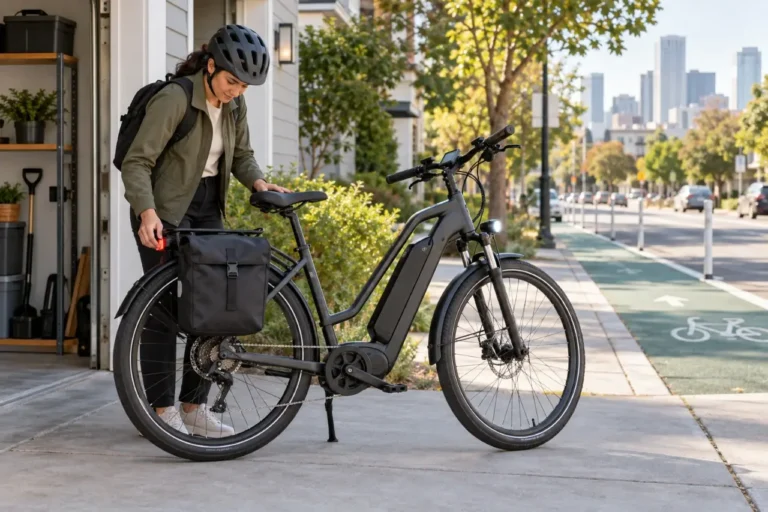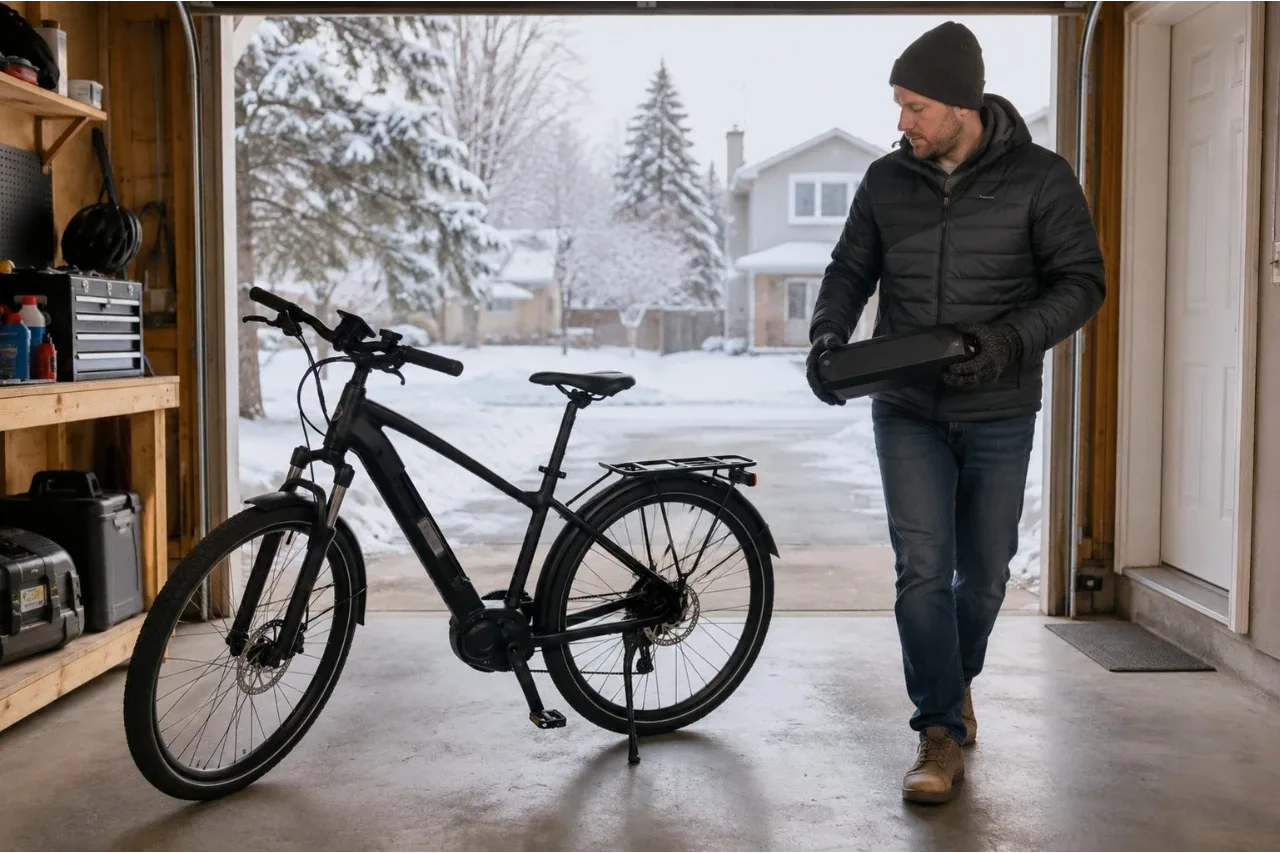
Yes, an e-bike battery can sometimes survive short exposure to freezing weather, but leaving it outside in the cold is not a good storage habit—and you should not charge it until the battery is within the charging-temperature range specified by its manufacturer. For many lithium-ion e-bike systems, charging is permitted only at or above 32°F (0°C), but limits vary by battery.
Cold weather usually causes a temporary drop in available power and range. The more important safety concern is charging a cold-soaked lithium-ion battery or using a battery that also shows signs of water intrusion, physical damage, swelling, unusual heat, odor, hissing, or smoke.
What freezing weather does to an e-bike battery
Most modern e-bikes use lithium-ion battery packs. A winter night below 32°F (0°C) does not mean the battery suddenly freezes solid like a bottle of water, and brief cold exposure does not automatically mean the pack is ruined.
Cold temperatures slow the electrochemical reactions that allow the cells to deliver energy. Riders may notice:
- Shorter apparent range
- Faster voltage or battery-gauge drop under load
- Reduced power or acceleration
- Slower-feeling performance until the pack warms
Much of that loss can be temporary. Once an undamaged battery returns to a moderate temperature, normal performance may largely return.
However, charging has different temperature limits from riding or storage. For example, Bosch says its e-bike batteries are temperature-monitored and allow charging only from 32°F to 104°F (0°C to 40°C). Shimano also specifies a 32°F to 104°F (0°C to 40°C) charging range for many STEPS batteries, while its permitted discharge and storage ranges are different.
That is why the battery manual matters more than a universal temperature rule.
Can you leave an e-bike battery outside overnight in freezing weather?
A sound battery that spends one cold night outside may still operate normally afterward, but outdoor freezing conditions should not be treated as routine battery storage.
If the battery is removable, bringing it into a dry, temperature-controlled location is usually the better choice when freezing weather is expected. Trek also advises riders in harsh winters to bring the battery indoors when possible.
Leaving the battery installed becomes less desirable when the bike is exposed to repeated temperature swings, snow, road salt, moisture, or condensation. A bike cover can reduce direct exposure to precipitation and debris, but it does not maintain the battery at an approved charging or storage temperature.
For multi-week or seasonal storage, follow the battery manufacturer’s specific temperature and state-of-charge instructions. GoEBikeLife’s separate guide to storing an e-bike battery for winter covers that longer-term process in detail.
What does “cold-soaked” mean?
A battery is cold-soaked when its internal temperature has had enough time to approach the surrounding air temperature. After several hours outside, the cells inside the case can remain cold even after the exterior has begun warming indoors.
Do not assume a battery is ready to charge just because the case no longer feels extremely cold.
The winter rule: warm first, then charge
After a freezing ride or outdoor parking period, allow the battery to return naturally to the manufacturer’s permitted charging-temperature range before connecting a charger.
A cautious routine is:
- Power the e-bike off. Remove the battery only if the design allows normal removal and the pack shows no damage or emergency warning signs.
- Inspect the exterior. Look for cracks, swelling, leakage, damaged seams, unusual odor, excessive heat, corrosion, or visible moisture around the charging port and contacts.
- Bring an undamaged removable battery to a dry indoor location. Place it on a stable surface away from direct heat and combustible clutter.
- Let it warm gradually. Follow the owner’s manual for the required charging-temperature range. If the manual does not give a waiting time, do not invent one; the pack’s size, starting temperature, enclosure, and room temperature all affect how quickly the cells warm.
- Confirm the battery and charging connections are dry. Do not connect a charger while condensation or visible moisture remains.
- Use only the charger supplied or specifically approved for that battery system. A plug that fits does not prove charger compatibility.
- Monitor charging. Follow the manufacturer’s charging instructions and do not charge while sleeping or when you are away from home.
For a broader seasonal checklist, see our winter e-bike maintenance guide.
What if condensation forms after bringing the battery inside?
Condensation can appear when a very cold object enters warmer, humid air. If moisture appears on the battery case, charging port, or nearby electrical connections, keep the charger disconnected.
Let the exterior warm and air-dry naturally in a dry location. Do not open the battery case to dry it internally, and do not use a hair dryer, heat gun, heating pad, space heater, oven, or open flame to speed warming.
If you suspect water entered the battery or an electrical connector rather than remaining on the exterior, stop using and charging the system until you have followed the manufacturer’s guidance or obtained qualified service. Our guide to e-bike water damage explains the difference between ordinary surface moisture and more serious water exposure.
Can you ride an e-bike when the battery is below freezing?
Possibly—but only if the battery manufacturer permits operation at that temperature and the bike is otherwise safe to ride.
Some lithium-ion e-bike systems allow discharge below 32°F (0°C) even though they prohibit charging at that temperature. Shimano, for example, specifies a lower operating-temperature limit for discharge than for charging on some STEPS systems.
Expect less usable range in cold weather and plan a larger reserve. Low tire pressure, headwinds, snow or slush, heavy clothing, hills, cargo, and high assist settings can reduce range further.
Do not judge long-term battery health from one freezing-weather ride. If range remains unusually poor after the battery has returned to normal temperature, or the electrical system behaves erratically in moderate conditions, contact the manufacturer or a qualified e-bike service provider.
How should you store an e-bike battery during winter?
For longer storage, prioritize the battery manufacturer’s instructions rather than a universal rule.
A useful general approach is to:
- Store the battery in a dry location with a relatively stable temperature.
- Avoid prolonged exposure to freezing conditions when the manufacturer recommends room-temperature storage.
- Store at the state of charge specified by the manufacturer rather than automatically leaving it at 100%.
- Keep the battery away from direct heat, sunlight, combustible clutter, and water exposure.
- Check it periodically according to the manufacturer’s storage guidance.
Manufacturer recommendations can differ. Bosch, for example, recommends approximately 30% to 60% charge for longer storage and advises room-temperature storage in a dry room.
If the bike must remain in an unheated garage or shed, check the battery manual for its exact storage-temperature range. Bringing only the removable battery indoors may be enough to avoid the coldest conditions while leaving the bicycle itself stored securely.
When cold exposure becomes a stop-use issue
Cold weather alone does not automatically make a lithium-ion e-bike battery unsafe. Visible damage or abnormal behavior does.
Do not ride or charge a battery that has:
- A cracked, crushed, or distorted case
- Swelling or separated seams
- Leakage
- Melting or scorch marks
- Unusual or rapidly increasing heat
- A strong chemical or burning odor
- Hissing or popping sounds
- Smoke or venting
- Serious crash, impact, submersion, or suspected internal water exposure
For more detail, see our guide to e-bike battery damage warning signs.
If a battery is smoking, venting, rapidly heating, or on fire, move people away and call emergency services. Do not attempt to carry, open, repair, puncture, discharge, or cool an actively failing battery yourself.
For non-emergency concerns, stop using the battery and contact the e-bike manufacturer, battery manufacturer, or a qualified e-bike battery service provider.
Bottom line
An e-bike battery may tolerate brief freezing exposure, but freezing outdoor conditions are not ideal for routine storage. The safest everyday habit is to bring a removable battery into a dry, temperature-controlled space when practical, especially before charging.
The most important distinction is this: a battery may be permitted to operate or be stored at temperatures where it is not permitted to charge. Always use the battery’s own manual or manufacturer instructions for those limits, allow a cold-soaked pack to warm naturally, keep charging connections dry, and stop using any battery that shows damage or abnormal behavior.