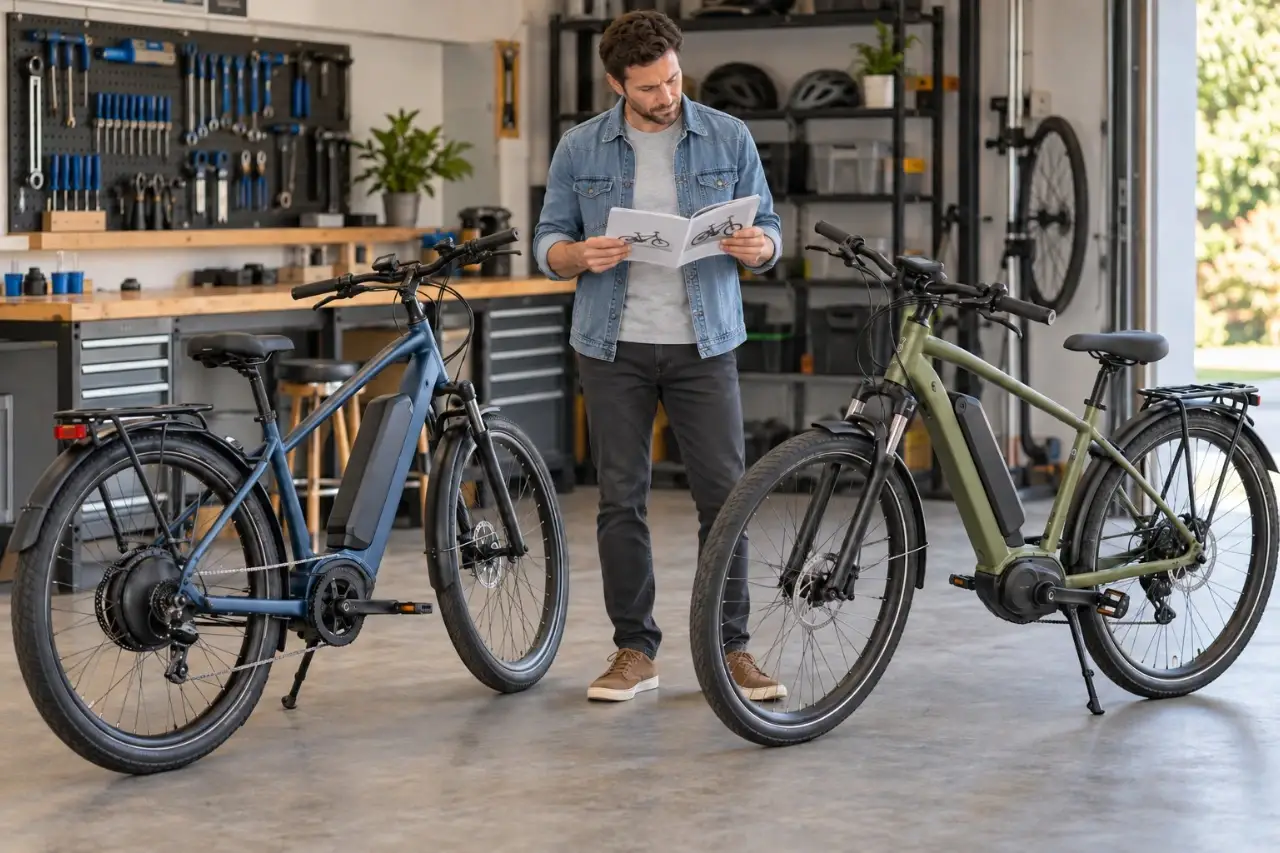
An e-bike motor converts electrical energy from the battery into mechanical assistance that helps move the bike. It does not work alone: the battery supplies energy, the controller regulates power, and sensors tell the system when and how strongly to assist. Motor location, gearing, torque, controller programming, and rider input all affect how that assistance feels.
For everyday riders, the goal is to understand how the system works, use it efficiently, and recognize when qualified service is needed.
How the motor fits into an e-bike system
A typical e-bike drive system includes:
- Battery: Stores electrical energy.
- Controller: Regulates power sent to the motor according to the bike’s programming, assist level, and sensor inputs.
- Sensors: Detect pedaling, pedal force, wheel speed, or other inputs.
- Motor: Converts electrical energy into rotating mechanical force.
- Display and controls: Let the rider select assistance and view system information.
When you pedal—or use a throttle on a bike designed with one—the controller decides how much assistance to request. Similar-wattage e-bikes can still feel very different because of their controllers, sensors, gearing, wheel size, and software.
Normal bicycle mechanics still matter. Tire pressure, drivetrain condition, brakes, rider weight, cargo, and terrain all affect performance.
Most modern e-bikes use brushless electric motors. From an owner’s perspective, these generally need little internal maintenance. Internal motor faults should be handled according to the manufacturer’s service instructions rather than by opening the motor at home.
Hub motors vs. mid-drive motors
The two common motor layouts are hub drive and mid drive.
| Motor type | Location | How it sends power | Main trade-off |
|---|---|---|---|
| Hub motor | Front or rear wheel hub | Drives that wheel independently of the bike’s selected gears | Adds weight and wiring to one wheel, making some wheel service more involved |
| Mid-drive motor | Crank/bottom-bracket area | Sends assistance through the bicycle drivetrain | Uses the bike’s gearing well but adds motor load to drivetrain parts |
For a deeper comparison, see hub motors vs. mid-drive e-bike systems.
Hub motors
A hub motor is built into a wheel. Rear hub motors are common, although front hub systems also exist.
A hub motor may be internally geared or direct-drive, so “hub motor” does not automatically mean “direct drive.” In either case, the motor does not use the bicycle’s derailleur or internal hub gears to change its own drive ratio.
Hub systems can work well for commuting and moderate terrain when matched to the route and load. A powered wheel is heavier and may include a motor cable, connector, or model-specific removal steps. Follow the bike maker’s instructions and never pull on a motor cable or force a connector.
Mid-drive motors
A mid-drive sits near the pedals and sends assistance through the bicycle drivetrain. Because the motor works through the bike’s gearing, an easier gear can help the system operate effectively during a climb.
Mid-drives can work especially well on changing terrain and low-speed climbs. The trade-off is drivetrain load: poor shifting habits, dirt, wear, or repeated high-load operation can accelerate chain, belt, cassette, or chainring wear.
On a conventional derailleur system, ease pedal pressure briefly while shifting unless the manufacturer says otherwise. Some electronic e-bike drivetrains manage motor support automatically during shifts, so the owner’s manual takes priority.
Watts, torque, and peak power need context
Motor specifications matter, but no single number predicts real-world performance.
Watts (W) measure power. Manufacturers may list rated, nominal, continuous, maximum, or peak power, and those figures are not always presented under identical test conditions. A large peak number alone does not tell you how well an e-bike will climb, accelerate, or use battery energy.
Our guide to e-bike motor watt ratings explains the differences in more detail.
Torque is rotational force, usually listed in newton-meters (Nm). More available torque can support stronger starts and climbing, but results still depend on gearing, motor speed, controller programming, traction, load, and where torque was measured.
Voltage describes electrical potential. Higher voltage alone does not guarantee better climbing or acceleration. Compare the complete drive system, not one headline number.
Cadence and torque sensors change ride feel
The sensor system is a major reason one e-bike can feel smooth while another feels more abrupt.
A cadence sensor detects crank rotation. On many systems, once pedaling is detected, the controller applies assistance according to the selected setting. Depending on the design, there may be a noticeable delay when power starts or stops.
A torque sensor measures how strongly the rider presses on the pedals. The controller can then vary assistance with rider effort, which often produces a more natural response.
Some e-bikes combine multiple sensors, and controller tuning also affects behavior.
For a detailed comparison, see torque sensor vs. cadence sensor.
On an unfamiliar e-bike, begin with low assistance in an open area. Practice starting, stopping, braking, and slow turns before entering traffic or a crowded path.
Assist levels, throttles, and U.S. class limits
For the same route and conditions, higher assistance usually uses more battery energy. Use an assist level that gives predictable control, increasing it for hills, headwinds, or loads when needed.
If your bike has a throttle, learn exactly how and when it activates. Avoid accidental throttle input while mounting or making a tight maneuver, and follow the manufacturer’s instructions for walk mode, interlocks, and startup behavior.
U.S. legal note — checked October 8, 2026: Under the widely used three-class framework, Class 1 provides pedal assistance up to 20 mph (32 km/h), Class 2 can provide motor-only propulsion up to 20 mph, and Class 3 provides pedal assistance up to 28 mph (45 km/h). State definitions and road, trail, park, or land-manager access rules can differ.
That class framework is separate from the federal consumer-product definition in 15 U.S.C. § 2085. Use our guide to checking local e-bike rules before riding in an unfamiliar jurisdiction or managed area.
How to use the motor better on hills
Long or steep climbs increase demand on the drive system, especially at low speed, with heavy cargo, or in hot weather.
For a mid-drive, shift to an easier gear before cadence drops too far. This lets the motor work through a more favorable gear ratio while you continue contributing pedal power.
For a hub motor, shifting to an easier bicycle gear helps your legs, but it does not change the hub motor’s own drive ratio. Avoid forcing the bike to crawl up a long, steep hill under maximum motor load if the manufacturer warns against that condition.
Some systems have thermal protection that can reduce motor output when temperatures become excessive, but do not assume every system behaves the same way. If assistance repeatedly fades, a temperature warning appears, the motor smells unusually hot, or you hear abnormal noises, stop riding when safe and follow the owner’s manual.
Basic motor care owners can do safely
E-bike motors are generally treated as sealed service units. Routine owner care should focus on the bike and visible components around the motor.
Before riding, check that:
- The powered wheel or crank area is secure.
- Visible motor wiring is not pinched, cut, sharply bent, or rubbing.
- Tires are within the approved pressure range.
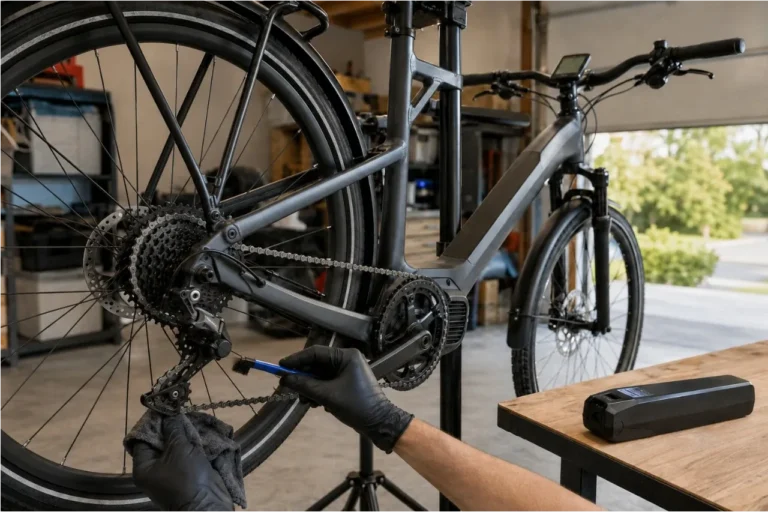
- The drivetrain is clean and lubricated as specified, especially on a mid-drive.
- The display shows no warning that requires service.
- Brake levers return normally.
When cleaning, use the method approved by your bike manufacturer. Avoid pressure washers, steam cleaners, or concentrated high-pressure spray around the motor, battery mount, display, connectors, and wheel hubs. Water resistance varies by system and does not mean the bike is waterproof.
During transport, keep rack hardware or straps from crushing motor cables or connectors.
Do not open the motor, controller, battery, charger, or wiring harness for routine troubleshooting.
When a motor problem needs professional help
A loss of assistance does not always mean the motor has failed. A low or poorly seated battery, brake cutoff input, display setting, sensor problem, connector issue, controller fault, or system error can create similar symptoms.
Start only with safe checks listed in the owner’s manual, such as battery charge and seating, display messages, visible cable condition, and whether the brake levers return normally.
Stop using the e-bike and arrange qualified service if you notice:
- Grinding, scraping, or new internal motor noises
- Repeated or unresolved error codes
- Sudden or unpredictable power surges
- A motor that continues driving when it should not
- Assistance that repeatedly cuts in and out
- Damaged, melted, or exposed wiring
- A powered wheel that is loose or incorrectly secured
- A warning that the manufacturer says requires stopping
Our e-bike error-code guide covers safe first checks without opening electrical components.
If the battery is swollen, leaking, unusually hot, emitting a strong odor, smoking, or burning, stop troubleshooting the motor. Move yourself and others away from the hazard, follow local emergency-service instructions, and contact the manufacturer or a qualified battery service provider when it is safe to do so.
What to remember
An e-bike motor is one part of a complete drive system. Hub motors and mid-drives deliver assistance differently, watts and torque need context, sensors shape power response, and riding technique affects heat, range, and drivetrain stress.
Use the system within the manufacturer’s limits, keep the surrounding bicycle components in good condition, and leave internal motor or electrical faults to qualified service.