A good ride can change your day.

How far can an electric bike go? Learn what affects real-world range and how to plan rides, protect battery life, and avoid getting stranded during rides.
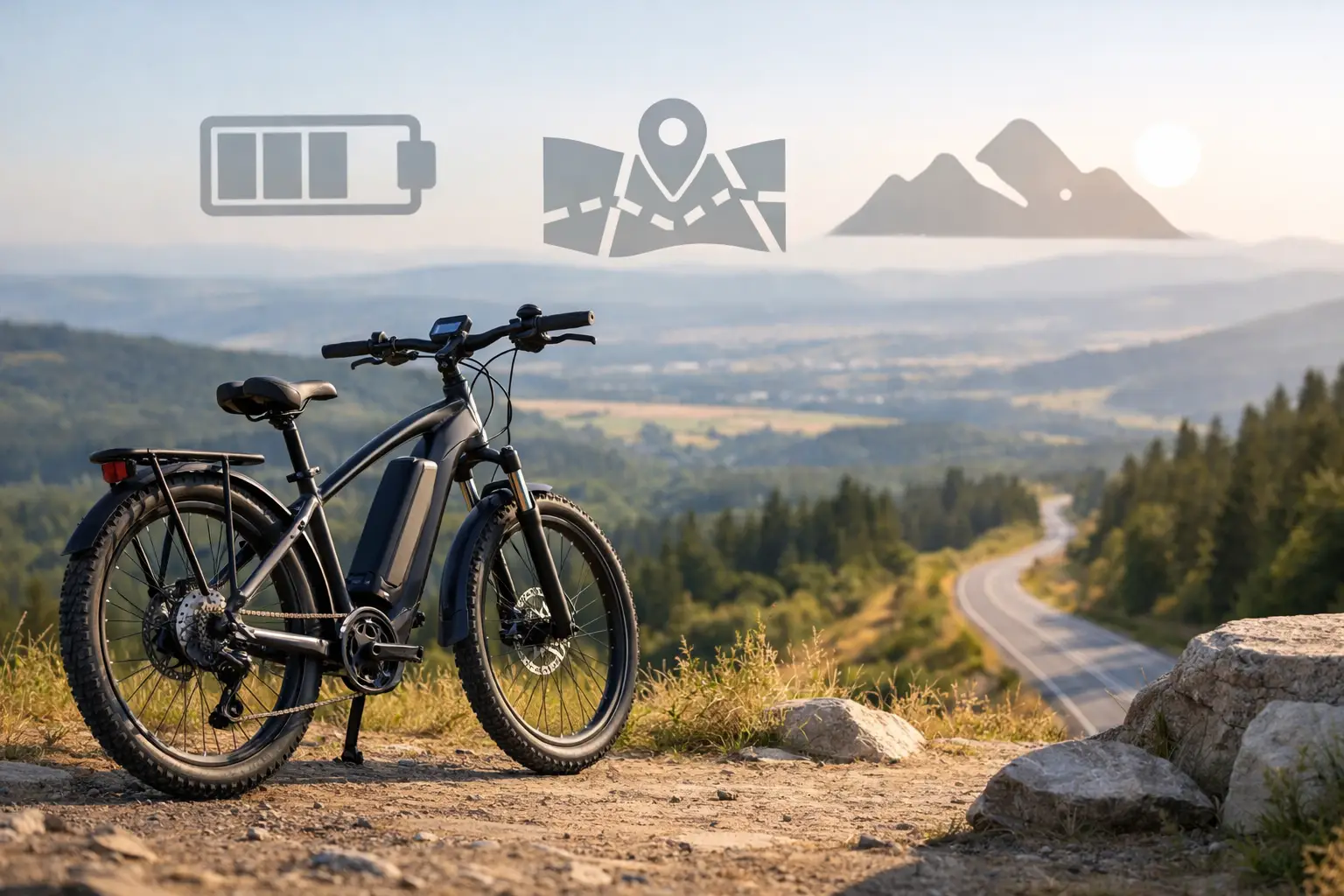
A realistic answer to how far can an electric bike go is usually 20 to 60 miles (32 to 97 km) on one charge, but your actual result may fall well outside that range. A light rider pedaling on flat pavement at a low assist setting can go much farther. A heavier load, steep hills, cold weather, high speeds, soft tires, or frequent full-power riding can shorten range quickly.
The number that matters is not a claimed maximum range. It is the distance your e-bike can cover on your regular route with enough battery left to finish safely and avoid deeply discharging the battery.
Battery capacity, measured in watt-hours (Wh), is the starting point. Watt-hours describe how much energy the battery stores. A 500 Wh battery can theoretically deliver 500 watts for one hour, although real riding does not use power at one steady rate.
Many e-bikes use roughly 10 to 30 watt-hours per mile, depending on riding conditions and how much work the rider contributes. That gives a useful planning range, not a promise.
| Battery capacity | Efficient riding at 10 Wh per mile | Typical mixed riding at 20 Wh per mile | High-demand riding at 30 Wh per mile |
|---|---|---|---|
| 400 Wh | About 40 miles (64 km) | About 20 miles (32 km) | About 13 miles (21 km) |
| 500 Wh | About 50 miles (80 km) | About 25 miles (40 km) | About 17 miles (27 km) |
| 750 Wh | About 75 miles (121 km) | About 38 miles (61 km) | About 25 miles (40 km) |
These figures assume a healthy battery and are best used as a conservative planning tool. Battery makers and e-bike manufacturers may calculate range differently, so use your owner’s manual and the display information on your specific bike as the primary reference.
E-Bike Range Tool
Estimate your realistic e-bike range based on battery size, rider weight, terrain, pedal assist level, average speed, weather, and cargo load.
You may see a battery labeled 48V 10Ah or 36V 14Ah. Voltage (V) and amp-hours (Ah) can be multiplied to estimate watt-hours. For example, 48V x 10Ah equals about 480Wh.
This helps explain why two batteries with similar-looking labels may offer different range. Still, the battery’s stated watt-hour rating from the manufacturer is usually the simplest number to use. Do not open a battery case to verify specifications or attempt internal battery repairs.
An e-bike uses the least energy when the motor is assisting a rider who is already pedaling at a steady pace on firm, level ground. It uses much more energy when the motor must overcome gravity, wind, weight, acceleration, or rolling resistance.
Higher pedal-assist settings draw more power. A throttle can be useful for starting in traffic or getting through a difficult hill, but continuous throttle riding generally reduces range faster than moderate pedal assist with active pedaling.
Speed also has a real trade-off. Wind resistance rises sharply as speed increases. Riding 20 mph instead of 15 mph may feel only modestly faster, but it can require noticeably more battery energy, especially into a headwind.
Long climbs are one of the biggest range drains because the motor is lifting the combined weight of the bike, rider, cargo, and battery. A strong headwind can have a similar effect. On routes with many stops, the motor also uses extra energy each time it accelerates the bike back to speed.
A route that is flat in one direction may not be easy in the other. If your outward trip includes a long downhill, remember that the return ride may demand far more battery power.
More weight means more work for the motor, particularly on hills and during acceleration. Carrying groceries, a child seat, work equipment, or delivery gear can materially change your normal range.
Tire pressure matters too. Underinflated tires increase rolling resistance and can make the bike feel slow and unstable. Check tire pressure with a gauge before longer rides, and use the pressure range printed on the tire sidewall or the bike manufacturer’s guidance. Do not exceed the tire, rim, or manufacturer limits.
Lithium-ion batteries provide less usable energy in cold conditions. A battery that comfortably handles a 30-mile (48 km) summer route may show lower range during a cold winter ride. The battery can often recover some performance after returning to a moderate indoor temperature, but do not charge it immediately if it is very cold. Follow the manufacturer’s temperature guidance.
All batteries also lose capacity gradually with age and use. If a battery that once completed your normal route begins dropping much faster than expected, check simple causes first: tire pressure, brake rub, assist level, weather, cargo, and route changes. If the change is sudden or significant, contact the manufacturer or a qualified e-bike technician.
The most useful range estimate comes from your own riding, not a box label. Build it gradually on familiar routes where you have a safe backup plan.
For longer rides, try to finish with at least 15% to 20% battery remaining when practical. That reserve is not a rule for every model, but it reduces the chance that an unexpected hill, headwind, or missed turn leaves you pedaling a heavy e-bike home without assistance.
The simplest range strategy is to match motor help to the moment. Use a lower assist setting on flat sections, pedal steadily, and increase assistance for hills, strong winds, busy intersections, or fatigue. Shift gears when your e-bike has them. Starting in an easier gear reduces strain on both you and the motor.
Keep tires properly inflated, keep the chain clean and lubricated according to the bike manufacturer’s instructions, and address rubbing brakes promptly. A bike that is hard to pedal with the power off deserves attention before a long ride. Brake adjustments and drivetrain service are reasonable jobs for a qualified bicycle mechanic if you are not comfortable doing them.
Avoid relying on regenerative braking claims to extend range. Most e-bikes do not recover enough energy through braking to make a meaningful difference in everyday range, especially on relatively flat routes. Smooth riding and moderate assist settings have a much larger effect.
Use the battery and charger approved for your e-bike. Charge on a stable, nonflammable surface in a dry area, away from exits, heat sources, and combustible materials. Stay nearby while charging when possible, and disconnect the charger once charging is complete if your manufacturer instructs you to do so.
For daily riders, follow the manufacturer’s guidance on charge limits and storage. If you will not ride for several weeks, many manufacturers recommend storing lithium-ion batteries partially charged rather than completely full or empty. Store the battery indoors in a dry, moderate-temperature place, not in a hot car, freezing shed, or direct sun.
Stop using the battery and seek manufacturer or qualified technician guidance if it is swollen, cracked, leaking, unusually hot, damaged after a crash, or producing an unusual odor or sound. Do not try to open, rebuild, or repair a lithium-ion battery.
A good range number is the one you can repeat on your real routes. Track a few rides, leave a sensible reserve, and adjust your plan when weather, hills, cargo, or battery age changes the equation.