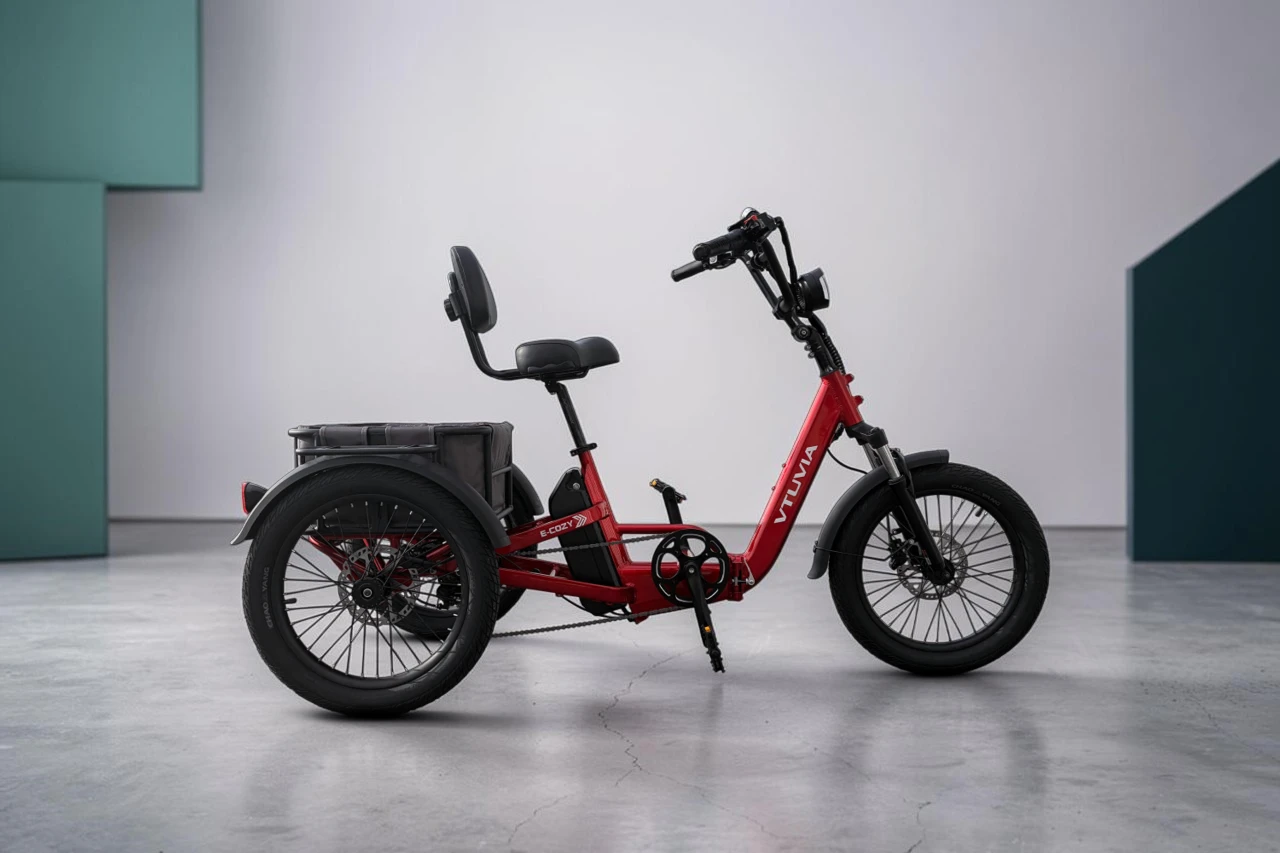
The VTUVIA E-Cozy makes the most sense to me as a trike for everyday independence: getting outside, visiting a nearby shop, or enjoying a relaxed ride without balancing a two-wheel bicycle at every stop. Its strongest features address the parts of riding that can become awkward: stepping over the frame, finding a comfortable reach, and backing a heavy trike out of a parking space. VTUVIA sums up that focus with its “Keep Living. Keep Riding.” slogan.
The combination is appealing. There is a 14.8-inch step-through, an adjustable seat and backrest, torque-sensing pedal assistance, a rear differential, and powered reverse. The current specification also includes an adjustable stem and front suspension, with a suspension seatpost available as an option.
I would put the E-Cozy on the shortlist for seniors, returning riders, and adults who prioritize comfort. However, its 95 lb listed weight and the care required when cornering deserve as much attention as the motor power and advertised range.
Test note: I tested an early-production E-Cozy. Where its hardware differs from the current model, I explain the difference below. I have not yet completed a full-charge range test, measured braking distances, or evaluated long-term durability.
Ride in Comfort & Save $50
Enjoy easier mounting, a supportive backrest, and convenient reverse with the VTUVIA E-Cozy. Use code GOEBIKE50 at checkout to save $50.
My Verdict on the VTUVIA E-Cozy
I recommend considering the E-Cozy for comfortable neighborhood riding and practical errands, provided its fit, weight, and storage requirements work for you. During my test, I particularly liked the torque sensor’s gentle response when I pedaled lightly. That predictable assistance suits a trike aimed at relaxed everyday riding. I also appreciated the reverse function and parking brakes when maneuvering and preparing to set off.
The main compromise is portability. A folding frame helps with storage, but this remains a substantial three-wheel vehicle. I would also approach the advertised 70-mile range as a manufacturer maximum rather than a dependable trip-planning figure.
For my money, the E-Cozy’s strongest argument is its combination of accessible mounting, adjustable riding position, and useful low-speed controls. Those features matter more to its intended rider than how quickly it reaches top speed.
Use code GOEBIKE50 at checkout.
VTUVIA E-Cozy Specifications
The following specifications come from VTUVIA’s current product sheet. They describe the current listed configuration, which differs in several respects from the early-production trike I tested.
| Specification | VTUVIA E-Cozy |
|---|---|
| Frame | Folding 6061 aluminum alloy with an ultra-low step-through |
| Step-through height | 14.8 inches |
| Motor | 48V 750W rear brushless motor; claimed 1,200W peak |
| Claimed motor torque | 85 Nm |
| Battery | 48V 15Ah, 720Wh lithium-ion |
| Controller | 48V 25A |
| Pedal-assist sensor | V-Adapt torque sensor |
| Riding modes | Pedal assist, throttle, and reverse |
| Listed speed class | Class 2 |
| Throttle | Thumb throttle on the current specification |
| Claimed range | Up to 70 miles with pedal assist; up to 40 miles on throttle |
| Charging time | Approximately 7 hours |
| Drivetrain | Shimano 7-speed |
| Tires | 20 × 3.0 inches |
| Front suspension | Up to 60 mm travel |
| Seatpost | Standard, with an optional suspension seatpost offering up to 50 mm travel |
| Brakes | Hydraulic front disc brake and separate left/right rear calipers |
| Brake rotors | 180 mm |
| Rear differential | Yes; 6061-T6 aluminum alloy construction listed |
| Display | 3.5-inch full-color display with adjustable viewing angle |
| Listed net weight | 95 lb, including rear racks and fenders |
| Listed total capacity | 450 lb |
| Recommended rider height | 5 ft 1 in to 6 ft 3 in |
| Colors | Ruby Red, Forest Green, Pearl White, Lavender Purple |
The power, torque, range, capacity, and weight figures above are manufacturer specifications. I have not independently verified those figures through instrumented testing.
My Test Trike and Current Equipment
I tested an early-production E-Cozy with a few components that differ from the current specification. Here are the differences to keep in mind when comparing my riding experience with the version available today.
| Component | My early-production test trike | Current specification sheet |
|---|---|---|
| Handlebar stem | Fixed stem | Adjustable aluminum stem |
| Front fork | Rigid fork without front suspension | Suspension fork with up to 60 mm travel |
| Throttle | Right-hand twist throttle | Thumb throttle |
My impressions apply to the equipment I actually rode. I have not tested the current suspension fork or optional suspension seatpost, so I cannot give a firsthand assessment of their performance.
The seatpost upgrade is also separate from the front fork. Selecting the standard seatpost configuration does not mean that the current specification calls for a rigid front fork. Buyers ordering older inventory should confirm the fitted equipment with the seller.
Comfort and Fit
Getting on through the low frame
The 14.8-inch step-through is one of the E-Cozy’s most useful design choices. It reduces how high a rider has to lift a leg to enter the frame, which can make starting and finishing a ride less awkward.
When I got on, I noticed the generous opening between the saddle and handlebars. I had room to move through the frame without feeling squeezed between the seat and cockpit. That space makes the low step-through more useful in practice.
Fit still needs to be checked in person when possible. Being within the advertised height range does not establish whether the saddle, pedals, backrest, and controls will suit a particular rider.
Seat support and handlebar adjustment
The adjustable seat and backrest give riders more scope to find a supported position. The adjustable stem listed for the current model adds another useful adjustment: handlebar reach and angle.
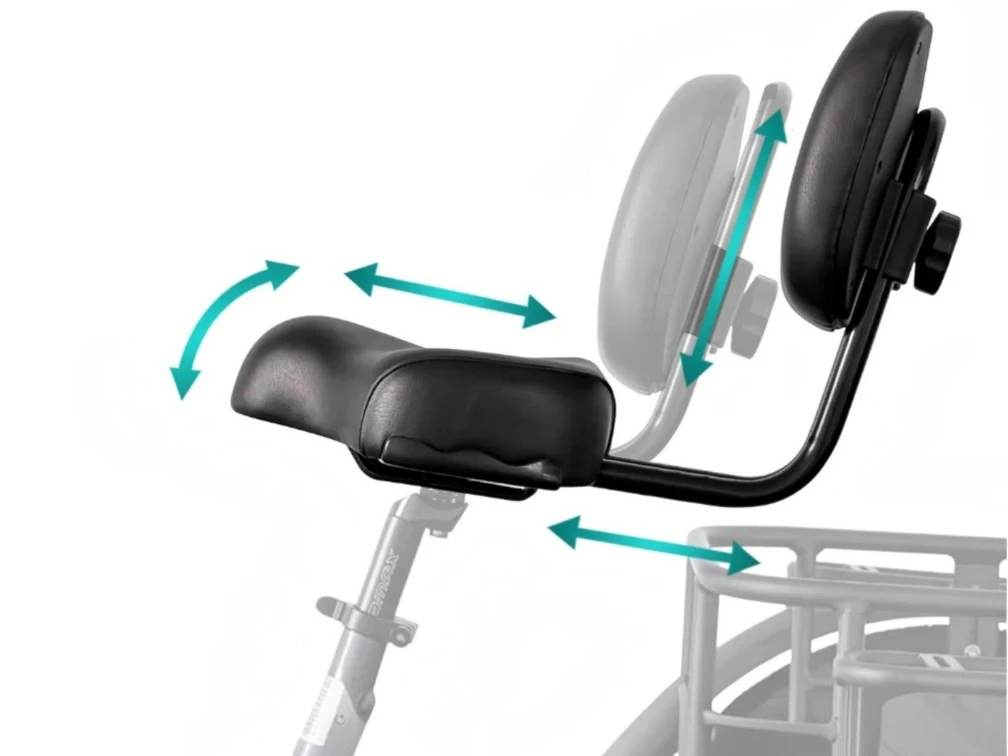
On my test trike, I found the original handlebars a little low, and my knees came close to them as I pedaled. I wanted more handlebar height, so the adjustable stem now listed is a welcome change. I have not ridden that revised setup yet, so I would still check the fit before buying.
I also found that my seat had loosened and needed its alignment and tilt corrected. It leaned farther back than I wanted. Based on that experience, I would make saddle security, backrest adjustment, and cockpit alignment part of the initial setup before riding. A comfortable position depends on those adjustments staying secure.
Tires and suspension
I was pleased to find 20 × 3-inch tires on the E-Cozy. They still have a broad profile, but I prefer their less bulky appearance to the 4-inch tires found on many recreational trikes. For the relaxed everyday riding I have in mind for this model, I like this slightly narrower format.
VTUVIA lists a 60 mm suspension fork and an optional 50 mm suspension seatpost for the current model. I rode the earlier version without front suspension and have not tested either of those suspension components. I would choose the seatpost upgrade after checking both its comfort and its effect on the achievable saddle height.
Torque Sensor and Pedal Assistance
The torque sensor was one of the features I appreciated most during my ride. It responds to pedal pressure, allowing me to influence the assistance by changing how firmly I pedal.
In pedal-assist level 1, I got a gentle, comfortable start. When I pedaled lightly, the display showed around 7 mph. As I put more pressure into the pedals, I brought that up to approximately 10–11 mph. Moving into higher assistance levels made it easier for me to build speed.
| How I rode | What I saw on the display |
|---|---|
| I pedaled gently in PAS 1 | Approximately 7 mph |
| I increased my effort in PAS 1 | Approximately 10–11 mph |
| I pedaled in PAS 2 | Approximately 13–15 mph |
| I increased my effort in PAS 3 | Approximately 16–20 mph |
| I used the throttle in PAS 1 | Approximately 20 mph |
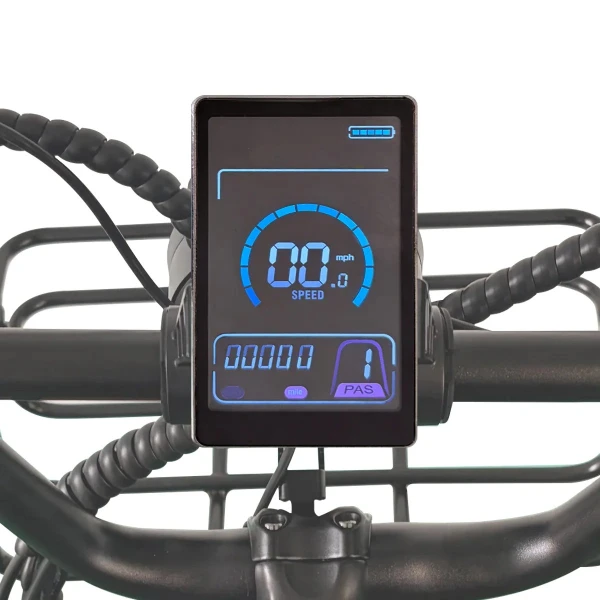
I took these readings from the trike’s display during my ride. I did not verify them with GPS, and they should not be treated as fixed speed limits for each assistance level.
What I liked most was the response at low effort. I could pedal gently and settle into a relaxed pace without feeling that I needed to ride near the trike’s top speed.
However, PAS 1 did not limit throttle speed on my test trike. I could still reach approximately 20 mph using the throttle in that setting. A new owner should verify the behavior of their own trike in a clear, level practice area and avoid assuming that a low PAS setting caps every form of motor assistance.
Use code GOEBIKE50 at checkout.
Motor Performance and Gearing
VTUVIA specifies a 750W rear motor, with a claimed 1,200W peak and 85 Nm of torque. During my throttle test, I reached an indicated 20 mph without a prolonged buildup. I found the motor relatively quiet in normal riding, with a more noticeable whine when I asked it to accelerate harder.
I also rode through grass, where the motor had enough power to keep me moving. My local test area does not have substantial hills, so I have not verified its performance on steep climbs or with a heavy load uphill. The pulling power felt encouraging, but I would want a proper hill test before making a stronger claim.
The Shimano 7-speed drivetrain suited my relaxed riding, although I found myself wanting a taller top gear as I picked up speed. At approximately 16–17 mph, I was already pedaling fairly quickly. I could keep contributing at the pedals, but a higher gear would have made that pace more comfortable.
That is a limitation for riders who want to pedal briskly near the trike’s maximum assisted speed. It is less significant for someone planning relaxed rides at lower speeds, where comfortable cadence and easy starts take priority.
Stability and the Rear Differential
The three-wheel layout removes the need to balance the trike upright in the same way as a bicycle when stopped on level ground. That can be a meaningful confidence benefit for a returning rider.
The rear differential also serves a practical purpose: it allows the rear wheels to rotate at different speeds as they follow different paths through a turn. I consider it a useful feature for smoother cornering, but it does not prevent a trike from tipping.
One moment during my ride deserves particular attention. When I made a few quick steering changes at around 10 mph, one wheel briefly lifted. That experience reminded me to respect the limits of a three-wheel layout, even when the trike feels steady during normal riding.
My recommendation is to build confidence through slow, deliberate turns on level ground. Reduce speed before a corner, leave room for both rear wheels, and take extra care on sloping or uneven surfaces. The E-Cozy’s stability benefits are most convincing when it is ridden within those limits.
For everyday use, I would prioritize a comfortable route and controlled pace over trying to reproduce its maximum speed.
Braking and Parking Controls
The current specification lists hydraulic disc braking at the front and both rear wheels, with 180 mm rotors. During my braking check, I applied the brakes firmly and brought the trike to a prompt stop. I was pleased with the braking power available in that test.
I did not measure the stopping distance or test the brakes in wet conditions, on a long descent, or with a heavy cargo load. My assessment here is limited to how they felt during that ride.
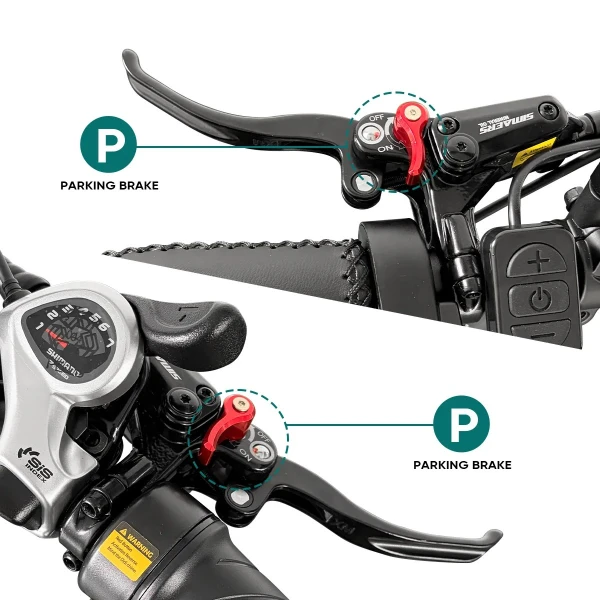
My test trike had parking-brake controls at both brake levers. I appreciated being able to keep it stationary while preparing to ride. That feature is also useful when mounting, dismounting, or loading a basket. Owners should check that the brakes hold securely on level ground before relying on them during those tasks.
Reverse Mode in Everyday Use
Powered reverse was one of the E-Cozy features I liked most when trying the controls. I can see it being particularly useful in a garage or confined parking space, where moving a 95 lb trike backward by hand can be inconvenient.
I pressed the reverse button and heard the audible indicator, then used the throttle to back up. At first, I had the trike in PAS 0 and reverse did not operate. After I selected PAS 1 and released the parking brakes, I could move backward. Pressing the button again switched reverse off so I could go forward.
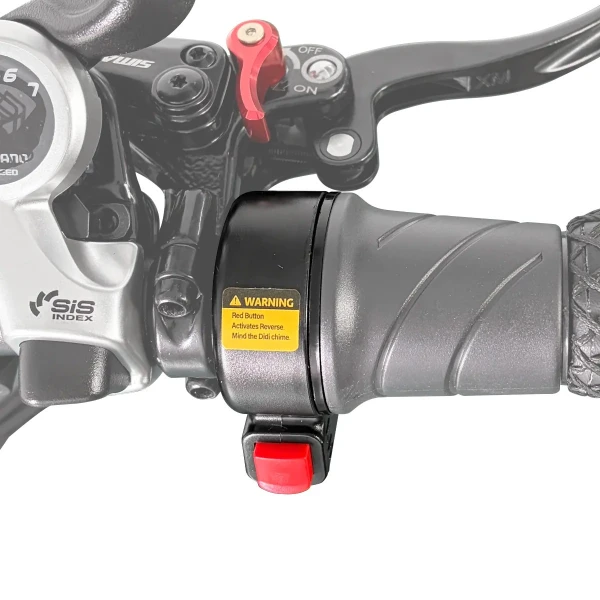
I liked the audible reminder because it made the selected direction easier to recognize. Once I understood the controls, I found the process straightforward. Owners should follow the instructions supplied with their particular version.
I would use reverse slowly, with the area behind the trike clear, and confirm forward mode before setting off again.
Battery and Realistic Range Expectations
The E-Cozy’s 48V 15Ah battery has a nominal capacity of 720Wh. VTUVIA claims up to 70 miles with pedal assist or up to 40 miles using the throttle, with charging taking approximately seven hours.
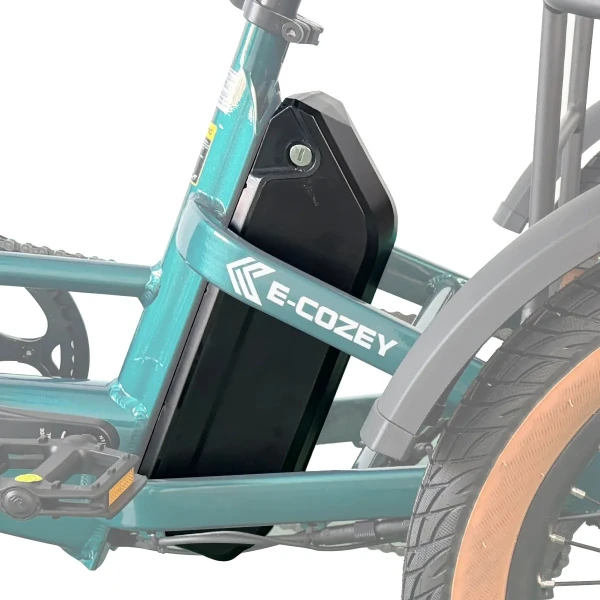
I have not completed a full-charge range test, so I cannot confirm those maximum figures from my own riding. Rider weight, cargo, speed, terrain, tire pressure, temperature, and the amount of pedaling all influence how far a charge lasts.
For the E-Cozy’s intended role, I would focus first on whether it comfortably covers a normal round trip with a reserve. Start with shorter familiar routes, learn the battery consumption of your own setup, and extend rides gradually.
I am reserving judgment on its long-distance capability until I complete a full range test.
Baskets and Everyday Equipment
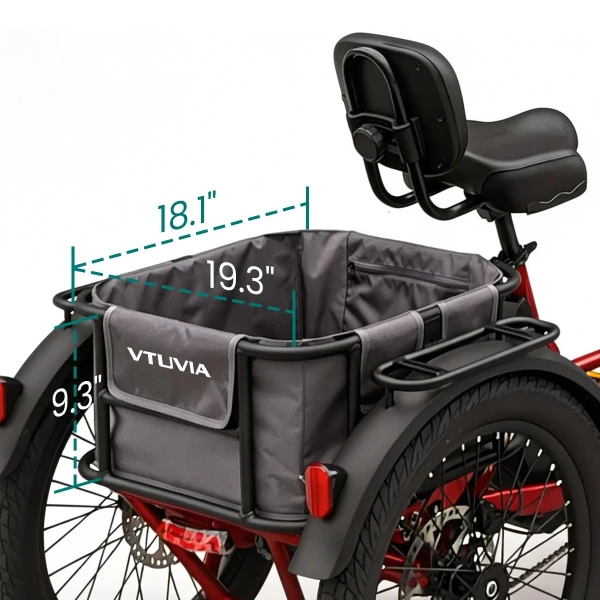
I liked having baskets at both the front and rear, which gives the E-Cozy a clear role as an errand trike. VTUVIA lists the rear basket at approximately 19.3 × 18.1 × 9.3 inches, providing useful space for shopping bags and everyday items.
One detail I noticed on my test trike was the lack of a liner or solid basket bottom. Small items could fall through, so I would secure them in a suitable bag. VTUVIA’s current E-Cozy landing page lists a rear basket with a bag, along with a front basket and two mirrors; check the package being ordered because it may differ from what came with my early-production trike.
The 450 lb figure is described as total capacity; it does not establish the permitted load for either basket. Confirm the individual cargo limits, account for rider and cargo weight together, and keep loads secure and evenly distributed.
My test trike also had adjustable mirrors, a headlight, rear light, turn signals, a horn, and fenders. I particularly liked the large mirrors and the rearward view they provided. I have not tested the lights at night, so I cannot yet assess their usefulness on unlit routes.
Folding and Storage
I see the folding frame primarily as a storage advantage. At a listed 95 lb, the E-Cozy still requires a realistic lifting and loading plan.
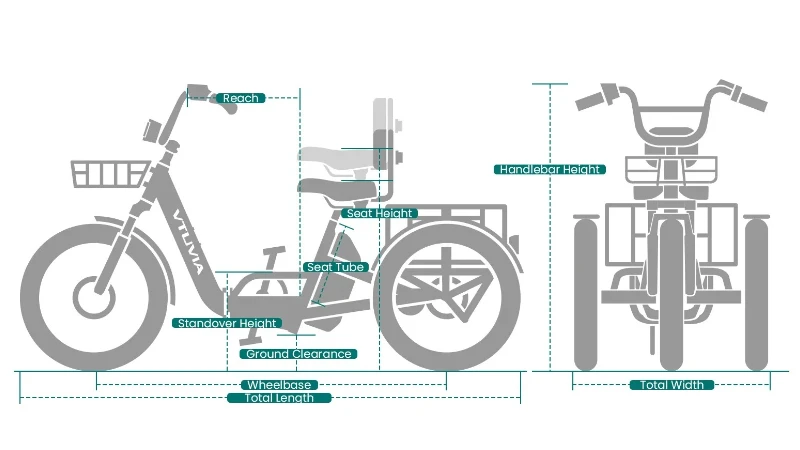
| Dimension | Manufacturer-listed measurement |
|---|---|
| Overall length | 72.4 inches |
| Overall width | 28.5 inches |
| Wheelbase | 52.8 inches |
| Folded dimensions | 41.3 × 26.8 × 34.3 inches |
| Seat height | 27.2–37.0 inches |
| Handlebar height | 33.5–41.3 inches |
| Recommended rider inseam | 30.5–39 inches |
| Ground clearance | 3.9 inches |
Use code GOEBIKE50 at checkout.
Before buying, measure the narrowest doorway or gate on the intended storage route and the actual opening of any vehicle used for transport. Allow space to maneuver and to accommodate fitted accessories. For rider fit, consider the stated inseam guidance alongside height and confirm comfortable pedal reach.
On the trike I tested, the seat needs to be removed before folding. Follow the current folding instructions and confirm which parts must be removed to achieve the advertised dimensions. Folding alone does not make the trike easy for one person to lift into a car or carry upstairs.
Assembly and Initial Build Impressions
My E-Cozy arrived by freight truck without visible damage. I found assembly straightforward, with relatively little work needed to get it together. When I looked closely at the frame, I was also impressed by the neat, consistent appearance of the welds.
That gave me a positive first impression of the build, although I have not put enough long-term use on the trike to judge durability. I still needed to correct the seat position and center the display, so I would leave time for final adjustments rather than expecting a perfect fit straight out of the box.
For a buyer who is uncomfortable checking fasteners, adjusting the cockpit, or confirming brake operation, I would include professional setup in the purchase budget. That is particularly worthwhile on a vehicle whose appeal depends on easy, predictable operation.
Price and the Free Accessory Offer
When I checked on September 17, 2026, the official product page displayed $2,099 for the standard configuration. The suspension seatpost is a separate configuration option, so confirm the final price for the version selected.
At the time of this review, VTUVIA was advertising a free accessory bundle valued at $306 on its E-Cozy landing page. Verify the exact items and eligibility in the cart. The advertised accessory value should be treated separately from a cash reduction in the trike’s price.
At this price, my buying decision would rest on fit and ease of use. The low frame, adjustable seating, torque sensor, differential, reverse, and hydraulic brakes form a useful package for the intended rider. The accessories add value when they are items the owner will actually use.
Warranty and returns
VTUVIA’s published warranty policy lists five years for the frame, two years for specified electrical components, and one year for the original battery and accessories, subject to its terms. The five-year headline therefore should not be read as five years of battery coverage. See the current warranty policy.
I would read the return terms before ordering. The policy checked for this review requires used returns to be requested within 20 days, with fewer than 10 miles and original packaging. It lists a $200 return shipping fee and a restocking fee typically equal to 30% of the purchase price. Qualifying unused returns also carry a $200 shipping deduction. These conditions make confirming fit before purchase especially useful. See the return and refund policy.
What I Like and What I Would Consider Carefully
Strengths
- Low step-through and a spacious frame opening make mounting more approachable.
- Current seat, backrest, and stem adjustments offer useful ways to personalize fit.
- I found the torque-sensing assistance gentle when pedaling lightly.
- Reverse and parking brakes address practical maneuvering needs.
- Front and rear baskets support everyday errands.
- The current specification combines a rear differential with hydraulic braking at all three wheels.
Limitations
- The 95 lb listed weight makes lifting and transport a significant consideration.
- I wanted taller gearing when pedaling at higher speeds.
- One wheel briefly lifted when I made quick steering changes, underscoring the need for careful cornering.
- I have not tested the current suspension components, completed a full-charge range test, or evaluated demanding climbs.
- My early-production test trike differs from the current specification.
Who I Would Recommend It For
I would consider the E-Cozy for a rider who wants relaxed neighborhood outings, practical basket space, and less concern about balancing a bicycle at stops. Its accessible frame and adjustable riding position also make it worth investigating for someone returning to cycling after time away.
For a senior rider, my priority is an actual fit check and a calm test ride. The useful questions are whether getting on feels manageable, the brake levers and controls are comfortable to operate, and slow turns feel predictable.
I would be less inclined to recommend it to someone who must carry a bike upstairs, regularly load it alone into a high vehicle, or primarily wants fast cornering and demanding off-road riding. Riders with steep daily routes should seek a demonstration on a comparable hill before deciding.
Frequently Asked Questions
Is the VTUVIA E-Cozy suitable for seniors?
It is worth considering for seniors who want a low step-through, a supported seating position, and three-wheel support at stops. Suitability depends on individual fit, control operation, and confidence when turning. I would recommend a test ride when available.
How fast does the E-Cozy go?
I reached approximately 20 mph on the display using the throttle. I did not verify that speed with GPS. VTUVIA lists the current model as Class 2, and I recommend taking turns substantially slower than its maximum straight-line speed.
Does it have a torque sensor and reverse?
Yes. I used both during my test. The torque sensor responded to my pedaling effort, and reverse included an audible indicator. Both features are also listed for the current model.
Is the suspension seatpost included?
The suspension seatpost is optional. VTUVIA lists up to 50 mm of seatpost travel for that upgrade and up to 60 mm of travel for the current front suspension fork.
Can it travel 70 miles on a charge?
VTUVIA advertises up to 70 miles with pedal assist and up to 40 miles on throttle. I have not completed a full-range test, so I cannot confirm either figure from my own riding.
Is the E-Cozy easy to transport?
It folds, but its 95 lb listed weight still makes loading a substantial task. Check the folded dimensions, vehicle opening, and available lifting assistance before planning to transport it regularly.
My Final Assessment
The E-Cozy has a persuasive design for riders who want to make everyday cycling feel more approachable. I particularly like how the low frame, adjustable seating, torque sensor, and reverse function address specific moments that can otherwise make a heavy trike inconvenient.
During my test, I enjoyed the gentle pedal assistance, found reverse straightforward once I understood the controls, and was pleased with the braking response. I also reached an indicated 20 mph without much difficulty. My main riding reservations were the quick pedaling cadence at higher speeds and the need to slow down and steer carefully through turns.
I would shortlist the VTUVIA E-Cozy for comfortable local rides and errands, with a fit check and storage plan before purchase. Its promise of helping people keep riding is most convincing when the trike matches the owner’s everyday routes and practical needs.
Use code GOEBIKE50 at checkout.