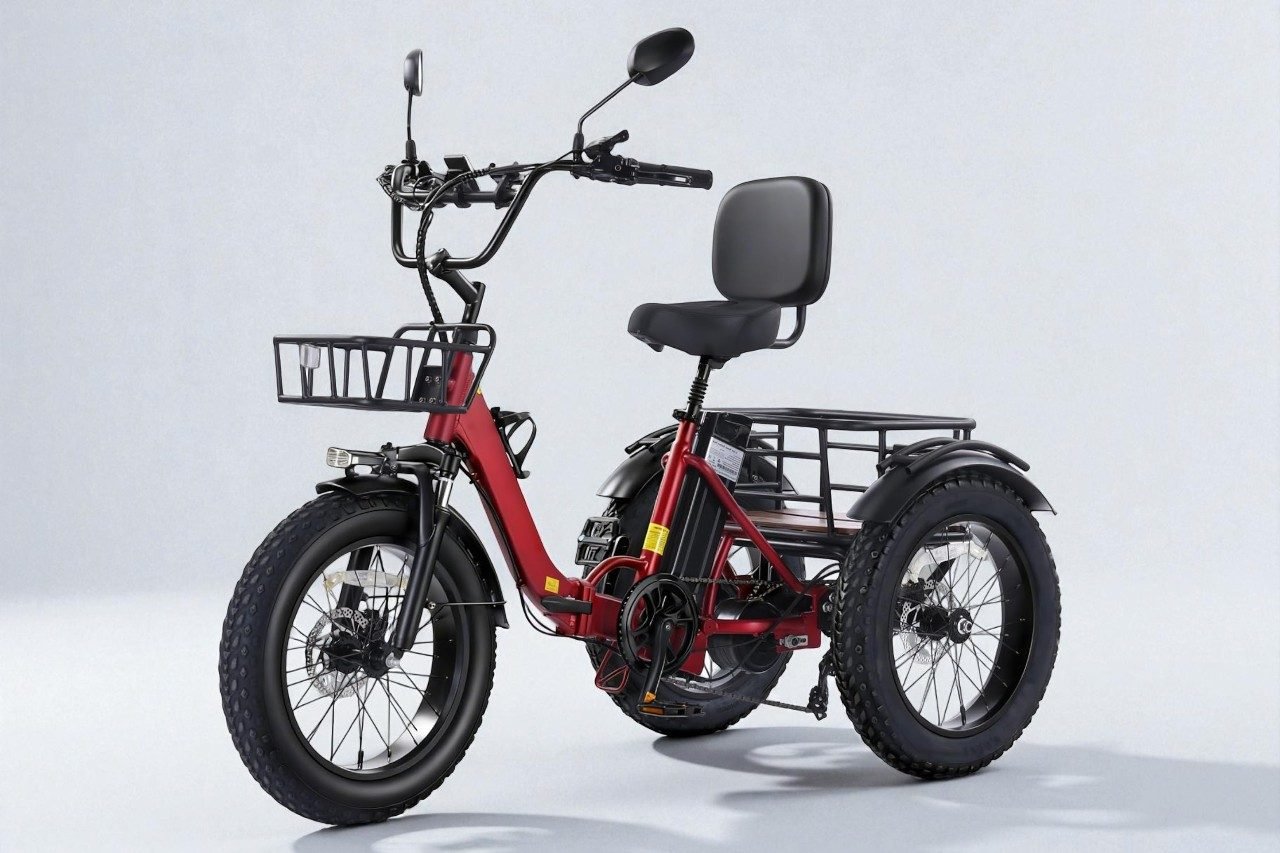
The KAKIGO Electric Tricycle is built for adults who want three-wheel stability, easy step-through access, and enough cargo room for groceries or everyday errands. Its most useful features are not the headline motor numbers. They are the rear differential, hydraulic brakes on all three wheels, parking-brake function, removable battery, and supportive seat with a backrest.
On paper, the KAKIGO is unusually well equipped. The manufacturer lists 1,350W peak power, 115 Nm of peak torque, a 48V 15.6Ah battery, 20-by-4-inch fat tires, a folding steel frame, and a maximum load of 440 pounds. The trike arrives approximately 90% assembled and includes both front and rear baskets.
There are also important reasons to look past the marketing numbers. This is a 130-pound tricycle that remains bulky after folding. Its 80–90-mile range claim would require exceptionally low energy consumption from a heavy fat-tire trike, and the listing does not provide several details buyers should know, including the motor’s continuous rating and charger output. The claimed UL 2272 certification should also be verified with documentation before purchase.
Bottom Line
The KAKIGO looks like a promising utility trike for moderate-speed neighborhood rides, grocery runs, and adults who prioritize predictable turning and confident braking. Its differential and three hydraulic disc brakes are more meaningful than its peak-power claim. It is a less convincing choice for apartments, frequent vehicle transport, high-speed riding, or buyers who need the advertised 80–90 miles without recharging.
KAKIGO Electric Tricycle Overview
Quick Verdict
The KAKIGO’s strongest use case is calm, practical riding on pavement and maintained paths. A 15 mph factory speed limit is sensible for a full-size tricycle, while the listed 20 mph maximum provides some extra assistance on open, appropriate routes. Five pedal-assist levels and a 7-speed drivetrain let the rider adjust both motor support and pedaling cadence.
This trike should work best for riders who have ground-level storage, want to carry everyday cargo, and understand that a three-wheeler turns differently from a bicycle. It should not be treated as a lightweight folding e-bike simply because the frame has a hinge.
Best For
- Adults and seniors who value three-wheel stability and a low step-through frame
- Neighborhood rides, park paths, grocery runs, and everyday errands
- Riders who want a differential for smoother low-speed cornering
- Buyers who prioritize hydraulic braking and a parking brake
- Larger riders who need a high claimed total payload, subject to seller confirmation
- Homes with a garage, shed, or other ground-level storage area
Consider Another Option If
- You need to lift the trike upstairs or into a vehicle regularly
- Your storage area has narrow doors, tight turns, or limited floor space
- You expect 80–90 miles under ordinary riding conditions
- You want bicycle-like handling at higher speeds
- You need verified certification paperwork but the seller cannot provide it
- You plan to ride technical trails, deep sand, steep side slopes, or heavy snow
Specifications
| Specification | Manufacturer-Listed Detail |
|---|---|
| Motor position | Rear-mounted |
| Peak motor output | 1,350W |
| Peak torque | 115 Nm |
| Maximum speed | Up to 20 mph |
| Factory speed limit | 15 mph |
| Pedal assist | 5 levels |
| Drivetrain | 7-speed |
| Rear axle | Differential system |
| Battery | 48V 15.6Ah removable lithium-ion |
| Nominal battery energy | 748.8Wh |
| Claimed assisted range | 80–90 miles |
| Claimed certification | UL 2272 |
| Claimed water resistance | IPX5 |
| Tires | 20 x 4-inch anti-slip fat tires |
| Rims | Aluminum alloy |
| Brakes | Three hydraulic disc brakes |
| Parking brake | Yes |
| Frame | Folding high-carbon-steel step-through |
| Claimed total load capacity | Up to 440 lb |
| Suggested rider height | 5 ft 5 in–6 ft 5 in |
| Net weight | 130 lb |
| Shipping weight | 145.5 lb |
| Assembly | Approximately 90% pre-assembled |
| Warranty | One year |
| Technical support | Lifetime, according to the seller |
Dimensions
| Measurement | Listed Size |
|---|---|
| Overall dimensions | 68.89 x 32.7 x 43.3 in |
| Handlebar width | 28.7 in |
| Folded dimensions | 43.3 x 45.3 x 49.2 in |
| Front basket | 9.4 x 10.62 x 3.94 in |
| Rear basket | 20.47 x 15.55 x 9.44 in |
The listing should clarify the order of the folded measurements. One folded dimension is larger than the trike’s listed riding width, so buyers should request a diagram and measure their intended storage and vehicle openings before ordering.
What Makes the KAKIGO Stand Out?
Four features give the KAKIGO a stronger practical specification than many basic adult electric trikes.
First, the rear differential allows the inside and outside rear wheels to rotate at different speeds in a turn. That can reduce tire scrub and make cornering feel less resistant than it does on a solid rear axle.
Second, the listing describes one hydraulic disc brake for each wheel, plus a parking-brake function. A heavy trike carrying a rider and groceries needs controlled stopping more than it needs aggressive acceleration, so this is a meaningful advantage if the system is correctly assembled and adjusted.
Third, the 48V 15.6Ah battery stores a nominal 748.8Wh. That is a useful amount of energy for errands and recreational riding, even though the maximum range claim needs realistic interpretation.
Finally, the step-through frame, wide saddle, curved backrest, and dual baskets make the trike more practical for its intended audience than a conventional fat-tire e-bike with a high top tube and optional cargo accessories.
1,350W Peak Motor and 115 Nm Torque
What the Numbers Suggest
The KAKIGO uses a rear-mounted motor with a claimed peak output of 1,350W and peak torque of 115 Nm. Those figures suggest useful assistance when starting from a stop, moving a heavier combined load, or climbing a moderate grade.
Peak output only describes what a system may deliver briefly. It does not reveal the motor’s continuous or nominal rating, controller current, heat management, or how gently assistance engages. Those details have a greater effect on sustained hill performance, legal classification, reliability, and low-speed control than one peak-watt number.
Before ordering, ask the seller for the continuous motor rating and a photo of the motor label. This is especially important if local e-bike rules set a power limit. GoEBikeLife’s guide to local e-bike rules explains why speed, motor rating, and equipment can affect where a vehicle may be used.
Why the 15 mph Factory Limit Makes Sense
The manufacturer lists a 20 mph maximum but says the trike is limited to 15 mph from the factory. That lower setting is a practical starting point. Three-wheelers do not lean through corners like two-wheel bicycles, and their weight shifts toward the outside wheel as turning speed increases.
New owners should begin at the lowest assistance level in a large, empty, level area. Practice starting, braking, wide turns, tight turns, and parking before adding cargo or riding near traffic. Complete most braking before entering a turn, keep the pace slow, and avoid abrupt steering inputs.
If the display permits a higher speed setting, confirm that changing it is allowed under local rules and does not affect the warranty. A faster setting does not make the trike’s chassis, tires, cargo, or turning behavior more suitable for speed.
Pedaling and Assistance Control
Five pedal-assist levels provide more useful control than a simple low-medium-high system. Lower levels should be better for crowded paths, learning the trike’s handling, and extending battery life. Higher levels can help with headwinds, gradual climbs, or additional cargo.
The 7-speed drivetrain lets the rider select an easier mechanical gear before a climb or a harder gear at cruising speed. On a rear-motor trike, those gears primarily change the rider’s pedaling effort; they do not give the hub motor seven internal ratios. Shift before the drivetrain is heavily loaded and avoid forcing a gear change while climbing.
The supplied information does not clearly state whether a throttle is included. Buyers who require throttle operation—or need to know the trike’s legal class—should confirm this directly with the seller.
Rear Differential, Stability, and Turning
Why the Differential Matters
In a turn, the outside rear wheel travels farther than the inside rear wheel. A differential lets the two wheels rotate at different speeds to accommodate that difference. Compared with a locked axle, it can reduce dragging, skipping, and steering resistance on dry pavement.
That should make the KAKIGO easier to guide through neighborhood corners, parking areas, and curved paths. It may also help the rear tires maintain more consistent contact when the trike is loaded.
A differential does not make a trike impossible to tip. Turning too fast, placing cargo high or far to one side, dropping a rear wheel off an edge, or crossing a steep side slope can still destabilize any three-wheeler. The safest technique is to slow down before the turn and keep cargo low, centered, and secured.
Wide Stance and Low-Speed Confidence
The listed overall width is 32.7 inches. A wider rear stance can feel planted when the trike is moving straight or stopped, and the rider does not need to balance it at a traffic light. This can be helpful for someone who feels uncomfortable supporting a heavy two-wheel e-bike at very low speed.
However, a trike follows three wheel tracks rather than one. The rider must give curbs, bollards, door frames, and path edges extra clearance. The rear wheels can clip an obstacle even after the front wheel has passed it.
Equal rear-tire pressure also matters. A soft tire on one side can change rolling resistance and handling. Check all three tires regularly with a gauge rather than judging pressure by feel.
48V 15.6Ah Battery and the 80–90-Mile Claim
Battery Capacity in Practical Terms
Multiplying 48 volts by 15.6 amp-hours gives the KAKIGO battery a nominal capacity of 748.8 watt-hours. That is a useful figure because watt-hours allow a more meaningful range check than voltage or amp-hours alone.
The listing claims 80–90 miles in pedal-assist mode. Covering that distance with 748.8Wh would require average consumption of only about 8.3–9.4Wh per mile before accounting for unusable reserve and other losses. That is a demanding efficiency target for a 130-pound, three-wheel vehicle on 4-inch-wide tires.
The claim may be approached only under unusually favorable conditions: a lighter rider, very low assistance, low speed, flat pavement, correct tire pressure, mild weather, little cargo, and substantial rider pedaling. It should not be treated as the distance most owners will receive on mixed everyday rides.
Range Planning Table
The table below is a capacity calculation, not a KAKIGO road-test result. It shows how far a nominal 748.8Wh battery could travel at different average energy-use rates before allowing for reserve and system losses.
| Average Energy Use | Capacity-Based Distance |
|---|---|
| 10Wh per mile | About 75 miles |
| 15Wh per mile | About 50 miles |
| 20Wh per mile | About 37 miles |
| 25Wh per mile | About 30 miles |
| 30Wh per mile | About 25 miles |
Higher speeds, hills, cold weather, low tire pressure, frequent starts, heavier riders, and loaded baskets all raise consumption. Until independent testing is available, plan trips conservatively, turn around well before half the display’s remaining charge on early rides, and learn how the battery indicator behaves under load.
Charging and Battery Safety
The removable pack can be charged on or off the trike, which is especially useful when the vehicle is stored in a garage or shed without a nearby outlet. The provided information does not state charger amperage or a full charging time, so ask the seller for both before purchase.
The manufacturer advertises an integrated battery-management system with overcharge, short-circuit, and overheating protection, as well as IPX5 water resistance and UL 2272 certification. These are seller claims rather than independently verified findings in this review.
Ask for the certification organization’s name, certificate or report number, model numbers covered, and confirmation that the supplied battery and charger match the certified configuration. The wording matters: certification of one component is not necessarily certification of the complete electrical system.
Use only the supplied or manufacturer-approved charger. Charge on a hard, dry surface away from exits and combustible materials, and stop using the pack if it is damaged, swollen, unusually hot, wet inside, or emitting an unfamiliar odor. IPX5 is a water-resistance claim, not permission to immerse the battery, pressure-wash the trike, or leave it exposed to prolonged heavy rain.
Three Hydraulic Disc Brakes and Parking Brake
The KAKIGO is advertised with triple hydraulic disc brakes, which appears to mean a dedicated brake at each wheel. That is the right type of equipment for a 130-pound trike with a high claimed payload. Hydraulic systems typically require less hand force and offer easier modulation than basic cable-operated brakes when properly set up.
The parking-brake function is equally important. It can keep the trike from rolling while the rider gets on or off, loads the baskets, or stops on a gentle slope. A parking brake should not be treated as a substitute for safe parking position, and owners should never assume it will hold a fully loaded trike on a steep grade without testing it cautiously.
Because the trike is partially assembled after shipping, inspect the following before the first ride:
- Both brake levers feel firm and do not pull to the grips
- All three calipers are secure and aligned
- Rotors do not show shipping damage or severe rubbing
- Hydraulic hoses are not kinked, pinched, or leaking
- The parking brake engages and releases consistently
- The trike stops straight during a low-speed test on level ground
New pads and rotors may require a controlled bedding-in process. If the brakes feel weak, uneven, or spongy, have a qualified bicycle mechanic inspect the system before riding in traffic or on hills.
20 x 4-Inch Fat Tires and Mixed-Surface Use
The three 20 x 4-inch tires create a broad contact patch and add some cushioning over patched pavement, driveway lips, and firm gravel. Their deep tread may also improve traction on loose surfaces compared with narrow street tires.
Fat tires do not turn the KAKIGO into an all-terrain vehicle. Deep sand and snow create substantial rolling resistance, while ruts, roots, and sloped ground can unsettle a three-wheeler. The trike’s safest environment is still relatively level pavement and well-maintained, firm-surface paths.
The correct pressure will depend on rider weight, cargo, surface, and the range printed on the tire sidewall. Avoid using a generic pressure without checking the tire. Pressure that is too low can increase drag, reduce range, damage the rim, or make steering vague; excessive pressure can reduce comfort and grip.
The aluminum-alloy rims avoid some weight and corrosion associated with basic steel rims, but the high-carbon-steel frame still deserves routine inspection. Dry the trike after wet rides and touch up paint damage before rust develops.
Step-Through Frame, Saddle, and Rider Fit
Easier Mounting
The low step-through frame removes the need to swing a leg over a tall top tube. That can make mounting easier for older adults and riders with limited hip or knee mobility. The parking brake should be engaged before getting on or off so the trike cannot roll away.
The manufacturer recommends the KAKIGO for riders from 5 feet 5 inches to 6 feet 5 inches. Height alone does not guarantee fit. Inseam, arm length, minimum saddle height, handlebar reach, and knee bend all matter. Shorter riders near the minimum should request the minimum saddle-to-pedal and saddle-to-ground measurements before ordering.
Seat and Backrest Comfort
The wide padded saddle and curved backrest are designed for an upright, supportive position. This will appeal to riders who prefer comfort and visibility over a forward-leaning cycling posture. A backrest can reduce fatigue, but it should support the rider without forcing the hips too far forward on the saddle.
No suspension system is included in the supplied specifications. The large tires and padded seat may filter minor vibration, but buyers should not expect the trike to isolate sharp potholes or rough trails like a full-suspension e-bike. Slow down for broken pavement and avoid striking obstacles squarely at speed.
Cargo Capacity and the 440-Pound Rating
The front basket is sized for small personal items, while the larger rear basket is better suited to grocery bags, a cooler, or everyday supplies. The rear rack adds utility, although every load should be strapped down so it cannot shift or contact the wheels.
The advertised 440-pound capacity should be treated as a total system limit unless the manufacturer confirms otherwise. That total normally needs to include the rider, battery, accessories, and cargo—not 440 pounds of cargo in addition to the rider. The listing does not provide separate front-basket, rear-basket, or rack limits, so ask for those figures before carrying a heavy load.
Payload affects more than the frame. It increases braking distance, battery consumption, tire load, and motor heat on hills. Put heavier items low and near the center of the rear basket, distribute weight evenly from left to right, and take the first loaded ride in a traffic-free area.
If cargo is a primary reason for buying, compare the KAKIGO with the other models in our best electric tricycles for adults guide.
Folding Design: Useful but Not Truly Portable
The folding frame can reduce the length of the KAKIGO for storage or vehicle transport. That is useful in a garage corner, shed, large SUV, van, or pickup bed.
It does not make this a carryable folding bike. At 130 pounds, the trike will be difficult for most people to lift safely. The listed folded size—43.3 x 45.3 x 49.2 inches—also remains much larger than a typical two-wheel folding e-bike.
Before buying, measure:
- The narrowest doorway and every turn along the storage route
- Available floor space, including room to maneuver the trike
- Vehicle hatch width, opening height, and cargo-floor length
- The vehicle’s cargo weight limit
- The rated capacity of any ramp or carrier
Remove the battery before moving the trike only if the manual recommends it and the remaining lift can be performed safely. Use a correctly rated ramp or a second capable adult rather than attempting an awkward solo lift. Buyers who transport a trike frequently may be better served by a purpose-built hitch carrier rated for the trike’s weight and wheel layout.
Assembly and First-Ride Setup
KAKIGO says the trike arrives approximately 90% pre-assembled and includes tools, a manual, and setup videos. That reduces the work, but the remaining 10% still matters. A three-wheel drivetrain, folding joint, multiple brakes, and cargo hardware demand more care than a simple city bike.
Professional final assembly is a sensible expense for anyone unfamiliar with bicycle brakes, wheel attachment, drivetrain adjustment, and torque specifications. At minimum, the first-ride inspection should cover:
- Confirm that all three wheels are correctly secured and aligned.
- Check the differential and rear axle area for play, shipping damage, or unusual noise.
- Tighten the handlebar, stem, seat, baskets, rack, pedals, and fenders to the manual’s specified torque.
- Verify that the folding latch fully closes and its safety mechanism engages.
- Inspect chain routing and shift through all seven gears on a stand.
- Test all three brakes and the parking-brake function at walking speed.
- Inflate each tire within its sidewall range and verify equal rear pressure.
- Confirm that the headlight, rear reflector, display, and battery lock are secure.
- Recheck critical fasteners after the first few rides as directed by the manual.
Do not assume that “90% assembled” means “ready to ride immediately after unboxing.” Shipping can change brake alignment, fastener tension, and wheel position.
Warranty, Support, and Ownership Questions
The seller advertises a one-year warranty, lifetime technical support, U.S.-based representatives, and 24/7 customer assistance. Those promises are useful only when the coverage and parts process are clear.
Before the return window closes, save the order information, serial number, manuals, packaging photos, and all seller correspondence. Ask whether the warranty covers labor, return shipping, battery capacity loss, electronics, the differential, hydraulic components, and damage caused by third-party assembly.
Also confirm the current price and availability of a replacement battery, charger, display, controller, brake parts, and differential components. A heavy trike can be expensive and inconvenient to return, so parts availability may matter more than a broad support claim.
Pros and Cons

| Pros | Cons |
|---|---|
| Rear differential should reduce tire scrub and improve turning feel | Heavy 130 lb build is difficult to lift or transport |
| Hydraulic disc brake at each wheel, according to the listing | Folded package remains large and dimension order needs clarification |
| Parking brake helps with mounting, loading, and stationary control | 80–90-mile range is a best-case manufacturer claim, not a tested expectation |
| Useful 748.8Wh removable battery | One-year warranty is modest for a complex, heavy trike |
| Step-through frame and supportive backrest | Fat tires add rolling resistance and do not make it suitable for technical terrain |
| Front and rear baskets included | Steel frame adds weight and requires care against corrosion |
| Five assist levels and 7-speed gearing | |
| High claimed 440 lb total capacity |
How the KAKIGO Compares With a Basic Budget E-Trike
| Buying Factor | KAKIGO | Typical Basic E-Trike |
|---|---|---|
| Turning system | Rear differential | Often a simpler fixed axle |
| Braking | Three hydraulic disc brakes, claimed | Mechanical discs are common |
| Parking control | Parking-brake function | May be basic or omitted |
| Battery | 48V 15.6Ah, 748.8Wh | Often a smaller-capacity pack |
| Tires | 20 x 4-inch fat tires | Commonly narrower tires |
| Cargo | Front and rear baskets | Rear basket often standard; front may be optional |
| Accessibility | Step-through frame and backrest | Varies widely |
| Portability | Folding, but 130 lb and bulky | Usually still heavy; some are smaller |
| Main uncertainty | Range and certification verification | Component quality and support often vary |
The KAKIGO’s strongest competitive case is its combination of differential steering behavior, braking equipment, battery size, and cargo hardware. Its weakest case is portability. Delivered price will determine whether that package represents good value, so compare the current total after shipping and coupons rather than relying on a crossed-out list price.
What to Confirm Before You Buy
Send the seller these questions before placing the order:
- What is the motor’s continuous or nominal wattage, not only peak output?
- Does this version include a throttle, and what legal e-bike class is it configured to meet?
- What exact test conditions produced the 80–90-mile range claim?
- What are the charger output, full charging time, and replacement battery price?
- Can the seller provide the UL certificate or report number and all covered model numbers?
- Does the 440-pound limit include the rider, battery, accessories, and cargo?
- What are the individual load limits for the front basket, rear basket, and rack?
- What is the correct length-width-height order for the folded dimensions?
- Which parts and shipping costs are covered during the one-year warranty?
- Who pays return freight if the trike arrives damaged or cannot be assembled correctly?
Clear answers materially reduce the risk of buying a large product that is difficult to repack and return.
Final Verdict: Is the KAKIGO Electric Tricycle Worth It?
The KAKIGO Electric Tricycle has the right priorities for a practical adult trike. Its rear differential should make turns smoother than a basic fixed-axle design, while three hydraulic disc brakes and a parking brake address the added mass of the vehicle and its cargo. The step-through frame, backrest, removable 748.8Wh battery, fat tires, and dual baskets complete a strong utility package.
The best reason to buy it is controlled everyday usability—not the 1,350W peak label or the 80–90-mile headline. Peak specifications do not prove refined low-speed motor response, and the stated range requires exceptionally favorable efficiency. Its 130-pound weight also means the folding hinge helps with footprint more than portability.
Our provisional recommendation is positive for riders who want moderate-speed neighborhood transportation, have suitable ground-level storage, and can verify the unanswered details with the seller. Confirm the certification paperwork, continuous motor rating, range test conditions, folded measurements, parts support, and return terms before ordering.
For the right owner, the KAKIGO could be a capable grocery-run and leisure trike with better-than-basic turning and braking equipment. For anyone who must lift it, store it in a small apartment, or depend on the maximum advertised range, a lighter or more thoroughly documented model will be the safer purchase.
| Preview | Product | Price | |
|---|---|---|---|

| KAKIGO Electric Tricycle for Adults,750W Motor Etrike,48V15.6Ah Ebike,20″x4″Fat Tire… | $1,099.00 $969.00 | View on Amazon |
Frequently Asked Questions
Is the KAKIGO Electric Tricycle suitable for seniors?
It may suit seniors who can comfortably fit the listed 5-foot-5 to 6-foot-5 rider range and who value a step-through frame, backrest, parking brake, and three-wheel stability. A tricycle handles differently from a bicycle, however, so every new rider should practice starts, stops, and slow turns in an empty level area before using roads or carrying cargo.
How far can the KAKIGO travel on one charge?
The manufacturer claims 80–90 miles in pedal-assist mode. The 48V 15.6Ah battery has a nominal capacity of 748.8Wh, so achieving the claim would require exceptionally low average energy use. Actual range will depend on assistance level, rider and cargo weight, speed, hills, temperature, wind, tire pressure, and rider effort. Treat 80–90 miles as an unverified best-case figure rather than a typical result.
What is the KAKIGO’s top speed?
The listing states a maximum speed of up to 20 mph and a 15 mph factory limit. Begin with the factory setting, especially if you are new to trikes. Confirm local rules and any warranty effect before changing a speed setting.
Does the KAKIGO have a rear differential?
Yes, according to the manufacturer. The differential lets the two rear wheels rotate at different speeds during a turn, which can reduce tire scrub and steering resistance. It improves the design but does not remove the need to slow down for corners.
Can the KAKIGO fit in an SUV?
Possibly, but not every SUV will have enough room. The listed folded dimensions are 43.3 x 45.3 x 49.2 inches, and the trike weighs 130 pounds. Ask the seller to confirm the dimension order, measure the vehicle’s hatch and cargo area, and plan a safe loading method before buying.
Is the 440-pound rating for the rider alone?
The listing calls it a load capacity but does not clarify the calculation. Treat it as a combined limit for rider, battery, accessories, and cargo unless the manufacturer provides written confirmation otherwise. Separate basket and rack limits should also be requested.
Is the KAKIGO waterproof?
No electric trike should be treated as waterproof. The manufacturer claims IPX5 water resistance, which does not cover immersion or pressure washing and may not apply equally to every component. Keep electrical connections dry and follow the manual’s wet-weather and storage instructions.
Does it arrive fully assembled?
KAKIGO says it arrives approximately 90% pre-assembled with tools, a manual, and setup videos. Final assembly and safety checks are still required. Professional assembly is recommended if you are not experienced with hydraulic brakes, folding frames, wheel attachment, and drivetrain adjustment.
Is it good for hills?
The claimed 1,350W peak output and 115 Nm peak torque suggest useful hill assistance, but the listing does not provide the continuous motor rating, controller specification, or a verified grade test. Hill performance will fall with heavier loads, low battery charge, heat, and steep or sustained climbs. Do not judge climbing ability from peak wattage alone.
GoEBikeLife publishes independent e-bike reviews, comparisons, and practical buying guides. Some links on this page are affiliate links. If you make a purchase through an eligible link, we may earn a commission at no additional cost to you.