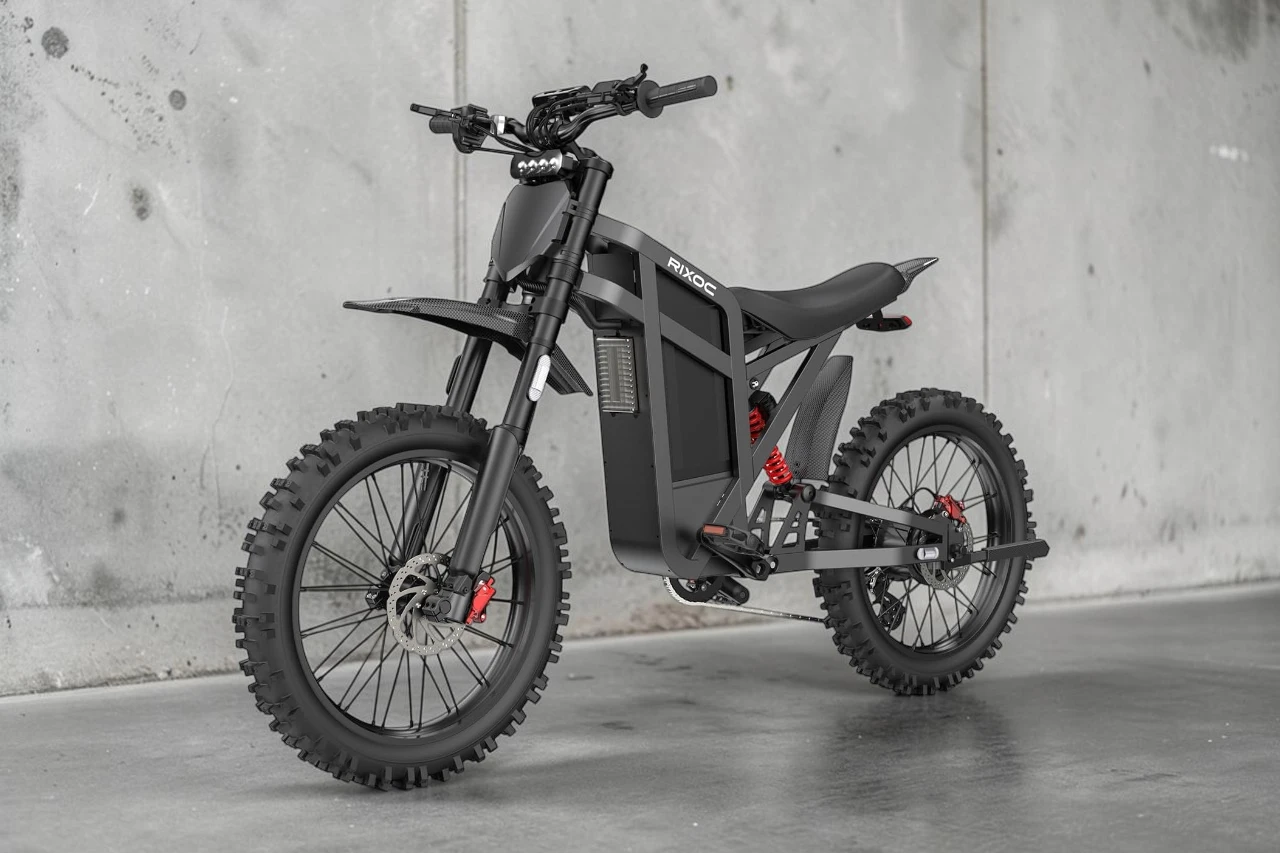
The RIXOC GT60 looks like the kind of electric dirt bike that should deliver an aggressive launch every time I twist the throttle. It has a motorcycle-style frame, a substantial removable battery, knobby tires, and a claimed 4,000W peak output. On paper, there is plenty to get excited about.
What stood out most during the ride, though, was how manageable it felt. Once the motor engaged, the power delivery was pleasantly controlled, the ride modes made a noticeable difference, and the hydraulic brakes felt well matched to the bike.
There are trade-offs. My GPS speed runs settled around 36–37 mph, with roughly 39 mph reached downhill. Throttle response had a noticeable delay, rough grass exposed the suspension’s limitations in its tested setup, and automatic cruise control in the highest power mode was a concern.
In this RIXOC GT60 review, I’ll explain where the bike impressed me, where its specifications need closer scrutiny, and who I think should consider it.
Review scope: This article covers the initial assembly impressions, feature inspection, GPS speed runs, and short pavement and grass rides documented in the test notes. It does not include a full battery range test, measured braking distances, or long-term durability testing. Advertised specifications are identified separately from riding observations.
My Quick Verdict
The RIXOC GT60 is worth considering for recreational riders who want motorcycle styling, a large battery, and manageable power. I would approach it as a recreational motorized machine for places where its use is permitted, rather than assume it has ordinary bicycle access.
I enjoyed its smooth delivery once underway, comfortable seat, and easy maneuverability during the ride. However, I would want the level-five cruise-control behavior resolved before relying on that mode regularly. Buyers looking for explosive acceleration or a proven rough-trail suspension package should keep their expectations in check.
| What I liked | What needs consideration |
|---|---|
| Smooth, controllable assistance once engaged | Noticeable delay before power arrives |
| Clearly different power modes | Low-end punch feels restrained for the advertised system |
| Hydraulic brakes felt appropriate for the performance | Tall seat and substantial weight complicate handling at a stop |
| Convenient removable battery arrangement | Level-five cruise control activated despite being disabled in the app |
| Comfortable motorcycle-style seat | Rough grass felt jarring in the tested suspension setup |
| Integrated headlight, brake light, and indicators | |
| Enjoyable handling on pavement |
Make Your Next Ride a RIXOC GT60
Smooth power. A 60V 35Ah removable battery. Bold dirt-bike styling. Explore the GT60 today.
RIXOC GT60 Specifications: Claims Versus Test Findings
The product specification sheet describes a 3,000W rated hub motor with up to 4,000W peak output, a 60V 35Ah battery, and a maximum advertised speed of 40 mph. Those figures describe the advertised configuration; they are not independent measurements of electrical output.
| Item | Advertised specification or observed result |
|---|---|
| Motor | Rear hub motor; supplied specifications list 3,000W rated and 4,000W peak |
| Torque | Up to 100 Nm claimed; not independently measured |
| Battery | 60V 35Ah removable battery |
| Nominal battery energy | 2,100Wh, calculated from voltage × amp-hours |
| Advertised maximum speed | Up to 40 mph |
| GPS speed during testing | Approximately 36–37 mph; around 39 mph downhill |
| Advertised range in supplied specifications | Up to 70 miles with assistance; up to 50 miles on electric power alone |
| Charging time | Approximately 8–9 hours claimed; not timed |
| Drive system | Single-speed pedal drivetrain and rear hub motor |
| Assistance | Five power modes; cadence-based behavior in the ride notes |
| Suspension | Hydraulic front fork and rear shock |
| Brakes | Hydraulic discs; supplied specifications advertise four-piston calipers |
| Wheels | Advertised 19-inch off-road setup; verify exact tire and rim markings |
| Seat height | 33.86 inches in the supplied specifications |
| Weight | 119.05 lb listed in the supplied specifications; not independently weighed |
| Maximum load | 330 lb claimed |
| Controls | Full-twist throttle, central display, key ignition, and NFC access |
| Lighting | Headlight, rear brake light, and turn signals |
A specification caveat: The official listing contains conflicting details: it labels the motor both 3,000W peak and 4,000W peak, gives both 62- and 70-mile range claims, and describes rear air suspension where the supplied specifications describe a spring shock. It also lists 110/100-19 tires, which differs from the supplied 19 × 1.6 notation. I would get the exact current configuration confirmed before ordering.
Assembly and First Impressions
The unboxing and assembly experience gave me a reasonably positive first impression. This bike felt more finished and less improvised in its presentation.
The overall layout is straightforward: a rear hub motor, single-speed chain drive for the pedals, a long motorcycle-style seat, and a battery housed within the main frame area. Front and rear fenders and a rear-shock mudguard help complete the package.
One small detail I noticed was the front fender. Its single-bolt mounting arrangement allowed some wobble. That does not establish a long-term failure problem, but it is something I would inspect during assembly and revisit after the first few rides.
The carbon-fiber-style finish on several plastic pieces is a cosmetic texture. I would not interpret it as evidence that those parts are structural carbon fiber.
Motor Performance: Controlled Rather Than Explosive
With the advertised 60V system, I expected stronger low-speed urgency than I actually felt. The GT60 has useful power, but its initial response is relatively restrained.
That character made it easy to manage once moving. I could build speed without the bike feeling as though every small throttle input would produce an abrupt surge. For relaxed recreational riding, I appreciated that.
However, smooth delivery and immediate response are different qualities. In the highest mode, I noticed a delay after applying throttle before the motor began ramping up. My spoken count during the ride was roughly “one, two, three,” but that was an informal observation, not a timed acceleration measurement.
I would not buy this bike expecting instant, competition-style response. Nor would I blame the motor’s physical dimensions for the behavior without further testing: controller settings, current limits, and other factors could contribute, and the ride did not isolate the cause.
How Fast Did the GT60 Actually Go?
The repeatable GPS result matters more to me than the headline speed.
| Test situation | Result |
|---|---|
| Regular GPS speed runs | Approximately 36–37 mph |
| Downhill portion | Approximately 39 mph |
| Wheel spinning off the ground | Display showed roughly 50 mph; not a riding-speed result |
The GT60 came reasonably close to its advertised 40 mph under favorable conditions, but I would describe the tested bike as a mid-to-high-30-mph machine. I would not advertise the downhill number as its sustained speed on level ground.
Battery charge, rider load, wind, and surface conditions can change the outcome. These runs establish what happened during this ride, not a guaranteed speed for every owner.
Pedal Assist and Ride Modes
Pedal assistance was one of the more pleasant surprises. There was some delay before activation, and the initial engagement in level one was noticeable, but the delivery settled into a smooth, usable rhythm.
It felt more refined than a system that simply applies a large burst of power whenever the cranks start turning. That impression should not be confused with confirmation of a torque sensor. The ride notes describe cadence-based assistance; I did not verify torque-sensing hardware.
The differences between modes were easy to feel:
- Level one: A noticeable initial push followed by manageable assistance.
- Level two: More assertive acceleration while remaining easy to control.
- Level three: The display appeared to settle near 20 mph during the ride.
- Level four: Assistance appeared limited to roughly 28 mph on the display.
- Level five: The strongest setting used for the higher-speed testing.
The level-three and level-four observations were display readings, not separate GPS validations. They also reflect the tested settings, rather than a promise about every firmware version or configuration.
Although the pedals are functional, the GT60 still feels like a motorcycle-style recreational machine. Its single-speed drivetrain and seat layout would not be my first choice for someone who wants a conventional cycling fit or an exercise-focused bike.
The Cruise-Control Behavior Deserves Attention
My biggest reservation concerns cruise control in level five.
During the speed runs, the bike continued holding speed after I released the throttle and stopped pedaling. The feature still activated even after I had disabled cruise control in the app. The notes suggest it did not behave the same way in levels one through four, but that observation needs more systematic checking.
This matters because releasing the throttle did not necessarily produce the response I expected. I would ask RIXOC for a confirmed explanation and remedy for the exact controller and firmware supplied with the bike.
Until resolved, I would avoid relying on level five and verify the control behavior in a clear, controlled setting. I cannot tell from this initial test whether the cause was software, a setting that failed to save, or an issue specific to the tested unit.
Battery and Range: Large Capacity, Unverified Mileage
The specified 60V 35Ah battery works out to 2,100Wh of nominal energy. That is a useful capacity figure, but it does not establish how many miles the GT60 will travel under a particular rider.
The supplied range claims are up to 70 miles with assistance and up to 50 miles on electric power alone. I did not complete a full-discharge ride, so I cannot confirm either figure.
I also would not combine the maximum speed and maximum range claims into an expectation of riding 70 miles at nearly 40 mph. Those figures describe different limits, and the supplied material does not establish the conditions needed to achieve the advertised mileage.
What I did like was the removable battery layout. The drop-down arrangement made removal convenient for indoor storage and security. There is also an indicator on the battery itself for a quick charge-level check; that should not be mistaken for a detailed battery-health diagnostic.
The advertised eight-to-nine-hour charging time suggests planning around overnight charging, but I did not time a complete charging cycle. Anyone with a fixed daily mileage requirement should seek a documented range result that matches their load, speed, and terrain.
Suspension and Off-Road Comfort
The GT60 has a hydraulic front fork and rear suspension, and I found the general ride enjoyable on pavement. The motorcycle-style seat helped make casual riding comfortable.
Rough grass told a different story. I could feel repeated bumps clearly through the bike, and the ride became uncomfortable enough that I preferred returning to the paved surface. The suspension was working, but it did not make the uneven ground disappear.
Adjustment may improve that experience, especially if the rear setup does not suit the rider. However, I did not establish an optimized setting or complete a before-and-after comparison, so I cannot promise that adjustment alone will solve the harshness.
The phrase “six-layer suspension” is less useful to me than the actual fork, shock, adjustment range, and ride quality. Based on this test, I see the GT60 as a recreational machine that can handle some uneven ground, with clear limits to what has been demonstrated.
I did ride up a grassy incline without an obvious struggle. That is encouraging, but there was no measured gradient or extended climb to support a precise hill-climbing claim. Technical trails, repeated jumps, deep sand, snow, and sustained steep descents were not evaluated.
Brakes, Tires, and Handling
The inspected bike had Logan-branded hydraulic disc brakes, and their feel was one of its stronger points. During the braking check, the response felt appropriate for the bike’s pace and weight.
I did not record stopping distances or perform repeated downhill stops, so my conclusion is about initial control and feel. It does not establish wet-weather braking performance, heat resistance, or a measured advantage over another model.
The large knobby tires complement the bike’s off-road appearance. I found the GT60 easy to maneuver once moving, which helped make the short ride enjoyable despite its substantial size.
Do not order replacement tires from a generic “19-inch” description alone. Confirm the markings on the fitted tire and rim, along with clearance and load requirements. The conflicting size information is particularly relevant here.
Seat Height, Fit, and Everyday Practicality
The supplied seat-height figure is 33.86 inches, and the tall riding position is a meaningful buying consideration. In the documented fit check, I could not put both feet flat on the ground and was more comfortable supporting the bike with one foot down.
That experience matters more than a broad recommended-height range. Inseam, seat width, footwear, and confidence handling a heavy machine all affect whether the fit works.
I also wanted the controls a little closer. A different handlebar shape might improve the riding position, but any change needs to preserve cable and hose clearance and proper control operation.
The supplied weight is 119.05 lb; I did not put the bike on a scale. Either way, the bulk alone makes ground-level storage far more attractive than carrying it upstairs. Removing the battery can reduce the load, but it does not turn the GT60 into a portable bicycle.
I would plan for secure garage or shed storage and check transport-equipment limits before expecting to carry it on a rack. The advertised 330 lb load capacity also should not be interpreted as passenger approval simply because the saddle is long.
Display, NFC Access, and Lighting
The startup process on the tested bike involved the key ignition, display power button, NFC card, and a brake squeeze to leave park mode. It also remembered the previously selected power mode, so I would check the displayed setting before moving off.
The central display puts the main riding information in view, while the app offers additional settings. App connectivity is convenient, but the cruise-control issue means I would verify how a setting changes the bike’s behavior instead of assuming the on-screen selection tells the whole story.
I liked the lighting package. The rear light responded to brake input, turn signals were integrated, and the headlight had an independent control. The front indicators appeared less bright than the rear ones during inspection, and the electronic horn sounded prominent.
Those are useful features, but I did not conduct a measured nighttime beam test. Their presence also does not establish road approval.
Is the RIXOC GT60 Street Legal?
I would not describe the GT60 as street legal merely because it has pedals or a lower-speed setting.
The U.S. federal consumer-product definition of a low-speed electric bicycle includes a motor of less than 750W, along with pedal and motor-only speed criteria. The GT60’s advertised 3,000W rating sits outside that definition. Federal product classification is separate from local road-access rules. CPSC bicycle requirements guidance
A 20 mph setting or a mode that stops assisting around 28 mph does not, by itself, establish bicycle-lane or public-trail eligibility. Before buying it for transport, confirm its classification and any registration, equipment, licensing, and access requirements with the relevant authorities. For recreational use, confirm that the riding area permits this type of motorized vehicle.
Price, Ownership, and Who Should Buy It
When checked on September 21, 2026, the official product page displayed a $1,399 sale price before any additional checkout promotion. Pricing and availability can change. Check the current RIXOC GT60 price
At that displayed price, the combination of a large specified battery, hydraulic brakes, integrated lighting, and enjoyable power delivery makes the bike interesting. I would still make purchase decisions around the exact delivered specification and support available, rather than the discount against a crossed-out price.
Before ordering, I would ask about the cruise-control issue, replacement-battery availability, brake consumables, and the exact rear shock supplied. I would also read the warranty exclusions and return-shipping terms. This review did not test customer-service responsiveness or a warranty claim.
I would shortlist the GT60 if:
- I wanted a motorcycle-style recreational machine with pedals and manageable power.
- I had a permitted place to ride and secure ground-level storage.
- I was satisfied with approximately 36–37 mph in the documented GPS runs.
- I valued battery capacity and comfort more than aggressive launch performance.
- The seller could satisfactorily address the cruise-control behavior and specification discrepancies.
I would look elsewhere if:
- I needed an unambiguous conventional Class 1, 2, or 3 bicycle for daily routes.
- I regularly had to lift or carry the bike.
- I wanted immediate throttle response and hard acceleration.
- I expected proven performance on demanding off-road terrain.
- I needed a verified range guarantee for a specific commute.
Final Verdict: An Enjoyable Ride With Important Limits
The RIXOC GT60’s strongest quality is how approachable its power feels once it arrives. I enjoyed the distinct assistance modes, comfortable seat, easy maneuverability, and reassuring initial brake feel.
The test also made its limits clear. Sustained GPS speed was closer to 37 mph than 40, throttle response was delayed, and rough grass was less comfortable than the styling might suggest. The unresolved level-five cruise behavior is the issue I would address first.
My recommendation is conditional: consider the GT60 for permitted recreational riding if its fit and handling priorities match yours, but confirm the current hardware and resolve the control concern before committing. Its appeal is a relaxed, enjoyable motorcycle-style ride with useful power—not a demonstrated competition dirt-bike package.
Interested in the GT60? Check current pricing and configuration, and ask RIXOC to confirm the controller behavior for the version you will receive.
Frequently Asked Questions
Does the RIXOC GT60 reach 40 mph?
The advertised maximum is 40 mph. In the documented GPS runs, I saw approximately 36–37 mph, with around 39 mph reached downhill. The roughly 50 mph wheel-off-ground display reading was not a real riding result.
What is the GT60’s real-world range?
This test did not measure full-charge range. The supplied specifications claim up to 70 miles with assistance and up to 50 miles on electric power alone. Treat those as advertised figures, not verified results.
Is the battery removable?
Yes. The tested bike used a removable drop-down battery arrangement that I found convenient for indoor storage and security. Its specified capacity is 60V 35Ah, equivalent to 2,100Wh nominal.
Does the RIXOC GT60 have a torque sensor?
The ride notes describe cadence-based assistance. Although the delivery felt smooth after engagement, that does not confirm a torque sensor.
Is it comfortable off road?
The short grass ride was noticeably jarring in the tested setup. Suspension adjustment may help, but I did not verify the improvement or test demanding trails. Pavement was more comfortable during this ride.
What is the biggest issue from the test?
Cruise control activated automatically in level five even after being disabled in the app. I would seek a confirmed fix or explanation before relying on that mode.