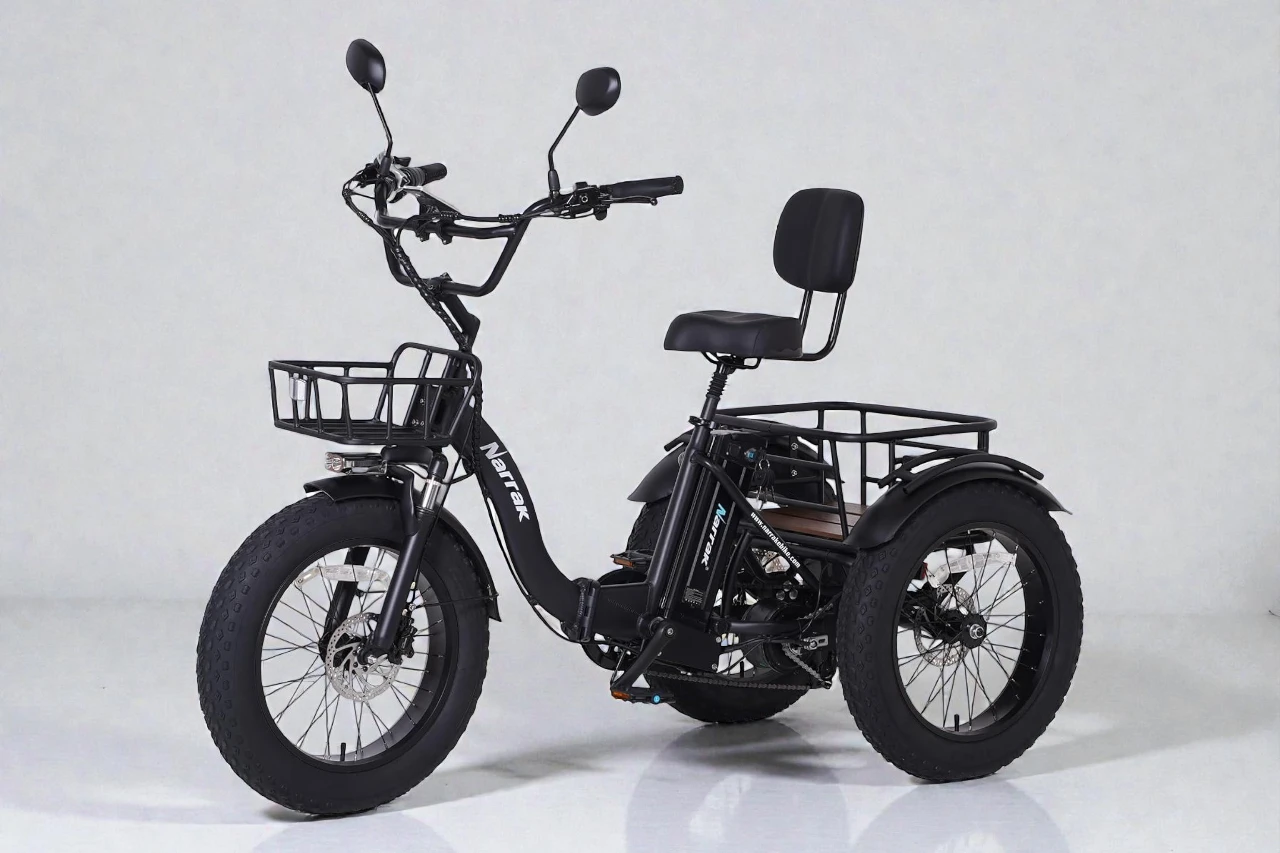
The Narrak S180 is one of those electric trikes that makes more sense the longer I spend with it.
On paper, its 750W motor, 48V 13Ah battery, 20 mph top speed, and 20 x 4-inch fat tires may not look especially dramatic compared with some of the increasingly powerful electric trikes on the market. But the S180 isn’t really trying to be a high-performance machine.
Instead, Narrak has focused on the things that matter more for everyday trike riders: predictable power delivery, strong hydraulic braking, a rear differential, a comfortable step-through frame, useful cargo capacity, and genuine 4-inch-wide tires.
After riding the S180 and spending more time with its controls and settings, I think its strongest argument is simple: it delivers a surprisingly complete electric trike experience without requiring you to move into the much more expensive end of the market.
It isn’t perfect. Pedal-assist engagement isn’t instantaneous, the 13Ah battery is relatively modest, and there are a couple of quirks in the display system. But for neighborhood rides, grocery runs, recreational riding, and riders who prioritize stability over outright speed, the S180 has a lot going for it.
Narrak S180 Specifications
| Specification | Narrak S180 |
|---|---|
| Motor | 750W, up to 1,350W peak |
| Drive System | Rear motor with differential |
| Battery | 48V 13Ah |
| Claimed Range | Up to 50 miles in PAS mode |
| Top Speed | 20 mph |
| Tires | 20 x 4.0-inch fat tires |
| Brakes | Hydraulic disc brakes on all three wheels |
| Frame | Aluminum, step-through, folding |
| Front Suspension | Adjustable suspension fork with lockout |
| Drivetrain | Shimano 7-speed |
| Display | Narrak M5 LCD |
| Riding Modes | Pedal assist, throttle/full electric, walk mode |
| Cargo | Front and large rear baskets |
| Parking Brake | Hydraulic parking brake |
| Weight Capacity | Up to 350 lbs |
| Assembly | Approximately 85% pre-assembled |
| Warranty | 12 months |
My Verdict
The Narrak S180 is best viewed as a comfortable, practical, budget-conscious electric trike rather than a high-powered performance trike.
I especially like its wide 4-inch tires, strong hydraulic brakes, rear differential, large cargo basket, wide handlebars, and controlled power delivery. Those features make a meaningful difference in normal riding.
Its biggest limitation is the relatively small 48V 13Ah battery. Narrak advertises up to 50 miles in pedal-assist mode, but I would not buy this trike expecting 50 miles on every charge. For normal mixed riding, I would plan much more conservatively.
What I Like
- Smooth and predictable 750W motor
- Up to 1,350W peak output
- Rear differential improves cornering behavior
- True 20 x 4-inch fat tires
- Hydraulic brakes on all three wheels
- Large rear cargo basket
- Comfortable seat with backrest
- Adjustable front suspension
- Wide handlebars provide good leverage
- Step-through frame is easy to access
- Folding frame adds storage flexibility
- Throttle response can be improved through display settings
- Good overall value
What Could Be Better
- 13Ah battery is smaller than many long-range trikes
- Pedal assist takes a couple of pedal rotations to engage
- Default throttle response may feel slow before adjustment
- Speedometer drops toward zero while coasting with the motor disengaged
- Only one parking-brake control
- Heavy enough that folding doesn’t automatically make it easy to lift
- Real-world range can be considerably lower than the maximum advertised figure

Motor and Performance
The Narrak S180 uses a 750W motor capable of producing up to 1,350W peak power.
For this kind of electric trike, I think that’s a sensible power level.
More power isn’t automatically better on three wheels. A trike that delivers an abrupt surge from a standstill can actually feel less comfortable, particularly for newer riders. What I want from an everyday e-trike is enough torque to get the extra weight moving without making the acceleration difficult to control.
That’s largely what I get from the S180.
Once I adjusted the response settings through the display, the throttle became much more responsive than it was initially. Acceleration still feels gradual rather than explosive, but on a trike I consider that an advantage.
Starting from a stop, the S180 builds speed progressively through the teens and continues toward its approximately 20 mph maximum.
During my riding, the display indicated slightly above 20 mph at the upper end. I wouldn’t treat that as a precision GPS speed measurement, but the advertised 20 mph maximum feels realistic.
And frankly, 20 mph is already plenty on an adult electric tricycle.
Because of the additional width and very different cornering dynamics of three wheels, I would much rather have predictable acceleration and manageable speed than chase a 30+ mph specification.
The Rear Differential Is an Important Feature
One of the more meaningful features of the S180 is its rear differential system.
A conventional bicycle only has one rear wheel, so this isn’t something cyclists normally need to think about.
A trike is different.
When turning, the inside rear wheel follows a shorter path than the outside rear wheel. Ideally, those two wheels need to rotate at different speeds.
That’s the job of the differential.
The system allows the two rear wheels to rotate at different rates as you corner instead of forcing them to behave like a rigidly connected axle.
In everyday riding, that contributes to smoother maneuvering and makes the S180 feel more natural through turns.
You still need to respect trike handling physics, though.
How the S180 Handles Corners
A three-wheel electric trike does not corner like a normal bicycle.
You don’t simply lean the entire trike aggressively into a corner.
If I enter a turn too quickly, I can feel weight transfer toward the outside of the trike. That’s normal behavior for this type of vehicle.
My approach is straightforward:
Slow down before the turn, steer smoothly, and use my body position to help counterbalance when necessary.
Once I adapted to that riding style, the S180 felt stable and predictable.
New trike riders should spend some time practicing at lower speeds before attempting faster turns.
Throttle Response: Adjust the Settings First
This is one area where my opinion of the S180 improved after spending more time with it.
When I initially rode the trike, there was a noticeable delay between pressing the throttle and receiving motor assistance.
The same was true of pedal assist.
It made the S180 feel less responsive than I wanted.
Fortunately, some of that behavior can be adjusted through the settings accessible from the display.
After changing those settings, throttle response improved considerably.
Now, when I use the throttle from a stop, assistance begins much sooner and the trike accelerates with a controlled, steady delivery.
That leads to one of my biggest recommendations for new S180 owners:
Read the manual and familiarize yourself with the display settings before deciding whether you like the power delivery.
The factory configuration may not be the configuration you ultimately prefer.
Pedal Assist Still Has Some Delay
Even after adjusting the system, the pedal-assist behavior isn’t instantaneous.
When starting only by pedaling, I typically need roughly two to three pedal rotations before the motor assistance kicks in.
That isn’t necessarily a deal-breaker, but it’s something buyers should understand.
Electric trikes are much heavier than conventional bicycles. Trying to start a heavy trike entirely under pedal power can require noticeable effort before the motor wakes up.
For that reason, I often prefer using a little throttle to start moving and then transitioning to pedaling once the trike has momentum.
It makes starts much easier and feels particularly useful at intersections or when carrying cargo.
Battery and Real-World Range
The S180 uses a 48V 13Ah battery, giving it roughly 624Wh of nominal battery capacity.
Narrak advertises up to 50 miles of range in pedal-assist mode.
That number should be treated as a best-case figure rather than what every rider will achieve.
Battery range varies dramatically depending on:
- Rider weight
- Cargo weight
- Throttle use
- Pedal-assist level
- Terrain
- Hills
- Tire pressure
- Surface conditions
- Wind
- Temperature
- Stop-and-go riding
Based on how I would realistically use this trike, I think roughly 15–25 miles is a more conservative planning range for many riders, although some riders can certainly travel farther under favorable conditions with more pedaling and lower assistance.
That’s a major distinction.
If your goal is a 40- or 50-mile recreational ride without worrying about the battery, I would look toward a trike with a substantially larger battery.
But if your normal use looks more like this:
- 3 miles around the neighborhood
- 5 miles to run errands
- 8–10 miles for recreation
- Grocery store and back
- Short daily transportation
then the 13Ah battery makes much more sense.
You’re not carrying around the cost and weight of an enormous battery that you may never actually need.
20 x 4-Inch Fat Tires
This is one of my favorite features.
Narrak didn’t fit the S180 with narrow 2- or 3-inch tires and then try to market it as something more rugged than it really is.
These are genuine 20 x 4.0-inch fat tires on all three wheels.
The additional air volume helps soften rough pavement and gives the trike a more planted feel.
I also took the S180 through relatively tall, wet grass using throttle power. It continued through without much difficulty and was even able to build some speed.
That doesn’t make it an off-road ATV, and I wouldn’t treat it like one.
But for:
- Grass
- Cracked pavement
- Neighborhood streets
- Packed paths
- Light gravel
- Uneven recreational surfaces
the wide tires add meaningful versatility.
They also contribute to the substantial, stable feeling that many buyers specifically want from a fat-tire electric trike.
Hydraulic Brakes on All Three Wheels
Braking performance is another major strength.
The S180 uses hydraulic disc brakes with braking at all three wheels.
When I applied the brakes firmly from around 18 mph, the trike stopped quickly and confidently.
In fact, the brakes have enough bite that riders should become familiar with them before performing emergency stops.
That’s a good problem to have.
A loaded electric trike is considerably heavier than a regular bicycle, so braking performance matters even more here than it does on a lightweight commuter e-bike.
I’d much rather have brakes that require some finesse than brakes that feel marginal when the trike is carrying a rider and groceries.
Parking Brake
Narrak also includes a parking-brake function, which is genuinely useful on a three-wheeler.
Unlike a bicycle, you’ll often leave a trike standing upright while loading groceries, adjusting cargo, or getting on and off.
Being able to secure it in place is particularly valuable on slightly sloped surfaces.
One minor complaint is that the S180 has only one parking-brake control rather than a parking lock on both brake levers.
It works, but dual controls would have been a nice touch.
Ride Comfort
The S180 performs well here.
Up front, Narrak includes an adjustable suspension fork with lockout.
Combined with those large 4-inch tires, the suspension helps remove some of the harshness from broken pavement and rougher surfaces.
The seat is also much more supportive than a traditional narrow bicycle saddle.
It includes a backrest, and I appreciate having that additional support on relaxed rides.
There’s even some ventilation built into the seat design.
This isn’t a sporty riding position.
It’s upright, relaxed, and appropriate for the kind of rider the S180 is targeting.
Wide Handlebars Give Me Better Control
One seemingly small detail that made a noticeable difference was the handlebar width.
The bars are fairly wide, and I like that.
On a three-wheel vehicle, the wider position gives me good leverage when steering and contributes to a stronger sense of control.
That becomes especially useful when maneuvering slowly or changing direction in tighter areas.
Combined with the upright seating position, the S180 feels less like a conventional bicycle and more like a comfortable utility vehicle that happens to have pedals.
Display and Controls
The S180 uses Narrak’s M5 LCD display.
It provides the information I’d expect, including:
- Current speed
- Battery level
- Distance information
- Pedal-assist level
There’s also an easy-to-reach control pad for adjusting assistance.
The trike includes a horn, and it’s loud enough to be genuinely useful rather than feeling like an afterthought.
A Shimano 7-speed drivetrain gives you conventional gearing when pedaling.
Personally, once I’m traveling at normal cruising speeds with electric assistance, I don’t find myself constantly changing gears. But having seven gears still gives riders more flexibility when pedaling manually or using lower assistance.
One Unusual Speedometer Quirk
There is one display behavior worth explaining.
When I stop pedaling or release the throttle and simply coast, the displayed speed can quickly drop toward zero even though the trike is still moving.
At first, that looks like something is wrong.
According to the explanation we received, the speed reading is tied to motor operation rather than being measured directly from wheel rotation.
So when motor engagement stops, the indicated speed drops.
Once the motor engages again, the speed reading returns.
It doesn’t stop the S180 from functioning properly, but it’s different from most e-bikes and trikes I’ve used.
I would prefer continuous wheel-speed measurement because it’s more intuitive.
Front and Rear Cargo Baskets
Cargo capacity is a major reason to buy a trike in the first place, and Narrak hasn’t forgotten that.
There’s a smaller basket at the front and a large rear cargo basket behind the seat.
The rear basket is where the S180 becomes especially practical.
There’s enough room for things like:
- Grocery bags
- Small packages
- Picnic supplies
- Everyday shopping
- Personal belongings
- Properly secured pet carriers
For errands, I find the rear basket considerably more useful than a conventional bicycle rack.
There’s no balancing a heavy grocery bag on one side of the bike or attaching multiple panniers.
You simply load the basket, secure anything that could move around, and ride.
That’s exactly the kind of practicality an electric trike should provide.
Folding Step-Through Frame
The S180 combines a step-through aluminum frame with a folding mechanism.
The step-through design is the more important feature for me.
You don’t need to swing your leg high over a top tube to get aboard, which makes entry and exit considerably easier.
That’s particularly helpful for riders with limited flexibility or anyone who simply prefers a more accessible frame.
The folding feature sounds extremely convenient, but buyers should have realistic expectations.
This is still a full-size fat-tire electric trike.
Folding reduces the amount of space it occupies, but it doesn’t suddenly turn the S180 into a lightweight folding bicycle that you can casually pick up with one hand.
If you’re buying it specifically because you intend to load it into an SUV, RV, truck, or storage area, check the folded dimensions and weight against your own lifting ability first.
I view the folding frame primarily as a storage and transport aid, not as something that makes the trike truly portable.
350-Pound Capacity
Narrak rates the aluminum frame for up to 350 pounds.
Remember that payload specifications generally need to account for everything the trike carries, not just the rider.
If you’re close to the maximum rider weight and intend to load the rear basket heavily, factor that into your decision.
For most average-size riders carrying normal groceries or recreational cargo, though, the capacity should be sufficient.

Assembly
Narrak states that the S180 arrives approximately 85% pre-assembled and includes the required tools and instructions.
That’s helpful, but I still recommend taking assembly seriously.
Electric trikes have more going on than ordinary bicycles.
Before the first ride, I would specifically inspect:
- Wheel attachment
- Brake operation
- Handlebar alignment
- Tire pressure
- Front fork
- Pedals
- Saddle and backrest
- Basket mounting hardware
- Folding-frame latch
- Battery installation
- Lights
- Electrical connectors
I’d also perform the first few rides in a quiet area where I can become familiar with acceleration, braking, and cornering behavior.
If you’re not comfortable assembling or inspecting a bicycle yourself, having a bike shop perform a final safety inspection is worth considering.
Safety Certification
The product information supplied by Narrak states that the 48V 13Ah battery is UL certified.
That’s reassuring, although I would distinguish that claim from certification of the complete electrical system unless Narrak specifically provides the applicable certification standard for the entire trike.
As with any e-bike battery, I recommend using the supplied compatible charger and following the manufacturer’s charging and storage instructions.
Who Is the Narrak S180 Best For?
I think the S180 makes the most sense for riders who want stability, utility, and comfort rather than maximum speed or extreme range.
I Would Consider the S180 If You:
- Want three-wheel stability
- Prefer a step-through frame
- Regularly carry groceries or cargo
- Ride mostly shorter or moderate distances
- Want true 4-inch fat tires
- Prefer controlled acceleration
- Want hydraulic disc brakes
- Need an electric trike for neighborhood recreation
- Want a differential-equipped rear axle
- Are trying to keep the purchase price reasonable
I Would Look Elsewhere If You:
- Regularly need 40–60 miles of real-world range
- Want speeds substantially above 20 mph
- Need an extremely lightweight trike
- Frequently need to lift the folded trike by yourself
- Want instant pedal-assist engagement
- Plan to tackle extremely steep or aggressive off-road terrain
Is the Narrak S180 Good for Seniors?
Potentially, yes—but I don’t think age alone should determine whether someone should ride a trike.
What matters more is whether the rider is comfortable with its weight, steering behavior, braking, controls, and three-wheel cornering dynamics.
The S180 does have several characteristics that may appeal to older riders:
- Step-through frame
- Stable three-wheel platform
- Backrest-equipped seat
- Gradual acceleration
- Throttle assistance from a stop
- Large cargo basket
- Hydraulic brakes
- 20 mph maximum speed
- Upright riding position
I’d still strongly recommend practicing turns and emergency braking before riding in traffic.
A stationary trike feels extremely stable, but riding dynamics through corners are different from a two-wheel bicycle.
Narrak S180 Range: Is 50 Miles Realistic?
This deserves a direct answer.
Narrak’s up-to-50-mile figure is possible under favorable pedal-assist conditions, but I would not assume that every owner will get 50 miles from the 48V 13Ah battery.
My practical expectation would be much lower when using substantial electric assistance.
For many riders, planning around approximately 15–25 miles of mixed real-world use gives you a more conservative safety margin.
Light riders using low PAS levels on flat pavement may do considerably better.
Heavy riders using frequent throttle, hills, cargo, soft terrain, or higher assistance should expect less.
For me, this isn’t necessarily a flaw.
It simply means you need to buy the S180 for the right type of riding.
Narrak S180 Review: Final Thoughts
After spending more time with the Narrak S180, I’ve come to appreciate what this trike is trying to accomplish.
It’s not designed to win a specification battle.
There are trikes with bigger batteries. There are models with more powerful motors. There are considerably more expensive electric trikes with more sophisticated components.
But the S180 gets the fundamentals surprisingly right.
The 750W motor provides enough power for normal riding, while the 1,350W peak output gives it some additional headroom when needed. The rear differential is a worthwhile feature on a three-wheeler. The hydraulic brakes are strong, and the 20 x 4-inch fat tires give it a comfortable, substantial feel.
I also like the large rear basket, step-through frame, adjustable suspension fork, wide handlebars, and supportive seat.
The biggest thing I would change is the battery.
A 48V 13Ah pack works for typical neighborhood and errand riding, but a larger battery would make the S180 more attractive for riders planning genuinely long trips.
I’d also like quicker pedal-assist engagement and a speedometer that continues reporting speed accurately while coasting.
Still, those complaints don’t outweigh the overall package.
If I wanted an affordable electric tricycle primarily for neighborhood riding, errands, grocery trips, and relaxed recreation—and I valued strong brakes and true fat tires more than extreme range—the Narrak S180 would absolutely be on my shortlist.
It delivers the core things I want from an everyday e-trike without trying to turn a practical three-wheeler into something it doesn’t need to be.
| Preview | Product | Price | |
|---|---|---|---|

| NARRAK Electric Tricycle for Adults Seniors, 750W Fat Tire 3 Wheel E-Trike, 48V 13Ah UL… | $1,099.00 | View on Amazon |
GoEBikeLife publishes independent e-bike reviews, comparisons, and practical buying guides. Some links on this page are affiliate links. If you make a purchase through an eligible link, we may earn a commission at no additional cost to you.