Real rides. Real notes. No hype.

The DEEPOWER S20 is a powerful moped-style e-bike with fat tires, full suspension, and big battery options. Here’s an honest, real-world review.
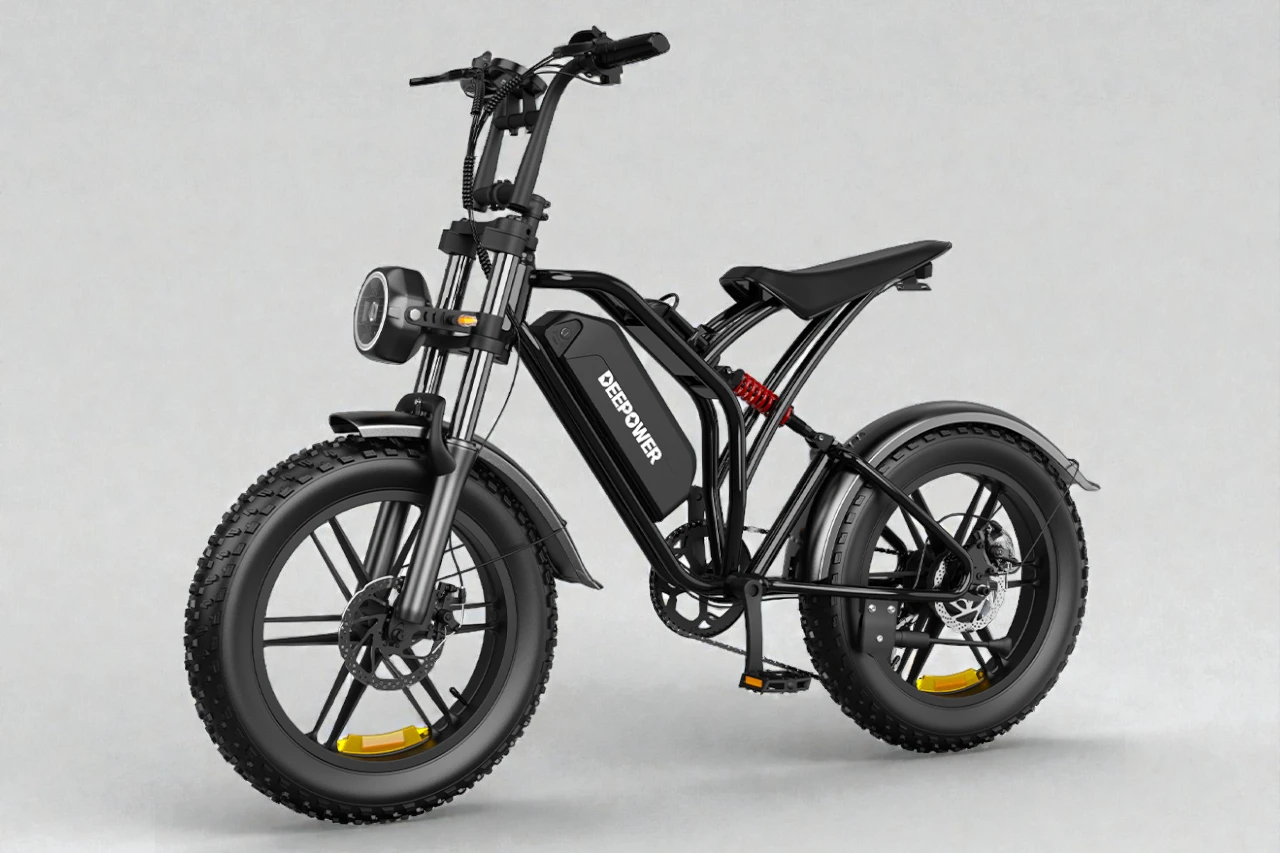
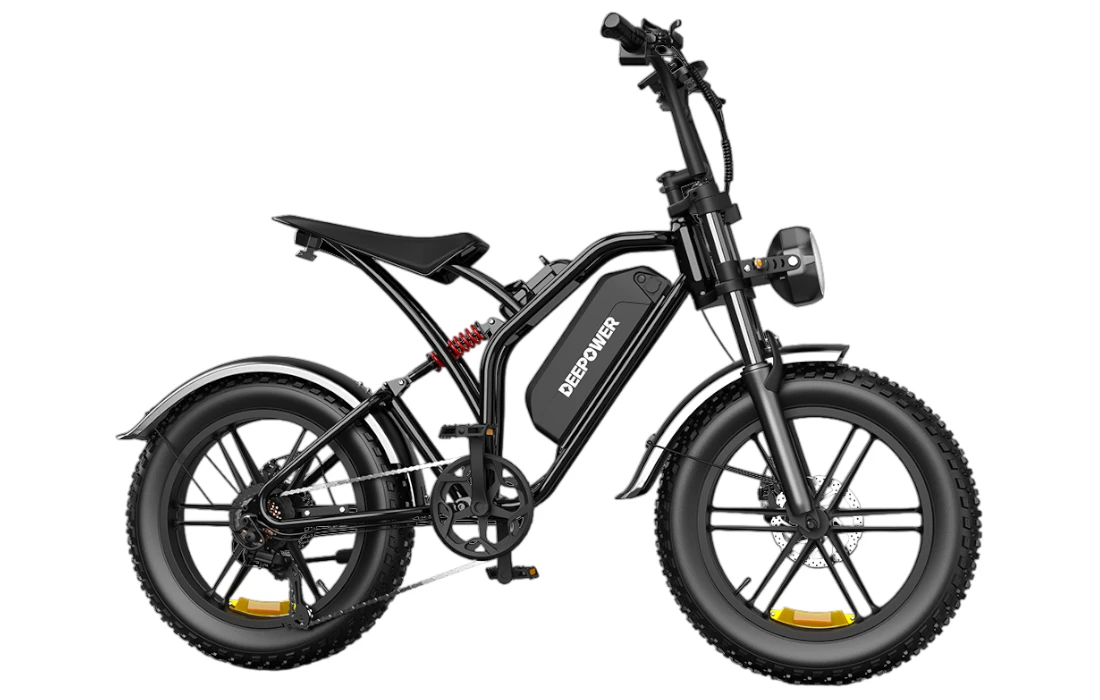
A moped-style fat-tire e-bike that prioritizes comfort and punchy acceleration—best for relaxed commuting and mixed-terrain fun, not for lifting upstairs.
Moped-style, full-suspension, fat-tire e-bike with a big battery option and a “mini e-moto” vibe—at a price that’s hard to ignore.
The DEEPOWER S20 is built for riders who want a powerful, comfort-first, all-terrain cruiser without paying premium-brand pricing. The headline specs—1500W peak motor, claimed 32+ mph, 20″×4.0″ fat tires, and a large removable 48V battery option up to 25Ah (1200Wh)—fit the “moped-style fun machine” category perfectly. It’s the kind of bike that makes short commutes feel like joyrides and turns rough pavement into “who cares?” thanks to its dual suspension (front fork + rear shock).
But it’s not a lightweight, not a nimble pedal-first bicycle, and it’s not for riders who want refined braking or a featherweight frame. The S20’s real-world appeal comes down to this: if you want comfort, traction, and punchy acceleration in a compact 20-inch platform, it’s a strong value. If you want a traditional bicycle feel, or you plan to carry it upstairs daily, you should look elsewhere.
(Exact details can vary slightly by listing/battery option, so treat these as “typical S20 configuration” rather than a single guaranteed build.)
The S20 is not trying to be a minimal commuter bike. Its frame shape, long bench seat, fat tires, and upright cockpit aim for a compact e-moped feel—stable, cushy, and confidence-inspiring. If you’re coming from a regular bicycle, the first impression is usually:
What I like about this design choice is that it matches real buyer intent. Most riders looking at a 20×4 fat-tire, dual-suspension e-bike aren’t dreaming about spinning at 90 RPM for cardio—they want a bike that feels planted, accelerates smoothly, and doesn’t punish them on rough surfaces.
That same “moped-ish” approach comes with predictable compromises:
The S20 is advertised with a 1500W peak rear hub motor and strong hill capability (often shown as up to ~30° grade in product materials).
On value-focused e-bikes, “peak” is typically a short burst rating rather than a continuous output number. The useful takeaway isn’t the label—it’s the behavior:
You’ll see different top-speed claims depending on where you read: some show ~28 mph, others advertise ~32 mph.
In real riding, top speed depends on:
My advice: buy this bike for torque and comfort, not because you’re chasing a specific “32.0 mph” number. If you end up with high-20s to low-30s capability, that’s already fast enough that braking quality and protective gear matter more than an extra 2–3 mph.
DEEPOWER markets battery options including 48V 13Ah / 20Ah / 25Ah, with the largest option commonly shown as 48V 25Ah (1200Wh) and a 5–6 hour stated charge time depending on configuration.
A battery in the ~1000Wh+ class (like 1200Wh) is a meaningful step up from the common 500–750Wh packs on entry-level e-bikes. In practical terms, it can mean:
Some listings show extremely wide ranges (for example, “35–120 miles”).
Here’s the honest framing: range claims are almost always best-case (light rider, low assist, flat terrain, ideal tire pressure, warm weather, steady pace). With a heavier, fat-tire, full-suspension bike, your real range will swing dramatically with:
If you plan to ride this like a mini e-moto—quick bursts, throttle, higher speed—expect range to be meaningfully lower than “max” claims. If you ride smoothly with moderate pedal assist, you’ll get a lot more out of it.
I consider the removable/keyed battery design a practical win for daily life. You can bring the battery inside for charging, and the key adds a basic layer of security (though no e-bike battery is theft-proof—always lock smart).
The S20 leans hard into comfort with:
On broken pavement, pothole patches, brick roads, or hard-packed trails, this kind of setup generally delivers:
The combination of fat tires + suspension is often redundant on a lightweight bike—but on a heavier moped-style e-bike, it makes sense. The bike’s mass can amplify impacts; the suspension helps prevent that “big bike, big jolt” feeling.
Comfort doesn’t eliminate:
The 20-inch wheel platform with 4-inch wide tires tends to produce a very specific handling personality:
For casual off-road (packed dirt, gravel paths, beach boardwalk approaches, light trail use), fat tires are confidence-inspiring. For technical mountain biking, this isn’t the right tool—mainly because of weight, geometry, and the moped seat design.
If you want the S20 to feel “plush,” you’ll naturally run lower pressure—but too low increases rolling resistance and can reduce range. Finding the sweet spot is part of dialing in the bike:
The S20 is commonly listed with mechanical disc brakes.
Mechanical discs can be perfectly usable, but they’re more sensitive to setup quality than hydraulic systems.
If you plan to ride near the upper end of the bike’s speed capability, I recommend:
One of the smarter “real world” safety features is the emphasis on a full lighting system, including turn signals, which is still not universal on budget e-bikes.
For city riding—especially dusk/night—this can be genuinely useful, not just marketing.
The S20 typically includes an LCD display showing speed, battery level, and trip/odometer-style info.
This is what most riders need:
DEEPOWER commonly markets three riding modes (pure electric/throttle, pedal assist, manual).
That’s the right set for this style of bike. If you’re commuting, you’ll live in pedal assist. If you’re cruising, you’ll use throttle strategically. If your battery is low, manual mode keeps you moving—though pedaling a heavy bike home is still work.
Product materials around recommended height can be inconsistent across sources, so I wouldn’t buy based on one height chart alone.
Instead, focus on what matters with moped-style e-bikes:
If you’re between sizes mentally, this bike generally favors riders who prefer:
DEEPOWER advertises the bike arriving ~90% assembled with tools and video guidance.
That matches the typical “large box e-bike” experience:
This is the difference between “it works” and “it feels solid.”
If your commute is a mix of rough pavement, uneven streets, and you value comfort, the S20 makes sense—especially with the larger battery. The riding posture and suspension help you arrive less fatigued, and the lighting package helps in real traffic conditions.
This is where the moped style shines. The S20 is the kind of bike you grab when you want to ride because it’s enjoyable, not because it’s the most efficient transport tool.
Hard-packed trails, gravel, grass, sand-adjacent riding—fat tires do well here, and the suspension helps. It’s not a technical singletrack machine, but it’s a capable “explorer” if you keep expectations realistic.
When a bike is in the 80+ lb neighborhood, everything changes:
If you live in an apartment without an elevator, I would think twice unless you have a ground-floor storage plan.
If you’re the type who never wants to touch a wrench after purchase, mechanical discs may frustrate you. If you’re comfortable with basic tuning (or you have a local shop), they’re manageable.
Some materials mention IPX4-type splash resistance.
That generally means: fine for light rain and wet roads, not fine for deep puddles, pressure washing, or prolonged heavy downpour exposure. Treat it like an e-bike, not a submarine.
You’re the right buyer if:
You should skip it if:
The DEEPOWER S20 is best understood as a budget-friendly, comfort-heavy, powerful cruiser that leans into what most shoppers in this category actually want: traction, suspension, a relaxed ride, and enough power to feel fun.
If you go in expecting a traditional bicycle experience, the weight and moped geometry will feel like compromises. But if you want a stable, cushy ride with a big-battery option and practical street-safety features (like turn signals), the S20 makes a compelling case—especially at its typical sale pricing relative to the spec sheet.
| Preview | Product | Price | |
|---|---|---|---|

|
DEEPOWER Electric Bike for Adults,2000W Peak Motor&32MPH Electric Dirt Bike,48V 20AH/35AH/60AH… | View on Amazon |