The 60Ah Deepower QS7 delivers exceptional battery capacity and a stable, comfortable road ride for the money, but its slow acceleration, weak hill performance, mechanical brakes, and confusing specifications keep it from being a true high-performance e-bike.
Our verdict: The Deepower QS7 is one of the most affordable ways I have seen to get a genuinely enormous 2,880Wh dual-battery system. My 60Ah test bike felt planted and confidence-inspiring on pavement, reached about 28–29 mph on its display with both batteries connected, and completed a roughly 26-mile ride without the five-bar battery indicator visibly dropping. Its full suspension, fat tires, upright riding position, useful lighting, and distinctive motorcycle-inspired design also make it feel more complete than its price suggests.
The QS7 is not as powerful as its appearance and marketing imply, however. Full-throttle acceleration was unusually gradual, it could not climb my steep grassy test hill head-on, and its 160mm mechanical disc brakes were merely adequate for an 88-pound bike capable of approaching 30 mph. The fixed moped-style saddle also limits pedaling efficiency and rider fit. Buy it for long, mostly flat road rides and outstanding battery-per-dollar value—not for aggressive acceleration, steep hills, technical trails, or bicycle-like pedaling.
Rating: 8.0/10
Best for: Long paved rides, recreational cruising, flatter commutes, and buyers who prioritize battery capacity, comfort, and value.
Skip it if: Your route includes steep hills, you want strong low-speed torque or hydraulic brakes, you regularly lift your bike, or you prefer an efficient pedaling position.
Deepower QS7 Review Summary
The QS7’s headline feature is not its 1,500W peak motor. It is the tested model’s two removable 48V batteries: a 25Ah upper pack and a 35Ah lower pack. Together, they provide a claimed 60Ah and 2,880Wh of energy—several times the capacity of a typical budget commuter e-bike.
That capacity changes how the QS7 feels as a product. It is heavy, and the extra battery mounted high in the frame is noticeable when maneuvering the bike by hand. Once moving, though, the weight, long wheelbase, low scooped saddle, fat tires, and full suspension combine to produce an unusually stable ride. It feels closer to a small motorcycle than a conventional bicycle.
The trade-off is that the motor controller appears tuned conservatively. The bike can cruise at a respectable speed after it gets moving, but it does not deliver the immediate launch or hill-climbing force that many riders will expect from the advertised power and torque figures.
How I Tested the Deepower QS7
I tested the 48V 60Ah dual-battery version rather than the 20Ah or 35Ah single-battery models.
| Test detail | What I used |
|---|---|
| Configuration | 48V 60Ah dual battery: 25Ah upper pack plus 35Ah lower pack |
| Test distance | Approximately 26 miles |
| Rider fit reference | 5’9” with a 31-inch inseam |
| Tire pressure | Approximately 25 PSI |
| Main surfaces | Paved streets, bike paths, broken pavement, grass, and a steep grassy hill |
| Power use | Predominantly throttle riding, with brief checks of the three pedal-assist settings |
| Instruments | Built-in display plus GPS distance comparison |
This was a real-world ride evaluation, not a laboratory test. I did not fully discharge both batteries, time a complete recharge, measure stopping distance, record the exact hill grade, or measure controller temperature. The test therefore supports conclusions about fit, handling, acceleration, braking feel, and short-term battery behavior, but it does not independently verify the maximum range, torque, charging time, or 30-degree climbing claims.
Deepower QS7 Specifications
The table below prioritizes the QS7 user manual when its figures conflict with promotional graphics. Observed results apply only to the 60Ah test bike.
| Specification | Details for the tested 60Ah version |
| Bike type | Moped-style, full-suspension fat-tire e-bike |
| Frame | Carbon steel |
| Motor | 750W rated rear-hub motor; 1,500W claimed peak output |
| Claimed torque | Up to 90 Nm |
| Claimed top speed | Up to 30 mph |
| Observed top speed | About 28–29 mph on the built-in display with both batteries connected |
| Battery | Two removable 48V packs: 25Ah plus 35Ah |
| Combined battery capacity | 60Ah / 2,880Wh claimed |
| Manual-listed range | 70–90 miles throttle-only; 100–120 miles with pedal assist |
| Partial range-test result | Approximately 26 miles with no visible decrease on the five-bar display |
| Charger | Two chargers supplied with the tested bike; 54.6V/4A listed for the 60Ah version |
| Claimed charging time | Approximately 4–6 hours; not independently verified |
| Pedal assist | Three levels |
| Throttle | Quarter-twist throttle on the test bike |
| Drivetrain | Shimano 7-speed |
| Tires | 20 × 4-inch fat tires |
| Recommended tire pressure | 15–25 PSI in the manual |
| Brakes | Front and rear mechanical disc brakes with 160mm rotors |
| Front suspension | Inverted aluminum fork; 40mm stanchions and 150mm claimed travel |
| Rear suspension | Central coil-spring shock |
| Display | Round multifunction LED dashboard |
| Lighting | Headlight, taillight/brake light, and front/rear turn signals |
| Water resistance | IPX4 in the user manual |
| Bike weight | 88.18 lb / 40 kg |
| Maximum load | 330 lb / 150 kg in the user manual |
| Advertised rider height | Approximately 5’3”–6’5” / 160–195 cm |
| Overall dimensions | 160 × 71 × 114 cm in the user manual |
Specifications and included components can change between sellers and production runs. Confirm the exact motor, battery, brake, charger, and certification details for the version shown at checkout.
What I Liked
- The 60Ah version offers an exceptional 2,880Wh of claimed battery capacity for the price.
- It feels unusually stable and composed once moving.
- The full suspension makes a noticeable difference over broken pavement and bumps.
- The scooped moped-style saddle supports a relaxed, upright position.
- The fat tires grip pavement well and contribute to the planted handling.
- Both batteries are removable, lockable, and can be charged simultaneously with two supplied chargers.
- The headlight, brake light, turn signals, horn, fenders, and rear rack add everyday usefulness.
- Its blue-gray frame, brown saddle, low handlebar, and motorcycle-inspired shape look more distinctive than the typical all-black budget moped e-bike.
- It provides a remarkable amount of equipment and battery capacity at around the $1,000 price level.
What Could Be Better
- Acceleration from a stop is slow and heavily softened, even at full throttle.
- The bike struggled on inclines and failed my steep grassy hill test.
- Mechanical 160mm disc brakes are not ideal for an approximately 88-pound bike that can approach 30 mph.
- The front brake developed a light squeak during the ride.
- The fixed saddle and compact crank position are not well suited to sustained pedaling.
- The official 5’3”–6’5” fit claim is too broad to accept without checking personal measurements.
- The display has no convenient thumb control for manually cycling through ride data.
- The pedal-assist levels did not feel clearly differentiated during my brief check.
- The bike’s odometer appeared to undercount distance compared with GPS.
- Product graphics, marketplace listings, and the user manual contain conflicting range, load, water-resistance, motor, and battery information.
Design, Build, and Everyday Practicality
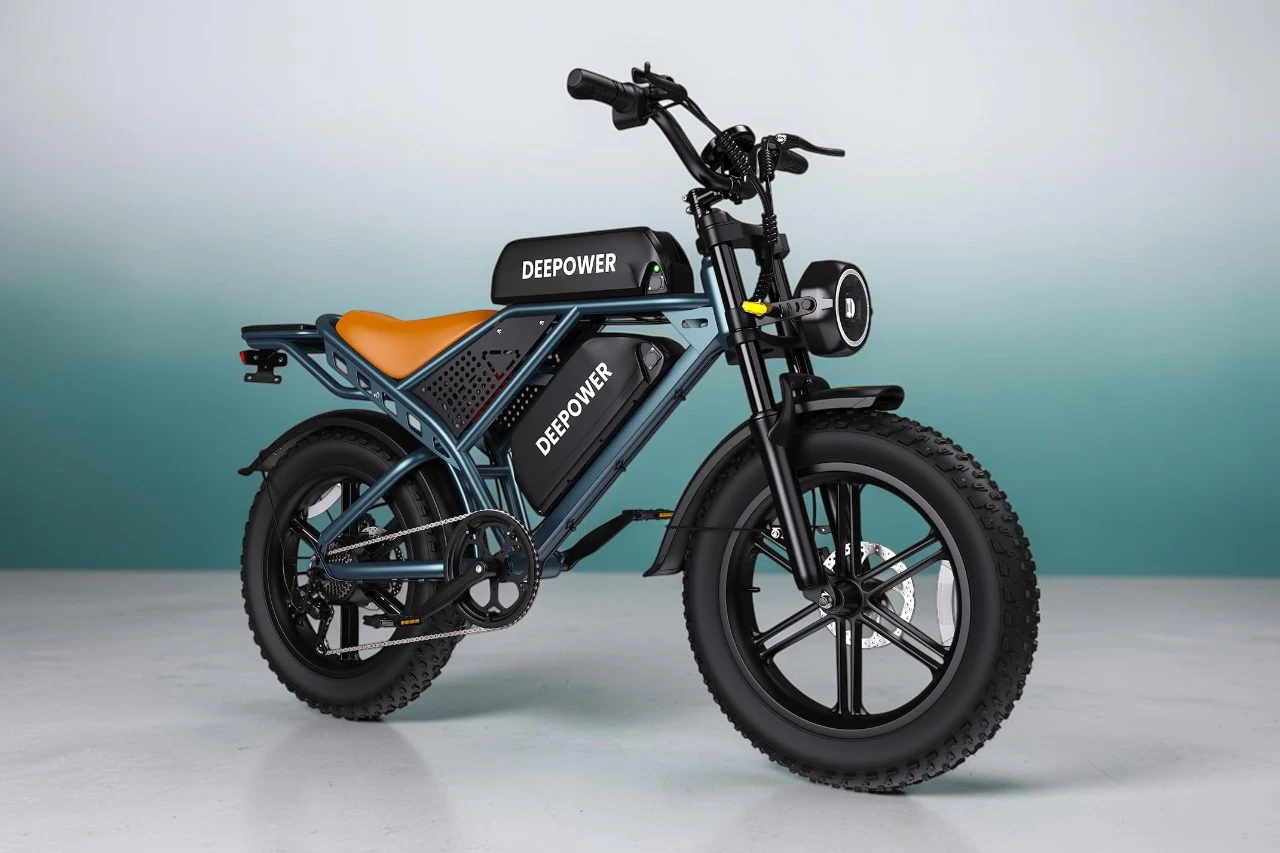
The QS7 is visually one of the more interesting moped-style e-bikes I have tested. The low handlebars, large round headlight, chunky frame, central battery placement, and long seat give it a cafe-racer influence without copying the usual flat bench-seat formula.
My test bike combined a muted blue-gray frame with a brown contoured saddle. That contrast looks more deliberate and premium than the generic black-on-black finish common in this price range. The upper battery visually resembles a motorcycle fuel tank, which reinforces the QS7’s motorbike-like character.
Most of the practical equipment is already included. There are plastic front and rear fenders, a rear cargo platform, a kickstand, a large headlight with a ring-shaped running light, a taillight that also functions as a brake light, front and rear turn signals, a horn, and a license-plate-style bracket.
The rear platform is useful for light cargo, but I could not confirm an official rack load rating. I would not carry a passenger or a heavy load on it unless Deepower provides a specific rating and compatible equipment. The saddle and supplied hardware are set up for one rider.
The bike is advertised as approximately 90% assembled. Final work includes installing the front wheel, handlebar assembly, headlight, fenders, pedals, and other small parts. Deepower suggests the setup can take less than 30 minutes, but first-time owners should allow extra time to align the front brake, confirm tire pressure, check every fastener, and verify that both batteries are fully seated.
One lesson from my ride is especially important: lock both batteries before moving the bike. I initially noticed the upper pack moving against the frame because it had not been locked into place. After stopping and securing it, the connection remained stable. A loose battery is not merely an annoyance; it can interrupt power or potentially detach from the bike.

Rider Fit and Comfort
At 5’9” with a 31-inch inseam, I fit the QS7 well. The saddle dips low in the middle, so I sat down inside the frame rather than perched high above it. I could put both feet flat on the ground with my knees bent, which made stops and low-speed balancing easy.
The swept-back, relatively low handlebar kept my upper body close to upright without forcing me into an aggressive crouch. Combined with the wide saddle, that position felt immediately comfortable and helped give the bike its motorcycle-like character.
Comfort remained good through the early and middle portions of my test. By the end of the roughly 26-mile ride, the saddle was no longer exceptionally plush, but I was not seriously uncomfortable. I would describe it as very comfortable for short-to-moderate trips and acceptable for longer recreational rides.
Fit becomes less certain for taller riders. Deepower advertises a broad 5’3”–6’5” height range, but the moped saddle does not provide the normal height adjustment of a bicycle seatpost. My 5’9” position already produced a fairly tight knee angle while pedaling. Riders much taller than me may feel cramped even if they can physically sit on the bike.
This is also not the best design for riders who want to contribute substantial pedal power. The saddle-to-pedal relationship favors relaxed throttle cruising, and my legs did not extend efficiently through the pedal stroke. Anyone planning to pedal frequently should check fit in person or choose a model with an adjustable bicycle saddle.
Controls and Display
The cockpit includes key-operated ignition, a quarter-twist throttle on my test bike, a Shimano seven-speed shifter, separate headlight and turn-signal controls, a horn, and a small switch for the three pedal-assist levels.
The round LED dashboard is attractive and easier to read at a glance than many rectangular budget displays. It can show speed, battery level, assist setting, trip distance, odometer distance, ride time, lighting status, turn-signal status, and several fault indicators.
Its interface is more frustrating than its appearance. There was no separate thumb pad for moving through trip, odometer, and timer screens. Instead, the information cycled automatically. I also did not find a USB charging port.
The battery indicator was not especially intuitive. Five lines appeared to represent remaining charge, but they did not move during my ride. That sounds impressive, and it is encouraging, but a bar display is too coarse and nonlinear to support a reliable range calculation.
The odometer also appeared inaccurate. When my GPS showed about four miles, the QS7 displayed roughly three. Later, GPS distance was close to 13 miles while the bike showed around 11. That difference is large enough that owners should compare the display with GPS before relying on its trip data for maintenance or range planning.
I briefly tested all three pedal-assist settings. The levels did not behave like clearly defined speed caps, and I felt little obvious difference in assistance while pedaling. A longer test with measured power would be needed to determine exactly how each level is programmed, but the system did not feel refined during this ride.
Motor Performance, Acceleration, and Top Speed
The user manual identifies the rear hub motor as 750W rated and 1,500W peak. Deepower also advertises up to 90 Nm of torque and a top speed of 30 mph for this configuration.
With only one battery operating, I saw approximately 25 mph at full throttle. After I properly connected and locked the second battery, acceleration and speed improved. With both packs active, the built-in display reached about 28–29 mph on level riding. A downhill run might produce a higher number, but I did not verify 30 or 32 mph under controlled conditions.
Top speed is only half of the performance story. The QS7’s biggest motor-related weakness is its response from a stop. Even with the throttle fully open, power arrived gradually and the bike took time to reach 20 mph. That gentle delivery may feel manageable to a new rider, but it is too soft when crossing a road, joining traffic, or restarting on an incline.
Once the QS7 reached cruising speed, it felt much better. The motor maintained useful pace on flat pavement, and the heavy bike remained calm rather than twitchy. Riders looking for relaxed, long-distance cruising may accept the soft launch. Riders expecting the punch of a high-current 750W fat-tire bike probably will not.
I would not recommend modifying the controller to chase harder acceleration. Deepower’s manual says not to alter the product from its original design, and an incompatible controller can create reliability, battery, wiring, warranty, and safety problems. If strong low-speed torque is essential, buying a bike designed and tested for that purpose is the better choice.
Because the test bike has a throttle and can exceed 20 mph, do not assume that it fits a particular e-bike class or is permitted on every road, bike lane, or trail. Speed limits, throttle rules, equipment requirements, and access vary by location. Check the rules where you plan to ride and become familiar with the QS7’s acceleration and braking in a traffic-free area before using higher speeds.
Hill Climbing and Off-Road Performance
The QS7 looks like an all-terrain machine, but my test suggests it is primarily a road and light-path bike.
On a steep grassy hill that I use for off-road checks, the bike could not climb straight to the top. I eventually had to approach across the slope. The surface also limited traction: the block-pattern tires felt secure on pavement but slipped on the grass, particularly at the front.
This was an unmeasured, traction-limited test, so it does not prove that the QS7 cannot handle an ordinary paved incline. It does show that buyers should not treat the advertised “30-degree” climbing figure as a guaranteed real-world result. A 30-degree slope is exceptionally steep, and my test did not come close to validating that claim.
The bike also seemed to lose some strength after the difficult off-road section. It may have been responding to heat, speed, surface resistance, or controller programming, but I did not measure temperature or current and cannot confirm thermal limiting.
The suspension itself performed much better than the powertrain off-road. It absorbed bumpy grass and rough patches without harsh impacts. The limiting factors were motor response, hill torque, tire traction, weight, and the bike’s road-oriented geometry—not a lack of suspension movement.
For paved streets, bike paths, maintained gravel, and occasional firm dirt, the QS7 should be comfortable. For steep loose climbs, mud, technical trails, or aggressive off-road riding, choose a lighter and more purpose-built electric mountain bike.
Ride Quality, Handling, and Suspension
Handling is one of the QS7’s strongest qualities. It is among the most planted moped-style e-bikes I have ridden recently.
The long wheelbase, wide tires, low seating pocket, and substantial battery weight give the bike a stable center of mass once it is rolling. Through paved corners, I could lean naturally and let the bike follow the line in a way that felt closer to steering a small motorcycle than a conventional bicycle.
The inverted fork and central rear coil shock are not premium adjustable mountain-bike components, but they made a real difference. Road seams, broken pavement, and larger bumps felt smoother than they do on many budget moped e-bikes whose rear shocks are mostly decorative.
I ran the tires at approximately 25 PSI, the upper end of the manual’s recommended 15–25 PSI range. At that pressure they rolled reasonably well on pavement while still contributing cushioning. Lower pressure may add compliance and loose-surface grip, but it can also increase rolling resistance and the risk of rim strikes or pinch damage. Stay within the tire and manual limits and adjust in small increments for rider weight and terrain.
The bike’s stability has a cost when it is not moving. At 88.18 pounds, the 60Ah QS7 is difficult to lift, load onto a vehicle rack, carry upstairs, or turn around in a tight space. The upper battery also makes the weight more noticeable when pushing the bike by hand. Confirm that any vehicle rack is rated for the bike’s actual weight, and remove the batteries before lifting if the manufacturer permits it.
Braking Performance
The QS7 uses cable-operated mechanical disc brakes with 160mm rotors. They stopped the bike during my test and felt predictable enough for ordinary riding, but they were not especially powerful.
That distinction matters because the dual-battery model weighs approximately 88 pounds before adding a rider or cargo and can reach the high-20-mph range. I had to plan stops earlier than I would with a good hydraulic system, and the front brake began producing a light squeak during the ride. I did not conduct a measured 20-to-0-mph test, so I am not assigning a stopping-distance figure.
Mechanical brakes are inexpensive and widely serviceable, but cable stretch, housing compression, pad wear, and contamination can reduce performance. Owners should check lever travel, cable tension, pad thickness, rotor alignment, and axle security regularly. New pads and rotors may also need proper bedding-in before they deliver their best performance.
For relaxed riding on flatter roads, the stock brakes are usable when correctly adjusted. For frequent hills, heavy cargo, wet conditions, or sustained high-speed riding, I would prefer a bike equipped with hydraulic brakes from the factory. Any brake conversion should be performed and checked by a qualified bicycle technician.

Dual Batteries and Real-World Range
The 60Ah version combines a 25Ah upper pack with a 35Ah lower pack for a claimed total of 2,880Wh. Both are removable and key-lockable. This is the QS7’s clearest competitive advantage.
During my approximately 26-mile ride, the display’s five-line battery indicator did not visibly fall. Motor performance also felt similar through most of the route. That is a strong partial result, particularly because I used substantial throttle, but it is not a completed range test.
Battery bars often stay full for a disproportionate amount of time and then fall more quickly later. The QS7’s distance display also undercounted compared with GPS. For those reasons, it would be misleading to extrapolate an exact total range from the unchanged gauge.
The documentation gives three different range stories:
- The current product page advertises up to 150 miles.
- The user manual lists 70–90 miles of throttle-only range and 100–120 miles with pedal assist for the 60Ah version.
- Some marketplace listings advertise still higher figures, including up to 180 miles, and may describe a different 2,000W-peak variant.
Of those figures, the manual’s 70–90 throttle miles and 100–120 pedal-assist miles are the more conservative manufacturer estimates, but I still did not independently verify them. Speed, rider and cargo weight, terrain, wind, temperature, tire pressure, stops, and the amount of human pedaling can change the result substantially.
Battery Options Compared
| Battery configuration | Claimed capacity | Manual-listed throttle range | Manual-listed pedal-assist range | Listed bike weight |
| 48V 20Ah | 960Wh | 25–30 miles | 35–50 miles | 74.95 lb / 34 kg |
| 48V 35Ah | 1,680Wh | 45–55 miles | 60–90 miles | 81.57 lb / 37 kg |
| 48V 60Ah dual battery | 2,880Wh | 70–90 miles | 100–120 miles | 88.18 lb / 40 kg |
The 35Ah version may be the more practical choice for riders who want long range without the full cost and weight of the second battery. The 60Ah model makes the most sense for people who genuinely need extended distance, want to charge less frequently, or value redundancy more than portability.
Charging the 60Ah Version
My dual-battery package included two chargers, allowing both removable packs to charge at the same time. The manual lists a 54.6V/4A charger for the 60Ah configuration, while Deepower advertises an approximate four-to-six-hour charging time.
I did not complete a timed zero-to-100% charge, so I cannot confirm that estimate. The two batteries have different capacities, and the 35Ah pack may require longer than the 25Ah pack depending on its starting charge, temperature, charger output, cell balancing, and the taper near full charge.
Use only the chargers supplied or specifically approved by Deepower for each battery. The U.S. Consumer Product Safety Commission advises owners to remain present while charging micromobility products, never charge while sleeping, unplug when charging is complete, and avoid unapproved replacement batteries or chargers.
Lights, Turn Signals, and Cargo Equipment
The QS7 includes more road equipment than many low-cost moped e-bikes. The large front lamp was bright during my check, and the surrounding ring gives the bike a recognizable appearance. Front and rear turn signals are controlled from the handlebar, while the rear lamp also brightens under braking.
The turn signals improve visibility, but their small size and mounting position may not make them obvious to every driver. Continue to ride defensively and use any hand signals required or recommended in your area.
The fenders help control spray and road debris, while the rear platform can hold a small bag or properly secured light cargo. As noted earlier, I could not verify a rack-specific capacity. The bike’s 330-pound manual-listed maximum applies to the complete load, not automatically to the rear rack itself.
Safety Documentation and Conflicting Claims
The Deepower QS7 product page links to documents labeled as an SGS UL 2849 report for the e-bike and a UL 2271 battery report. That is better than providing no supporting documentation, but buyers should examine what the reports actually cover.
The available UL 2271 battery test report identifies two specific 48V 20Ah battery models: HL4820-M48-G80 and HY4820-M48-Y52. It does not, by itself, verify that every 25Ah, 35Ah, or combined 60Ah package is covered. If certification is a deciding factor, compare the model numbers printed on the batteries with the documentation and ask Deepower for a report or certification listing that matches the exact packs being sold.
Other important conflicts include:
| Item | Promotional material | QS7 user manual | What I recommend using |
| Maximum load | Up to 440 lb on the product page; other graphics vary | 330 lb / 150 kg | Use 330 lb unless Deepower provides model-specific proof of a higher rating |
| Water resistance | IPX5 on the product page | IPX4 | Treat the bike as IPX4; avoid pressure washing, immersion, and charging while wet |
| 60Ah maximum range | Up to 150 miles on the current page; some listings say 180 | 70–90 miles throttle; 100–120 miles pedal assist | Treat every figure as a manufacturer estimate until a full controlled test verifies it |
| Motor output | “1,500W motor” language on the page | 750W rated / 1,500W peak | Describe the reviewed version as 750W rated and 1,500W peak |
| Battery choices | Some tables show 20Ah, 25Ah, and 35Ah | 20Ah, 35Ah, and 60Ah configurations | The 60Ah test bike uses separate 25Ah and 35Ah packs |
Deepower and marketplace sellers also advertise QS7 listings with 2,000W peak output and a 28 mph limit. Those should be treated as separate or updated configurations rather than mixed with the 750W-rated, 1,500W-peak bike reviewed here.
Price and Value
Pricing changes frequently, but the 60Ah QS7 has been offered around the $1,000–$1,100 level. The 20Ah and 35Ah versions have also been listed for less.
At that price, the battery capacity is extraordinary. A claimed 2,880Wh from two removable packs, two chargers, full suspension, fat tires, a seven-speed drivetrain, integrated lights, signals, fenders, and a rack is a lot of hardware for the money.
Deepower has clearly spent more of the budget on battery capacity and overall equipment than on performance refinement. The brakes, controller tuning, display interface, pedaling ergonomics, and specification consistency all reveal where compromises were made.
That makes the value proposition unusually specific. If range and relaxed road comfort come first, the QS7 is compelling. If braking quality, hill torque, low weight, accurate ride data, dealer support, or polished pedal assist matter more, a lower-capacity bike with better components may be the wiser purchase.
Warranty and Support Considerations
Deepower currently advertises a two-year limited warranty for the original owner, including a two-year prorated battery warranty. The official warranty policy says owners must retain their order information and may need to activate coverage. It also states that purchases through non-Deepower channels are not covered unless the channel is approved.
That distinction matters when buying through a marketplace. Confirm that the exact seller is authorized, save screenshots of the listing and stated specifications, and keep the invoice, serial numbers, battery labels, and packaging until the bike has been fully inspected. The policy also contains exclusions for modifications, incompatible chargers, improper assembly, water exposure, and normal wear; labor and some shipping costs may not be included.
Who Should Buy the Deepower QS7?
The QS7 60Ah is a good match for:
- Riders who want maximum battery capacity for the lowest practical purchase price
- Long recreational rides on pavement and maintained paths
- Flatter commutes where gentle acceleration is acceptable
- Riders who prefer a low, motorcycle-inspired seating position
- Buyers who value full suspension and stable handling over low weight
- People with secure ground-level storage and no need to carry the bike upstairs
- Riders who want integrated lights, brake light, turn signals, fenders, and a rack
It is a less suitable choice for:
- Frequent steep-hill riding
- Fast launches or strong low-speed torque
- Technical off-road trails and loose climbs
- Riders who want a natural and efficient pedaling position
- Tall riders who cannot confirm fit on the fixed saddle
- Apartment dwellers who need to carry the bike
- Riders who expect hydraulic braking at nearly 30 mph
- Buyers who require unambiguous model-specific certification documentation
Deepower QS7 Review: Final Verdict
The Deepower QS7 60Ah succeeds by doing one expensive thing at a surprisingly low price: carrying a massive amount of battery capacity. Its two removable packs, partial 26-mile range result, useful road equipment, comfortable full suspension, and excellent high-speed stability make it a strong option for long, mostly flat rides.
It also has real limitations. The soft controller tuning makes acceleration feel slower than the 1,500W peak claim suggests. The bike could not conquer my steep grassy test hill, its mechanical brakes are only adequate for its weight and speed, and the fixed moped saddle is better for cruising than pedaling. The display and pedal-assist behavior also need refinement, while conflicting manufacturer specifications make careful version checking essential.
I would recommend the QS7 to a range-focused buyer who understands those compromises and rides primarily on pavement. I would not recommend it to someone choosing based on the 30-degree climbing graphic, expecting sports-bike acceleration, or planning to treat it like a true electric mountain bike.
For the right rider, it remains one of the most unusual battery-per-dollar values in the budget e-bike market.
| Preview | Product | Price | |
|---|---|---|---|

| Electric Bike for Adults,2000W Peak Motor,70-160 Mi Range,Moped Ebike | 48V 20/35/60Ah… | $1,039.00 | View on Amazon |
Frequently Asked Questions
How fast is the Deepower QS7?
Deepower claims up to 30 mph for the 750W-rated, 1,500W-peak version. I observed about 25 mph with one battery operating and approximately 28–29 mph on the built-in display after both batteries were properly connected. Rider weight, charge, terrain, wind, tire pressure, and display calibration can affect speed.
Does the Deepower QS7 really have a 150-mile range?
I did not verify 150 miles. My test covered approximately 26 miles, and the display did not visibly lose a battery bar, but a five-bar gauge cannot support a reliable full-range estimate. The manual gives more conservative manufacturer estimates of 70–90 throttle-only miles and 100–120 pedal-assist miles for the 60Ah version.
What batteries are used on the 60Ah QS7?
The tested bike used one removable 48V 25Ah upper battery and one removable 48V 35Ah lower battery. Together they are advertised as 60Ah and 2,880Wh. Both packs should be fully seated and locked before riding.
Can the QS7 run on one battery?
My test bike operated with one battery, but its top speed was limited to about 25 mph and performance improved after the second pack was connected. Follow Deepower’s instructions for selecting, connecting, charging, and removing the batteries.
Is the Deepower QS7 good for hills?
It may handle ordinary paved slopes with a light load, but hill performance was one of its weakest areas in my test. It failed to climb my steep grassy test hill head-on, and I did not verify the advertised 30-degree figure. Riders with sustained steep routes should choose a bike with proven hill-test results.
Are the QS7’s brakes hydraulic?
No. The reviewed version used front and rear cable-operated mechanical disc brakes with 160mm rotors. They were adequate during my ride but less powerful than I would prefer on an 88-pound bike capable of high-20-mph speeds.
Is the Deepower QS7 suitable for tall riders?
Deepower advertises a rider range of approximately 5’3”–6’5”, but fit should be checked carefully because the moped-style saddle is not height-adjustable like a normal bicycle seat. At 5’9” with a 31-inch inseam, I fit the bike well; significantly taller riders may experience a cramped pedaling position.
How long does the 60Ah QS7 take to charge?
Deepower advertises approximately four to six hours and supplies two chargers with the dual-battery package so the packs can charge simultaneously. I did not independently time a complete charge, and the larger 35Ah pack may take longer depending on its starting level and charging conditions.
Is the Deepower QS7 UL certified?
Deepower publishes links labeled as an SGS UL 2849 report and a UL 2271 battery report. The battery report available from the product page specifically identifies two 48V 20Ah pack models, so it should not automatically be treated as proof for every 25Ah, 35Ah, or 60Ah configuration. Verify the exact battery model numbers and matching documentation before buying if certification is essential to you.
Is the QS7 waterproof?
No e-bike should be treated as waterproof. Although the product page says IPX5, the QS7 manual lists IPX4. Use the more conservative IPX4 figure, avoid immersion and pressure washing, keep charging ports dry, and never connect a charger to a wet battery or bike.
Can the rear rack carry a passenger?
I would not use it for a passenger. The bike is supplied with a single-rider saddle, and I could not verify a separate passenger or rear-rack load rating. Use the platform only for properly secured cargo within a capacity confirmed by Deepower.
GoEBikeLife publishes independent e-bike reviews, comparisons, and practical buying guides. Some links on this page are affiliate links. If you make a purchase through an eligible link, we may earn a commission at no additional cost to you.