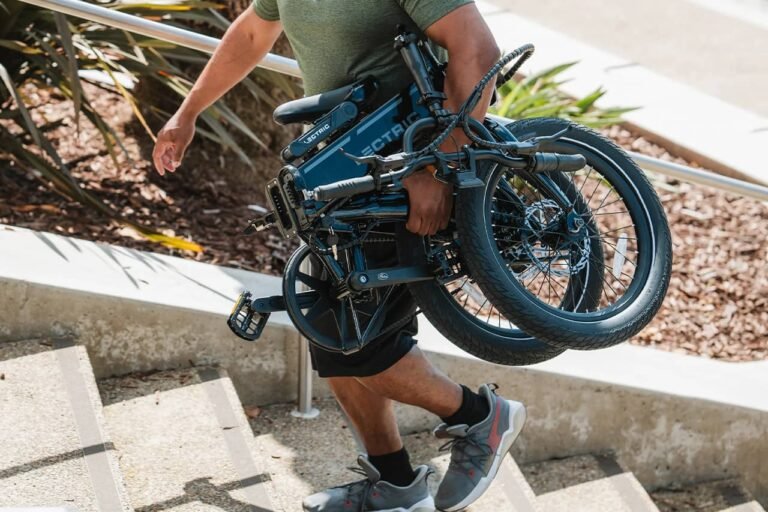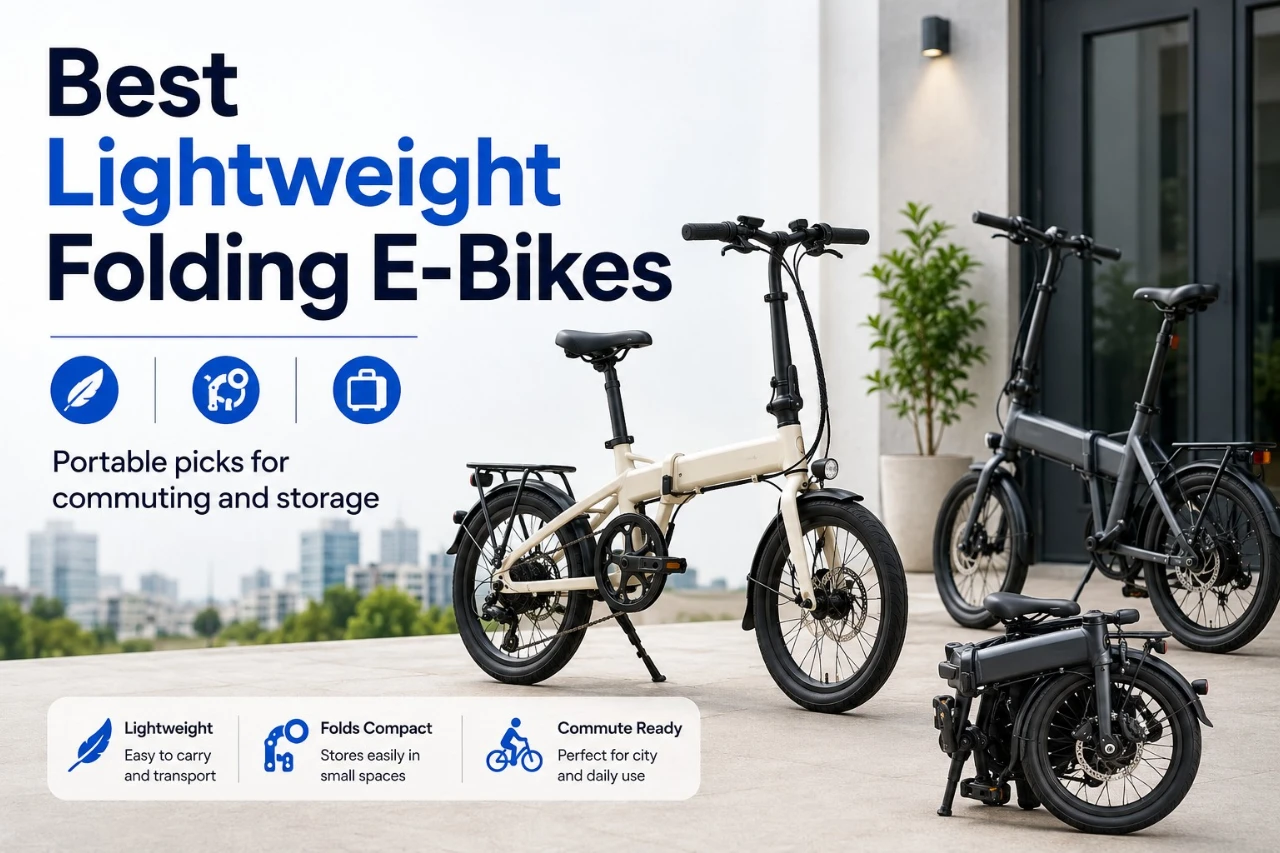
A folding hinge does not make a bike lightweight. What actually determines whether you can carry an e-bike upstairs, lift it into a trunk, or wheel it onto a train is the assembled weight with the battery installed, since that’s the weight you’re handling every time you use it. A folding electric bike under 50 lbs is a reasonable benchmark for genuine portability, though some bikes exceed that threshold and still earn a spot on this list if the added weight buys meaningfully more range, payload, or comfort.
This guide is built for commuters, apartment dwellers, RV travelers, transit riders, and anyone who regularly hauls a bike up stairs or into a vehicle. We looked at verified specs, manufacturer claims, and real trade-offs rather than assuming “folding” and “lightweight” mean the same thing. Where weight or spec data was missing or inconsistent, we call that out instead of guessing.
Best for portability and daily commuting: Gotrax R1
Best for long-range off-pavement riding: Hopepeak Z10
Best for tight apartment storage: URLIFE F1L
Best for budget-conscious commuters: HQYEX 14-Inch Ebike
Best for heavier riders needing higher payload: LELEKUAI T5
Best for a lightweight build with strong braking: HLOIE FZG140
1. Gotrax R1: Best for Portability and Daily Commuting


The Gotrax R1 fits riders who want a genuinely liftable folding e-bike for commuting, with the trade-off being a shorter pure-electric range than heavier competitors.
| Spec | Detail |
|---|---|
| Assembled weight | 45 lbs (manufacturer listed) |
| Folded dimensions | 37.4″ x 17.7″ x 27.5″ |
| Wheel size | 20″ x 2.6″ |
| Motor | 350W rated / 500W peak |
| Battery | 48V 7.8Ah, 374.4Wh |
| Claimed range | 15.5 mi electric-only / 25 mi pedal-assist |
| Top speed | 20 mph |
| Brakes | Dual disc |
| Payload | 264 lbs |
| Certification | UL 2849 |
| Warranty | 180-day limited |
At 45 lbs, this is one of the few bikes here that clears the 50 lb benchmark with room to spare. One adult can reasonably carry it up a flight of stairs or lift it into a trunk, though the aluminum frame and 20-inch wheels still make it feel substantial for a single-arm carry.
Ride stability benefits from the wider 2.6-inch tires. The battery is not removable, so full-bike storage is required rather than pulling the battery out separately.
Advantages:
- Verified sub-50 lb weight
- Dual disc brakes
- UL 2849 safety certification
- Smart display with ride data
Limitations:
- Battery is not removable
- Short 180-day warranty compared to competitors
Best for: Commuters and renters who need a genuinely portable bike for daily trips.
Not ideal for: Riders wanting 40+ miles of throttle-only range.
2. Hopepeak Z10: Best for Long-Range Off-Pavement Riding

The Z10 trades portability for range and power, making it a better fit for riders who value distance and terrain capability over easy lifting.
| Spec | Detail |
|---|---|
| Assembled weight | Not listed by manufacturer |
| Folded dimensions | 36″ x 29″ |
| Wheel size | 20″ x 3.0″ fat tire |
| Motor | Peak 1200W |
| Battery | 48V 13.5Ah, 648Wh, removable |
| Claimed range | Up to 65 mi electric / 80 mi pedal-assist |
| Top speed | Not specified in listing |
| Brakes | Disc |
| Payload | 400 lbs |
| Certification | Not listed |
| Warranty | 1 year |
No assembled weight is listed in the product data, so we cannot confirm whether this bike meets the 50 lb portability benchmark. Fat tires and a steel frame suggest it likely runs heavier than the aluminum options on this list.
The removable 648Wh battery is a strong convenience feature for charging without moving the whole bike. Reviewers mention it handles gravel and uneven terrain well.
Advantages:
- High payload capacity at 400 lbs
- Removable battery
- Long claimed range
- Front suspension for rougher terrain
Limitations:
- No published assembled weight
- No certification listed in available specs
Best for: Riders prioritizing range and cargo capacity over easy carrying.
Not ideal for: Anyone needing a confirmed lightweight bike for frequent lifting.
3. URLIFE F1L: Best for Tight Apartment Storage

The 14-inch wheels and compact fold make this one of the smallest-footprint options here, ideal for closets, under-desk storage, or small apartments.
| Spec | Detail |
|---|---|
| Assembled weight | Not listed by manufacturer |
| Folded dimensions | Not specified |
| Wheel size | 14″ |
| Motor | 500W peak |
| Battery | 48V, 375Wh |
| Claimed range | Up to 40 mi (manufacturer claim) |
| Top speed | 20 mph |
| Brakes | Disc |
| Payload | 265 lbs |
| Certification | UL & GCC |
| Warranty | 1 year |
Smaller 14-inch wheels typically mean a lighter overall build, though URLIFE does not publish an exact assembled weight, so this remains unverified. The compact fold likely fits small trunks and closets well.
Reviewers note the small wheels feel stable for short urban rides but less so at higher speeds. Multi-point shock absorption helps offset the smaller wheel size on rougher pavement.
Advantages:
- Compact fold for small living spaces
- UL and GCC certified
- Three riding modes
- Reasonable payload for size
Limitations:
- No confirmed assembled weight
- Range claims vary widely (20 to 40 miles) without clarification
Best for: Apartment dwellers with limited storage space.
Not ideal for: Riders wanting confirmed weight specs before buying.
4. HQYEX 14-Inch Ebike: Best for Budget-Conscious Commuters

This model offers a reasonably light build and decent range for shoppers watching their budget, with the trade-off being less established brand history than competitors.
| Spec | Detail |
|---|---|
| Assembled weight | 52 lbs (manufacturer listed) |
| Folded dimensions | Not specified |
| Wheel size | 14″ |
| Motor | 500W (also offered in 1500W variant) |
| Battery | 48V 9Ah, 432Wh, removable |
| Claimed range | 20 to 40 mi |
| Top speed | 20 mph |
| Brakes | Dual disc |
| Payload | 265 lbs |
| Certification | Not listed |
| Warranty | 1 year |
At 52 lbs, this bike sits just above the 50 lb benchmark despite its small 14-inch wheels, which is a notable exception. The removable battery helps offset the weight somewhat, since riders can pull it out before lifting the frame.
Reviewers mention easy assembly and a secure key-locking battery system. Adjustable seat and handlebars help fit a wider range of rider heights.
Advantages:
- Removable battery for easier lifting
- Dual disc brakes
- Adjustable seat and handlebars
- Competitive price point
Limitations:
- Slightly over the 50 lb lightweight threshold
- No certification listed in available specs
Best for: Budget shoppers who can remove the battery before carrying.
Not ideal for: Anyone needing the lightest possible frame for stair carrying.
5. LELEKUAI T5: Best for Heavier Riders Needing Higher Payload

The T5’s standout feature is its 350 lb payload rating, making it a strong pick for larger riders, though weight and range data remain unclear.
| Spec | Detail |
|---|---|
| Assembled weight | Not listed by manufacturer |
| Folded dimensions | Not specified |
| Wheel size | 14″ |
| Motor | 560W rated (740W peak per title) |
| Battery | 48V 10Ah, 480Wh, removable |
| Claimed range | Up to 32 mi |
| Top speed | 20 to 25 mph |
| Brakes | Dual disc |
| Payload | 350 lbs |
| Certification | UL 2849 |
| Warranty | 1 year |
No assembled weight appears in the available specifications, so we can’t confirm whether this qualifies as lightweight. The 350 lb payload rating stands out among this group and suggests a sturdier, likely heavier frame.
Reviewers mention the fabric basket feels flimsy and one reported a malfunction. The included basket, headlight, and lock add convenience for errands.
Advantages:
- High 350 lb payload rating
- UL 2849 certified
- Removable battery
- Includes basket, lock, and headlight
Limitations:
- No published assembled weight
- Mixed reliability feedback in reviews
Best for: Larger riders or those needing higher weight capacity.
Not ideal for: Shoppers who need a verified lightweight bike for lifting.
6. HLOIE FZG140: Best for a Lightweight Build With Strong Braking

At 62 lbs manufacturer-listed, this bike is heavier than the 50 lb benchmark despite its compact 14-inch frame, making it a clear exception rather than a lightweight pick.
| Spec | Detail |
|---|---|
| Assembled weight | 62 lbs (manufacturer listed) |
| Folded dimensions | Not specified |
| Wheel size | 14″ |
| Motor | Peak 750W |
| Battery | 48V 12Ah, 576Wh, removable |
| Claimed range | 21 to 35+ mi |
| Top speed | 20 mph |
| Brakes | Disc |
| Payload | Not specified |
| Certification | UL & GCC |
| Warranty | 180-day limited |
This is the heaviest bike in the roundup at a manufacturer-listed 62 lbs, so it does not meet the lightweight benchmark despite its small wheels. The added weight likely comes from the larger 576Wh battery and front suspension.
One reviewer reported a serious safety concern, so buyers should read current reviews closely before ordering. The removable battery helps with charging convenience even though full-bike lifting stays difficult.
Advantages:
- Removable, larger-capacity battery
- Front suspension for comfort
- UL and GCC certified
- Adjustable handlebars
Limitations:
- Heaviest bike in this roundup at 62 lbs
- At least one serious safety complaint in reviews
Best for: Riders prioritizing battery range over lifting ease.
Not ideal for: Anyone needing a confirmed sub-50 lb bike for stairs or transit.
Buying Guide
Choosing a portable folding electric bike starts with weight, not folded size. A bike that folds small but weighs 65 lbs is still hard to carry up a flight of stairs.
Check assembled weight with the battery installed. This is the number that matters when lifting a bike into a trunk or up an apartment stairwell. Manufacturers sometimes list frame-only weight, so look for “assembled” or “with battery” callouts.
Consider wheel size trade-offs. 14-inch wheels usually mean a lighter, more compact bike, but they can feel less stable at higher speeds. 20-inch wheels ride smoother and handle rougher pavement better, at the cost of added weight and bulk.
Look for a removable battery. Pulling the battery out before lifting the frame can cut several pounds and makes charging easier without hauling the whole bike inside.
Match motor power to your terrain. Rated wattage reflects sustained output; peak wattage is a short burst figure used mostly for acceleration and hills. A 350-500W rated motor covers flat commutes, while hills call for higher rated power.
Verify certification. UL 2849 is the main U.S. safety standard for e-bike batteries and electrical systems. Bikes without this listed certification carry more unknown risk.
Match payload to your weight. Confirm the manufacturer’s maximum rider weight, including any bags or cargo, before buying.
Compare warranty length. Coverage in this roundup ranges from 180 days to one year. Shorter warranties are common at lower price points but leave less room for defects to surface.
Frequently Asked Questions
What is the lightest folding electric bike for adults?
Among the bikes in this roundup, the Gotrax R1 has the lowest manufacturer-listed assembled weight at 45 lbs. Several other models did not publish exact weight figures, so we can’t confirm if they’re lighter without verified data.
Which folding electric bike is best for seniors?
A lighter bike with a step-through frame and low top tube tends to work best for seniors who need to lift or maneuver the bike often. The Gotrax R1’s confirmed 45 lb weight and dual disc brakes make it a reasonable starting point, though seat height and comfort should be tested personally.
How much should a lightweight folding e-bike weigh?
We use 50 lbs or less as the main benchmark for a genuinely portable folding e-bike. Some bikes exceed this weight but offer larger batteries or higher payload capacity that may justify the trade-off depending on your needs.
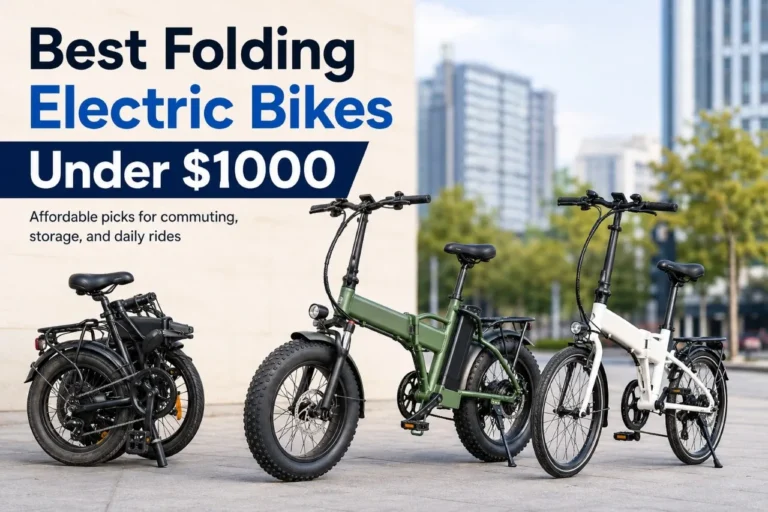
What are the best folding electric bikes under $1,000?
Several models in this roundup, including the Gotrax R1, URLIFE F1L, and HQYEX 14-inch bike, are commonly priced under $1,000. Prices change frequently, so always check current listings before deciding.
Is a 750W folding electric bike suitable for daily commuting?
Yes, a 750W peak motor provides enough power for most commuting routes, including moderate hills. Keep in mind that peak wattage is a short burst figure, so rated wattage gives a better sense of sustained performance.
What features should I look for in a compact folding e-bike?
Prioritize confirmed assembled weight, a removable battery, disc brakes, and UL 2849 certification. Also check payload capacity and folded dimensions to make sure the bike fits your storage space and body size.
GoEBikeLife publishes independent e-bike reviews, comparisons, and practical buying guides. Some links on this page are affiliate links. If you make a purchase through an eligible link, we may earn a commission at no additional cost to you.