Real rides. Real notes. No hype.

A decision-first guide to the best electric scooters—ranked for real commuting comfort, braking confidence, range realism, and value.
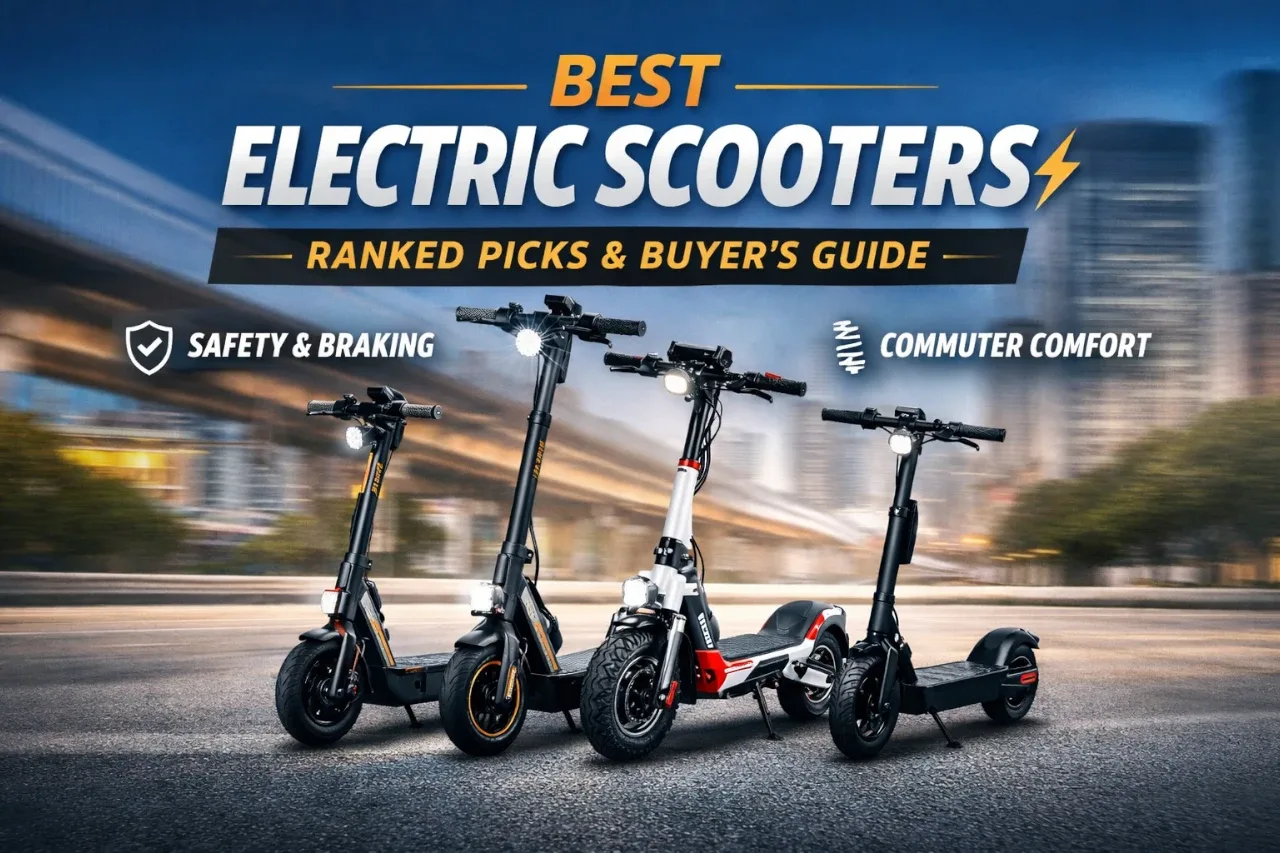
Electric scooters look similar in photos, but they don’t ride similar. Some feel planted at 18–22 mph on rough city pavement. Others feel twitchy, under-braked, or short on real range once you’re a normal adult carrying a backpack and riding into wind.
In this guide, I’m focusing on the things you notice in daily riding: stability, braking confidence, suspension behavior, tire practicality, real range expectations, and ownership friction (weight, portability, charging habits, support). I’m also conservative with claims—especially on range—because scooters are notoriously optimistic on paper.
How these picks were ranked: safety and braking first, then ride stability, range realism, reliability/support signals, and value for money.
Best overall pick: Segway Ninebot MAX G2 — the most confidence-inspiring “daily driver” choice for commuting, with a mature ride feel and safety features that matter.
Best value pick: VOLPAM SP01 — a strong feature set for the price if you’re realistic about range and want a comfortable, simple commuter.
Who should buy from this list: adults who want a commuter-friendly scooter (smooth ride, predictable brakes, practical tires) or a higher-speed “adventure” scooter with real stability.
Who may want to look elsewhere: riders who must carry a scooter up stairs daily, or anyone who wants ultra-light portability above everything else.
| Product | Best for | Key strength | Main drawback |
|---|---|---|---|
| Segway Ninebot MAX G2 | Daily commuting + mixed pavement | Mature ride feel + strong safety suite | Heavy for stairs/carrying |
| Segway ZT3 Pro | Faster rides + light off-road | Big tubeless tires + suspension + flash charge | Pricey; bigger footprint |
| RelayWay R8 | Heavy riders + rougher surfaces | High claimed speed/range + heavy-duty framing | Newer brand risk; weight likely high |
| iScooter iX3 | Value off-road-ish commuter | Adjustable bar + lighting features | Expect range drop at higher speed |
| VOLPAM SP01 | Budget comfort commuter | Dual suspension + practical braking mix | Not for steep hills at speed |
Claimed highlights: up to ~22 mph, up to ~43 miles (variant listed), dual suspension, 10″ self-healing tubeless tires, traction control, UL-2272/2271.
If you want a scooter you can ride most days without constantly “managing” it, the MAX G2 is the type of product that typically feels thought-through: stable geometry, practical tires, and features that reduce bad surprises (traction control, turn signals, brake lighting). For commuting, that predictability matters more than peak speed.
| Pros | Cons |
|---|---|
| Calm, commuter-friendly ride feel | Heavy for frequent lifting |
| Tubeless self-healing tires reduce flat anxiety | Not a true “fast” scooter |
| Strong safety suite (signals, lighting, traction control) | Real range varies widely with speed/hills |
Claimed highlights: up to ~24.9 mph, up to ~43.5 miles (ECO), 11″ tubeless tires, dual suspension, flash charge, UL-2272/2271.
This is the “bigger shoe” option: larger tires, more speed headroom, and suspension designed to keep things composed when the surface stops being perfect. If your commute includes broken pavement, uneven bike lanes, or occasional dirt paths, tire size and suspension quality are what you’ll feel every single ride.
| Pros | Cons |
|---|---|
| 11″ tubeless tires for stability | Higher price |
| Suspension suited to rougher routes | Larger footprint for storage |
| Fast charge convenience | “Off-road” still has limits |
Claimed highlights: ~30 mph, up to ~50 miles (eco), dual suspension, 10.5″ pneumatic tires, 300 lb limit, UL2272 listed, strong lighting, 1-year warranty + support.
On paper, this is built for a specific buyer: heavier riders or anyone who wants a scooter that doesn’t feel delicate when the road gets ugly. Higher capacity and a “heavy duty” framing approach can translate to better stability—if the scooter is well-tuned and well-assembled.
| Pros | Cons |
|---|---|
| Higher stated capacity for heavier riders | Newer brand risk (support/parts) |
| Pneumatic tires + suspension for comfort | Likely heavy and bulky |
| Strong commuter intent (lights, warranty messaging) | Real range drops fast at high speed |
Claimed highlights: 800W motor, up to ~25 mph, up to ~25 miles, 10″ pneumatic “off-road” tires, adjustable handlebar, turn signals/ambient lighting, ~51 lb, app.
This is a practical “feature density” scooter: decent power, useful adjustability, and commuter-friendly lighting. It’s not pretending to be a 40–50 mile cruiser, which I actually like—shorter range claims are often more realistic, and that honesty matters.
| Pros | Cons |
|---|---|
| Adjustable handlebar improves fit/control | Not for long commutes without charging |
| Good commuter lighting features | App may be a dependency |
| Pneumatic tires help comfort | Range drops at higher speed |
Claimed highlights: 500W motor, up to ~21–22 mph, up to ~28 miles, dual suspension, dual braking (electronic + drum), foldable, app.
For the price, you’re getting the basics that matter: enough speed for commuting, a suspension setup to reduce harshness, and a braking system that’s more confidence-inspiring than a single brake. For many riders, this is the sweet spot.
| Pros | Cons |
|---|---|
| Strong value for a comfort-focused commuter | Not ideal for steep hills at speed |
| Dual braking improves confidence | Range is highly conditional |
| Foldable for storage convenience | Budget-tier maintenance expectations |
If a scooter is going into your home, battery safety matters. When certifications like UL 2272 / UL 2271 are listed, it’s a good signal—but still verify what’s actually stated for the exact model/variant you’re buying.
Buyer tip: prioritize reputable brands, clear safety documentation, and realistic chargers (quality charging habits reduce risk).
At 18–25 mph, braking feel is everything: lever modulation, stopping predictability, and how stable the scooter stays under hard braking. Drum brakes can be low-maintenance; electronic brakes can add control. The best setups feel consistent and not grabby.
If you ride on rough pavement, tires matter more than motor wattage.
Suspension isn’t just comfort—it helps keep the scooter stable over bumps so you’re not getting bounced off-line. For commuters, a good suspension/tire combo reduces hand and shoulder fatigue and makes longer rides more pleasant.
Real range drops with:
If you need 15 miles per day, don’t buy a scooter that “claims” 15 miles—buy one that claims much more.
This is where many people make a mistake. Long range + suspension usually equals weight. If you have stairs or public transit daily, portability becomes your #1 spec.
Rule of thumb: if you can’t comfortably lift it, you won’t use it as often.
Scooters are wear-item machines: tires, brake components, and folding mechanisms need attention. Brands with clearer parts availability and better documentation usually cause fewer headaches over time.
If you want the safest, least-stress path to owning a capable commuter scooter, the Segway Ninebot MAX G2 is my best overall choice. It’s built around the daily-riding experience: stable, practical tires, strong safety features, and the kind of mature design that reduces surprises.
The main compromise you accept is weight and portability—this is not the scooter I’d recommend for someone hauling it up stairs every day.
If you’re on a tighter budget but still want comfort and a practical commuting setup, the VOLPAM SP01 is the best value pick—just keep your expectations realistic on hills and range.
| Preview | Product | Price | |
|---|---|---|---|

|
Segway Ninebot MAX G2 Electric KickScooter, Power by 1000W Motor, Up to 43 Miles Range and 22MPH… |
$649 |
View on Amazon |
Is a 25–30 mph scooter safe for commuting?
It can be, but only if the scooter is stable, brakes are strong, and you ride defensively with proper safety gear.
How much range should I “really” plan for?
Plan for 60–70% of the best-case claim if you ride at higher speeds, face hills, or weigh more than average.
Are tubeless tires worth it?
Yes—especially for commuting. They usually improve stability and reduce flat headaches (particularly self-healing types).
Do I need suspension if I’m mostly on roads?
If your pavement is rough, yes. Suspension reduces fatigue and improves control over cracks and bumps.
What’s the biggest maintenance item on scooters?
Tire pressure checks, brake adjustments, and bolt tightening (especially early on) are the big three.
Can I ride in the rain?
Some models claim water resistance, but “water-resistant” isn’t “waterproof.” Wet traction and braking distance also change—ride slower and more cautiously.
Is a heavier scooter always better?
Not always, but heavier scooters often feel more stable at speed because they have larger batteries and sturdier frames. The trade-off is carrying/storage pain.