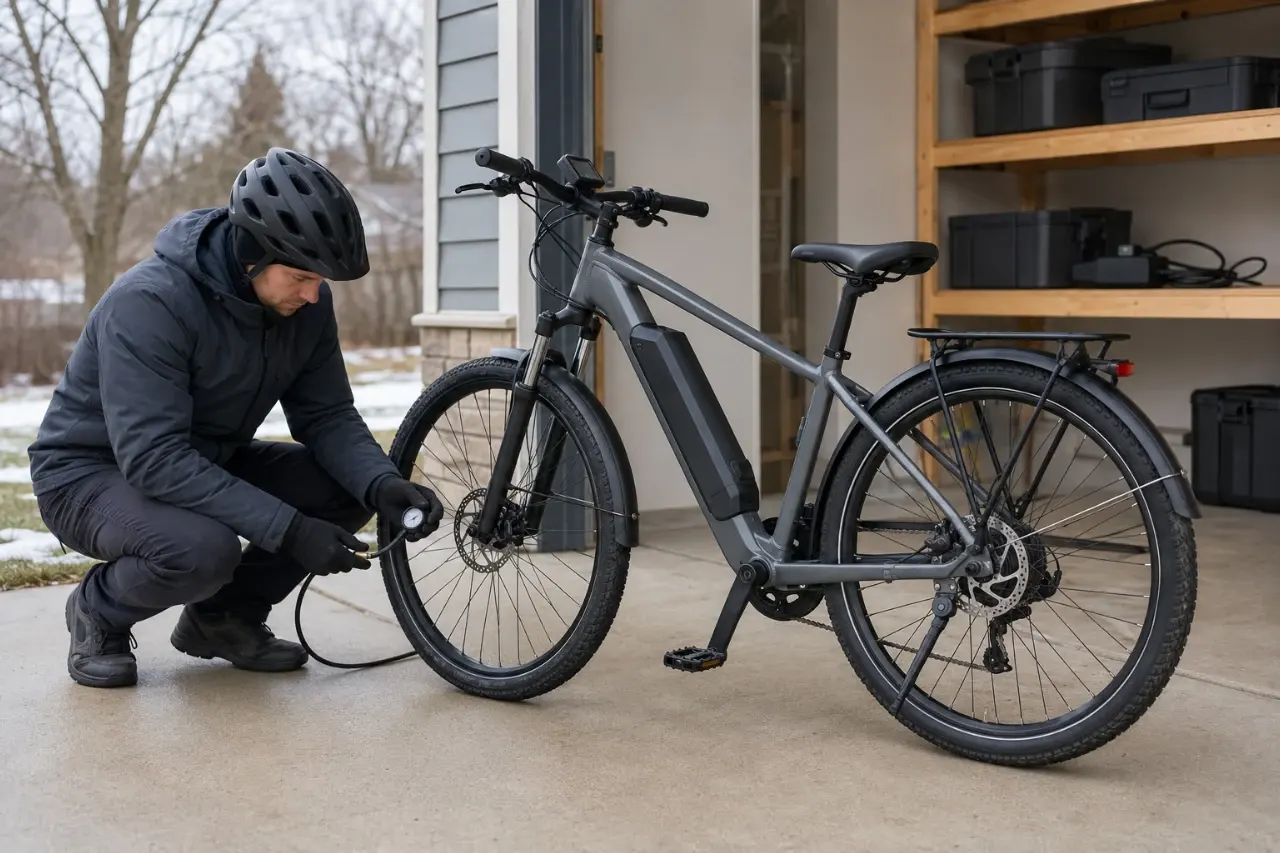
Winter e-bike maintenance should focus on four things: traction, braking, battery temperature, and moisture or salt exposure. Before every ride, check the tires, brakes, wheels, lights, and battery mount.
After a wet or salty ride, clean and dry the bike, then service the chain as needed. Always follow the temperature, cleaning, charging, and storage limits in your e-bike manual because they vary by system.
Quick Winter E-Bike Maintenance Schedule
| When | What to check or do |
|---|---|
| Before every ride | Tires, wheel security, brakes, steering, lights, battery mounting, and visible wiring |
| After a wet, slushy, or salty ride | Remove salt and grit, dry the bike, inspect the charging port, and wipe the chain |
| Weekly during frequent winter use | Measure tire pressure, inspect brake pads and tire tread, check the drivetrain, and look for corrosion or loose accessories |
| Before storing the bike for several weeks | Clean and dry the bike, follow the battery maker’s storage-charge guidance, and choose a dry storage area |
| Before the first ride after storage | Recheck tires, brakes, wheels, chain, fasteners, lights, and battery operation |
The schedule above is a practical starting point, not a replacement for the maintenance intervals in your owner’s manual.
1. Decide Whether the Route Is Safe to Ride
Maintenance cannot make every winter road rideable. Untreated ice, freezing rain, deep ruts, and hidden black ice may exceed the grip available from ordinary e-bike tires. Postpone the ride if you cannot control the bike at low speed.
Pedal assist and a throttle add power, not traction. Use low assist on slippery surfaces, keep the bike upright through turns, and steer, brake, and accelerate gradually. Even compatible studded bicycle tires cannot eliminate the risk of losing control on ice.
2. Complete a Pre-Ride Safety Check
With the system switched off, confirm that both wheels are secure, the handlebar and stem do not move independently of the front wheel, and nothing rubs when the wheels turn. Look for visible frame or fork damage.
Measure tire pressure and squeeze both brake levers. Turn on the system and verify the headlight, taillight, display, and brake light if equipped. Test the brakes and steering at walking speed before joining traffic.
For a fuller routine, use this three-minute e-bike pre-ride safety checklist.
Do not ride if a wheel is loose, the steering has play, the frame or fork is damaged, a brake does not work normally, or a tire has a bulge or exposed casing.
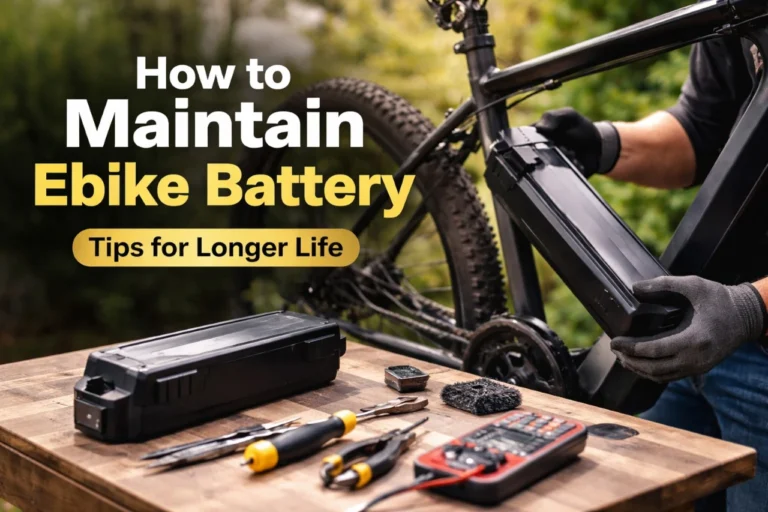
3. Protect the Battery From Cold-Weather Charging Damage
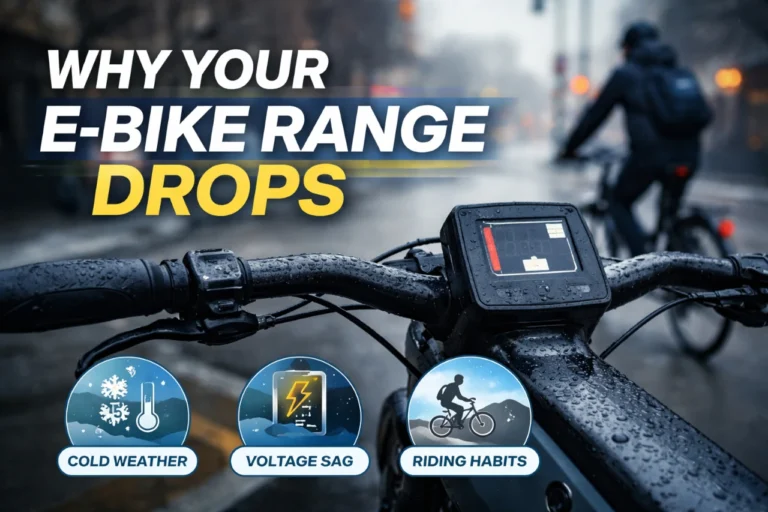
Cold weather can temporarily reduce the energy and power a lithium-ion battery can deliver. A shorter cold-weather range does not by itself prove damage. Wind, hills, cargo, low tire pressure, and high assist can reduce range further, so plan an extra reserve.
If the battery has been outside, let it return naturally to the manufacturer’s permitted charging-temperature range. Do not use a heater or heating pad. Let a wet battery exterior or charging port dry completely before connecting the charger.
Use only the supplied or manufacturer-approved charger. A matching plug is not enough: battery chemistry, nominal voltage, charger output voltage, current, connector, polarity, and manufacturer compatibility must match.
Before charging, look for case damage, swelling, leakage, unusual heat, a strong odor, hissing, popping, or smoke. Stop using and charging an abnormal battery; do not open or repair it. If it is smoking, hissing, or rapidly heating, do not touch or move it. Leave the area, call emergency services, and follow responder instructions.
4. Check Tire Pressure, Condition, and Winter Grip
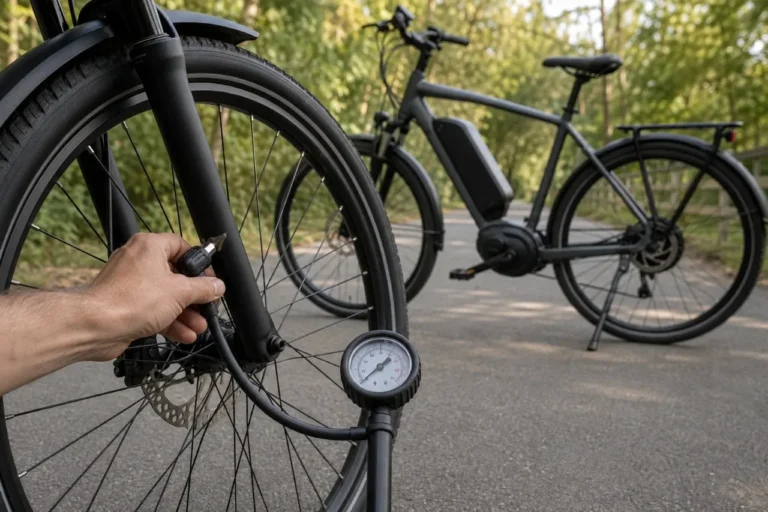
Tire pressure decreases as air gets colder, so check it with a gauge when the tires are cold. Follow the guidance for the bike, tire, rim, rider weight, and cargo. The highest sidewall number is not automatically the target; never exceed the lower maximum specified for the tire or rim.
Do not lower pressure simply because it is winter. Too little can cause unstable handling, pinch flats, rim strikes, or tire roll. The e-bike tire pressure guide explains how tire width, load, and wheel limits affect the correct starting pressure.
Inspect both tires for glass, cuts, bulges, exposed casing, worn tread, and uneven seating. Replace a damaged tire before riding. For winter or studded tires, verify wheel size, rim-width range, frame and fender clearance, load rating, and manufacturer compatibility.
5. Keep the Brakes Clean and Predictable
Wet roads can increase stopping distance. Test both brakes at low speed, reduce speed before turns, and brake earlier and more gradually than on dry pavement.
Inspect the pads more often around wet grit or salt. Watch for lost braking power, grinding, a wobbling rotor, hydraulic-fluid leakage, or a soft lever. Stop riding if either brake cannot reliably stop the bike.
Keep chain lubricant, corrosion inhibitor, and general cleaner away from brake rotors, pads, rim-braking surfaces, and tires. If you cannot judge pad or rotor condition, use this e-bike brake inspection guide or ask a technician.
6. Remove Road Salt and Grit Without Pressure Washing
Remove salt and grit promptly. Switch the e-bike off, disconnect the charger, and close the charging-port cover. Remove the battery or display only when the manual permits it.
Follow the manufacturer’s cleaning method. Use a damp cloth, soft brush, low-pressure water where permitted, and mild bike-safe cleaner. Never pressure- or steam-clean the bike or direct water at bearings, connectors, controls, the charging port, battery interfaces, or motor seals.
Clean where water will not refreeze. Dry the bike before storage or charging. Do not separate sealed connectors or apply unapproved sprays to corrosion.
7. Clean and Lubricate the Drivetrain as Needed
After a wet or salty ride, wipe the chain and nearby drivetrain parts. If grime remains, use bicycle-specific drivetrain cleaner as directed, then let the chain dry.
Choose a lubricant for the conditions. Wet-weather lube may last longer in rain or slush, but excess attracts dirt. Apply a small amount to the rollers, let it penetrate as directed, and wipe the chain’s exterior. Keep cleaner and lubricant off braking surfaces.
This guide explains how to clean an e-bike drivetrain without damaging electrical or brake components.
Test shifting under light pedal pressure. Do not force a skipping chain through a climb with high motor assistance. Repeated skipping, chain drop, damaged teeth, or a bent derailleur needs adjustment or inspection.
8. Inspect Covers, Cables, and External Electrical Parts
Water resistance is not waterproofing. Check charging-port covers, battery latches, display mounts, light cables, and visible connectors. Look for split insulation, crushed harnesses, trapped moisture, or corrosion residue.
Never charge through a wet port. Do not probe, scrape, or spray a connector unless the manufacturer directs it. Recurring errors, power loss, damaged cables, or wet electrical parts require authorized guidance.
9. Check Fasteners, Accessories, and Visibility Equipment
Rough pavement can loosen fenders, racks, baskets, kickstands, and lights. Check for movement or rattles. Use the manual’s torque specifications for adjustments; do not guess.
Fenders can reduce spray but need secure mounts and adequate tire clearance. Remove packed snow that could jam a wheel. Keep lights and reflectors clean, and carry a backup light when needed.
10. Store the Bike and Battery Correctly
Before storing an e-bike for several weeks, clean and dry it, service the chain, and set approved tire pressure. Use a dry, sheltered area away from exits, heaters, flames, and water.
Battery storage requirements are system-specific. Many manufacturers specify a partial charge, but the correct percentage, temperature, and inspection interval must come from your manual. Do not leave the battery depleted or recharge it on a guessed schedule. See the guide to storing an e-bike battery for winter for a dedicated routine.
Before riding again, inspect the battery and mount, tire pressure, brakes, lights, rust, leaks, fasteners, and wiring.
When to Stop Riding and Contact a Professional
Routine inspection, gentle cleaning, tire inflation, and external chain care are realistic owner tasks. Stop riding and arrange qualified service if you find:
- A loose wheel, steering play, or visible frame or fork damage
- A brake that is weak, leaking, grinding, or inconsistent
- A tire bulge, exposed casing, damaged rim, or recurring pressure loss
- A chain that repeatedly skips or falls off
- A crushed cable, damaged connector, recurring electrical fault, or water intrusion
- A battery that is swollen, leaking, unusually hot, physically damaged, smoking, hissing, or producing a strong odor
Do not open the battery, charger, controller, display, or motor. Use the e-bike manufacturer’s support channel or a qualified, manufacturer-authorized e-bike service provider for electrical and battery faults.
Winter riding is more predictable when the routine stays simple: inspect before every ride, remove salt and moisture promptly, charge only within the battery maker’s limits, and stop when a safety-critical part does not feel normal.