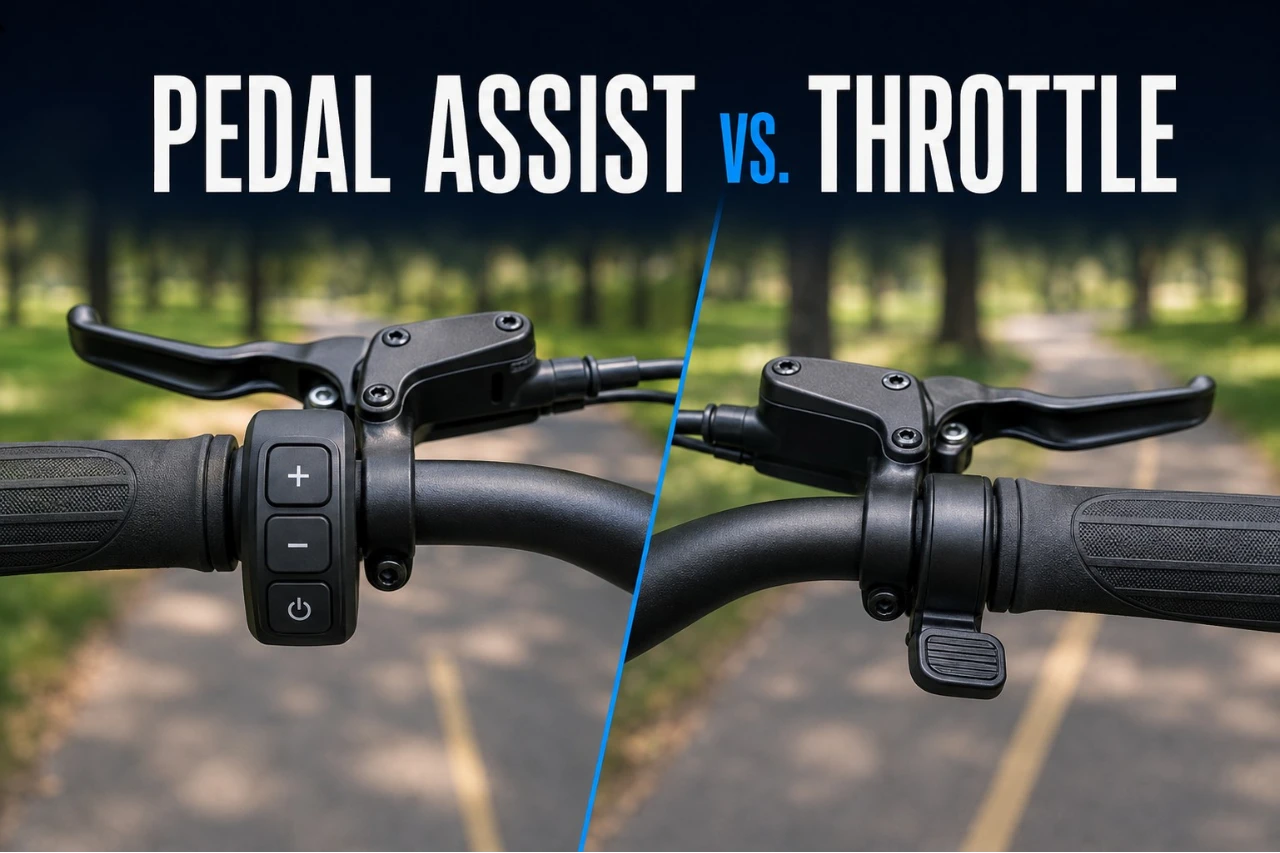
A pedal assist throttle setup gives an e-bike rider two different ways to request motor power: pedaling to activate assistance and using a hand control for power without pedaling. They can work well together, but they do not feel the same, use battery power the same way, or fit every riding situation.
For most riders, pedal assist is the natural choice for steady travel. A throttle can be useful when starting from a stop, crossing an intersection, or getting a heavily loaded bike moving. The safest approach is to understand exactly what your controls do before relying on either one in traffic, on trails, or around pedestrians.
Pedal Assist and Throttle: The Basic Difference
Pedal assist, often called PAS, turns on motor support when the bike detects that you are pedaling. Depending on the e-bike, a sensor may detect pedal movement, pedal force, or both. You choose an assist level using the display or handlebar controls, and the motor adds more or less power to your effort.
A throttle is a hand-operated control, usually a thumb lever or twist grip. It requests motor power without requiring you to pedal. Some throttles provide power gradually as you press or twist them. Others have a simpler on-off feel. The response varies substantially by e-bike model and its programmed settings.
An e-bike may have pedal assist only, a throttle only, or both. If your bike has both, the throttle does not replace the need to learn pedal assist. It is another control with its own benefits and limits.
What the assist level changes
Higher pedal-assist levels usually deliver more motor support and may bring the bike to speed faster. They also use more battery energy, especially on hills, into headwinds, or with a cargo load. A lower level asks more from the rider but often provides smoother control and better range.
The number shown on a display is not universal. Level 3 on one e-bike may feel gentler or stronger than level 3 on another. Your owner’s manual is the authority for how your system is designed to behave.
When Each Control Makes Sense
Pedal assist is generally best for normal riding on bike lanes, paved paths where e-bikes are permitted, and longer trips. Because you are pedaling, it is easier to maintain a steady rhythm and anticipate changes in speed. Starting in a low or middle assist setting also gives new riders time to get comfortable with the bike’s weight and acceleration.
A throttle can be practical in a few common situations. It can help you move away from a stop before placing full pressure on the pedals, which may be helpful at an intersection or when carrying cargo. It can also help after you have shifted to an easier gear on a hill. On some bikes, a light throttle input can help stabilize a slow start.
That said, a throttle is not always the right tool. Using it heavily at low speed can make a bike surge forward unexpectedly, particularly if the motor is powerful or the surface is loose. It can also reduce range faster than moderate pedal assist because the motor is doing more of the work.
Start and Stop Safely With a Throttle
The first few seconds after stopping are where many riders make control mistakes. An e-bike can accelerate faster than a regular bicycle, and a throttle can apply power before you are fully balanced.
Use this routine until it becomes automatic:
- Before stopping, lower pedal assist if you are approaching a crowded area, driveway, sharp turn, or uneven surface.
- Come to a complete stop with both feet ready to support the bike. Keep your brake levers covered if traffic or pedestrians are close.
- Select an easy gear before starting again. A lower gear reduces the force needed to begin pedaling.
- Look ahead, not down at the display or throttle. Confirm that the path is clear and your front wheel is pointed where you intend to go.
- Start with gentle pedal pressure or a light throttle input. Add power only after the bike is rolling straight and you feel balanced.
Avoid pressing a throttle while mounting, walking beside the bike, loading it onto a rack, or moving it through a garage or apartment hallway. If the bike has a walk-assist mode, use only the manufacturer-designated control and follow its instructions. Walk assist is designed differently from a regular throttle, but it can still move a heavy bike with enough force to cause damage or injury if misused.
How Pedal Assist Throttle Use Affects Range
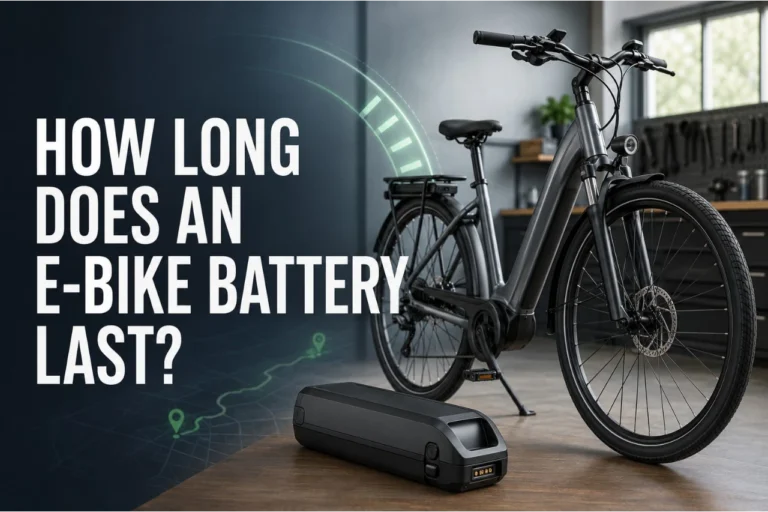
Range is not determined by one setting alone. Rider weight, cargo, tire pressure, hills, wind, temperature, speed, and battery condition all matter. Still, your use of pedal assist and throttle is one of the most direct factors you can control.
Frequent full-throttle starts and high assist levels draw more energy from the battery. They may be reasonable for a short, steep hill or a quick merge where conditions allow, but they are inefficient for routine riding. Smooth acceleration, moderate cruising speeds, and lower assist on flat ground are usually easier on battery charge.
Try treating higher assist and throttle power as tools for specific demands rather than default settings. For example, a commuter might use low assist on a flat neighborhood street, increase assistance for a bridge climb, then reduce it again on the descent. This approach can make range more predictable without making the ride feel underpowered.
Never try to extend range by altering electrical components, changing controller settings, or bypassing built-in speed or power limits. Those changes can create safety, reliability, warranty, and legal problems.
Match Your Controls to Road and Trail Conditions
A higher assist setting is not automatically safer when conditions get harder. On wet leaves, gravel, sand, painted road markings, or slick pavement, quick motor torque can break rear-wheel traction. Reduce assistance before entering low-grip surfaces, keep your movements smooth, and avoid abrupt throttle application while turning.
In tight spaces, lower power is usually better. This includes shared paths, crowded trail entrances, parking areas, and ride elevators. Slow down early and be ready to brake. A throttle can be especially easy to bump accidentally when wearing gloves or gripping the bars tightly on rough ground.
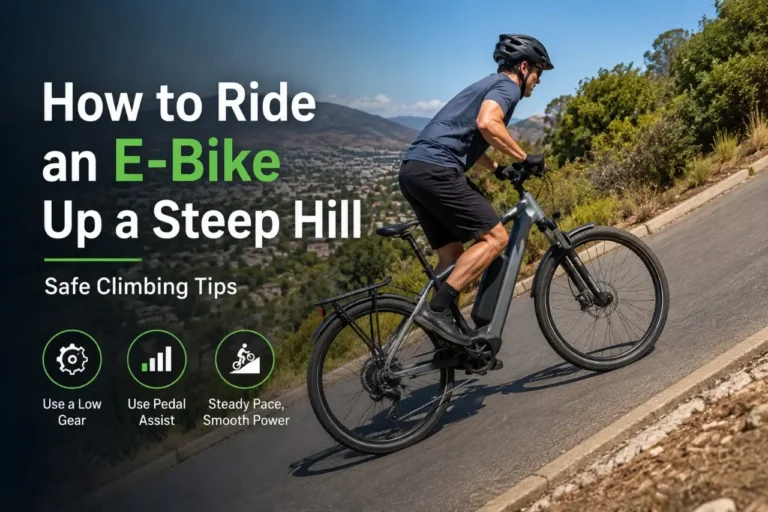
When climbing, shift to an easier gear before your cadence becomes very slow. Pedal assist works most efficiently when you keep the pedals turning comfortably rather than pushing hard in a tall gear. If you use the throttle to help on a climb, apply it gradually and remain seated when possible to keep traction over the rear wheel.
Know the Rules Where You Ride
E-bike rules vary by state and can also differ by city, county, trail operator, and land-management agency. The presence of a throttle may affect how an e-bike is classified and where it is allowed.
Many jurisdictions use a three-class framework. Class 1 e-bikes provide pedal assist only and stop assisting at 20 mph (32 km/h). Class 2 models can use a throttle and generally have a 20 mph motor-assisted limit. Class 3 e-bikes provide pedal assistance up to 28 mph (45 km/h), though throttle rules for these bikes vary by jurisdiction and by the bike’s configuration.
These labels are useful, not a guarantee of access. A trail may permit Class 1 bikes but prohibit throttle-equipped bikes, even if the rider chooses not to use the throttle. Before using a new path or traveling across local boundaries, check the applicable rules and follow posted restrictions. Manufacturer labeling and your owner’s manual can help you identify your bike’s intended classification.
If the Controls Do Not Feel Normal
A sudden change in pedal assist or throttle response deserves attention. Stop riding and consult the owner’s manual if the motor accelerates unexpectedly, continues applying power after you release the throttle, cuts out repeatedly, displays an error code, or behaves differently after rain, impact, or a fall.
Owners can safely check for simple issues such as a loose display connection, a visibly damaged control cable, a misplaced magnet or sensor near the crank area, or a low battery charge. Turn the bike off before inspecting it, and do not pull apart wiring connectors unless the manufacturer specifically instructs you to do so.
Do not continue riding a bike with a sticky throttle, damaged wiring, or unexplained power behavior. A qualified e-bike mechanic or the manufacturer can diagnose controls, sensors, and electrical connections without guessing.
The best pedal assist throttle setting is the one that gives you enough help while leaving you fully in control. Start gently, learn how your own bike responds, and save the extra power for the moments when it truly helps.
Frequently Asked Questions
What is pedal assist on an electric bike?
Pedal assist uses sensors to detect when the rider is pedaling and activates the motor to provide additional power. The rider selects an assistance level through the display or handlebar controls. Higher levels generally provide stronger support but consume more battery energy.
How is an e-bike throttle different from pedal assist?
A throttle allows the motor to provide power without requiring the rider to pedal. It is usually operated with a thumb lever or twist grip. Pedal assist supports the rider’s own pedaling, while a throttle can move the bike using motor power alone.
Can pedal assist and the throttle be used at the same time?
Many e-bikes allow riders to pedal while using the throttle, but the exact behavior depends on the bike’s controller settings. Some throttles work at every assist level, while others operate only under certain conditions. Check the owner’s manual for model-specific instructions.
Does using the throttle reduce e-bike range?
Frequent throttle use can reduce range because the motor performs more of the work. Full-throttle starts, steep hills, high speeds, and heavy cargo increase battery consumption further. Moderate pedal assist and smooth acceleration generally provide more predictable range.
Which pedal-assist level should a beginner use?
New riders should usually begin with a low or middle assist level in an open, low-traffic area. Lower assistance provides gentler acceleration and makes the bike easier to control. Higher levels can be introduced gradually after the rider becomes comfortable with braking, turning, and starting.
Can an e-bike throttle help when climbing hills?
A throttle can provide additional power on a hill, especially when starting or carrying cargo. However, it should be applied gradually. Shift into an easier gear, maintain a steady cadence, and avoid prolonged full-throttle operation because it can increase battery use and motor heat.
Are throttle-equipped electric bikes legal on bike paths?
Access rules vary by state, city, trail operator, and land-management agency. In many three-class systems, throttle-equipped bikes are classified as Class 2 and provide motor assistance up to 20 mph. Some paths permit only pedal-assist bikes, so riders should check local rules before entering.
What should I do if the throttle sticks or the motor keeps running?
Stop riding immediately, apply the brakes, and turn off the e-bike if it is safe to do so. Do not continue using a bike with a sticky throttle, damaged wiring, or unexplained motor behavior. Contact the manufacturer or a qualified e-bike mechanic for inspection.