A little joy belongs in every day.

How long does ebike battery last? Learn range per charge, expected service life, and charging and storage habits to protect your battery health over time.
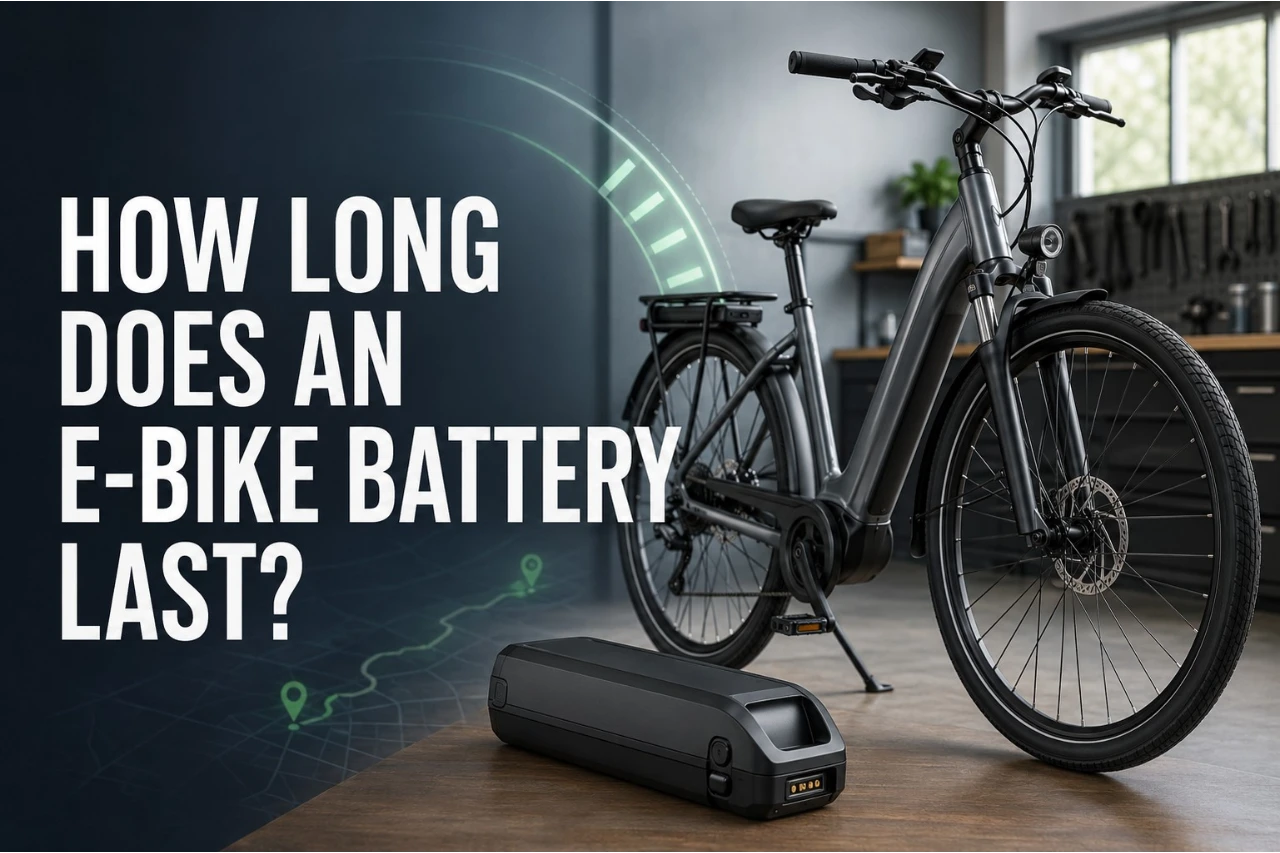
Most e-bike owners are really asking two questions when they ask, “how long does ebike battery last?” First, how far can it take me on one charge? Second, how many years will the battery remain useful? A typical lithium-ion e-bike battery may provide roughly 20 to 60 miles (32 to 97 km) of assisted riding per charge and remain serviceable for about 3 to 5 years. Real results depend heavily on the battery size, riding conditions, care, and age.
The battery is one of the most expensive and safety-critical parts of an e-bike. Knowing what affects its range and lifespan helps you plan rides, avoid getting stranded, and make charging habits that support long-term battery health.
A single charge commonly delivers 20 to 60 miles (32 to 97 km), but that is a broad real-world range. Some riders using low pedal assist on flat routes can travel farther. A rider climbing hills with high assist, a heavy load, or a strong headwind may get much less.
Battery capacity is the starting point. It is usually listed in watt-hours (Wh), which measures stored energy. For example, a 500 Wh battery generally holds more energy than a 350 Wh battery, so it can usually support a longer ride under similar conditions. Watt-hours do not guarantee a particular range, though. They tell you how much energy is available, not how quickly your e-bike will use it.
| Riding factor | What it does to range |
|---|---|
| Higher pedal-assist or throttle use | Uses energy faster and reduces range |
| Hills, frequent stops, and fast starts | Increase power demand |
| Rider, cargo, and trailer weight | Require more energy to move |
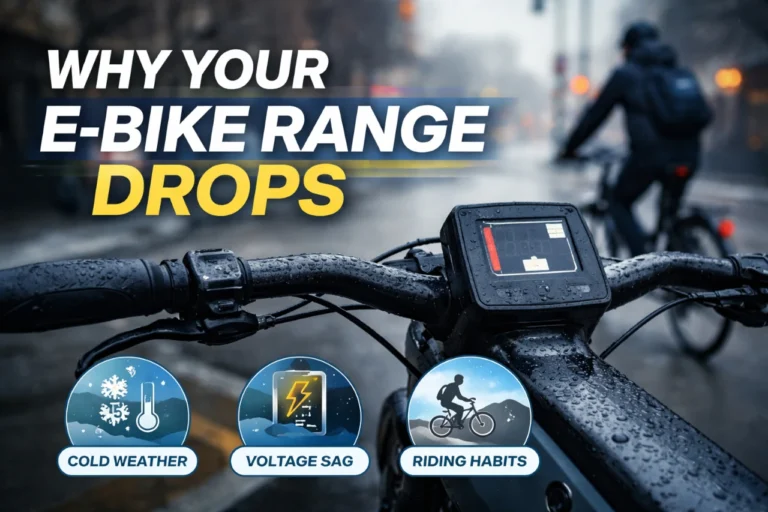
| Cold temperatures | Temporarily reduce available battery capacity |
| Low tire pressure or rubbing brakes | Make the motor work harder |
| Steady pedaling on flatter roads | Helps extend range |
Think of a stated range as a favorable estimate, not a promise. Your own repeatable route is more useful. After several rides, note your distance, assist level, terrain, temperature, and battery indicator. That gives you a realistic range figure for your riding style.
If your display shows battery percentage, start with a full charge and ride a familiar route until the battery reaches about 25% to 30%. Record the distance traveled, then use that as a planning baseline rather than routinely draining the battery to empty.
For example, if you travel 24 miles (39 km) before reaching 30%, your practical full-charge range under similar conditions may be around 30 to 35 miles (48 to 56 km). Leave a margin for detours, wind, cold weather, and normal changes in battery performance.
Most e-bike batteries use lithium-ion cells. Their capacity gradually declines with use and time, even when they are cared for properly. Many batteries remain useful for approximately 500 to 1,000 full charge cycles, often translating to about 3 to 5 years for a regular rider.
A full cycle does not always mean one charging session. Using 50% of the battery one day and 50% the next day adds up to roughly one full cycle. Partial charging is normal and does not automatically harm a lithium-ion battery.
Battery age is not the only measure of condition. A battery may be ready for replacement when its range has dropped enough to interfere with your normal trips, even if it still powers the bike. For a commuter who needs 25 miles (40 km) of dependable range, a battery that now provides only 15 miles (24 km) may no longer meet the job.
Gradually shorter range is expected as a battery ages. Sudden or unusual changes deserve a closer look. Check simple causes first: tire pressure, brake drag, colder weather, a changed assist setting, or a different route can all reduce range.
Stop using the battery and contact the manufacturer or a qualified e-bike technician if you notice swelling, cracks, leaking, a strong chemical odor, unusual heat, smoke, sparking, damaged terminals, or a charger that repeatedly behaves abnormally. Do not open the battery case or attempt to repair battery cells, wiring, or its internal battery management system yourself.
Heat is one of the biggest long-term stressors for lithium-ion batteries. Avoid leaving the battery in a hot car, direct summer sun, or an unventilated shed. After a demanding ride, let a warm battery cool to room temperature before charging it.
Extreme cold affects range differently. A cold battery can feel weaker during the ride because the chemical reaction inside slows down. The lost range is often temporary once the battery returns to a moderate temperature, but charging a battery that is very cold can be harmful. Bring it indoors and allow it to warm naturally before charging, following the temperature guidance in your owner’s manual.
Repeatedly storing a battery completely empty can also shorten its useful life. A deeply discharged battery may enter a low-voltage protection state and may not accept a charge normally. At the other end, holding it at 100% for long periods, especially in heat, is not ideal for long-term storage.
Water exposure deserves care as well. Many e-bike batteries are designed to handle normal riding in light rain, but they are not meant to be submerged, pressure-washed, or charged while wet. Dry the battery contacts and charging port before connecting the charger.
Your manual and battery label take priority because charging limits and indicators vary by manufacturer. In general, these habits are sensible for most removable lithium-ion e-bike batteries:
You do not need to run the battery nearly empty before recharging. Charging after a short ride is generally fine. For everyday use, many riders charge fully when they need maximum range and use partial charges when a shorter trip is planned. The best routine is one that gives you enough range without leaving a fully charged battery sitting unused for extended periods.
For a few days between rides, store the e-bike or removable battery in a dry place away from temperature extremes. For longer storage, such as several weeks or winter, many manufacturers recommend a partial charge, often around 30% to 60%. Check the manual for the exact recommendation for your model.
Remove the battery from the bike if the bike will be kept in an unheated garage, hot shed, or damp location. Store it indoors at a stable, moderate temperature, out of reach of children and away from metal objects that could bridge the terminals. Check the charge level periodically during long storage and recharge only as the manufacturer directs.
Before your first ride after storage, inspect the battery case, terminals, mounting rail, and charger cable. Make sure the battery locks securely into the bike. A loose battery can interrupt power on bumps and may damage its mounting connections.
A range drop does not always mean the battery has failed. Cold weather, soft tires, a sticky brake, extra cargo, and stronger assist settings are common explanations. Start with basic maintenance: inflate tires to the pressure range printed on their sidewalls, confirm that the wheels spin freely, and make sure the battery is fully seated and charged with the correct charger.
If range remains unexpectedly low in mild weather after these checks, contact the e-bike manufacturer or a qualified technician. They can assess the bike’s charging system, connections, display settings, and battery condition without opening the battery pack.
A well-cared-for battery will still age, but it should do so gradually. Plan around your real range, charge with care, and treat unusual heat, damage, or sudden performance changes as a reason to stop and get qualified help.