A good ride can change your day.

Hydraulic vs mechanical disc brakes on e-bikes: real stopping power, modulation, heat, wet performance, and maintenance—choose the right system.
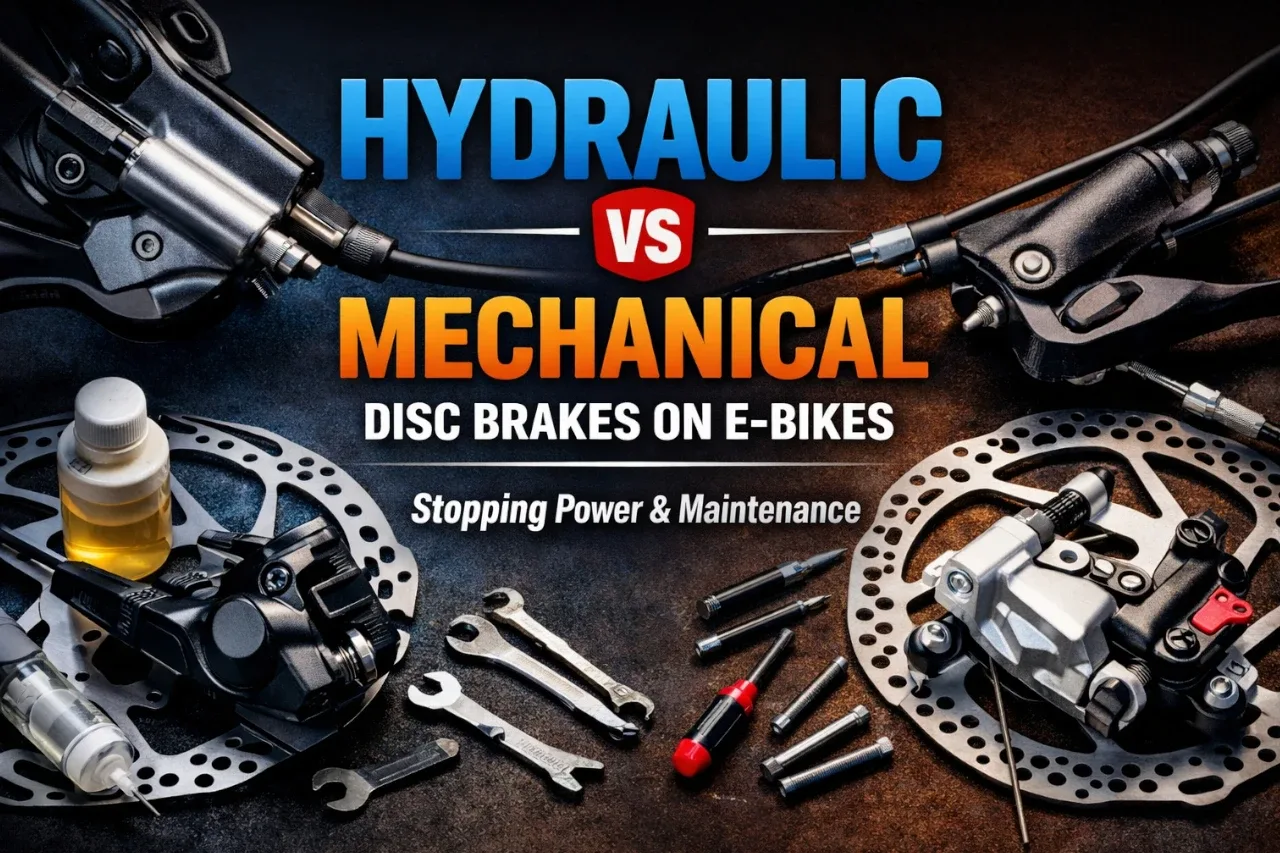
Disc brakes are one of the most important safety components on an e-bike—because e-bikes are usually heavier, often ridden faster, and more likely to carry cargo. When you need to stop quickly, “good enough” brakes stop being good enough.
Mechanical disc brakes use a cable (like a traditional bike brake) to pull the caliper. Hydraulic disc brakes use fluid pressure in a sealed line to push the caliper pistons.
This guide will help you choose the right system for your riding—based on real stopping feel, control, upkeep, and what tends to go wrong in ownership.
Best overall choice: Hydraulic disc brakes—better control, stronger feel under load, and less day-to-day fuss for most e-bike riders.
Choose mechanical disc brakes if:
Choose hydraulic disc brakes if:
Key deciding factor: how often you ride heavy / fast / hilly and how much you value consistent lever feel versus DIY simplicity.
Here’s what actually matters on an e-bike (not spec-dumping):
Mechanical discs can stop an e-bike safely—especially at commuter speeds—if the system is well set up (good pads, proper alignment, clean rotors, and correct cable tension). The issue is that power often depends on hand strength and perfect adjustment.
Score: 7/10
Hydraulics generally deliver more clamp force for the same lever effort, which matters when the bike is heavy, you’re descending, or you need a hard stop without a “death grip” on the lever. This is the difference you feel most clearly on heavier e-bikes.
Score: 9/10
If you’re riding a heavier e-bike (or carrying cargo), hydraulics give you a bigger safety margin in true emergency braking—especially when fatigue sets in.
Mechanical systems can feel a bit “digital” (grabby or vague), especially if the cable housing compresses or if the caliper design only moves one pad aggressively. You can get good control, but it takes more setup discipline.
Score: 6.5/10
Hydraulics tend to feel smoother and more linear: light braking is easy, and stronger braking ramps up predictably. This makes a real difference in wet corners, gravel patches, or when you’re braking while turning.
Score: 9/10
For confidence riding in traffic or on mixed surfaces, hydraulics usually feel calmer and easier to “meter out” without surprises.
Mechanical brakes can overheat too—but the bigger practical issue is that heat + pad wear + cable stretch can change lever feel over the ride. On long descents, you may notice you’re pulling the lever farther as things warm up.
Score: 6.5/10
Hydraulics generally maintain a more consistent feel under repeated braking. They’re not immune to fade, but in typical e-bike use (commutes, rolling hills, short descents), they tend to stay more stable.
Score: 8.5/10
If you live somewhere hilly or you regularly brake hard (stoplights, fast paths, heavier loads), hydraulics usually keep their “bite” and lever feel more consistently.
Mechanical discs work in the wet, but you’re more likely to notice:
Score: 7/10
Hydraulics also squeal sometimes, but they’re less affected by cable contamination because there is no cable. Lever feel is typically more consistent ride-to-ride in messy conditions.
Score: 8.5/10
Both can be safe in rain—clean rotors and good pads matter more than the system type—but hydraulics usually require less frequent “tuning” after wet/dirty rides.
You should expect routine attention:
If you like tinkering, it’s manageable. If you want low-fuss commuting, it can feel annoying.
Score: 6.5/10 (lower = more frequent fiddling)
Hydraulics usually need less frequent adjustment because the system self-compensates for pad wear. Most riders go a long time with only:
Score: 8.5/10 (higher = less day-to-day attention)
Mechanical = frequent small adjustments. Hydraulic = fewer interventions, but bigger service when needed.
Mechanical wins for simple DIY:
Score: 9/10
Hydraulic service is more technical:
Score: 6.5/10
If you want the easiest “anywhere fix,” mechanical is friendlier. If you’d rather not touch brakes often, hydraulics usually reduce routine fiddling.
Common issues are usually gradual and noticeable:
These problems often give warning through increasing lever travel.
Score: 8/10
Hydraulics are reliable day-to-day, but failures can be more “all at once”:
They’re not frequent, but when they happen, you need proper service.
Score: 7.5/10
Mechanical problems are usually easier to diagnose and limp home on. Hydraulic problems are less common in routine use but can require the right fix when they appear.
Upfront cost is usually lower, and replacement parts (cables/housing) are cheap. But if you pay a shop to keep tuning them, costs can creep up.
Score: 8/10 (value)
Upfront is typically higher. Pads/rotors are similar, but bleeding/service can cost more if you don’t DIY.
Score: 7/10 (value)
For DIY riders, mechanical is often the cheaper ownership path. For riders who value less frequent adjustments, hydraulics can be “cheaper in hassle,” even if not cheaper in dollars.
| Factor | Mechanical Disc Brakes | Hydraulic Disc Brakes |
|---|---|---|
| Real stopping power | 7/10 – depends heavily on setup | 9/10 – stronger with less effort |
| Modulation/control | 6.5/10 – can feel grabby/vague | 9/10 – smoother, more predictable |
| Heat & fade resilience | 6.5/10 – lever feel can drift | 8.5/10 – more consistent feel |
| Wet/dirty consistency | 7/10 – cable/housing can degrade feel | 8.5/10 – less affected by grime |
| Maintenance frequency | 6.5/10 – regular small tweaks | 8.5/10 – fewer routine tweaks |
| DIY service difficulty | 9/10 – simple tools | 6.5/10 – bleeding/tools needed |
| Failure mode severity | 8/10 – usually gradual | 7.5/10 – rarer, but can be abrupt |
| Overall | Best for simple DIY + lower cost | Best for confidence + consistency |
Hydraulic disc brakes win overall because e-bikes magnify braking demands: more mass, higher average speeds, and more “real” emergency stops in traffic. Hydraulics usually deliver the most confidence per ride—not just raw power, but predictable control and less day-to-day fuss.
The compromise: when hydraulics need service, it’s more technical and sometimes more expensive. If you’re a hands-on DIY rider who wants simple fixes anywhere, mechanical still has a strong case.
Hydraulic vs mechanical disc brakes on e-bikes isn’t about what’s “premium.” It’s about how much safety margin and consistency you want versus how simple you want repairs to be.
If you ride heavier, faster, or in more complex conditions, hydraulics are the safer, less stressful choice. If you ride casually and value simple maintenance above all, mechanical can still be a smart, workable pick—just commit to keeping them adjusted.