A little joy belongs in every day.

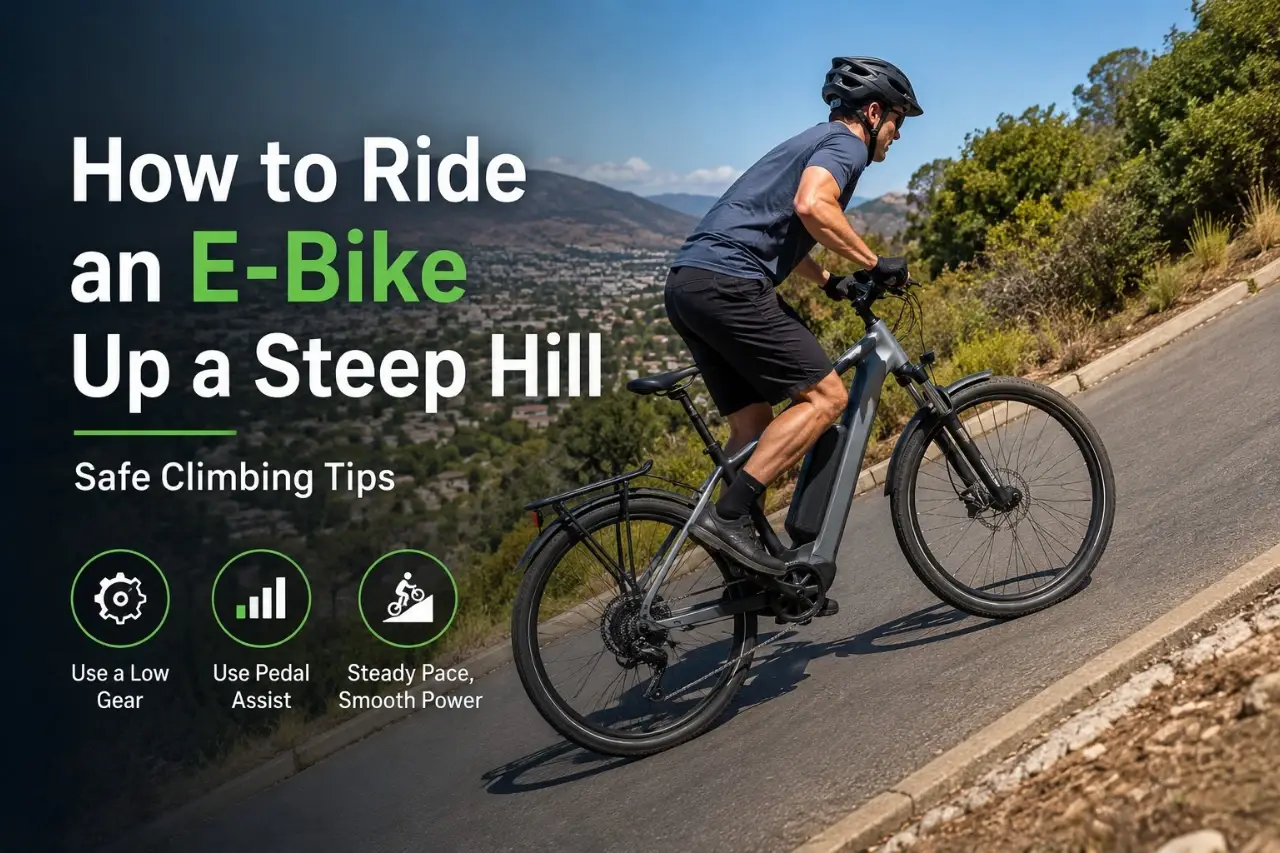
To ride an e-bike up a steep hill, shift into low gear early, use steady pedal assist, keep a smooth cadence, stay seated, and manage traction.
Steep hills expose every weakness in your riding technique and your e-bike setup. The wrong gear, a low battery, or a sudden throttle burst can leave you stalled halfway up, spinning your rear wheel, or struggling to control the descent.
The good news is that most e-bikes can handle moderate to steep grades when you combine the right technique with smart power management. Knowing when to shift, how much assist to use, and where to put your weight makes a bigger difference than raw motor wattage alone.
This guide walks you through exactly how to ride an e-bike up a steep hill, from pre-ride prep to body position to protecting your motor on long climbs.
To ride an e-bike up a steep hill, shift into a low gear before the gradient increases, select an appropriate pedal-assist level, and keep a smooth, consistent cadence throughout the climb. Stay seated to maintain rear-wheel traction, lean your upper body slightly forward, and avoid sudden bursts of throttle that can spin the wheel or drain the battery quickly.
The motor helps, but it works best when you contribute steady pedaling effort. Think of your assist level as a multiplier for your own input, not a substitute for it. On very steep grades, you may need high assist, but pairing that with proper gearing and body position is what actually gets you to the top.
Several factors combine to determine how hard any given hill is for your e-bike and your body. Understanding these helps you prepare rather than react.
A 5% grade is manageable for most e-bikes. A 10% to 15% grade demands real power and technique. Grades above 15% push many entry-level e-bikes close to their limits. Add loose gravel, wet pavement, or a headwind and the effective difficulty increases further. According to Trek’s e-bike guide, hills are one of the clearest situations where an e-bike’s assist makes a real difference, but terrain and surface still shape the outcome.
Your total payload matters. A heavier rider with loaded panniers or a cargo rack puts significantly more demand on the motor. Rolling in with good momentum before the hill starts makes the first section easier. Approaching a steep climb from a dead stop is much harder on both the motor and your legs.
A fully charged battery delivers consistent power output. A battery sitting below 20% capacity may throttle motor output automatically or drop voltage under load. Watt-hours give you a more honest measure of climbing range than the amp-hour figures some brands advertise. Larger watt-hour packs simply last longer when the motor is working hard.
Hub motors are common and capable on moderate hills, but they lack the ability to use the bike’s gears to their advantage. Mid-drive motors work through the drivetrain directly, which means they benefit from low gearing on steep grades. Torque output, measured in newton-meters, determines how hard the motor can push. Higher torque motors handle steep climbs with less strain, especially at low cadence.
A few minutes of preparation before a long or steep climb can prevent stalling, overheating, or a brake failure on the way down.
Start any significant climb with at least 50% battery remaining. If you know a steep section is coming, consider dropping to a lower assist level on the flat sections before it to conserve charge. Set your assist mode before you hit the hill so you are not fumbling with controls mid-climb. As noted in the League of American Bicyclists’ pre-ride guidance, checking your battery and key components before heading out is a core part of safe e-bike riding.
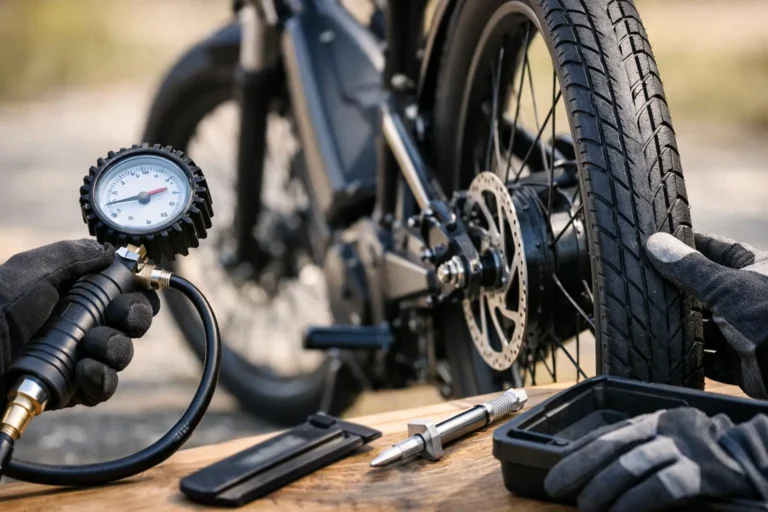
Check your tire pressure before climbing. For paved hills, run pressure closer to the upper end of your tire’s recommended range for lower rolling resistance. For gravel or dirt climbs, drop pressure slightly to increase the contact patch and improve traction. Incorrect pressure increases wheel spin risk and reduces control.
Squeeze both brake levers before you ride. They should feel firm and engage before reaching the bar. Check that your chain shifts cleanly through the gears. A stiff or skipping drivetrain can cause problems when you need to shift quickly under load. Reliable brakes matter even more on the way down.
Look at the climb before you commit. Identify loose patches, wet paint, or debris you want to avoid. If you are on a road, pick a traffic gap wide enough to let you set your pace without pressure. Carry some speed into the base of the hill when safe to do so. Starting momentum reduces the initial motor load.
Shift down one or two gears before the gradient increases. Shifting under heavy load risks a dropped chain or a missed shift. The goal is to find a gear where you can spin at a comfortable cadence, roughly 70 to 90 revolutions per minute, without grinding or bouncing in the saddle.
Start with a mid-level assist and increase it only as the hill demands. On longer climbs, starting too high drains the battery before the top. Use eco or tour mode on gentle ramps, then step up to higher assist when the grade steepens. Bosch’s riding mode system, for example, is designed to let riders tailor support to the terrain precisely.
Pushing hard on each pedal stroke in a gear that is too high wastes energy and stresses the motor. Spinning smoothly in a lower gear keeps your output consistent and works with the motor more efficiently. If your cadence drops below about 60 rpm, shift down rather than pushing harder.
Keep your weight over the saddle to maintain rear-wheel traction. Shift your upper body slightly forward by bending your elbows and lowering your chest toward the bars. Avoid standing unless you are on a firm, dry surface and you need a short burst of extra power. Standing shifts weight back and can cause rear-wheel spin on loose or wet terrain.
Throttle is most useful for a short burst when momentum drops suddenly or at the start of a climb from a stop. Using it continuously on a long steep section puts heavy demand on the battery and generates more heat in the motor. Pair any throttle use with active pedaling to keep the system balanced.
Eco mode uses the least battery but still adds meaningful assistance on flat or gentle grades. Reserve turbo or high assist for the steepest sections of a climb. Switching back down once the grade eases is a simple habit that preserves battery range significantly over a long ride. The key is adjusting assist level as conditions change rather than locking into one setting for the whole climb.
Sustained climbs put constant load on both the motor and battery. Heat builds up over time, and most motors have built-in thermal protection that reduces power output automatically if the motor gets too hot. This is not a malfunction. It is the system protecting itself. Longer climbs in hot weather or with a heavy load accelerate heat buildup.
Watch for these warning signs during a climb:
These signals mean the system is under stress. Reduce assist demand by shifting down, easing your pace, or stopping briefly.
If assist cuts out suddenly, stay calm. Keep pedaling at whatever pace you can manage. Look for a safe spot to pull over, ideally on a flat section or a wide shoulder. Let the motor cool for a few minutes before resuming. Do not force the system by applying maximum throttle repeatedly after a cutout.
Dry pavement gives you good grip for most climbs. Stay alert to painted crosswalk markings, manhole covers, or wet patches even on a sunny day. These surfaces become slick quickly. Steer around painted lines where possible, especially when climbing at low speed with more torque going through the rear wheel.
Loose gravel and wet dirt are the most demanding surfaces for traction. On these surfaces, avoid sudden increases in throttle or assist, as wheel spin is immediate and recovery is difficult on a slope. Lower your tire pressure slightly if you know the climb involves loose terrain. Keep your weight seated and centered. Smooth, consistent power is far more effective than bursts.
Wider tires with more tread give you a larger contact patch and more grip on rough or slippery surfaces. Fat tires offer the most traction on loose or mixed terrain but add rolling resistance on pavement. A narrower commuter tire rolls efficiently on smooth roads but gives up grip quickly off-pavement. Match your tire choice to the terrain you climb most.
| Tire Type | Best Surface | Traction on Loose Terrain | Rolling Resistance |
|---|---|---|---|
| Narrow commuter (1.5–2 in) | Pavement | Low | Low |
| Mid-width hybrid (2–2.4 in) | Mixed surfaces | Moderate | Moderate |
| Fat tire (3.8–5 in) | Gravel, dirt, sand | High | Higher |
A mid-drive motor connects directly to the crankshaft and works through the bike’s gears. This means on a steep climb, dropping to a low gear allows the motor to spin efficiently even at slow speed. A rear hub motor applies power at the wheel regardless of gearing. Hub motors work well on moderate hills but lose efficiency on very steep grades or heavy loads. Mid-drive systems are generally the stronger choice for serious climbing.
A torque sensor measures how hard you push on the pedals and delivers assist proportionally. The result feels smooth and natural, especially when the gradient changes. A cadence sensor only detects whether you are pedaling and switches assist on or off in steps. On steep climbs where your cadence drops, torque sensors maintain better support. This is one of the most meaningful differences between mid-range and higher-quality e-bikes.
Wide gearing range matters. A bike with at least 7 speeds and a large rear sprocket gives you low enough gears to spin up steep grades without overloading the motor. Hydraulic disc brakes give you more modulation and stopping power on the descent, especially with a heavier e-bike. Frame geometry and weight distribution also affect how stable the bike feels on steep, technical climbs.
| Feature | Minimum for Moderate Hills | Recommended for Steep Hills |
|---|---|---|
| Motor power | 500W | 750W or more |
| Motor torque | 50 Nm | 65–85 Nm or more |
| Battery capacity | 480 Wh | 614 Wh or more |
| Gearing | 7-speed | 8–12 speed with wide range |
| Brakes | Mechanical disc | Hydraulic disc |
These are general benchmarks. Your actual results depend on your weight, cargo, grade, and riding style. If your current e-bike struggles on steep climbs, compare hill-ready models in the GoEBikeLife buying guides before upgrading.
Waiting until the hill gets steep to shift down means you are trying to change gears under maximum load. Chains skip, derailleurs struggle, and you lose momentum. Shift early and set your gear before the gradient demands it.
Throttle use on a long climb drains the battery faster, generates more motor heat, and increases wheel spin risk. Using throttle as a substitute for pedaling rather than a supplement puts real strain on the drivetrain and battery over time.
Climbing too slowly stresses the motor because it holds high torque at low rpm for an extended time. Climbing too fast at maximum assist burns battery quickly and leaves you exposed on the descent. A controlled, moderate pace is both safer and more efficient.
Once you are at the top, the descent requires its own technique. Avoid squeezing the brakes hard all the way down. Instead, use light, controlled pressure and alternate between front and rear to manage speed. On a heavier e-bike, poor brake control on a steep descent becomes dangerous quickly. Hydraulic disc brakes are significantly more reliable here than mechanical ones, particularly under repeated braking.
If your e-bike regularly struggles on grades you need to climb, the issue may be the bike itself, not just technique. Check whether the motor torque, gearing range, and battery capacity match your actual route. You can browse fat tire e-bike options for off-road climbs, or look at longer range models if battery drain on hills is your main concern. The GoEBikeLife bike finder is a useful starting point for matching a bike to your terrain.
Which type of e-bike motor performs better on steep climbs: mid-drive or hub motor?
Mid-drive motors generally perform better on steep grades because they work through the bike’s gears, allowing the motor to stay in an efficient rpm range even at slow climbing speeds.
Hub motors apply power at the wheel directly and can struggle on very steep or sustained climbs, especially under heavy load.
For occasional moderate hills, a hub motor is often sufficient.
What gear and pedal cadence should I use to climb a steep hill efficiently on an e-bike?
Use your lowest available gear and aim for a cadence of around 70 to 90 rpm.
This keeps your pedal stroke smooth and lets the motor work efficiently rather than fighting high mechanical resistance.
Avoid grinding slowly in a gear that is too high, as this strains both your knees and the motor.
How much rider input is needed on very steep hills, and can an e-bike climb without pedaling?
Some e-bikes with throttle can climb steep hills without pedaling, but this puts heavy demand on the battery and motor and is not reliable on long or sustained grades.
Contributing steady pedal effort alongside the assist makes the climb faster, reduces heat buildup, and preserves battery range significantly.
What motor wattage and torque rating are typically needed to handle steep hills reliably?
A 750W motor with at least 65 Newton-meters of torque is a practical minimum for regular steep hill climbing with a typical rider weight.
Higher torque matters more than peak wattage for low-speed hill performance.
Budget e-bikes with 500W motors and 40 to 50 Nm of torque can manage moderate hills but will struggle on grades above 10% to 12% with heavier riders or cargo.
How can I prevent motor or battery overheating during long, steep uphill climbs?
Keep your assist level matched to the actual grade rather than running turbo mode continuously.
Take short breaks on long climbs if you notice power cutting out or performance dropping.
Hot weather, heavy cargo, and sustained steep grades all accelerate heat buildup.
Most modern e-bike motors include thermal cutouts that reduce power before damage occurs, so if power drops mid-climb, stop and let the system cool.
What e-bike features matter most for hill climbing, such as gearing range, tire choice, and weight?
The most important features are motor torque, a wide gearing range with a low enough gear to climb at a comfortable cadence, hydraulic disc brakes for safe descents, and a battery with enough watt-hours to complete your route.
Tire choice affects traction on loose or wet surfaces. Frame weight also matters since a lighter bike requires less motor effort for the same grade.
As noted in the League of American Bicyclists’ e-bike safety program, understanding how your specific e-bike’s components work together is key to riding it confidently in demanding conditions.