A little joy belongs in every day.

I see the Aipas M2 Pro as a comfort-focused fat-tire e-bike with an 840Wh battery, while its weight and mechanical brakes shape my buying recommendation.
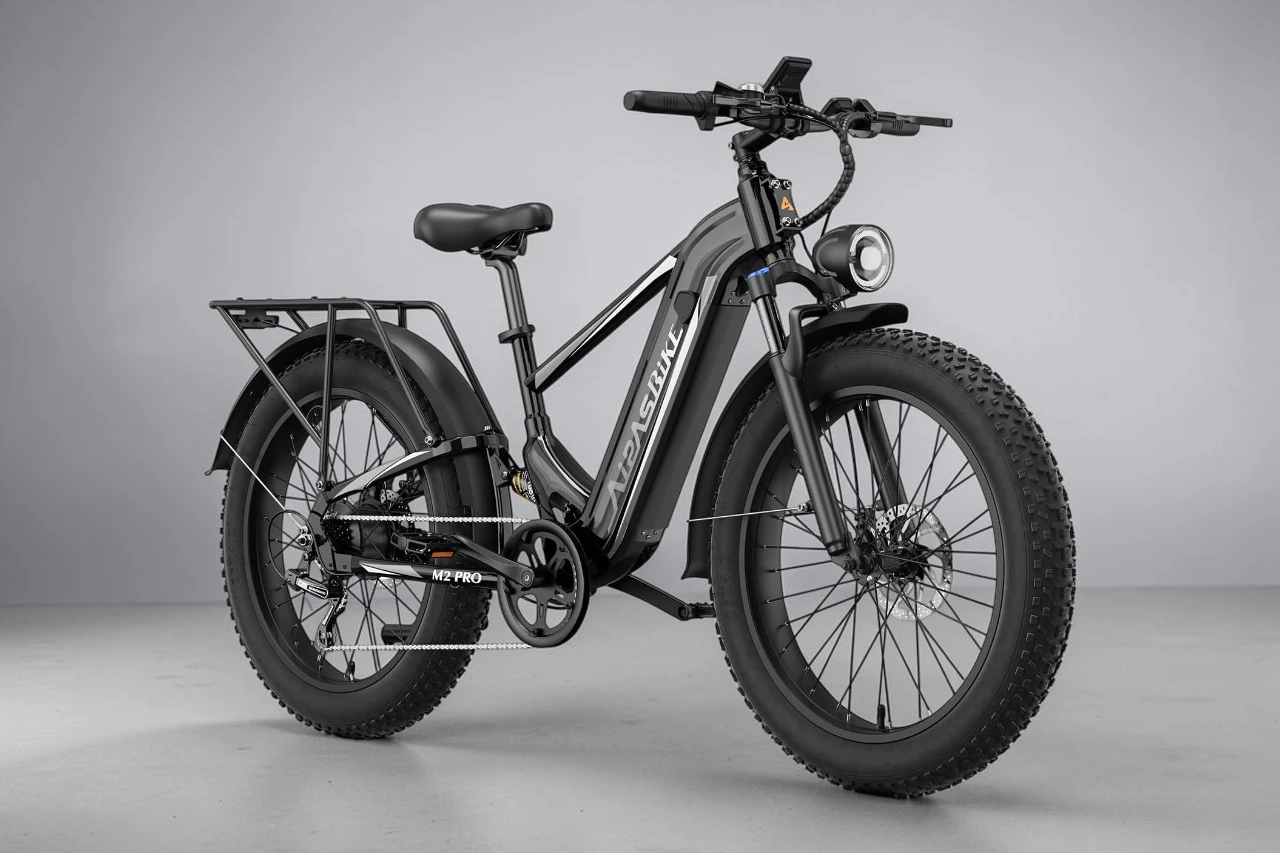
What interests me most about the Aipas M2 Pro is how much equipment it brings together: front and rear suspension, a removable 840Wh battery, 26 × 4-inch tires, and an 1800W peak rear hub motor. For a buyer looking for an affordable recreational e-bike, that is an appealing combination.
My priorities go beyond the motor specification, though. I want a bike that makes sense for the routes, storage space, and transportation arrangements of the person buying it. With the M2 Pro, the two details I would consider most carefully are its substantial weight and mechanical disc brakes.
I see the M2 Pro as a promising choice for comfortable recreational riding, provided its size and component choices match your needs. Here is how I weigh its strengths and compromises.
Explore the Aipas M2 Pro with an 1800W peak motor, full suspension, and an 840Wh removable battery.
I would shortlist the Aipas M2 Pro for relaxed mixed-surface riding, especially if you have ground-level storage and rarely need to lift the bike. I would give more consideration to braking performance if your plans involve frequent fast riding or long descents.
What appeals to me most is the combination of a high-output rear hub motor, full suspension, and wide tires. For neighborhood outings, campground exploring, and maintained gravel routes, I place more value on that comfort-oriented setup than on the advertised maximum speed.
My biggest reservation is the mechanical braking system. On a bike this heavy, I would prioritize a well-matched braking package over gaining another few miles per hour.
| What I like | What I would consider carefully |
|---|---|
| Advertised 1800W peak motor and 110 Nm torque | Peak power does not establish sustained performance |
| Front and rear suspension with 4-inch tires | Large dimensions and substantial weight |
| Removable 840Wh nominal battery | The 85-mile range claim is not a guaranteed riding distance |
| Rack, fenders, and integrated lighting | Mechanical discs are not my preferred choice for a speed-focused purchase |
| Straightforward Shimano 7-speed drivetrain | Fit and ease of handling matter more than the headline height range |
I use the following specifications as a starting point for evaluating the bike. Performance figures labeled as advertised remain manufacturer claims.
| Component | Specification |
|---|---|
| Motor | Rear hub motor; advertised 1800W peak |
| Torque | Advertised 110 Nm |
| Battery | Removable 48V 17.5Ah; approximately 840Wh |
| Maximum speed | Advertised up to 36 mph |
| Assisted range | Advertised up to 85 miles |
| Suspension | Front suspension fork and center-mounted rear shock |
| Tires | 26 × 4.0 inches |
| Brakes | Mechanical disc brakes with 180mm rotors |
| Gearing | Shimano 7-speed |
| Pedal assistance | Five assist levels |
| Display | LCD with ride information and USB charging |
| Weight | Approximately 90 lb including the battery, based on listed component weights |
| Maximum payload | Advertised 500 lb; separate rider and rack limits require confirmation |
| Overall dimensions | Listed as 80 × 26 × 44 inches |
| Assembly | Listed as 90% preassembled |
| Charger | Listed as 2A |
For weight, I add the listed 81 lb bike weight and 9 lb battery weight to arrive at approximately 90 lb. I would confirm the complete weight of the selected configuration before choosing a carrier.
I like the M2 Pro’s practical equipment package. The rear rack, fenders, and lighting give it a useful everyday role alongside its recreational appeal. Those additions matter to me because they reduce the number of accessories a buyer needs to research immediately after purchase.
The full-size wheels, wide tires, and substantial frame also make its priorities clear. I would approach this as a large recreational e-bike with carrying and storage requirements to match.
Weight is the first practical issue I would resolve. Lifting a roughly 90-pound bike onto a vehicle carrier or carrying it up stairs is a significant task. Removing the battery reduces the load, but the remaining bike is still heavy.
For vehicle-based outings, I would check the carrier’s per-bike weight rating, tire-width accommodation, and compatibility with the vehicle. A suitable loading ramp could make a bigger difference to convenience than another handlebar accessory.
If I could roll the bike directly out of a garage, I would find its bulk much easier to accept. If my daily routine involved stairs or frequent lifting, I would prioritize a lighter model.
The advertised 1800W peak rear hub motor is one of the M2 Pro’s main selling points. Together with the claimed 110 Nm torque, it gives the bike an appealing specification for buyers seeking strong motor assistance.
I keep the distinction between peak and continuous power clear. An 1800W peak figure does not mean the motor produces that output continuously, and I would not use it alone to predict sustained climbing performance.
For my buying decision, assistance on rolling routes and during repeated starts matters more than the highest number on the display. A powerful motor can be useful on a heavy bike, but I want that power paired with manageable controls and an appropriate braking system.
Aipas advertises up to 36 mph. I treat that as a configuration- and condition-dependent claim, rather than a speed every rider should expect. I also would not make maximum speed the main reason to choose this model.
For steep routes, I would want to know more than the torque figure. Rider weight, gradient, hill length, available traction, and the motor’s ability to sustain its output all affect the result. I would not promise a particular climbing angle without a clearly documented test.
Before buying, I would also check whether the selected configuration is permitted on the roads and trails I plan to use.
I consider the battery one of the more attractive parts of the M2 Pro’s specification. Its nominal capacity is straightforward:
48V × 17.5Ah = 840Wh.
The removable design is useful for charging arrangements and for reducing the bike’s weight before transport. It still leaves the owner with a substantial bicycle to move, but I appreciate having that flexibility.
I am more cautious about the advertised 85-mile assisted range. Covering 85 miles on 840Wh would require average battery consumption of approximately 9.9Wh per mile, before accounting for any difference between nominal and usable energy.
I would therefore treat that distance as an optimistic assisted-riding maximum. I would not plan an 85-mile outing on the assumption that strong assistance or sustained fast throttle use will deliver the same result.
Here is the simple arithmetic I use to put battery consumption into perspective. These are illustrative calculations, not measured M2 Pro range results.
| Assumed average consumption | Calculated distance from 840Wh nominal capacity |
|---|---|
| 15Wh per mile | 56 miles |
| 20Wh per mile | 42 miles |
| 25Wh per mile | About 34 miles |
| 30Wh per mile | 28 miles |
Actual distance can be lower, and the calculations do not include a reserve. Speed, terrain, load, temperature, tire setup, and pedal effort influence consumption.
My advice is to establish a comfortable range on familiar routes before planning a longer trip. I would leave a meaningful battery reserve, especially when the return leg includes hills or a headwind.
With the listed 2A charger and a 17.5Ah battery, simple capacity/current arithmetic gives approximately 8.75 hours, before allowing for charging taper and other factors. That is a rough planning calculation, not a timed charging test.
I would not rely on a 4–6-hour empty-to-full promise for this combination. A partial recharge can be shorter, but I would allow considerably more time when the battery is near empty and follow the manufacturer’s charging instructions.
The combination of front suspension, a center-mounted rear shock, and 4-inch tires is what makes the M2 Pro interesting to me as a recreational bike. I would choose this setup with everyday uneven surfaces in mind: patched pavement, maintained gravel, and campground roads.
My interest is in reducing the harshness of those ordinary routes. Many riders want a more forgiving ride without moving into the cost and complexity of a specialized mountain bike.
I would keep the intended use realistic, however. Suspension at both ends does not establish suitability for jumps, repeated hard impacts, or technical descending. I would want clear information about the frame’s intended-use limits and suspension capabilities before taking it into those conditions.
Tire setup also deserves attention. I would follow the bike and tire guidance and stay within approved pressure limits for the load. Lowering pressure indiscriminately is not how I would approach comfort.
For relaxed exploring, I like the overall design direction. For demanding mountain-bike trails, I would prioritize a bike with clearly documented trail capability and braking performance.
The 26 × 4-inch tires are a major part of the M2 Pro’s appeal, but I would not assume they make every surface easy. Firm gravel is a different challenge from deep sand, mud, or loose material on a steep slope.
I would also consider how the bike handles when motor assistance is not relevant: turning it around in a garage, steadying it at a stop, or pushing it into a storage space. Those everyday tasks can reveal whether a large bike is a practical fit.
The advertised rider-height range is broad at 5’8″–7’6″. I would use detailed geometry and body measurements to assess fit rather than depend on that range alone.
Standover clearance, reach, saddle adjustment, and comfortable access to the controls are the dimensions I would investigate. If a seat-height measurement is provided, I would confirm where it was measured from before using it to judge fit.
My purchase would depend on being able to mount, stop, and maneuver the bike comfortably. I would give those requirements more weight than an impressive motor specification.
The M2 Pro configuration discussed here uses mechanical disc brakes with 180mm rotors. This is the component choice I would examine most carefully in relation to the bike’s weight and advertised speed.
I would prefer a well-matched hydraulic braking system for a purchase centered on fast riding or frequent descending. That preference does not mean every mechanical brake is inadequate; brake setup, component quality, tires, load, and riding conditions all matter.
What I would avoid is assuming that a high motor-output figure guarantees an equally capable complete package. I want acceleration and speed control to receive comparable attention.
I would be especially cautious if my routine involved heavy cargo, long descents, or repeated braking from higher speeds. For those uses, I would make demonstrated braking performance a priority when comparing alternatives.
I also would not assume that upgrading the brakes later will be inexpensive or straightforward. Compatibility, motor-cutoff integration, component limits, and installation costs can complicate the decision. I would compare the complete cost with buying a better-equipped model from the start.
For the M2 Pro, correct brake adjustment and final assembly would be essential before my first ride. I would arrange a professional setup if I were not confident doing that work.
I like the simplicity of a Shimano 7-speed drivetrain for recreational use. It provides gearing choices for different terrain without making the bike unnecessarily complicated to operate.
I would not assume seven gears guarantee comfortable pedaling at the advertised maximum speed, though. Gearing and cadence determine how effectively a rider can continue contributing as speed increases.
The LCD provides the information I would want readily available: speed, battery status, assist level, and trip information. I also appreciate the ability to adjust the viewing angle and the convenience of a USB charging port.
For everyday ownership, I place considerable value on the rack and full fenders. They make the bike more useful for errands and rides where the road surface is damp or dirty. Integrated lighting and a kickstand also reduce the need for immediate accessory purchases.
I would confirm the exact rear-light functions and accessory package before ordering. Product configurations can change, so I would want the order details to match my expectations.
The advertised 500-pound payload requires a separate check. I would confirm the rider limit, rack limit, and total-load definition rather than treat that headline figure as permission to carry 500 pounds on the rack or add a passenger.
The listed 90% preassembly would not change my approach to the final inspection. I would follow the manual when checking the wheels, steering components, pedals, required fasteners, and brakes before riding.
I would also inspect the bike for shipping damage and confirm that the battery seats securely and the electrical functions operate correctly. Resolving a delivery issue immediately is preferable to discovering it during an outing.
Aipas lists a one-year warranty and ongoing technical support. I would read the coverage terms before buying, particularly how replacement parts, labor, and return shipping are handled.
For wet-weather care, I would follow the component-specific guidance. The listing attaches an IP65 rating to the battery; I would not interpret that as permission to immerse the complete bike or use a pressure washer.
I would consider the M2 Pro for a rider looking for an affordable, well-equipped bike for neighborhood outings, campground loops, paved routes, and maintained gravel roads. Easy storage and infrequent lifting would make it a much more attractive purchase.
I would also consider it for commuting when the route, storage arrangements, and applicable riding rules suit the bike. The rack and fenders add useful practicality, although stairs and mixed public-transport journeys would reduce its appeal for me.
I would choose a different style of bike if my main priorities were easy carrying, technical mountain biking, frequent high-speed riding, or long steep descents. I would also favor easier handling if managing a tall, heavy bicycle were a concern.
I see the Aipas M2 Pro’s appeal in its combination of full suspension, a removable 840Wh battery, wide tires, and useful everyday equipment. For a buyer seeking an affordable recreational e-bike, there is plenty here to consider.
My recommendation depends on how you intend to use it. I am more interested in this model for comfortable exploring than for chasing its advertised maximum speed. Its weight needs a practical storage and transport plan, while the mechanical brakes remain my main component reservation.
I would shortlist the M2 Pro if comfort, motor assistance, and included equipment are your priorities. I would prioritize a better-supported braking package if fast riding or sustained descending is central to your plans.
| Preview | Product | Price | |
|---|---|---|---|

| LEONX M2 Pro Electric Bike for Adults, 1800W Peak Motor, 85-Mile Long Range | $898.99 | View on Amazon |
How fast is the Aipas M2 Pro?
Aipas advertises up to 36 mph. I treat that as a condition- and configuration-dependent claim, rather than a guaranteed result. I would check the rules for my intended riding locations before choosing a high-speed configuration.
Can I expect 85 miles on one charge?
I would not use 85 miles as a guaranteed planning figure. It is an advertised assisted-range maximum. I would establish consumption on familiar routes and leave a reserve before attempting longer outings.
Does the M2 Pro have hydraulic brakes?
The configuration I discuss here has mechanical disc brakes. I would confirm the exact model and brake specification at purchase, especially when comparing similarly named versions.
Would I find it easy to transport?
I would plan carefully around its approximately 90-pound listed combined weight. Removing the battery helps, but I would still want a compatible carrier and a manageable loading arrangement.
Would I choose it for off-road riding?
I would consider it for maintained gravel routes and gentle recreational paths where permitted. For technical trails, jumps, or aggressive descending, I would choose a bike with clearly documented capability for those uses.
What would I change first?
My first component priority would be the braking package, subject to compatibility and professional advice. Before budgeting for upgrades, I would compare their complete cost with purchasing a model already equipped for my intended riding.
GoEBikeLife is reader-supported. We test and review e-bikes, create detailed comparisons, and publish practical buying guides for riders. Some links on this page are affiliate links, which means we may earn a commission at no extra cost to you.